Evangelische Laurentiuskirche: Medieval Village Church in Biebergemünd, Germany

Site at a Glance
- Rating
- 4.3
- Popularity
- Very Low
- Country
- Germany
- Primary era
- Early Modern
- External website
- Open
- Eras represented
- Medieval, Early Modern, Modern
- Civilizations
- German, Holy Roman Empire
- Site type
- Religious
- Remains
- Fortified Church
On this page11 sections
History
Evangelische Laurentiuskirche is the medieval village church of Biebergemünd-Bieber in Germany, originating in the twelfth century as a fortified Romanesque church on the Römerberg. It was first mentioned in 1339 as a cemetery church and was dedicated to Saint Martin before the Reformation. Its surviving form reflects repeated changes in ownership, worship, warfare, and restoration.
Medieval ecclesiastical setting
During the Middle Ages, Bieber belonged to the County of Rieneck and lay within the jurisdiction of the Archdiocese of Mainz. Ecclesiastical administration passed through the Archdeaconate of St. Peter and Alexander in Aschaffenburg and the Deanery of Rodgau. After the Rieneck-Rothenfels line became extinct, half of the district went to the County of Hanau-Münzenberg, while the other half remained with Mainz. Hanau and Mainz jointly exercised territorial authority from 1559 to 1684.
Reformation and wartime destruction
The congregation became Lutheran during the Reformation in the County of Hanau-Münzenberg, between 1540 and 1550. In the 1630s, Bieber was devastated by the Thirty Years’ War, the European conflict of 1618–1648 that combined religious, dynastic, and territorial struggles. In 1636, soldiers serving Emperor Ferdinand II, the leading Catholic ruler who reigned as Holy Roman Emperor from 1619 to 1637, partly burned the church. The Romanesque nave was destroyed, along with the pre-Reformation service books and vestments still kept there.
The parish remained vacant until 1648. The war also drastically reduced the local population, from about 1,000 parishioners in 1601 to a largely deserted Bieber in 1640. The church was rebuilt around 1660, when the nave was widened and a new altar retable was made. The eighteenth century brought a second church, the Untere Kirche, for Reformed worshippers, particularly immigrant miners.
Union and changing use
The Hanau Union of 1818 united the Lutheran and Reformed Protestant churches in the former County of Hanau. One of Bieber’s two churches consequently became redundant. The upper church, now the Laurentiuskirche, continued to host morning worship, while the lower church was used for afternoon children’s services or liturgical services.
Since 1966, the Laurentiuskirche has served as a cemetery chapel and a place for special religious services. Funeral services, Easter worship, and Reformation Day services are held there, with the traditional Reformation Day observance also including a lay theatrical performance. The building is additionally used for concerts and cultural exhibitions. It is protected as a cultural monument under the Hessian Monument Protection Act.
Preservation in the modern period
The Förderkreis Laurentia was founded in 2006 to support the church’s preservation. By August 2024, the association had about 85 members and had raised funds for restoration and maintenance. Major work included conservation of the altar retable from 2015 to 2019, restoration of the organ in 2017 and 2018, renewal of the bell control system and bell clappers in 2022, and renewal of the electrical distribution system with new interior pendant lights in 2023.
Remains
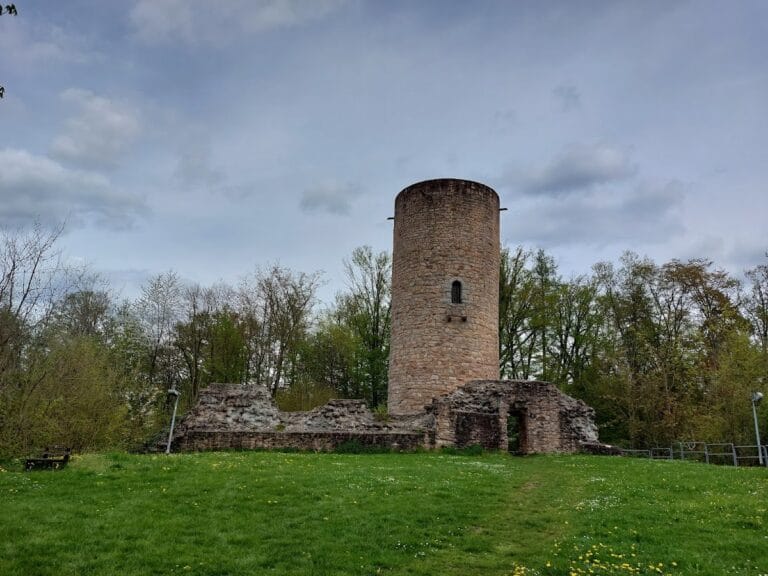
The church stands on a hillside above Bieber, on the Römerberg, within a walled cemetery. Its core is a Romanesque hall church, meaning a church with a simple longitudinal nave, combined with an inset chancel tower, a tower narrower than the nave and set into the eastern liturgical end. The tower probably dates from the twelfth century, while the building as a whole preserves evidence of substantial alteration over several centuries.
Church building
The nave was widened during the rebuilding around 1660. In 1756, a wing was added at right angles on the south side to plans by Jacob Sigismund Waitz von Eschen, an architect associated with building projects in Hesse. This changed the church into a transverse church, whose principal worship space extends across the axis of a conventional longitudinal church. The portals and windows were given Baroque forms, and the pulpit belongs to the same phase. Painted galleries were installed in 1797.
Conservation work has renewed the tower, entrance doors, ceiling, and roof. Drainage was installed along the south and east sides, and the entire floor was renovated with new stone slabs. A rediscovered sandstone baptismal font was formally installed and dedicated in 2023.
Interior furnishings and music
Altar retable
The Baroque altar retable is a triptych, a three-part artwork with a central panel and two hinged wings. When open, its central shrine presents the Crucifixion, while the wings show the Apostles and the Evangelists Matthew on the left and Mark on the right. When closed, the wings display Luke on the left and John on the right. Sebastian Vogt, a painter active in Karlstadt, produced the paintings in 1660. Following repeated repairs, the retable received a preliminary conservation examination in 2013 and was restored at the Hessian State Office for Monument Preservation between 2015 and 2019.
Organ
The gallery organ was built by the Ratzmann brothers in 1890. It has a side console and mechanical cone chests, mechanisms in which cone-shaped valves control air flowing to the pipes. Its five-part facade is divided by pilasters into three round-arched fields and two adjoining, two-storey flat fields. The outer arched fields end in shallow segmental arches, while the raised central field carries a triangular pediment. The largely preserved instrument was restored in 2017 and 2018 by the organ builder Andreas Schmidt of Gelnhausen. It has ten stops, or selectable groups of pipes with distinct tone colours, distributed across two hand-operated manuals and a foot-operated pedal.
Bells
The church formerly possessed two bronze bells cast in 1858 by Henschel & Sohn of Kassel. They were melted down for military purposes in 1917. The postwar bells are steel bells made by Buderus of Wetzlar and distributed by the Rincker bell foundry in Sinn. They hang in a historic wooden frame on straight steel yokes and are rung by electromechanical machines made by the Herforder Elektromotoren-Werke.
The bells have a characteristic partial-tone structure that produces a distinctive resonant sound, coordinated with the three-bell peal of the neighbouring Untere Kirche. Together, the five bells produce the tone sequence d′, fis′, ais′, h′, and e′′. The a′ bell was cast a semitone higher than originally intended.