Emporion (Via Appia Antica): A Roman Market Complex in Italy


Site at a Glance
- Rating
- 4.3
- Popularity
- Very Low
- Country
- Italy
- Primary era
- Classical
- External website
- Open
- Eras represented
- Classical
- Civilizations
- Roman
- Site type
- Economic
- Remains
- Market
On this page7 sections
History
Emporion is a Roman archaeological site in Italy on the eighth mile of the Via Appia Antica, within the Appia Antica Regional Park. Dating probably to the late Republican period, around the first century BC, it functioned as a market and stopping place for travellers, combining commercial and productive activities along one of Rome’s principal roads.
A roadside market in the late Republic
The complex probably served people travelling along the Via Appia, while its shops and workshops supported commercial and productive work. Funerary monuments surrounded it, following the established ancient practice of placing tombs along major roads outside Rome. An altar dedicated to Silvanus, a Roman deity associated with rural places and woodland, stood at the entrance. His cult was often connected with that of Hercules.
The former Hercules identification
The site was once identified as the “Temple of Hercules” mentioned by Martial, a Roman poet of the first century AD. Martial wrote that Emperor Domitian, who ruled from AD 81 to 96, had erected a sanctuary to Hercules near the eighth milestone of the Via Appia and that its statue of Hercules bore the emperor’s features. Recent archaeological investigation has made that identification unlikely, and the remains are now generally understood as an emporion, meaning a market or commercial centre. Martial’s reference does not establish that this complex was the sanctuary.
Remains
Portico and courtyard
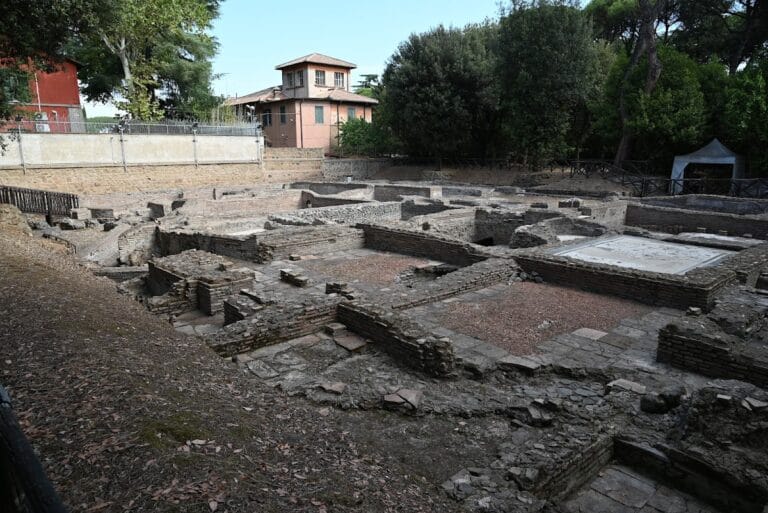
The surviving remains form a porticoed complex organized around a rectangular courtyard. Columns in the Tuscan order, a relatively plain form of classical column design, stood along the opposite and two lateral sides, creating a quadrangular arrangement with five elements on each side. Entry from the Via Appia led through a portico into the courtyard.
Shops and workshops
Fifteen rooms occupied the three sides behind the colonnades. These spaces served as shops, commercial areas, or production workshops, giving the courtyard complex both a trading and working function. Their walls were constructed in opus reticulatum, a Roman technique using small, regularly arranged diamond-shaped masonry blocks.
Entrance altar and roadside monuments
The altar dedicated to Silvanus was found at the entrance to the complex, where it marked the approach to the market. The surrounding area contained funerary monuments associated with the ancient roadside setting, linking the commercial site to the broader landscape of the Via Appia.