Church of Saint-Paul-des-Champs: A Medieval Parish in Paris
Site at a Glance
- Rating
- 2
- Popularity
- Very Low
- Country
- France
- Primary era
- Medieval
- Eras represented
- Medieval
- Civilizations
- French
- Site type
- Religious
- Remains
- Church
On this page14 sections
History
The Church of Saint-Paul-des-Champs was a medieval parish church in Paris, France, whose origins lay in a seventh-century chapel beyond the early city. It developed from a cemetery chapel into a parish serving the growing Marais district, and later became closely associated with the French royal family.
Monastic foundation and parish growth
In the early 630s, Eligius, a royal goldsmith and treasurer who later became bishop of Noyon, founded a women’s monastery dedicated to Saint Martial on the Île de la Cité. King Dagobert I gave the community farmland outside the city. The nuns followed the monastic rule of Columbanus, an Irish missionary whose practices influenced early medieval religious communities. Aure of Paris served first as the monastery’s superior and later as its abbess. The community was also known as Sainte-Aure and Saint-Éloi.
Between about 632 and 642, the nuns established a cemetery and chapel beyond the city, with the chapel often dated to around 635. Dedicated to Saint Paul of Thebes, an early Christian hermit, it was distinguished from churches dedicated to the apostle Paul. Its name, Saint-Paul-des-Champs, reflected its location among cultivated fields; it was also known as Saint-Paul outside the walls. Funeral processions between the monastery and cemetery crossed the Seine by boat.
A small settlement grew around the chapel and the adjoining Saint-Éloi grange, within an agricultural estate that formed one of the early settlement nuclei on the Seine’s right bank. The estate held jurisdiction over the settlement, including authority in serious criminal cases. Its lands extended around the chapel and church and into parts of what are now the 11th and 12th arrondissements.
The Normans destroyed the early church in 845. A church later replaced the chapel, though its construction date is uncertain, and it became a parish church in 1125, serving the growing population of the Marais. The district came within Paris when Philip II Augustus’s walls were built between 1190 and 1209. In 1134, the estate passed to the religious community of the Benedictine abbey of Saint-Maur-des-Fossés. The church was rebuilt in the middle of the 13th century.
Royal connections and later church life
From the 14th century, the church was associated with the French royal family, whose nearby residences included the Hôtel Saint-Pol and the Hôtel des Tournelles. Charles V had the Hôtel Saint-Pol built between 1361 and 1364 after he no longer considered the Palais de la Cité secure. Saint-Paul served as the royal family’s parish church until 1555. Charles V and Charles VI contributed to repairs.
Several members of the royal family were baptized there. Charles VI was baptized in 1368, Charles V’s son Louis of Valois in 1372, and the future Charles VII in 1403. The church was rebuilt in 1430 and 1431, then consecrated again in 1434 by Jacques du Châtelier, bishop of Paris.
In 1533, the estate was attached to the domain of the bishop of Paris, then commendatory abbot of Saint-Maur. A commendatory abbot held an abbey’s title and revenues without necessarily governing its monastic community. On 9 July 1559, Emmanuel-Philibert, duke of Savoy, married Marguerite of Valois at the church, fulfilling a clause in the Treaty of Cateau-Cambrésis, a peace agreement between France and Spain. Marguerite’s brother, King Henry II, had been fatally wounded in a tournament on 29 June. He asked for the wedding to be hastened and died the day after it took place. Marie de Rabutin-Chantal, later celebrated as Madame de Sévigné, was baptized at Saint-Paul in 1626.
Revolution and the successor parish
The church closed in 1790. That year, human remains found in the Bastille’s dungeons during the fortress’s demolition were buried in the Saint-Paul cemetery. After an uprising on 10 August 1792, nineteen bodies collected from the streets were also interred there. Five parish vicars who refused the oath required by the Civil Constitution of the Clergy, a revolutionary measure that reorganized the Catholic Church, were killed in the September Massacres, a wave of prison killings. They were killed at the Abbey or Carmes prisons and were beatified by Pope Pius XI in 1926.
The parish was suppressed in 1793, and the church, cemetery, and adjoining grange were seized as national property. A timber merchant bought them in 1796. The church was used as a meeting hall and as a storage depot for royal carriages seized at Versailles; their gilding and metal were salvaged. Demolition followed between 1796 and 1799, and some of the stone was reused in buildings, including those on Boulevard de Bonne-Nouvelle.
In the early 19th century, a new parish was established in the former Jesuit church of Saint-Louis on Rue Saint-Antoine. Built in the 17th century, it took the joint dedication Saint-Paul-Saint-Louis and assumed the parish role in 1820.
Remains
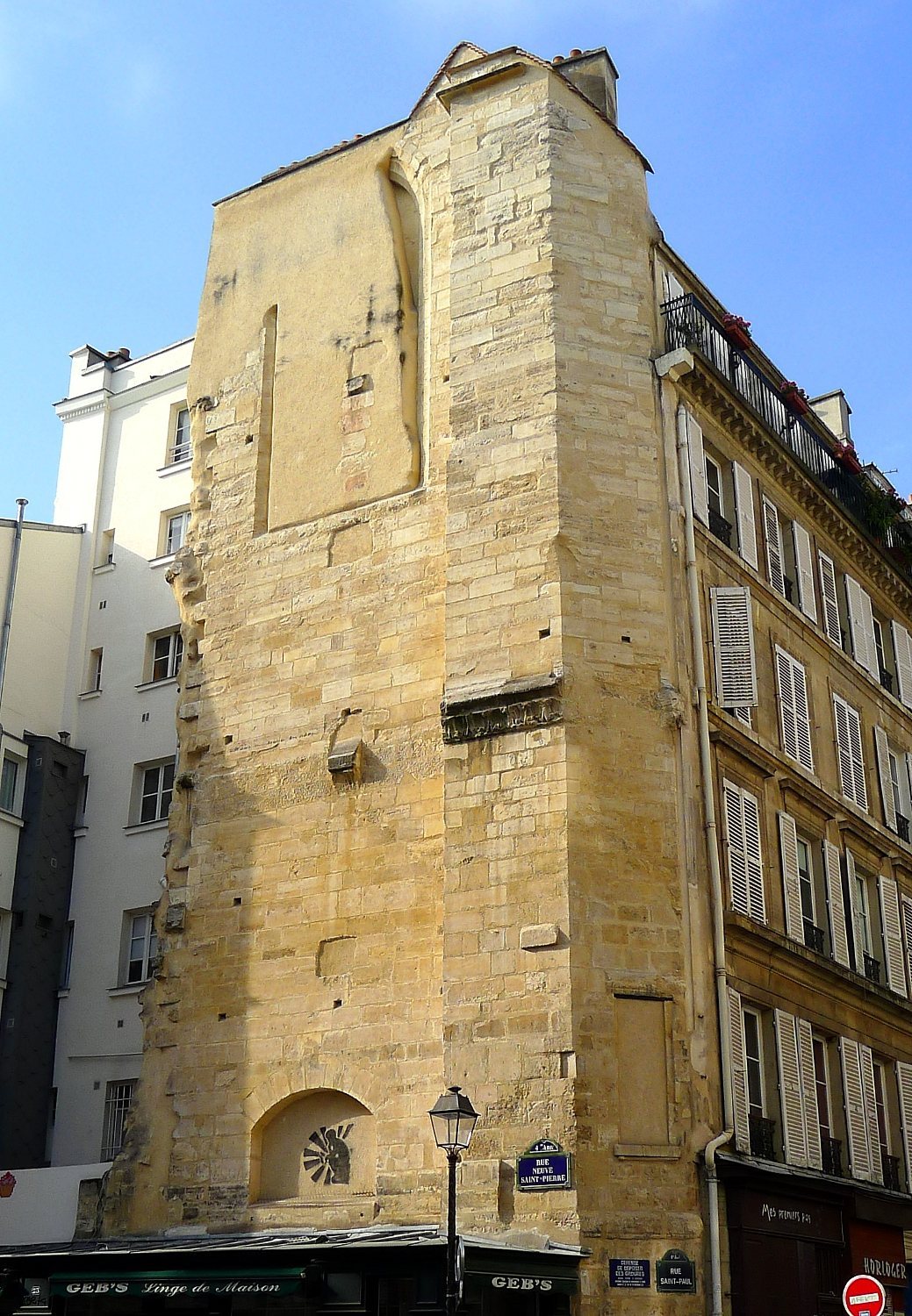
The church stood on the non-flooding eastern end of the Saint-Gervais mound, beside marshland that later became the Marais. Its address was 30–32 Rue Saint-Paul, at the corner of today’s Rue Neuve-Saint-Pierre. It faced Rue Eginhard, while Rue de Jouy approached it from Porte Baudoyer.
Site layout and adjoining structures
Cemetery and charnel house
The cemetery lay behind the church and included a charnel house, a building for collecting human bones. Used from the seventh century until its closure in the late 18th century, it ranked among Paris’s largest cemeteries, after the Cemetery of the Innocents. Stone coffins from the Merovingian period, the era of the early Frankish dynasty, have been found near the chapel site.
Saint-Éloi grange
The grange adjoined the chapel and later church. It contained the estate court and prison.
Surviving fabric and commemorative features
Bell-tower wall
A fragment of the bell tower’s wall remains, incorporated into the gable of the adjoining building at no. 32.
Clock and stained-glass window
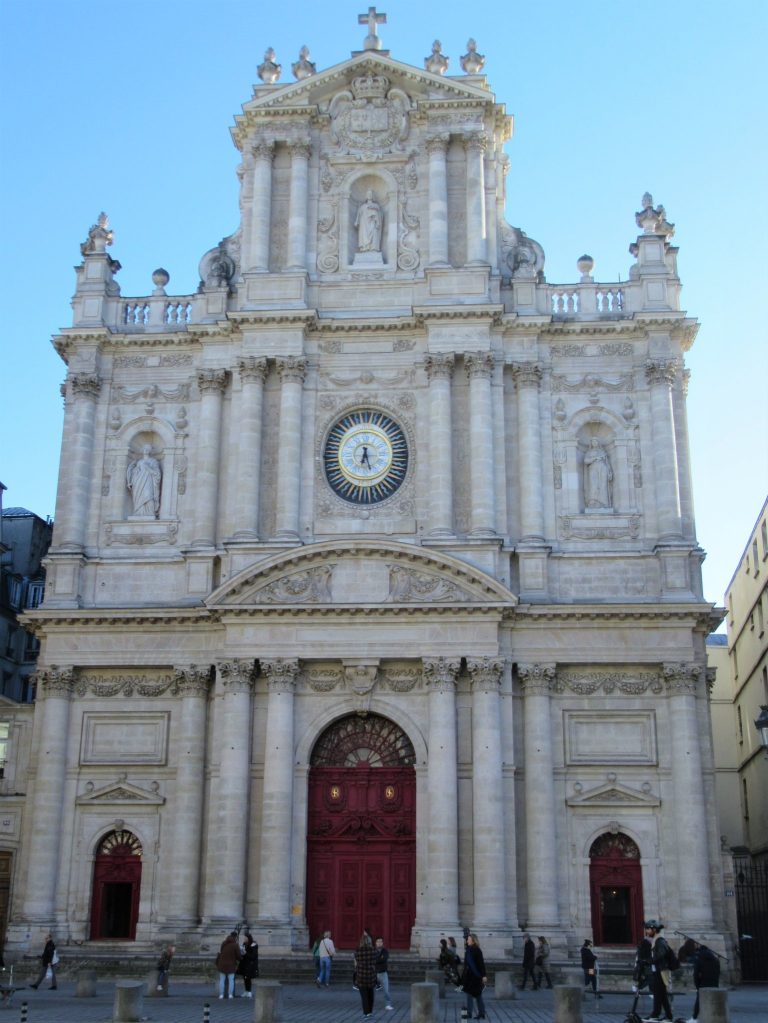
The church’s clock, made in 1627, survives on the façade of Saint-Paul-Saint-Louis, where it was installed in 1802. A stained-glass window commissioned by Charles VII after the English departure depicted Joan of Arc, the French military leader.
Chancel
The chancel, the part of a church around the altar and choir, was remodeled from 1684 under the architect Jules Hardouin-Mansart.
Burial monuments and mausoleums
The church contained burial monuments for François Rabelais, Jean Desmarets de Saint-Sorlin, Adrien Baillet, bishop Pierre Daniel Huet, and the architects Mansart de Jouy and Mansart de Sagonne. King Henry III also commissioned mausoleums for his favorites Jacques de Lévis, known as Quélus, Louis de Maugiron, and Robert de Saint-Mégrin. Quélus and Maugiron had died in a duel in 1578; a popular uprising destroyed the mausoleums in January 1589.
Memorial plaque
A plaque in Saint-Paul-Saint-Louis commemorates the five parish vicars killed during the Revolution.