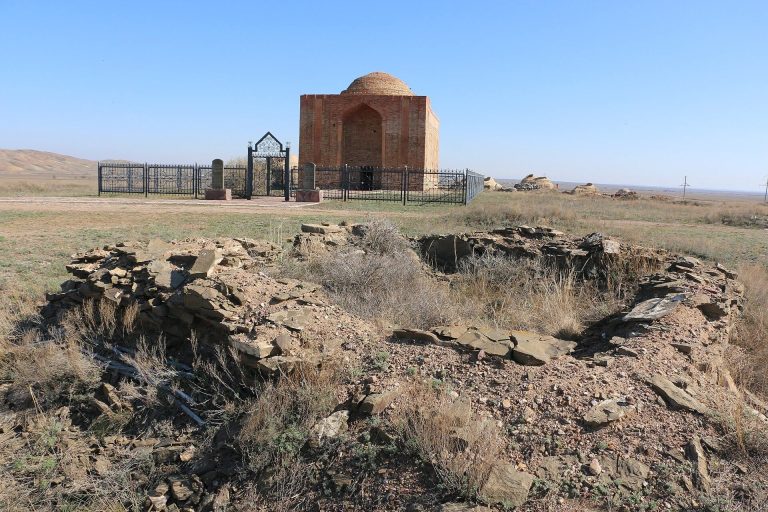
Dzhuchi-khan Mausoleum: A Golden Horde Burial Monument in Kazakhstan


Site at a Glance
- Rating
- 4.8
- Popularity
- Low
- Country
- Kazakhstan
- Primary era
- Medieval
- Eras represented
- Medieval
- Civilizations
- Golden Horde, Mongolian
- Site type
- Religious
- Remains
- Tomb
On this page12 sections
History
Dzhuchi-khan Mausoleum is a fourteenth-century Islamic burial monument in Kazakhstan, in the Ulytau District, traditionally identified as the tomb of Jochi Khan, the eldest son of Genghis Khan and founder of the Jochid ruling line. Its portal-and-dome design belongs to the period when the Golden Horde, the Jochid khanate that ruled extensive territories of western Eurasia after the Mongol conquests, adopted Islam as its official religion in the early fourteenth century.
Tradition and the Golden Horde
Jochi died in 1227, and historical tradition holds that a domed mausoleum was built for him in 1228, before the first anniversary feast traditionally held for the deceased. Symbols preserved on the dome have been interpreted as signs of participation by tribes subject to Jochi, including the Oghuz, Argyn, Kipchak, Kerey, Naiman, Kongyrat, and Kangly.
Archaeological investigation, written evidence, restoration analysis, and radiocarbon dating instead place the construction of the present mausoleum in the fourteenth century. This chronology corresponds to the emergence of Islamic mausoleums over the graves of khans and nobles after the Golden Horde adopted Islam. A later building phase, probably belonging to the Timurid period, added the outer dome. The Timurid period was the era of the dynasty founded by Timur, whose political and cultural influence extended across Central Asia in the late fourteenth and fifteenth centuries.
Written references and archaeological investigation
The earliest written information about the monument dates to the sixteenth century. During Abdulla Khan II’s 1582 campaign in Ulytau, the Persianate historian Hafiz-i Tanish Bukhari described the ruler’s encampment near the mausoleum of Jochi Khan. Abdulla Khan II ruled the Bukhara Khanate, while Hafiz-i Tanish Bukhari was a historian and author of the sixteenth century.
In 1946, the Central Kazakhstan Archaeological Expedition, led by the Kazakh archaeologist and scholar Alkey Margulan, examined the monument and attributed its burials to Jochi Khan and his wife. Later work exposed two graves, but the archaeological evidence has left Jochi’s burial at the mausoleum uncertain. The first grave contained a coffin dated by radiocarbon to a time corresponding to 1245, with an uncertainty of plus or minus 25 years at the approximately 95-percent probability level. This burial therefore predates the present mausoleum while postdating Jochi’s death.
The first burial combined Muslim and pre-Islamic practices. Members of the Borjigin dynasty, the ruling lineage descended from Genghis Khan and known as the “Golden Family,” were reportedly buried secretly according to pagan rites. For this reason, Burial 1 may have belonged to a Muslim member of Jochi’s lineage rather than to Jochi himself, with the mausoleum subsequently acquiring his name.
Burial 2 probably belonged to Bektumish, described as Jochi’s senior wife and the daughter of the younger brother of Toghril Khan, ruler of the Kerey Khanate. Bricks from the grave carried a repeatedly inscribed word or expression in Arabic letters, transcribed as “Iqpal.”
Legend and modern protection
A popular legend says that Jochi was killed while hunting after a wounded, lame kulan, a wild Asiatic ass of the Central Asian steppes, attacked him, pulled him from his horse, and bit off his right arm. Versions of the story say that his body was buried without the arm, that only one arm was recovered, or that only a finger was found.
In 1982, the mausoleum entered Kazakhstan’s state list of historical and cultural monuments of republican significance and came under state protection. Restoration work has continued since 1999, adding a modern phase to the monument’s long history of interpretation and preservation.
Remains
The mausoleum stands on a low hill beside the Karakengir River, a position from which the building is visible across a considerable distance. Its rectangular plan measures approximately 7.25 by 9.52 metres, and the structure rises about 7.9 metres. Built from red fired bricks measuring about 26 by 29 by 5 centimetres, it rests on a shallow foundation of brick rubble. Clay-and-straw mortar covers the interior walls, and the floor is paved with brick.
Portal and entrance chamber
Monumental portal
The principal facade faces southwest and is formed by a pishtaq, a monumental projecting entrance portal, with a pointed arch above a deep entrance niche. The niche is about 4.5 metres high and is enclosed by a recessed U-shaped frame. Glazed tiles measuring 45 by 45 centimetres originally filled this frame with ornamental designs and inscriptions. In 1911, an official of the Atbasar district removed decorated bricks and sent them to a museum; some fragments remain preserved. A parapet forms the upper edge of the portal, with a brick frieze beneath it.
Domed chamber
The inner dome covers a square chamber and rests on arched pendentives, curved structural elements that transfer the dome’s weight onto the square room. The entrance niche has a half-dome supported by brick pendentives shaped as cellular stalactites. Two small lighting openings, each about 35 by 55 centimetres, lie on the transverse axis near the base of the dome, approximately 3.28 metres above the floor. They illuminate the chamber from beneath the drum. A tombstone stands at the rear of the chamber.
Double-shell dome
The mausoleum’s double-shell dome includes an inner dome approximately 7 to 7.1 metres high and an outer dome that was approximately 8 metres high. The outer shell was covered with tiles and turquoise glaze and rested on an unusual faceted drum. When the outer dome was installed, an opening from the inner dome was closed. The faceted drum has been associated in interpretations of the monument with Oghuz and Kipchak building practices.
Burial chambers
Burial 1
Burial 1 lay beside the eastern foundation of the dome in a grave approximately 2.2 metres long, 70 centimetres wide, and 1.2 metres deep. Its walls were built of large bricks, while thin brick slabs lined the base. The grave contained a wooden coffin, disarticulated human bones, animal bones, a camel skull, and fragments of leather, textiles, a banner, clothing, red saffian leather footwear, mulberry silk, and iron weapons. Saffian is a finely finished leather traditionally made from goatskin.
Burial 2
Burial 2 contained another skeleton, the remains of a wooden coffin, leather, and textiles. Two slabs lining the grave base carried epigraphic ornament. The grave’s association with Bektumish provides a possible identity for its occupant and helps explain the mausoleum’s connection with the Jochid lineage.