Karakhan Mausoleum: An Eleventh-Century Karakhanid Funerary Monument in Taraz
Site at a Glance
- Rating
- 4.6
- Popularity
- Very Low
- Country
- Kazakhstan
- Primary era
- Medieval
- External website
- Open
- Eras represented
- Medieval
- Civilizations
- Karakhanid
- Site type
- Religious
- Remains
- Tomb
On this page9 sections
History
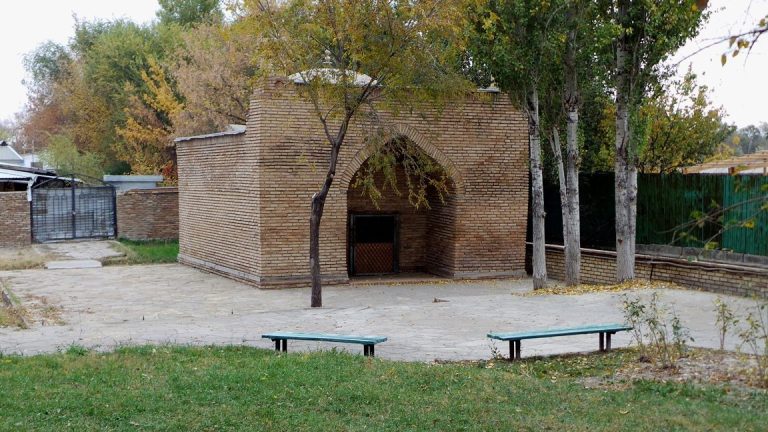
The Karakhan Mausoleum, also known as the Aulie-Ata Mausoleum, is an eleventh-century funerary monument in Taraz, Kazakhstan, built over the grave of a member of the Karakhanid dynasty. The Karakhanids were a Turkic Muslim dynasty that ruled parts of Central Asia from the tenth to the early thirteenth century, and the mausoleum reflects both dynastic memory and Islamic funerary practice.
Dynastic memory and attribution
Local oral tradition attributes the tomb to Karakhan, regarded in that tradition as the founder of the Karakhanid dynasty and the first Turk to accept Islam. Another identification connects the buried figure with Shah-Mahmud Bugra Karakhan, a representative of the same dynasty. These traditions associate the monument with the dynasty’s early Islamic history while preserving different interpretations of the person commemorated there.
Destruction and reconstruction
The original mausoleum was destroyed down to its foundations and rebuilt in the early twentieth century. The reconstruction retained the building’s structural principle but did not preserve its original architectural and decorative treatment. Its rebuilding was financed by Said Bakhanov, an ishan, a respected Islamic spiritual guide from Tashkent.
Boris Denike was the first specialist to study the mausoleum in detail, describing it in his work on architectural ornament in Central Asia. Archaeologist Taisia Senigova later reconstructed the original appearance of the facade from photographs made in the 1850s. During the Soviet period, the building housed an anti-religious museum. In 1982, it was placed on the Kazakh Soviet Socialist Republic’s list of historical and cultural monuments of republican significance and received state protection. Restoration followed in 2002 as part of the celebration of Taraz’s 2,000th anniversary. The mausoleum remains recognized as a monument of history and culture of republican significance.
Remains
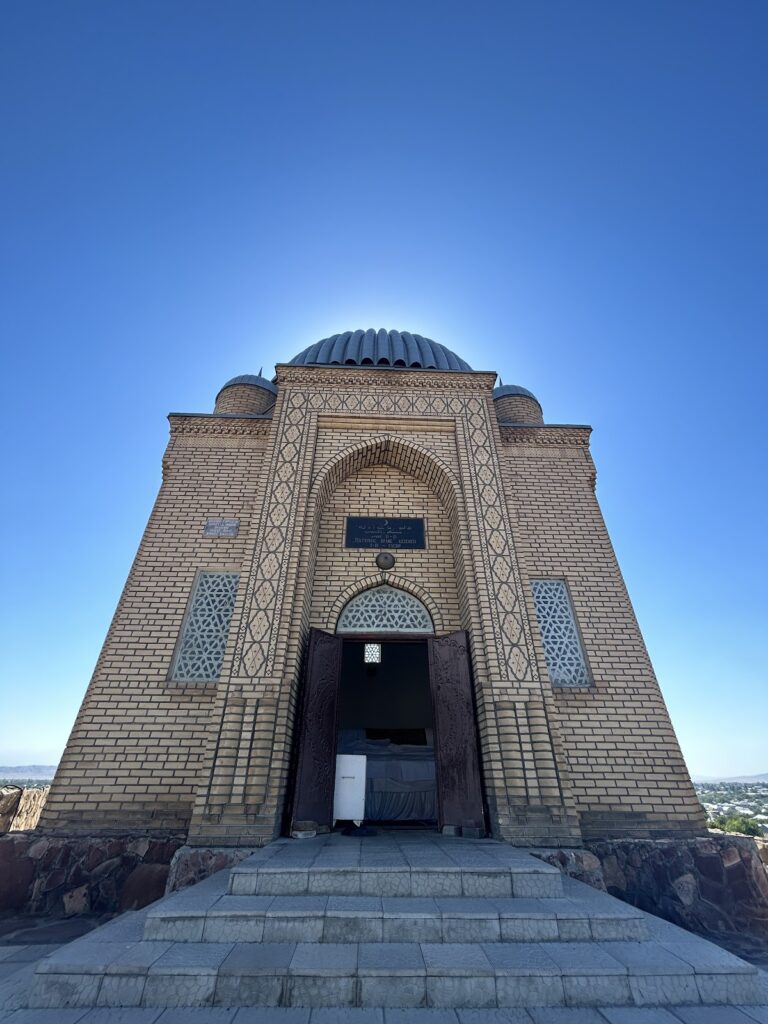
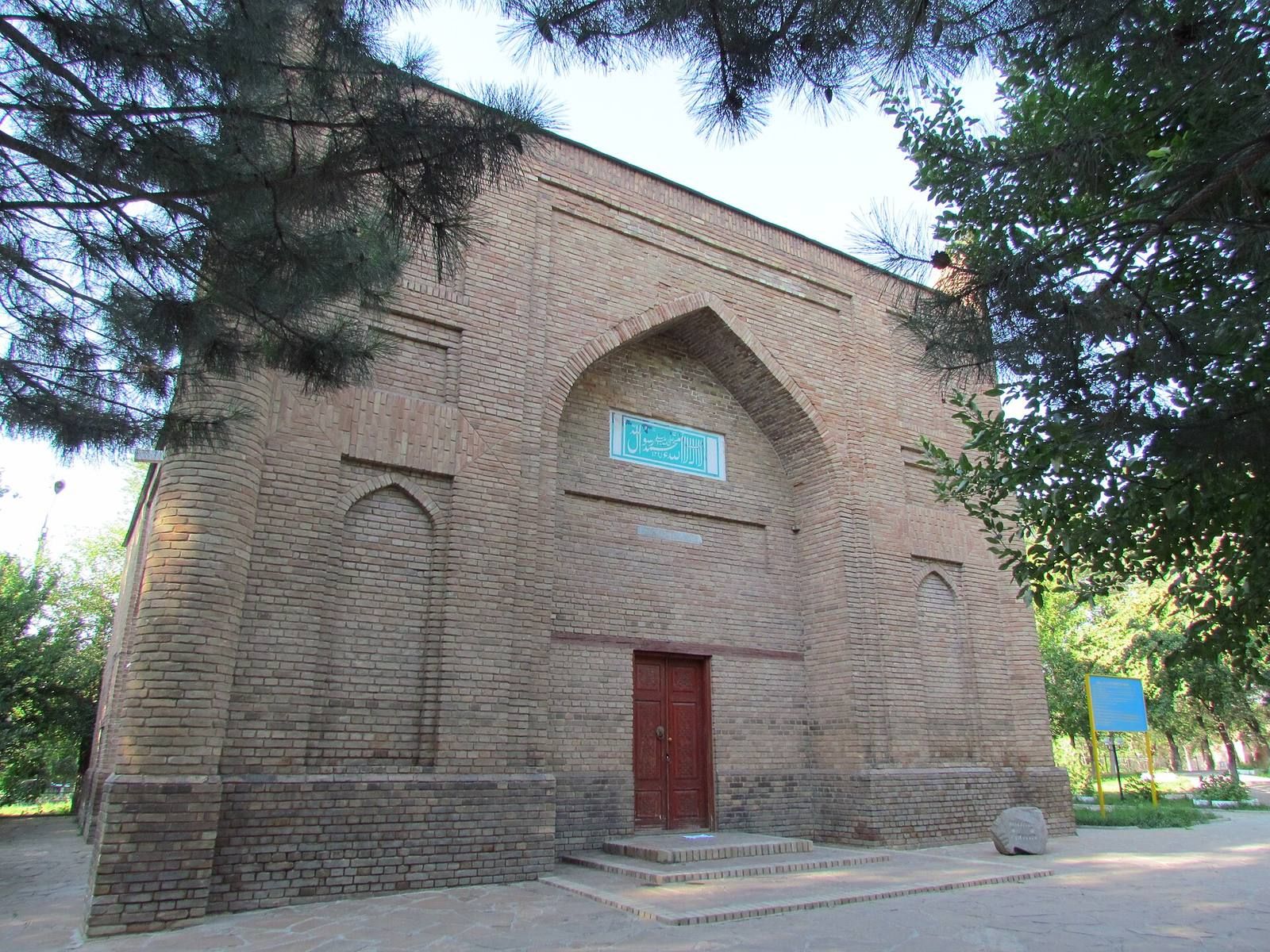
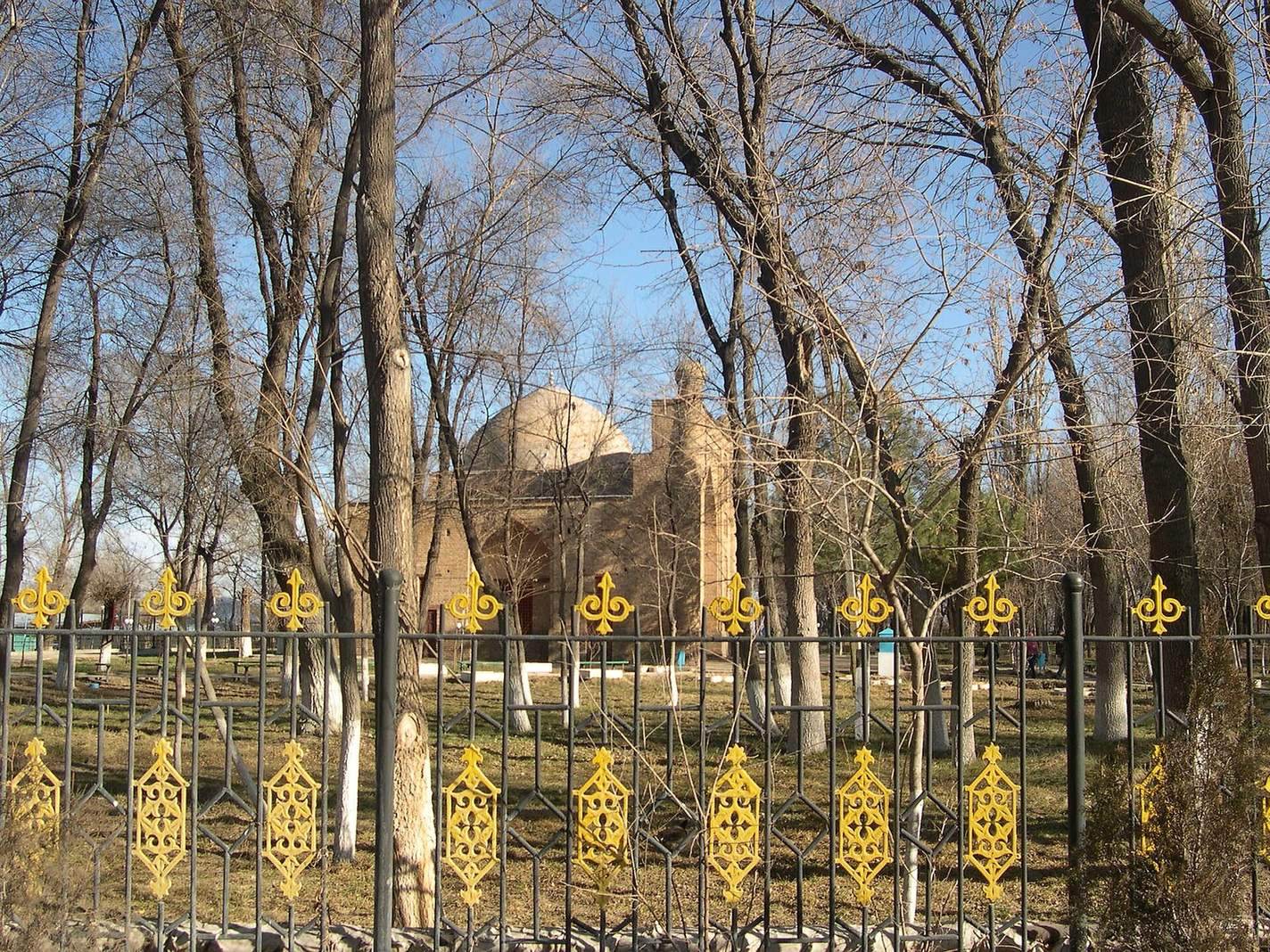
The surviving monument is a portal-and-dome building with a square plan. Its interior is arranged around a central hall, with three small corner rooms, or hujras, meaning small chambers or cells. A staircase occupies the fourth corner and leads to the roof. The building stands in a park at the intersection of Tole bi and Baizak batyr streets in Taraz.
Interior arrangement
Central hall and corner chambers
The central hall is covered by a dome, preserving the centralized arrangement of the original building. The dome and the arched niches beside the windows are constructed with brick from the Karakhanid period, while the exterior is faced with modern brick. A stepped tombstone survives inside the mausoleum and identifies the building’s funerary purpose.
South facade
Portal and entrance
The facade faces south and is flanked by towers. Its entrance is set within an arch, above which appears the shahada, the Islamic declaration of faith. Three niches stand on each side of the entrance, arranged as rectangular, square, and pointed forms. In the original design, the entrance lay beneath a shallow pointed arch marked by wedge-shaped masonry and outlined with bricks laid flat.
Original brick ornament
The original entrance arch rested on a three-quarter column made from paired bricks. A deeper entrance stood behind an arched niche, while slightly projecting U-shaped arches framed the portal. The facade was richly decorated, and more than 30 types of carved brick have been identified from the original architectural treatment, even though the early twentieth-century rebuilding did not retain that decoration.