Alasha-Khan Mausoleum: A Portal-Domed Funerary Monument in Kazakhstan
Site at a Glance
- Rating
- 4.8
- Popularity
- Very Low
- Country
- Kazakhstan
- Primary era
- Medieval
- Eras represented
- Medieval, Early Modern
- Civilizations
- Unclassified
- Site type
- Religious
- Remains
- Tomb
On this page8 sections
History
Alasha-Khan Mausoleum is a funerary monument in Kazakhstan, associated with Central Asian architectural traditions of the Karakhanid and Oghuz-Qipchaq period between the tenth and thirteenth centuries, although other interpretations place it in the fifteenth or sixteenth centuries. It has also been dated to the tenth or eleventh centuries. The building’s date and original historical setting therefore remain subjects of discussion.
Traditions surrounding Alasha Khan
Alasha Khan is a legendary or semi-legendary figure in Kazakh and Central Asian historical memory rather than a securely documented ruler. One tradition regards him as an ancestor of the people who united and protected the “Six Alash.” Another identifies him as the son of Kyzyl Arslan, a ruler of Turkestan, and connects the name Alasha with a mottled or spotted appearance. These traditions explain the monument’s cultural associations, but they do not establish a confirmed biography for the person commemorated.
The mausoleum has long been connected with local veneration. Its earliest recorded written mention appeared in Shokan Valikhanov’s 1855 article on Kyrgyz-Kaisak graves and antiquities. Valikhanov was a nineteenth-century Kazakh scholar, ethnographer, and military officer who recorded the history, geography, and antiquities of Central Asia. Nikolai Krasovsky supplied a fuller description in 1868, while accounts by Y. A. Schmidt, Krasovsky, and the eighteenth volume of the Complete Geographical Description of Russia also noted the respect shown locally to the monument.
Research and protection
An expedition led by M. B. Levinson made the first photographic record, technical examination, and measurements of the mausoleum in 1945 and 1946. Archaeological research in the surrounding area began in 1946 under the Institute of History, Archaeology, and Ethnography of the Academy of Sciences of the Kazakh SSR. These investigations established a lasting basis for studying the building’s form, construction, and place within the history of the region.
In 1982, the mausoleum was placed among the historical and cultural monuments of republican significance of the Kazakh SSR and received state protection. It is also included in the list of monuments of history and culture of republican importance in the Ulytau region.
Architectural influence
The brickwork and ornamental treatment of Alasha-Khan Mausoleum influenced later mausoleums associated with Talmas Ata, Zhuban Ana, Bolgan Ana, Kaiyp Ata, Düzen, and Erden. Its artistic character is also discussed alongside the mausoleums of Aisha Bibi, Jochi Khan, and Khoja Ahmed Yasawi. Aisha Bibi commemorates a traditionally identified woman, Jochi Khan was a son of Genghis Khan, and Khoja Ahmed Yasawi was a prominent medieval Sufi religious figure.
Remains
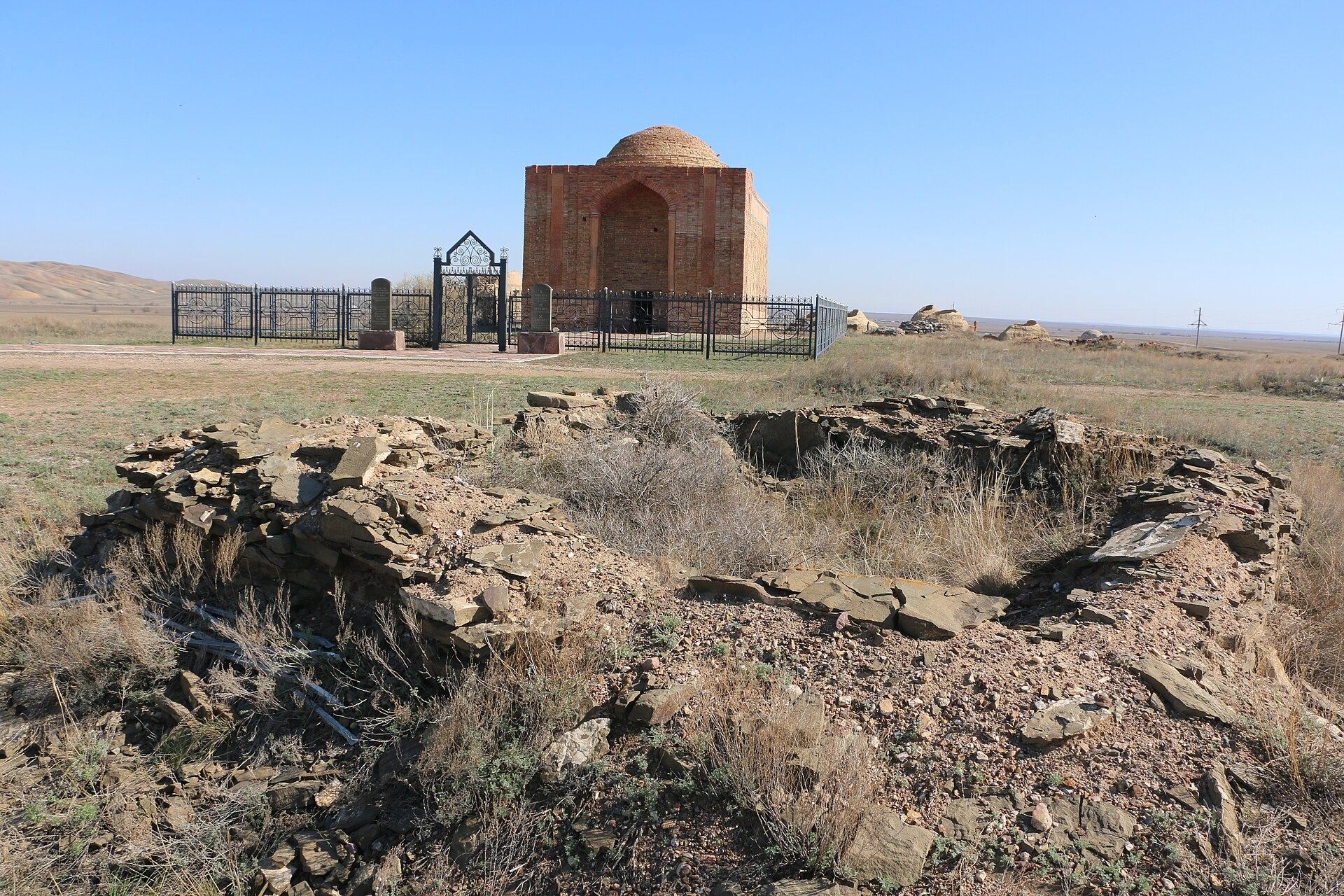
The mausoleum stands on elevated ground on the right side of the Karakengir River valley, near the river’s confluence with the Sarykengir and about 2 kilometres south-southwest of Malshybay village. Its rectangular building measures 9.73 by 11.9 metres and rises approximately 10 metres. Fired red brick forms the principal construction material, while wood was used for the window openings and doors. The walls are strengthened by eight buttresses.
Portal and entrance facade
Alasha-Khan Mausoleum is a portal-domed building, meaning that a prominent entrance portal is combined with a dome over the main interior space. The central facade contains a two-leaf door that opens into a deep, double-arched niche. A slightly recessed band in two colours frames the niche, while shaped bricks add further definition. Geometric patterns made from bricks of different colours, forms, and sizes cover the exterior. The entrance facade is especially elaborate, with an arrangement compared to an Eastern carpet, while the building’s overall ornament is likened to velvet.
Hexagonal, column-like elements flank the facade. Each stands on three hemispherical forms, two complete and one serving as the base of the column. This arrangement is unusual in Central Asian architecture. The entrance door is approximately 2 metres high and 1.2 metres wide. The upper parts of the entrance portal and its two tower-like side sections have been lost from the level where the dome drums begin, so their original height cannot be established.
Dome and surviving fabric
The dome rises from a drum, the cylindrical or polygonal structure that supports and lifts a dome. The drum is approximately 2.31 metres high and has four stepped belts that decrease in size, combining polygonal and cylindrical forms. The belt diameters are given as 743, 673, and 643 centimetres. A circular gallery surrounds the drum. From the left corner of the entrance, a narrow stair passage leads to the second circular level of the dome, or drum gallery, and continues to the roof behind the portal arch.
Thin patterned glazed cladding was formerly associated with the portal and dome, but none remains. It was probably taken away as devotional souvenirs by travellers. A modern gravestone stands southwest of the mausoleum and carries inscriptions in Cyrillic and Old Turkic. Cyrillic is used for modern Kazakh and Russian writing, while Old Turkic refers to the historic Turkic script used for early inscriptions.
Architectural character
The architect is unknown. The mausoleum’s distinctive treatment has been linked with Karakhanid-period architecture and with Seljuk artistic traditions, particularly forms found in Turkmenistan. Its ornamental character has also been compared with that of the former Kok Kesene building near ancient Syganak. Together, the surviving brick patterns, portal composition, dome structure, and unusual facade elements define the monument’s architectural identity.