Cathedral of Saint Nicholas of Bari: Termini Imerese’s Parish and Archpriest’s Church
Site at a Glance
- Popularity
- Medium
- Country
- Italy
- Primary era
- Early Modern
- Eras represented
- Medieval, Early Modern, Modern
- Civilizations
- Crown of Aragon, Italian, Kingdom of Sicily, Spanish
- Site type
- Religious
- Remains
- Church
On this page18 sections
History
The Cathedral of Saint Nicholas of Bari is a Roman Catholic church in Termini Imerese, Italy, whose larger present building was designed from a commission made in 1604. Dedicated to Saint Nicholas of Myra, a fourth-century Christian bishop in Asia Minor, it serves as the parish church of San Nicola and the city’s archpriest’s church. An archpriest is a senior priest responsible for a church or local ecclesiastical district.
Medieval churches and church authority
Termini Imerese was a bishop’s seat during the first millennium, and its diocese, the territory governed by a bishop, was suppressed during the Arab conquest of Sicily. Norman rule did not restore it. After the Norman reconquest, the Church of San Giacomo became the city’s cathedral. Pope Innocent III, who led the church from 1198 to 1216, consecrated San Giacomo while travelling from Palermo toward Rome by way of Messina.
Under Frederick II, king of Sicily and Holy Roman Emperor, the church came under the ecclesiastical authority of Palermo. Its priest no longer held the office of bishop, although he kept the insignia associated with bishops and the right to appoint chaplains. Enrico De Scalfani’s appointment in 1407 began the succession of archpriests.
The church of Santa Maria La Nova
By the end of the fifteenth century, a new church had been built in the upper city to become its main church and parish. Dedicated to Santa Maria La Nova under the title of San Nicolò, it occupied a more central and accessible position than San Giacomo. The site included an earlier church of Santa Maria La Nuova and a church dedicated to San Paolo, both slated for demolition.
Expansion and consecration
Commercial growth and a rising population led the community to plan a larger church. On 30 January 1604, Antonio Spadafora received the commission to design it. Construction was supported by charitable alms, periodic pledges from the town’s magistrates, a substantial levy on bread, a tax on snow, and contributions from the wider community. The main structures and the first level of the façade were complete by 1660. Stucco work in the three transept apses followed from 1688 to 1695.
Restoration and changes to the main chapel were designed in 1760, first by Pietro Casano of Palermo and later by Filippo Mola. Federico Siragusa embellished the Chapel of the Blessed Sacrament with high-relief sculpture from 1788 to 1791. Giuseppe Di Garbo decorated the church’s barrel-vaulted ceilings in 1802. The façade, designed by Ernesto Armò with engineer Giuseppe Indovina, was completed in 1912. Cardinal Alessandro Lualdi presided at the church’s solemn consecration on 28 October 1922.
The cathedral belongs to the Archdiocese of Palermo, a major church jurisdiction led by an archbishop, and follows the Roman rite, the principal liturgical tradition of the Latin Church. Its patron is Blessed Augustine Novello, a medieval Italian Augustinian friar and church official.
Remains
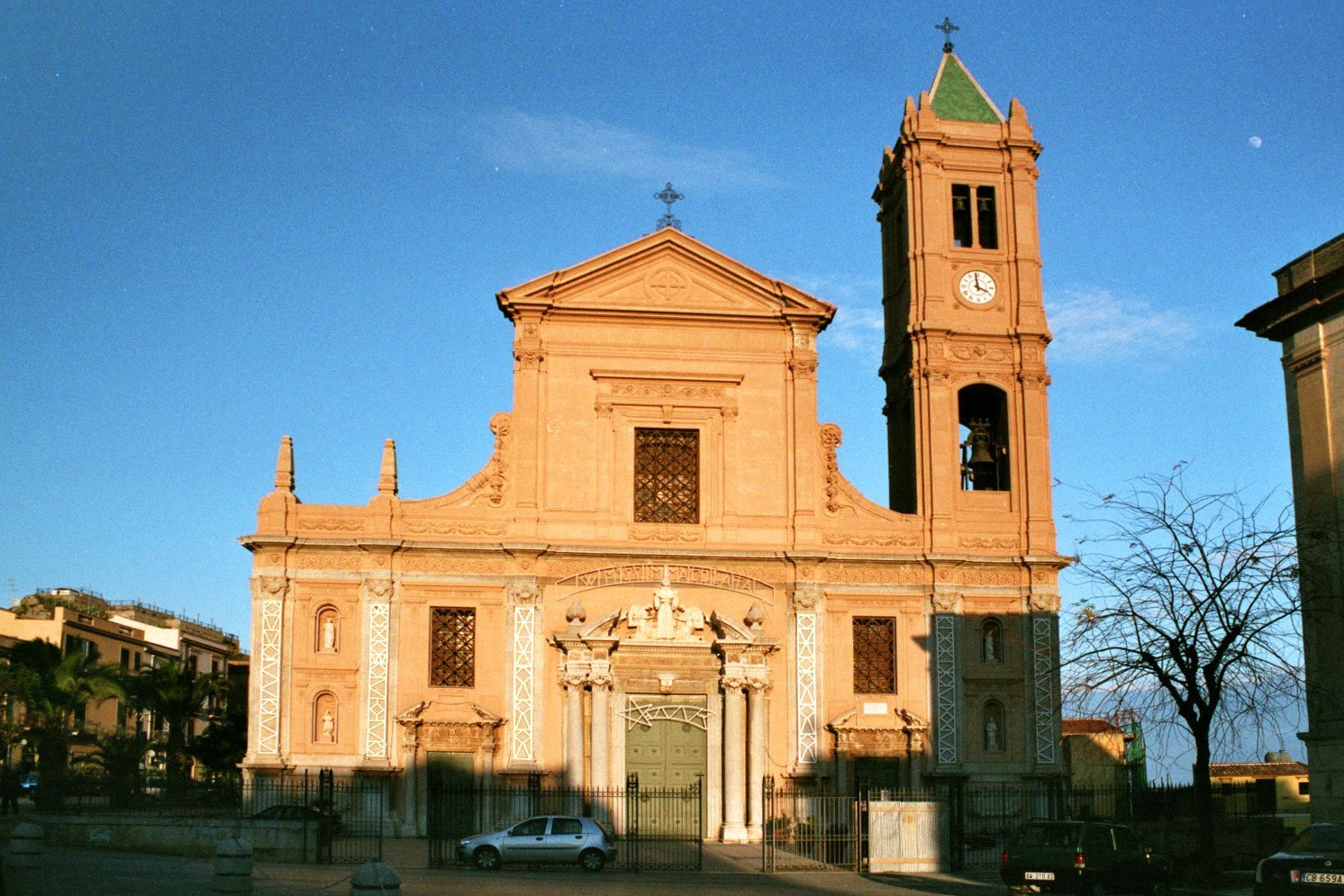
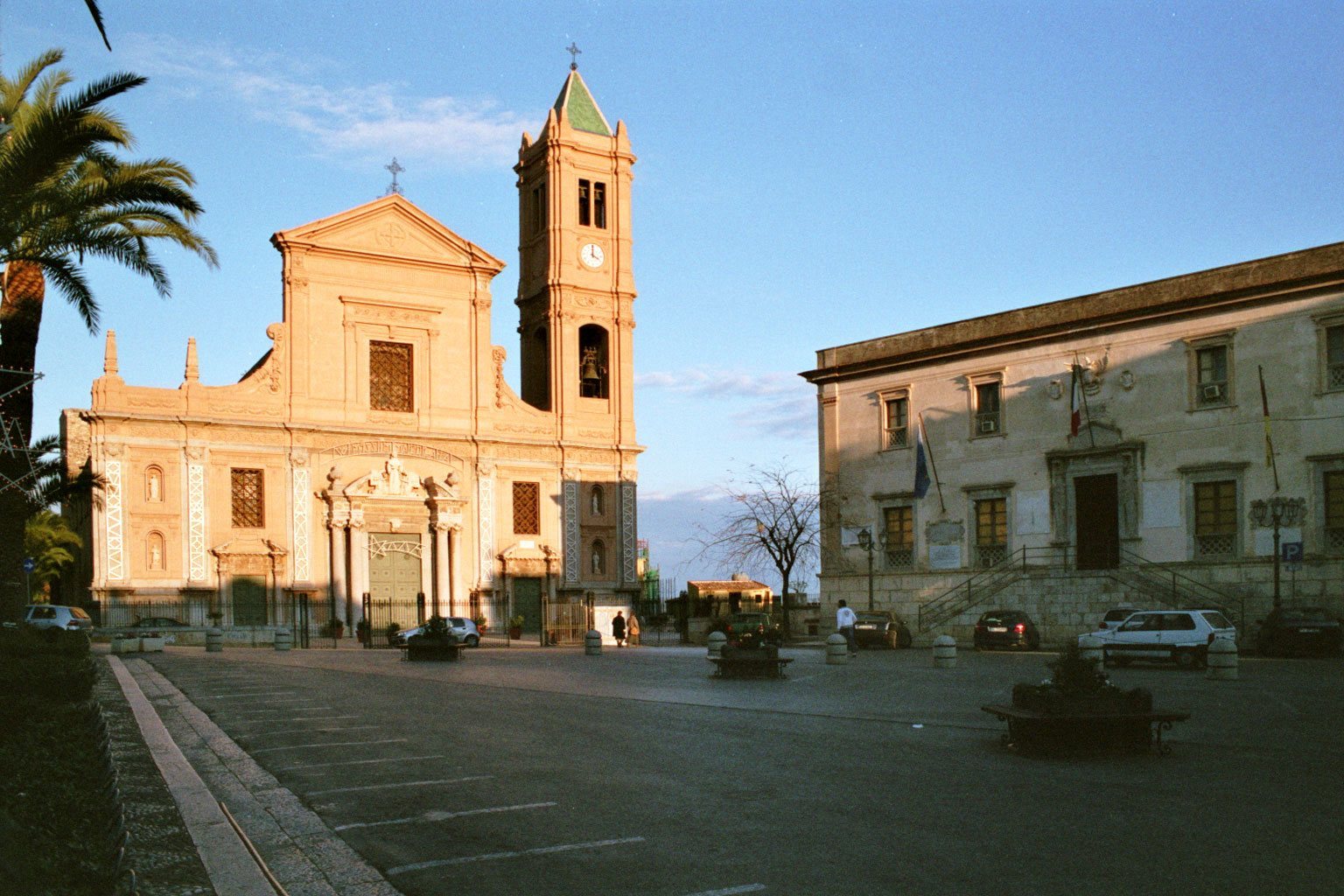
The cathedral is the largest church in Termini Imerese. Its central nave, the main body of the church, meets a transept, the crosswise arm, at the crossing. Three recessed apses, or rounded end spaces, are set in the transept, while the presbytery, the area around the main altar, completes the plan.
Exterior
Façade
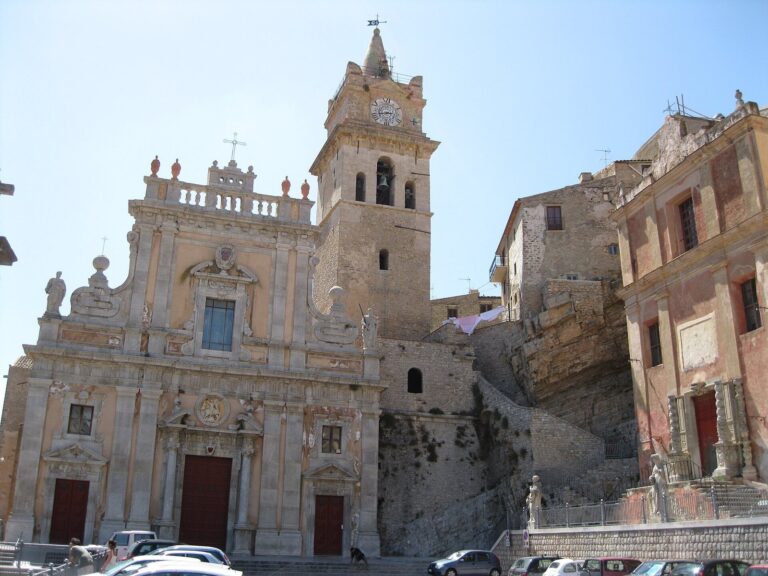
The façade has three monumental portals, framed by columns in the Composite style, which combines features associated with the Ionic and Corinthian classical orders. Niches at the sides hold copies of four figures: Saint John the Baptist, Saints Peter and Paul, and Saint James the Greater. The originals, from a marble altarpiece in the earlier church of Santa Maria La Nova, are kept inside. Above the central portal, a marble group of Blessed Augustine Novello with angels was made by Filippo Sgarlata in 1925.
Churchyard railing
An iron railing encloses the churchyard. Vincenzo Chiavetta made it with his sons Antonino and Nicola, and it dates to 1926.
Nave chapels
Right nave chapels
The second bay of the right nave contains the Chapel of the Madonna of the Mace, with a marble statue made by Giorgio da Milano in 1487. The statue came from the Church of St Vincent Ferrer at a Dominican convent, belonging to the Catholic order founded for preaching and teaching. In the fourth bay, a marble oval depicting the Virgin, made by Ignazio Marabitti, is set into the wall of the Chapel of the Virgin of the Bridge. The right nave also contains a chapel of the Immaculate Conception, reflecting the Catholic belief that Mary was preserved from original sin from the moment of her conception. It holds a cypress-wood statue made by Francesco Quattrocchi in 1799.
Chapel of the Crucifix
The sixth bay of the left nave contains the Chapel of the Crucifix. Its altar holds a wooden crucifix made by Giacomo Di Leo around 1520.
Apse and transept chapels
Central apse sculpture
Behind the main altar is a marble sculpture of the enthroned Virgin and Child, also known as Our Lady of Succour. Giuliano Mancino and Bartolomeo Berrettaro made it as part of a polyptych, an altarpiece composed of multiple panels or sections, commissioned between 1504 and 1517 for the Blessed Sacrament chapel in Santa Maria La Nova. The work was completed after the artists’ partnership ended, following Mancino’s death shortly after 1517. Figures of Saints Peter, Paul, James the Greater, and John the Baptist associated with the altarpiece were later placed on the façade and have since been replaced there by copies. Mancino’s hand is recognized in the figures of James and John.
Chapel of Blessed Augustine Novello
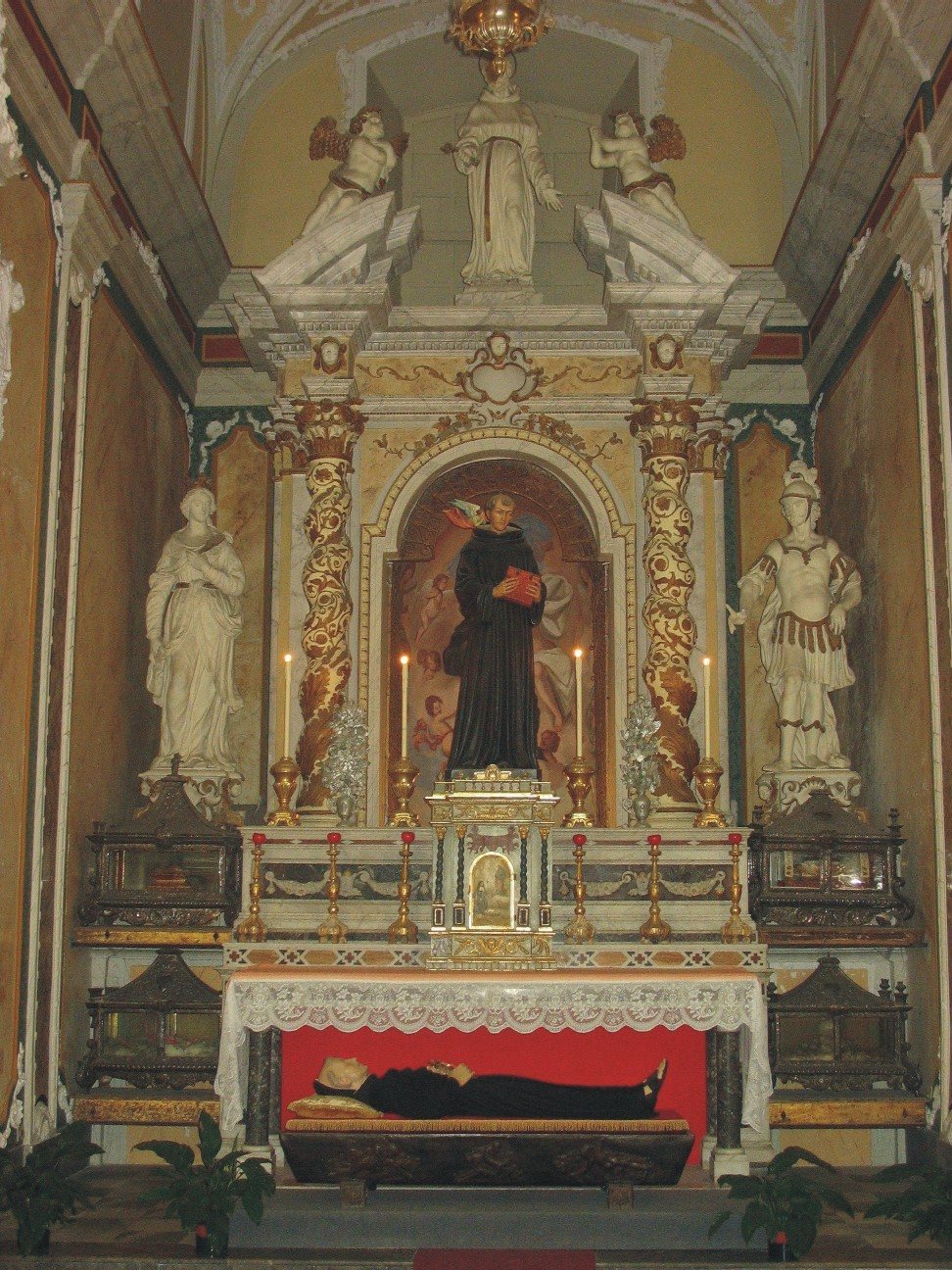
The right transept apse holds the Chapel of Blessed Augustine Novello. Its altar has twisted columns and a pediment with overlapping broken arches. Angels and a central figure of Saint Peter decorate the upper moldings, and two statues flank the altar table. The body of Augustine and relics of Saints Calogero, Basilla, and Candida lie beneath it. Wall paintings from the second half of the seventeenth century show Augustine receiving the office and key of papal penitentiary from Pope Nicholas IV, and giving a religious habit to a warrior in the presence of nobles and clergy. A papal penitentiary dealt with matters of conscience and sacramental absolution.
Chapel of the Blessed Sacrament
The eighteenth-century Chapel of the Blessed Sacrament occupies the left transept apse. It contains high reliefs by Ignazio Marabitti, made with Federico Siragusa’s collaboration. A marble tabernacle, a container for the consecrated Eucharist, was made by Francesco lo Mastro in 1513 for the Blessed Sacrament chapel of Santa Maria La Nova. It was later associated with this chapel and may have been transferred from the earlier church.
Painted works
Painted crucifix
A painted crucifix by Pietro Ruzzolone, dated 1484, now stands at the back of the central apse. On its front, the Crucified Christ appears with a serpent coiled around the tree of knowledge, a pelican with its young, Mary Magdalene below, and the Virgin Mary and Saint John the Evangelist at the sides. The reverse shows the risen Christ holding a banner above the tomb, with a centurion and two angels carrying inscribed cartouches; symbols and Gospel phrases represent the Evangelists. Paintings of the Apostles line the apse walls. The crucifix was moved to its present position in 1967. Before then, it stood on a side altar in the third chapel of the left nave. That altar was built in 1847 to receive the painting from storerooms beneath the sacristy.
Other paintings
A 1630 painting by Francesco La Quaresima depicts the Madonna of the Milk between Saint Onuphrius and Saint Nicholas. It came from the Church of Maria Santissima Annunziata, as did a seventeenth-century painting of Blessed Augustine Novello by Vincenzo La Barbera. Other paintings include a seventeenth-century Annunciation from the workshop of Novelli; a scene of Saint Agatha visited in prison by Saint Peter, by an unidentified painter of the Novellesque school; and Filippo Randazzo’s 1741 painting of Saint Ignatius of Loyola and Saint Cajetan of Thiene.