Castello di Caccamo: A Norman Castle and Noble Palace
Site at a Glance
- Rating
- 4.5
- Popularity
- Medium
- Country
- Italy
- Primary era
- Medieval
- External website
- Open
- Eras represented
- Medieval, Early Modern
- Civilizations
- Kingdom of Sicily, Norman, Spanish
- Site type
- Military
- Remains
- Castle
On this page10 sections
History
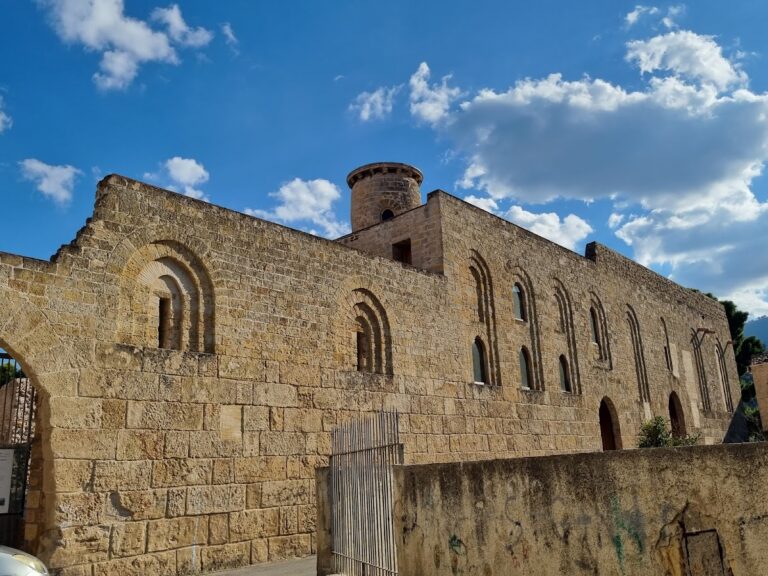
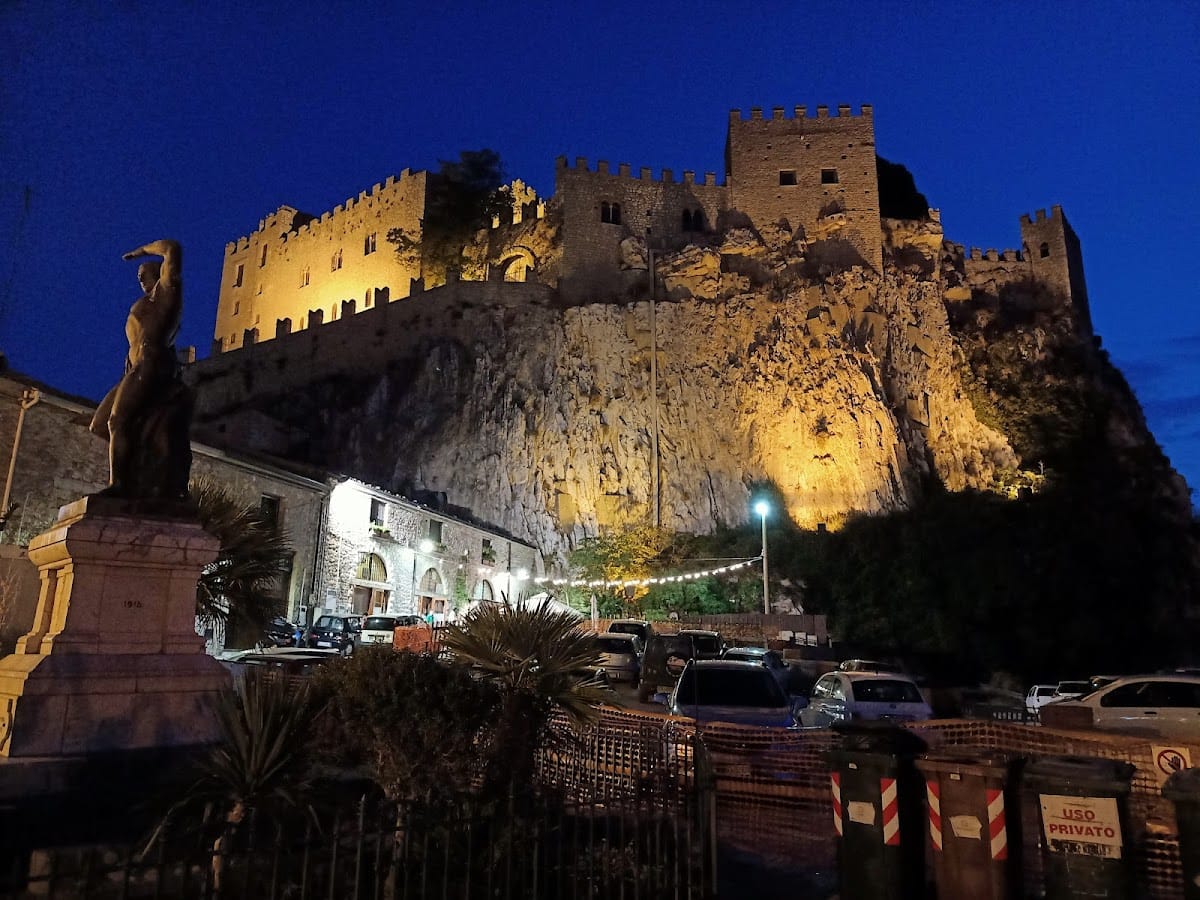
Castello di Caccamo is a defensive castle in Caccamo, Italy, built in the twelfth century under Norman rule and regarded as one of Sicily’s largest and best-preserved Norman castles. Its position on a steep rocky outcrop gave it strategic control over the surrounding countryside and helped make it an important stronghold after the Norman reconquest of Sicily.
Norman foundation and medieval conflicts
The site was probably occupied before the Norman period by an Arab fortress or watchtower. After the reconquest of Sicily, Matteo Bonello, lord of Caccamo, established the castle’s Norman structures during the twelfth century. The Normans were the dynasty and military elite that conquered Sicily in the eleventh century and founded the Kingdom of Sicily, combining fortified construction with architectural elements developed under their rule.
In 1160, Norman barons assembled in the castle’s principal interior room to plot against William I of Sicily, the twelfth-century Norman king. The rebellion was defeated and suppressed at an early stage. More than a century later, the castle became involved in the opening of the Sicilian Vespers, a major uprising against Angevin rule that began in Sicily in 1282. Giovanni di Saint-Rémy, prefect of Charles I of Anjou, fled Palermo and sought refuge at Caccamo, but the people of the town captured and executed him.
Chiaramonte alterations and aristocratic ownership
During the fourteenth century, Manfredi I Chiaramonte and the Chiaramonte family radically altered the complex. The Chiaramontes were a powerful Sicilian noble family whose control brought extensive remodelling, while smaller structural interventions continued until the seventeenth century.
A marriage in 1480 between Fadrique Enríquez, admiral of Castile, and the last representative of the Prades-Cabrera family began a period of decline for the castle. It later passed to Filippo Amato, Prince of Galati, who acted as liquidator of the indebted Enríquez family. In 1646, the Amato family acquired the barony of Caccamo. The barony had been elevated to a duchy by Philip III of Sicily, and the Amatos retained it until 1813.
From fortress to noble palace
Under the Amatos, extensive renovations transformed the earlier Chiaramonte complex. Medieval structures were erased or reshaped, and the castle became a noble palace with reception rooms, painted wooden ceilings, and frescoed friezes. The complex reached its greatest extent during this period, but its earlier strategic and military character was greatly reduced.
After 1813, the De Spucches family, Princes of Galati, took ownership and assumed the title of Dukes of Caccamo. They carried out a drastic stylistic restoration, followed by a later period of deterioration and a series of collapses. An earthquake in 1923 brought down the Torre Mastra, the castle’s main tower, and contributed to the continuing structural decline.
Ruins, restoration, and museum use
When the Region of Sicily acquired the castle in October 1963, the complex was in ruins. Restoration and adaptive-reuse work began in 1974. In 2012, work started on a museum of ancient weapons known as the MAAC. The Region of Sicily remains the owner, and the restored complex is used as a museum.
Remains
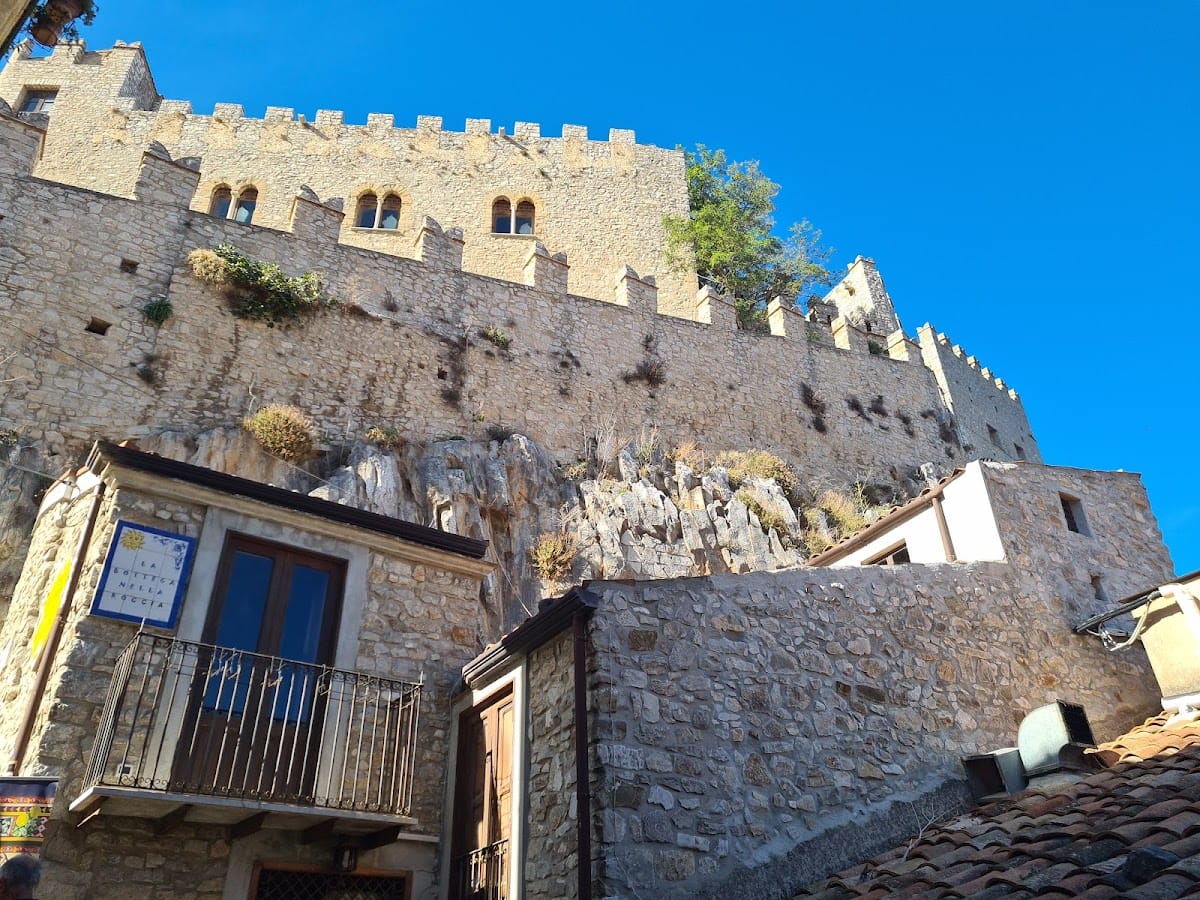
Castello di Caccamo occupies a steep rocky outcrop at about 520 metres above sea level on the slopes of Monte Rotondo, which rises to 919 metres. From this position, the complex overlooks the surrounding countryside, the valley of the San Leonardo River, and the Rosamarina artificial lake. Its irregular plan follows the rocky setting and combines massive defensive walls, towers, a moat, and an interior courtyard.
Fortifications and surviving structures
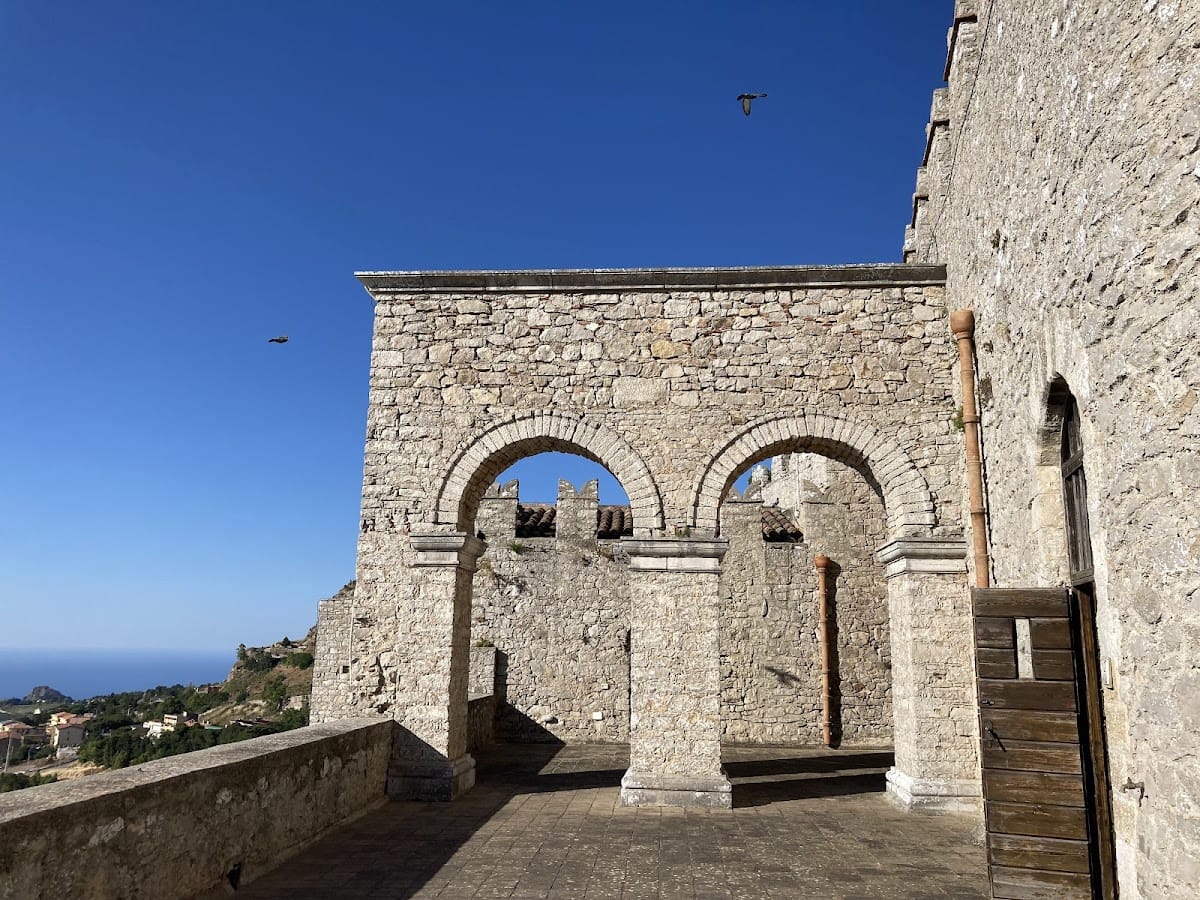
The castle’s defensive fabric is built of stone and includes massive walls with V-shaped, or swallowtail, battlements. Towers reinforce the enclosure, while the moat forms a defensive ditch intended to impede access to the fortified complex. Medieval-style bifora windows, each divided into two lights by a central support beneath a shared arch, appear among the surviving architectural features. The Torre Mastra, once the main tower, collapsed in the earthquake of 1923, and other sections later fell into ruin before restoration.
Interior rooms and palace conversion
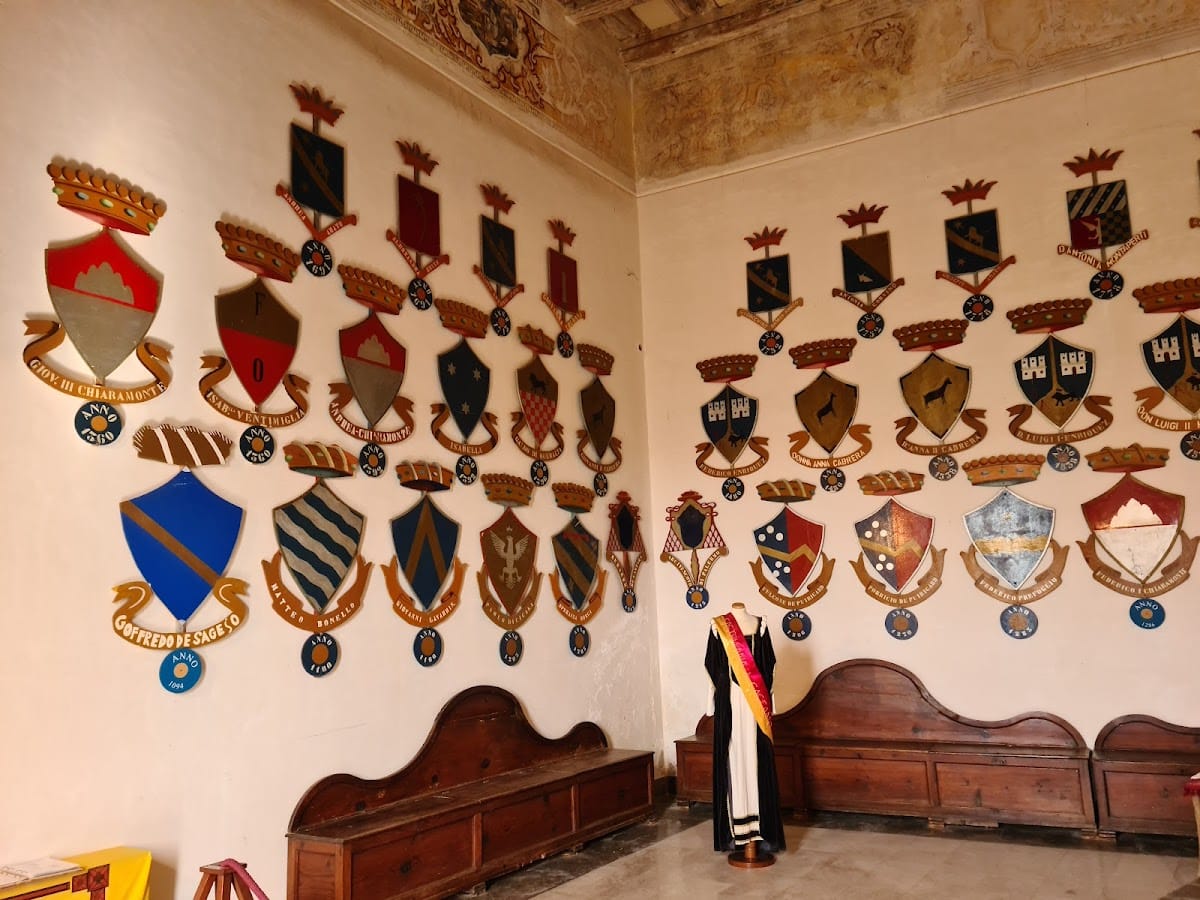
Sala della Congiura
The Sala della Congiura, or Conspiracy Hall, is identified as the castle’s most important room. It was the principal interior space in which Norman barons gathered in 1160 to conspire against William I of Sicily. Its historical importance comes from this connection with the failed rebellion, which formed part of the castle’s medieval political history.
Palace interiors
Inside, the complex forms a maze of rooms and stairways comparable in scale and arrangement to a royal residence. The later conversion into a noble palace added a series of salons with painted wooden ceilings and frescoed friezes. These interiors reflect the extensive Amato-period remodelling, when the medieval fortress was reshaped for aristocratic residence and reception.