Dunollie Castle: A MacDougall Fortress near Oban


Site at a Glance
- Rating
- 4.4
- Popularity
- Low
- Country
- United Kingdom
- Primary era
- Medieval
- External website
- Open
- Eras represented
- Medieval, Early Modern, Modern
- Civilizations
- Kingdom of Scotland
- Site type
- Military
- Remains
- Castle
On this page10 sections
History
Dunollie Castle is a ruined fortress in the United Kingdom, on a rocky promontory north of Oban beside the Firth of Lorne. An early medieval fortification at the site served as the royal centre of Cenél Loairn, a major kin group within the Gaelic kingdom of Dál Riata, whose territories extended across western Scotland and northeastern Ireland. The surviving castle was built largely in the fifteenth century and expanded in the sixteenth, continuing a long history of fortification at this strategic coastal position.
The royal centre of Dál Riata
The early stronghold at Dunollie was attacked or burned in 686, 698, and 701. Selbach mac Ferchair, king of Dál Riata, is credited with destroying it in 701 and rebuilding the fortification in 714. Excavations in the 1970s indicate that this early site was abandoned sometime during the tenth century. Archaeological investigations in 1978 also examined predecessor structures, including a fortification dated to the seventh or eighth century.
The MacDougall lordship
During the twelfth century, the area became part of the Kingdom of the Isles, a semi-independent maritime kingdom controlling much of the Hebridean region. Its ruler Somerled was a Gaelic-Norse lord whose descendants included the MacDougalls. After Somerled’s death, his son Dougall and the MacDougalls became Lords of Lorne, holding territories across much of Argyll and the islands of Mull, Lismore, Jura, Tiree, and Coll.
Dunollie was refortified as an earthwork castle during the thirteenth century, or possibly in the late twelfth century. Dougall or his son Duncan may have overseen this work. The MacDougalls, direct descendants of Somerled, retained the site. In the mid-thirteenth century, Ewan MacDougall shifted the clan’s allegiance from an initial alliance with Haakon IV, the medieval king of Norway, to loyalty to the kings of Scotland.
Conflict with the Scottish crown
In the fourteenth century, John MacDougall and his Comyn relatives supported the Balliols, a rival royal faction during Scotland’s succession struggles, against Robert the Bruce. John MacDougall’s forces defeated Bruce at Dalrigh in 1306, but Bruce defeated the MacDougalls at the Pass of Brander in 1308. The MacDougall lands of Lorne were then forfeited to the Campbells, although Dunollie and other estates were recovered later in the century.
The castle that survives today was constructed mainly during the fifteenth century. The MacDougalls enlarged it in the sixteenth century, creating the fortified complex whose enclosure and tower remain visible on the promontory.
Seventeenth- and eighteenth-century changes
Archibald Campbell, the first Marquis of Argyll, captured Dunollie in 1644. In 1647, a Covenanter army commanded by General David Leslie besieged the castle. The Covenanters were Scottish Presbyterians who supported a religious and political covenant opposing royal religious policies. Their forces captured, plundered, and burned Dunollie. The MacDougalls regained the castle in 1661.
During the Jacobite rising of 1715, an attempt to restore the Stewart monarchy, the MacDougalls supported the Stewart cause and the castle was attacked. John MacDougall of Dunollie was captured and his estates were forfeited. He later received a pardon, and the family recovered the estates in 1745. Another tradition identifies Iain Ciar, described as the twenty-second laird of Dunollie, as the person who abandoned the castle in 1715.
In 1746, or possibly somewhat earlier, the MacDougalls built Dunollie House downhill from the castle and left the medieval stronghold. Dunollie is now a Scheduled Monument, a legally protected archaeological or historic site considered nationally important, with protected-monument status in the United Kingdom since 28 February 1931. The MacDougall of Dunollie Preservation Trust was later established to care for the historic buildings and collections. Its work includes conservation and education through Dunollie Museum, Castle and Grounds, while archaeological work in the grounds has identified the remains of a historical herb garden.
Folklore
Local traditions associate Dunollie with the ghost of a piper or Highlander. Another story tells of a glaistig, a supernatural female being in Scottish Gaelic folklore, who lived at the castle, swept its floors, did laundry, and sometimes placed dust in the inhabitants’ food. The tradition adds that she never spoiled the food of the jester, who was said to be her favourite.
Remains
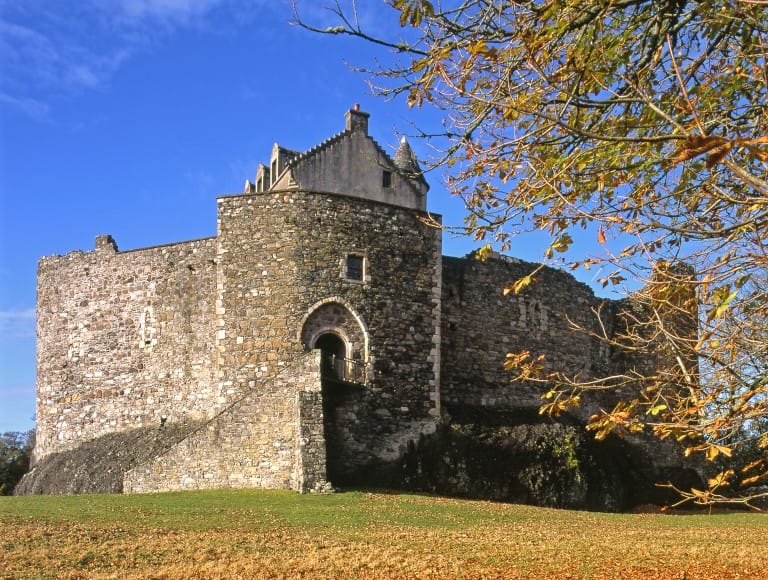
Dunollie Castle occupies a high, rocky promontory beside the Firth of Lorne. Its position overlooks the waterway leading toward Oban Bay and the Sound of Kerrera, with views toward Kerrera, Oban, its harbour, and the surrounding islands. The surviving fortress is arranged around a roughly square courtyard, with a four-storey rectangular tower house attached to its northeastern corner. The buildings are made of rubble masonry bonded with clay, and the complex survives as a dangerous, substantially collapsed ruin.
Courtyard enclosure
The courtyard measures approximately 24.4 metres on each side. Its wall is about 2.3 metres thick along the strategically important northeastern side and between 0.6 and 1.5 metres thick elsewhere. The standing enclosure wall dates from the fifteenth century, while much of the western wall is later and probably belongs to the sixteenth century. The northern and eastern sides survive to roughly 4.6 metres high, particularly around the northeast, while substantial portions of the outer wall have collapsed.
An entrance gate in the eastern wall has been restored. It could be secured by sliding a horizontal beam into position. A smaller entrance was later made in the northern wall and subsequently blocked with masonry. Several buildings once occupied the courtyard, with indications that further structures were arranged against the enclosure walls. These internal buildings are now ruined and overgrown.
Tower house
The rectangular tower is attached to the northeastern corner of the courtyard and was entered at ground level through its west side. Its vaulted basement supported a small hall on the first floor and a great hall on the second floor. Two straight stairways led to the great hall, while a spiral stair served the upper rooms. The tower originally ended in a battlemented wall-walk, which is now largely ruined.
Ringed cross
South of the eastern gate stands a ringed Celtic cross, a Christian cross surrounded by a circular band. It is associated with Alexander James MacDougall, who died in 1953, and his wife, Colina Edith MacDougall, who died in 1963. The cross carries the MacDougall family arms and a galley with a dragon-headed prow.