Dún Dúchathair: A Stone Promontory Fort on Inishmore, Ireland


Site at a Glance
- Rating
- 4.9
- Popularity
- Low
- Country
- Ireland
- Primary era
- Unclassified
- External website
- Open
- Eras represented
- Unclassified
- Civilizations
- Unclassified
- Site type
- Military
- Remains
- Fort
On this page6 sections
History
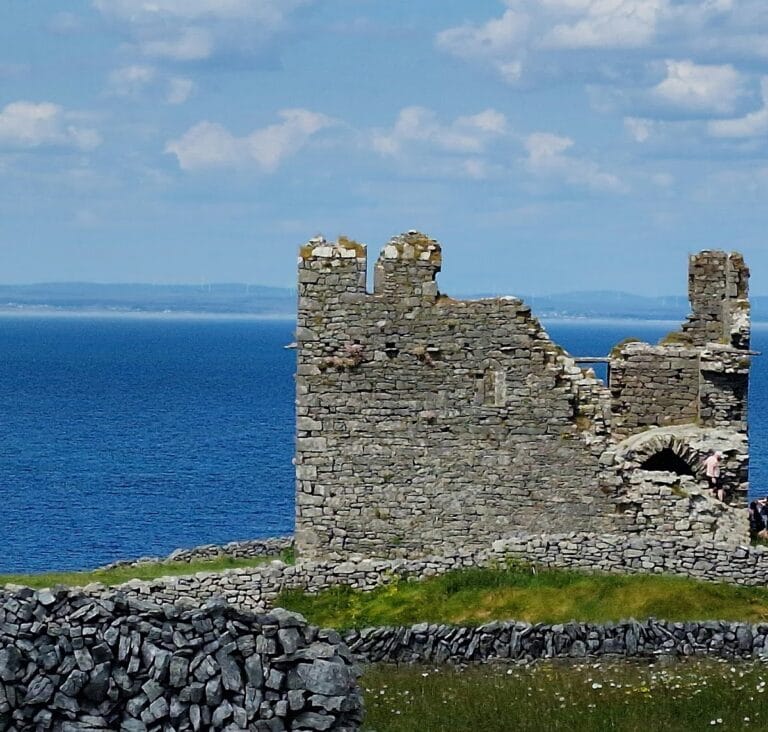
Dún Dúchathair, also known as Dúchathair and formerly Dún Dubhchathair, is a large stone promontory fort on Inishmore in County Galway, Ireland. Its name means “black fort,” while its anglicized form is Doocaher. The fort stands at Killeany near the eastern end of the island, and its age remains unknown. It may be considerably older than Dún Aonghasa, another major stone fort on Inishmore.
Dún Dúchathair is one of seven stone forts on the Aran Islands. Although it has historically received less attention than the more accessible Dún Aonghasa, it has been regarded as nearly as remarkable. Erosion has left the fort on a rocky headland extending into the sea, creating a promontory fort in which the cliffs and maritime position formed part of the defensive setting. The site is designated a National Monument, a status that protects places considered archaeologically or historically important under Ireland’s national heritage legislation.
Remains
Fortifications
Stone enclosure wall
The fort occupies Dúnach Ard, a limestone headland partly undermined by the sea. A dry-stone wall about 70 metres long closes the landward side of the promontory. It runs straight for most of its length before bending at the end, separating the fortified area from the surrounding land. The wall’s construction is comparable to that of the defenses at large ringforts such as Cahergall, Cashel of Kilmovee, Dun Ballynavenooragh, Grianán of Aileach, and Staigue Fort. Its inner face is arranged in three terrace-like levels. Surviving masonry reaches approximately 5 to 6 metres in height, while the outer walls are described as up to 6 metres high and 5 metres wide.
Defensive stone barrier
Traces of a defensive barrier made from closely spaced projecting stones survive outside the fort. This obstacle protected the approach, particularly around the entrance, by making movement toward the enclosure more difficult.
Interior remains
Within the enclosure are the ruins of several clocháns, small dry-built stone huts whose walls curve inward toward beehive-shaped roofs. The surviving buildings include adjoining oval and elongated structures, forming part of the settlement contained within the fort. No water supply has been identified inside the enclosure.