Fort Pospelov: A Major Vladivostok Fortress Defensive Work


Site at a Glance
- Rating
- 4.8
- Popularity
- Low
- Country
- Russia
- Primary era
- Modern
- External website
- Open
- Eras represented
- Modern
- Civilizations
- Russian
- Site type
- Military
- Remains
- Fort
On this page6 sections
History
Fort Pospelov is a Russian fortification on Russky Island in Russia, built in 1903 as part of the Vladivostok Fortress complex. It followed a design prepared in 1899, and its complex was developed by the engineer Petr Gnuchev. The fort was one of the major defensive works protecting Vladivostok and its approaches.
Construction and naming
The fort occupies Pospelov Ridge, about 150 metres high, on the Saperny Peninsula of Russky Island. It was formerly called Temporary Fortification No. 4 and was also known historically as the Fort of Prince Dmitry Donskoy. Dmitry Donskoy was a fourteenth-century grand prince of Moscow, traditionally associated with the Russian victory over Mongol forces at the Battle of Kulikovo in 1380.
The name Fort Pospelov came from the surrounding landscape, which includes Pospelov Mountain, Cape Pospelov, and Pospelov settlement. During the 1860s, the Sea of Japan researcher Vasily Babkin carried out cartographic work in Peter the Great Bay and named a cape on the northern part of Russky Island after his colleague Mikhail Pospelov. The fort later adopted the name of this locality. Its fortifications are a close analogue of those at Port Arthur, now Dalian in China.
Soviet-period use and protection
During the Soviet period, Fort Pospelov was used by the Pacific Fleet’s School of Weapons as artillery and ammunition stores. Cadets from the school also performed guard duty at the former fort. The site is designated a cultural-heritage site of the peoples of Russia at federal level.
Remains
Defensive works
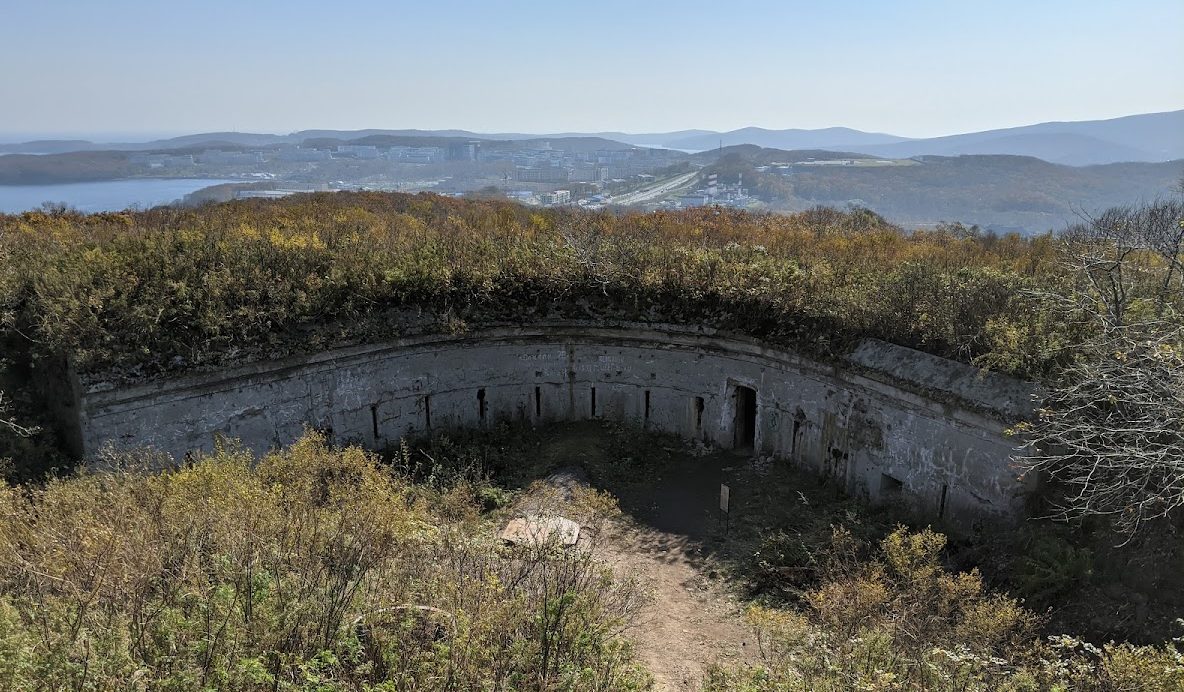
Fort Pospelov includes a defensive ditch, a gorge caponier, two gun shelters, and a double coffer. A caponier is a fortified structure projecting into or covering a ditch, while a coffer is a covered defensive position used to deliver flanking fire along a ditch. The concrete walls are 90 centimetres thick. The fort was designed for ten 9-pounder, 107-millimetre guns and two machine guns mounted on fortress carriages.
Buildings and artillery installations
The internal buildings include a rifle barracks, two personnel barracks, a pavilion for an artesian well, a powder magazine, and a shell magazine. Eighty-seven-millimetre Model 1867 guns remained at the fort until 2000. A gallery identifies a technical block and part of Fort Pospelov.