Devanahalli Fort: A Historic Fortification in Karnataka
Site at a Glance
- Rating
- 3.9
- Popularity
- Medium
- Country
- India
- Primary era
- Early Modern
- Eras represented
- Early Modern
- Civilizations
- Unclassified
- Site type
- Military
- Remains
- Fort
On this page14 sections
History
Devanahalli Fort is a historic fortification in India, near Devanahalli in Karnataka, founded under the Vijayanagara Empire around 1501. Its original mud defenses were built by Malla Baire Gowda, a local chieftain and Vijayanagara vassal, with the consent of Devaraya. The fort later became part of the stone structure rebuilt by Hyder Ali in the eighteenth century.
Origins and Vijayanagara Rule
Devanahalli’s history reaches back to the fifteenth century, when Rana Baire Gowda and his Morasu Wokkalu family settled near Ramaswami Betta after leaving Conjeevaram. According to the local account, Rana Baire Gowda received the direction to settle there in a dream. His son, Malla Baire Gowda, subsequently founded Devanahalli.
The settlement, formerly called Devanadoddi, was associated at different times with Gangawadi, the Rashtrakutas, Nolamba, Pallava, Chola, Hoysala, and Vijayanagara realms. During Vijayanagara rule, Malla Baire Gowda built the original mud fort around 1501. His descendants retained control until the middle of the eighteenth century.
Mysore, Hyder Ali, and Tipu Sultan
In 1747, the fort passed to the Wodeyars of Mysore under Nanja Raja. It was later contested with the Marathas before passing to Hyder Ali and his son Tipu Sultan. Hyder Ali, the eighteenth-century ruler who expanded Mysore’s power, reconstructed the fort in stone, creating the basis of the present structure.
Tipu Sultan later renamed the fort Yousafabad, meaning “the abode of Yousuf,” but that name did not become established. Tipu Sultan, Hyder Ali’s son and successor, was born near the fort. A memorial at the birthplace gives 1751 as the year of his birth, while 1750 is also given, so the exact year remains uncertain. The birthplace is locally regarded as a revered historical site.
British Capture and Later Protection
In 1791, during the Anglo-Mysore War, Lord Cornwallis besieged and captured Devanahalli Fort for the British. The conflict was part of the British campaigns against Mysore, and Cornwallis was the British commander in that campaign.
After India became independent in 1947, the fort was transferred to the Government of India and later placed under the Archaeological Survey of India, the national institution responsible for protecting designated archaeological monuments. The fort and Tipu Sultan’s nearby birthplace are protected historical monuments.
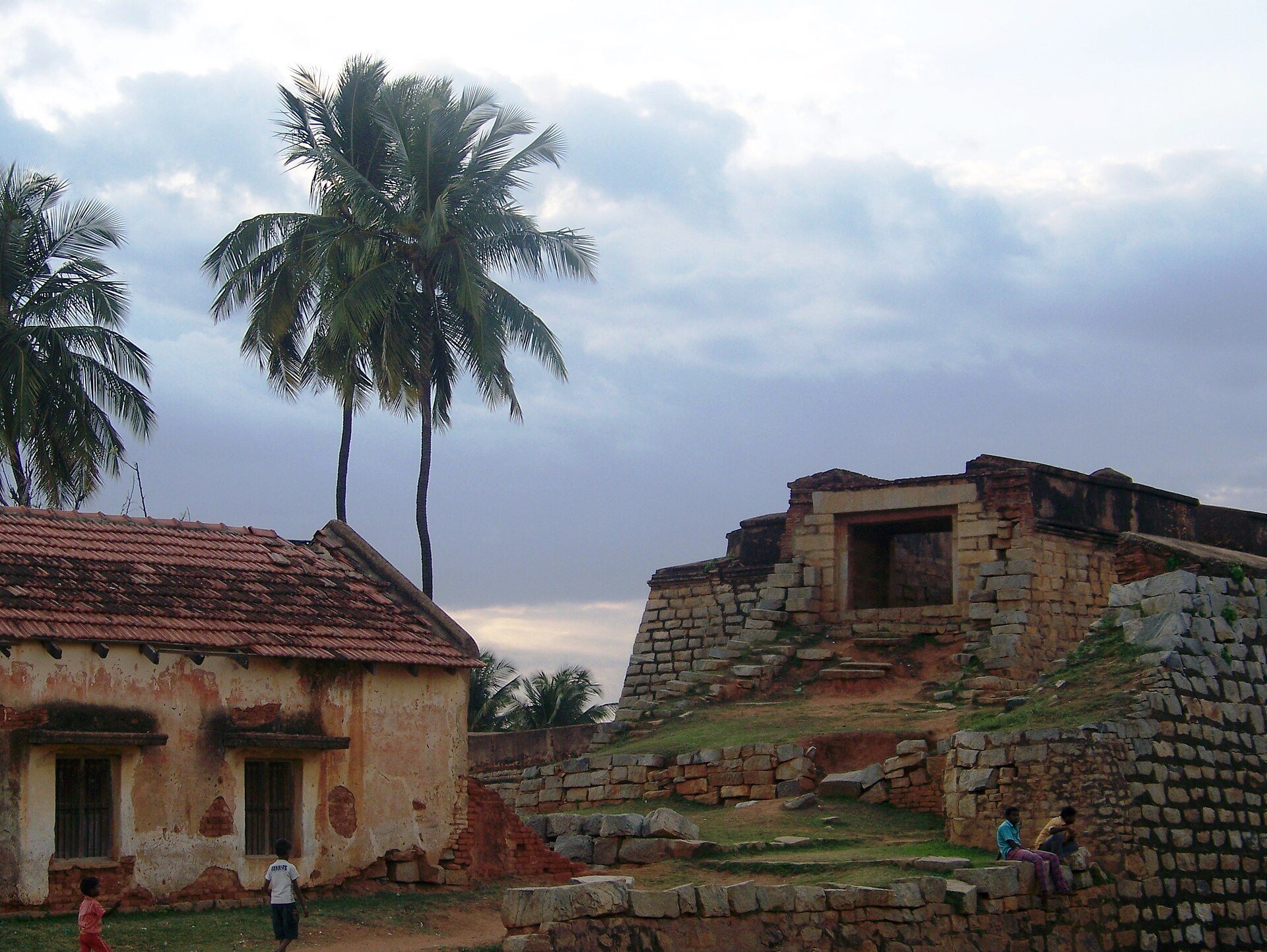
Some of the fort’s interior has also been used for ordinary residences. Residential construction and inadequate maintenance have contributed to the deterioration and concealment of historical features. Modern urban expansion around Devanahalli threatens both the fort and the birthplace.
Remains
Fortifications and Layout
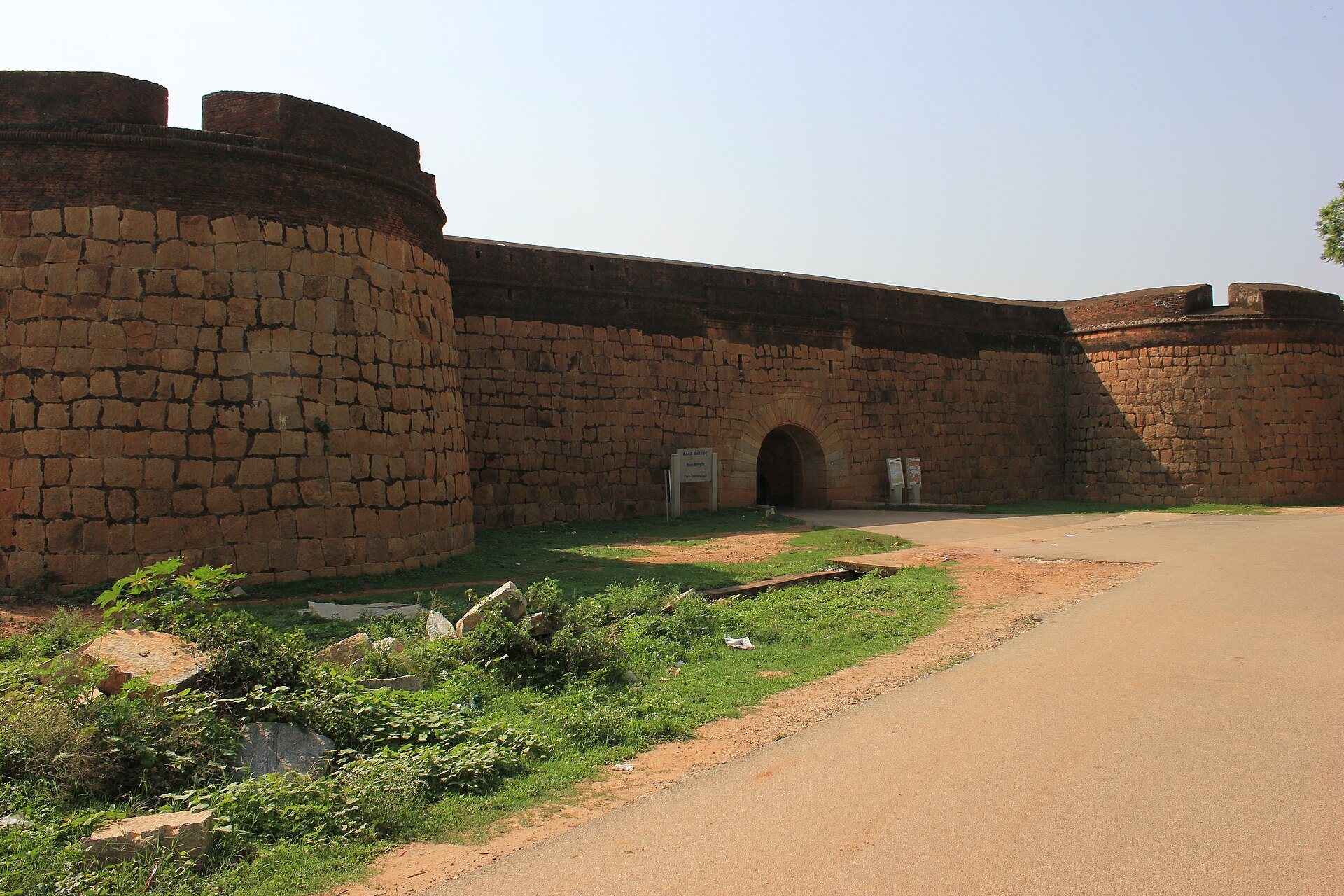
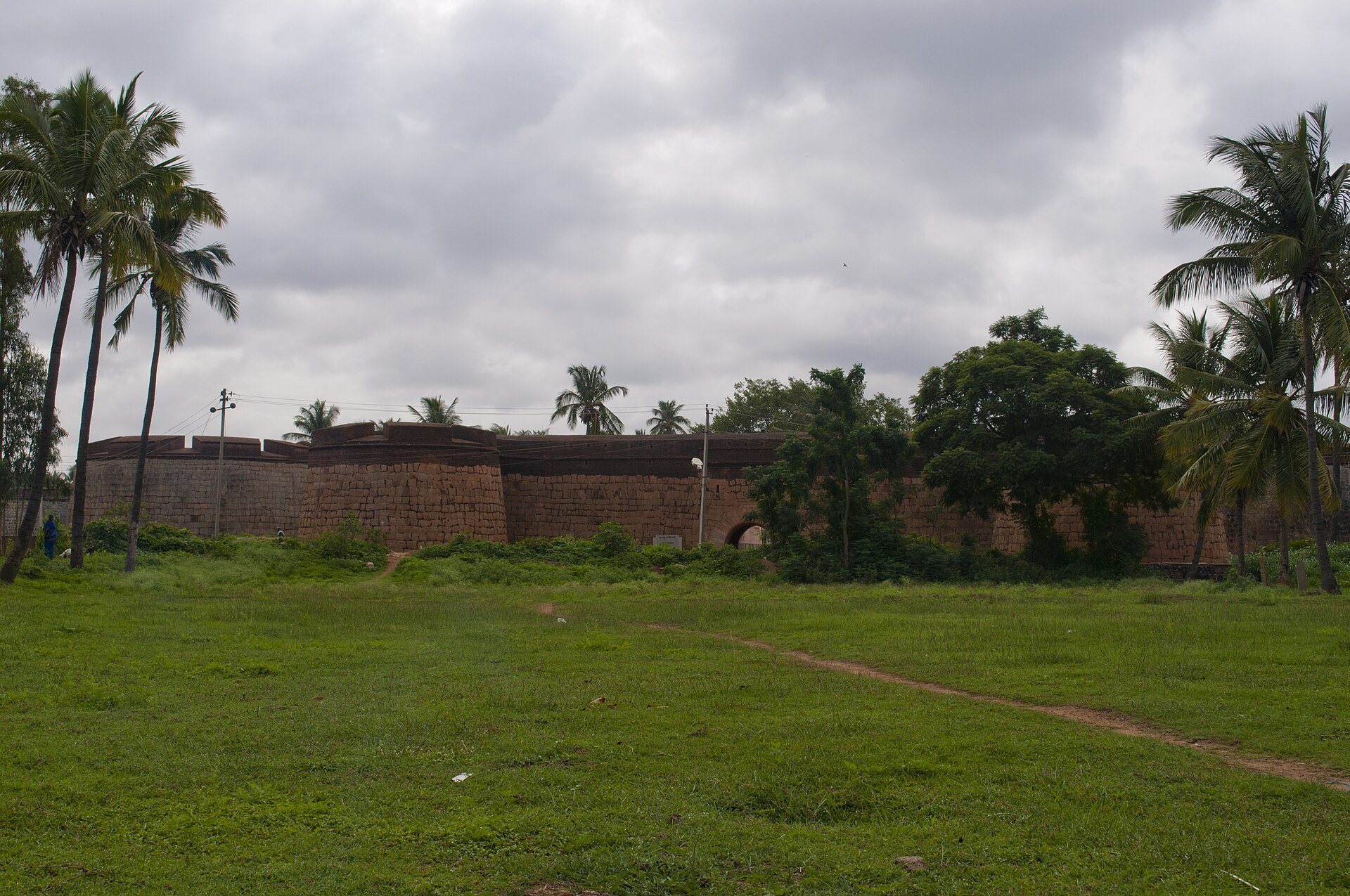
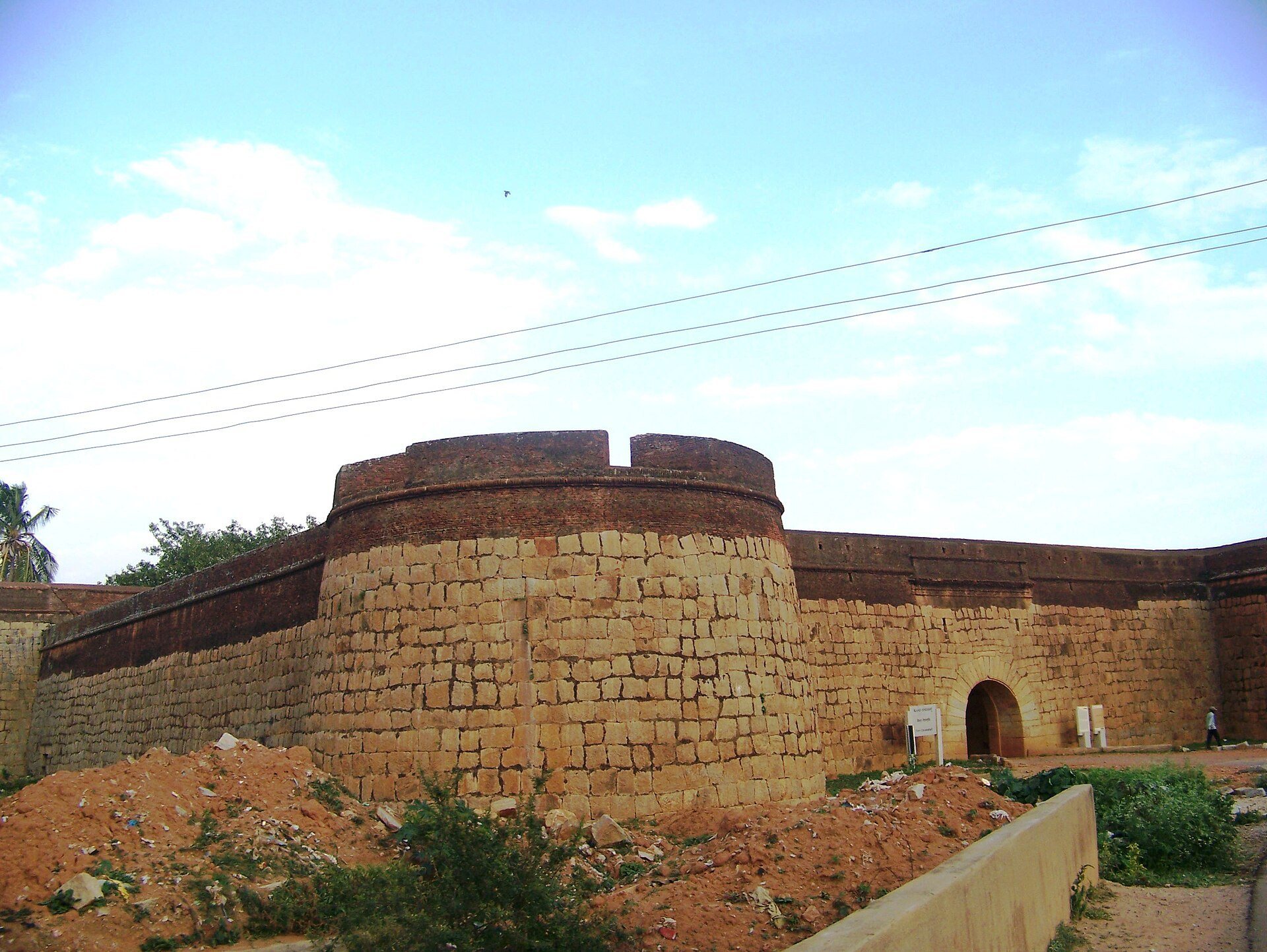
The fort occupies about 20 acres, or 8 hectares, and measures roughly 180 metres from north to south and 140 metres from east to west. Its plan is approximately oval and oriented toward the east. Dressed masonry faces the fortification, which includes 12 semicircular bastions placed at regular intervals. A spacious battlement runs along the inner side, while the bastions contain gun positions built with lime and brick.
Small entrances at the eastern and western ends of the main axis are decorated with cut plasterwork. Their dimensions allowed horses and carts to pass through, linking the entrances to the fort’s internal circulation and defensive arrangement.
Interior Residences
The house associated with Hyder Ali and Tipu Sultan remains inside the fort. The residence of Dewan Purnaiah, a high-ranking official at the courts of both rulers, also stands within the walls. These buildings form part of the fort’s surviving domestic and administrative fabric.
Birthplace Memorial and Khas Bagh
About 150 metres southwest of the fort, outside its walls, a memorial marks the birthplace of Tipu Sultan. Approximately six feet, or two metres, high, it consists of a pillared enclosure with a square top and a stone tablet. A small plaque identifies the birthplace. The surrounding area, known as Khas Bagh, includes a dried stone pond and plantations of banana, tamarind, and mango.
Temples within the Fort
Kote Venugopalaswamy Temple
Kote Venugopalaswamy Temple is among the oldest temples within the fort. Facing the main town road, it has a spacious courtyard and a Garuda pillar, a ceremonial pillar associated with Garuda, the eagle-like figure linked with Vishnu. Its walls depict scenes from the Ramayana and episodes from Krishna’s childhood, while carved figures decorate the pillars. Two sword-bearing horsemen stand on the pillars at the main entrance.
The temple’s sanctum contains a standing image of Venugopala in the Vijayanagara style, with a Dravidian-style tower above it. Its pillared hall contains four black-stone pillars covered with reliefs. These include a horse-headed figure, dancing women with musicians, a conch blower, a kinnara with a bird-like lower body, and a huntress removing a thorn from her foot. A large temple chariot carries the image of Gopalaswamy around the town once a year.
Siddalingeshwara Temple
Siddalingeshwara Temple stands a short distance from Kote Venugopalaswamy Temple, beside a Raghavendra Swamy monastery. Its interior contains religious paintings.
Chandramouleshwara Temple
Across the street from the other temples, Chandramouleshwara Temple is an old Vijayanagara-style building with a spacious inner enclosure. Its sanctum contains a Shiva linga, the principal aniconic symbol used in the worship of Shiva, while two adjoining cells house images of Ganapati and Parvati.
Sarovaranjaneya Temple
Sarovaranjaneya Temple stands on the left side of the main road and is dedicated to Anjaneya, another name for Hanuman.
Nanjundeshwara Temple
Nanjundeshwara Temple is a small structure with two aligned cells and a shared pillared hall. It is traditionally regarded as the oldest temple in the town and is said to have formerly been called Kashi Vishveshwara.