Archaeological Site of Delos: A Sacred and Cosmopolitan Centre of Ancient Greece


Site at a Glance
- Rating
- 4.6
- Popularity
- Medium
- Country
- Greece
- Primary era
- Classical
- External website
- Open
- Eras represented
- Bronze Age, Classical
- Civilizations
- Ancient Greek, Byzantine, Mycenaean, Roman
- Site type
- City
On this page33 sections
History
The Archaeological Site of Delos is an ancient Greek sanctuary and city on the island of Delos, Greece, whose history extends from the third millennium BC through the early medieval period. In Greek mythology, Delos was the birthplace of Apollo and Artemis, the twin children of Leto and Zeus. This sacred association helped make the island a major religious and political centre of the Aegean.
Early settlement and the Apollonian sanctuary
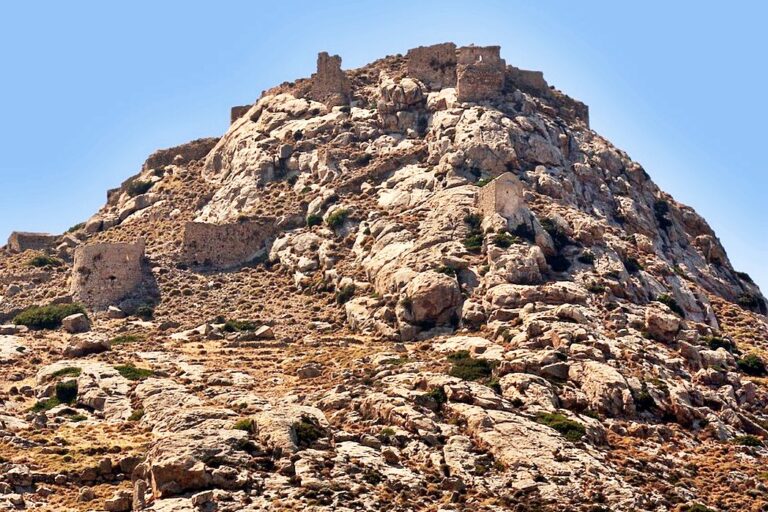
The earliest settlement dates from the third millennium BC. The first inhabitants lived in simple dwellings on Mount Kynthos, probably choosing its elevated position for defensive visibility over the surrounding sea. Mycenaean settlement is attested from the later second millennium BC, although its extent and continuity remain uncertain.
The sanctuary of Apollo existed by at least the ninth century BC. During the Archaic and Classical periods, Delos acquired Panhellenic importance, drawing pilgrims from across the Greek world to worship Apollo and Artemis. Religious gatherings and festivals made the island a centre for shared Greek ceremonies and cultural exchange. During the Archaic period, Delos was strongly influenced by Naxos, while Athens later sought control of both the island and its sanctuary.
Between approximately 540 and 528 BC, Pisistratus ordered an initial purification of Delos. Graves near the sanctuary were removed to neighbouring Rheneia because death was forbidden on the sacred island. Around 525 BC, Polycrates of Samos dedicated Rheneia to Apollo and was said to have connected it to Delos with a chain. Delos retained land on Rheneia, where childbirth, medical treatment and burial were permitted because birth and death were prohibited on the sacred island.
Athenian authority and religious festivals
During the Persian Wars, the Persian commander Datis respected the sanctuary of Apollo when he reached Delos in 490 BC. In 478 BC, Athens made the island the headquarters of the Delian League, an alliance of Greek city-states formed under Athenian leadership to oppose Persia. The league’s common treasury was kept in the temple of Apollo until Pericles transferred it to Athens in 454 BC.
Athens carried out a second and complete purification in 426 BC, moving the contents of Delian graves to a communal burial pit on Rheneia. From that time, religious rules prohibited birth and burial on Delos. In 422 BC, Athens expelled the island’s population to Adramyttion in Asia Minor. The exiles were allowed to return the following year after a new religious ruling.
The Delian festival took place every four years until 316 BC. Its programme included athletic, equestrian and musical competitions, dances, theatrical performances, banquets and commercial exchange. It became one of the major religious and cultural events of the Greek world. After Athens was defeated in 404 BC, the Delians controlled the island and sanctuary for about a decade, but Athens regained authority in 394 BC and again influenced Delos through the Second Athenian League.
Independence and the Hellenistic city
From about 314 BC, Delos became independent of Athens under Antigonid protection and served as the religious centre of the League of the Islanders. Delian officials administered the sanctuary and kept records of its lands, livestock, offerings and finances. The sanctuary also operated as a deposit bank, lending money for public construction.
Independence encouraged extensive building. The Theatre, the Monument of the Bulls, the Kynthion, the Portico of Philip and sanctuaries of foreign deities were established or expanded during this period. Hellenistic rulers financed buildings and festivals, while merchants, bankers, ship-owners, artisans and religious communities settled on the island.
Delos became a highly cosmopolitan society. Cemetery inscriptions identify residents from mainland and island Greece, Italy, Egypt, Syria, Phoenicia, Asia Minor, the Black Sea region, North Africa and other parts of the Mediterranean. Greek remained the principal spoken and written language, while communities continued to worship deities associated with their homelands.
Roman free-port and commercial expansion
In 167 BC, after the Third Macedonian War, Rome transferred Delos to Athens and declared its port free of transit taxes. A free port was a harbour exempt from some or all duties on goods passing through it. The policy was partly intended to weaken Rhodes, whose maritime commerce competed with Roman interests. Delos subsequently became a major redistribution centre for eastern Mediterranean trade.
The free-port regime produced rapid urban and economic growth. Population estimates place roughly 25,000 to 30,000 people on the island around the late second or early first century BC, although lower figures have been proposed for earlier Hellenistic phases. Delos imported much of its food, timber and incense, while its port handled extensive trade, including the slave trade. Luxury workshops produced sculpture, glass, perfumes, jewellery and purple dye. Agriculture continued on terraced land, where barley, vegetables, figs and grapes were cultivated, while goats and cattle were kept on Delos and Rheneia.
Delos was attacked and looted in 88 BC by forces of Mithridates VI Eupator, king of Pontus. In 69 BC, pirates led by Athenodorus, an ally of Mithridates, attacked the island again. These assaults damaged the water-supply system and sharply reduced the population and commercial activity. The city then declined into a small settlement focused mainly on maintaining the sanctuary.
Late antiquity, abandonment and archaeology
Delos remained occupied during the Roman Imperial and Palaeochristian periods, although its religious and commercial importance diminished. Christianity was present by the late third century. Churches, a monastery and a fifth-century basilica dedicated to Saint Cyricus were established in or beside earlier buildings.
The island was gradually abandoned between the sixth and eighth centuries AD. Later Byzantine, Slavic, Saracen, Venetian, Hospitaller and Ottoman occupations or incursions affected the island. Ancient buildings were quarried, and marble columns were burned to produce lime. Delos was definitively deserted after the seventh or eighth century.
Pasch van Krienen undertook the first recorded archaeological excavation in 1772, and some of his finds were taken to Saint Petersburg and Bucharest. A small excavation followed in 1829, while systematic scientific work began under the French School at Athens in 1872 and 1873, initially under Albert Lebègue. French excavations continued intermittently through the late nineteenth century, resumed systematically from 1902 to 1914 and expanded after the First World War. Large-scale investigations were also conducted between 1958 and 1975, followed by continuing excavation, study, conservation and restoration.
Excavation revealed the sanctuary and much of the Hellenistic city, including buildings, inscriptions, sculpture, pottery, mosaics, coins, bronzes and seal impressions. These discoveries allowed the political, religious, economic and monumental history of Delos to be reconstructed. The entire island is protected as an archaeological site, and Delos was inscribed on the UNESCO World Heritage List in 1990 under criteria (ii), (iii), (iv) and (vi). The designation recognizes its influence on Greco-Roman architecture and monumental art, its evidence for successive Aegean civilizations, its architectural representation of a cosmopolitan Mediterranean port and its direct association with the myth of Apollo.
Modern conservation is supervised by the Greek Ministry of Culture, the Ephorate of Antiquities of the Cyclades and the Committee for the Conservation of the Monuments of Delos. Work has concentrated on stabilizing, restoring and presenting the excavated remains while keeping them in, or close to, their excavated condition. Marble sculptures vulnerable to the strong north winds, including the Naxian Lions, were transferred to the archaeological museum and replaced at the site by exact replicas. The island’s remote location, marine exposure and powerful winds continue to challenge conservation.
Remains
Delos extends approximately 5 kilometres from north to south and reaches about 1.3 kilometres at its greatest width. Mount Kynthos rises to approximately 112 to 115 metres, while the principal archaeological areas occupy the valley west of the mountain. The sanctuary lies north of the main residential and commercial districts. On the western coast, the Sacred Harbour served the sanctuary and the Agora of the Competaliasts, while the Commercial Harbour lay farther south beside the Theatre Quarter. Parts of the ancient breakwater remain visible, and the Sacred Harbour was partly filled by natural sediment and excavation debris.
The harbour approach and sanctuary
Sacred Way and Agora of the Competaliasts
The Sacred Way led north from the harbour and the Agora of the Competaliasts to the sanctuary. It passed between the South Stoa and the Portico of Philip before entering the sacred precinct through the propylon, a monumental entrance. The Agora served as an arrival and gathering place and retains postholes for market awnings, linking the harbour approach with the activities of the sanctuary.
Temples of Apollo
The sanctuary precinct contains a broad esplanade, remains of the propylon and four structures associated with Apollo. Three principal temples were aligned along the eastern side of the precinct. Farther north, between the Keraton and the Artemision, stood the Pythion, a large sanctuary dedicated to Apollo of Delphi.
The Oikos of the Naxians stands beside the propylon. This rectangular building measures approximately 24 by 10 metres and contains an internal colonnade. Built during the sixth century BC, probably between 600 and 575 BC, it has been interpreted either as an early temple of Apollo or, more commonly, as an oikos, a banqueting hall. Its marble roof was an unusually early and technically demanding feature.
The Porinos Naos is a Doric temple in antis, meaning that its entrance porch is formed by the forward extension of the side walls, with columns between them. It is generally attributed to the Athenian period of influence in the second half of the sixth century BC. The building consists of a principal room and a pronaos framed by two columns.
The Temple of the Athenians, also called the Temple of the Seven Statues, is a Doric amphiprostyle building, with columns at both the front and rear. Its strongly Attic construction dates to approximately 425 to 420 BC, and it may have been inaugurated by the Athenian general Nicias in 417 BC.
The Great Temple, or Temple of the Delians, is the only known peripteral building on Delos, a temple surrounded by a continuous colonnade. Construction began around 475 to 470 BC and reached the level of the frieze. Work was completed after Delos regained its independence in 314 BC. The building remains a major example of Doric architecture.
Pythion, Keraton and Artemision
The Pythion was a large sanctuary of Apollo of Delphi and is named in numerous inscriptions. Opposite its entrance stood the Keraton, or Horned Altar, a monumental altar with an apsidal podium to the east and two lateral stairways to the west. Cattle sacrifices and the Delian rituals known as the geranos dance and the whip-race were performed there.
The Artemision behind the Pythion contains remains of three successive buildings. The earliest, probably Mycenaean, may have been a sacred deposit rather than a temple. A sixth-century BC structure was a temple in antis, while the latest was a Hellenistic prostyle temple measuring approximately 15 by 10 metres. An additional Artemision stood on Rheneia.
Civic and commemorative buildings
The former colossal statue of Apollo stood within the sanctuary. Its surviving remains include the torso, part of the pelvis and other fragments. A foot is preserved in the British Museum, while additional fragments are associated with the site museum.
The eastern sanctuary area contains the remains of a possible bouleuterion, or council house, together with the Prytaneion and the Neorion. Built near the end of the fourth century BC, the Neorion may have housed a ship dedicated to Apollo after a naval victory by a Macedonian ruler, although its precise identification remains uncertain.
The Prytaneion served at least partly as the public residence of the city’s chief magistrates. It also contained the civic archive, a continuously burning hearth, rooms for meals with honoured guests and an altar of Hestia. The adjacent bouleuterion is poorly preserved.
The Portico of Antigonus bounded the northern side of the sanctuary and was probably established by Antigonus Gonatas during the third quarter of the third century BC. The nearby Ecclesiasterion was used for assemblies. The Stoibadeion, a Dionysian cult building or exedra rather than a conventional temple, contained a statue of Dionysus originally flanked by two actors impersonating Papposilenoi. Two monumental ithyphallic columns remain in place, and the building’s decoration and orientation suggest a connection with chthonic aspects of Dionysian worship.
The sacred landscape around the lake
Sacred Lake and Temple of Leto
The Sacred Lake lay immediately north of the sanctuary. It was originally approximately circular and later became oval, but is now dry. Together with its surrounding area, the lake formed an important part of the sacred landscape associated with Leto and the birth of Apollo.
The Temple of Leto, or Letoon, stood near the lake. It is an Archaic temple in antis measuring approximately 10 by 12 metres and is conventionally dated to around 540 BC.
Temple of the Twelve Gods
Near the lake stands the Temple of the Twelve Gods, a marble Doric amphiprostyle temple accompanied by several altars dating from the fourth and third centuries BC. The Delian form of the cult included the Apollonian triad of Apollo, Artemis and Leto, together with other divine groupings whose exact composition remains uncertain.
Terrace of the Lions
The Terrace of the Lions lay beside the Sacred Way near the lake. It originally contained approximately nine to sixteen crouching marble lions or lionesses, probably dedicated by Naxos during the late seventh or early sixth century BC. Five are preserved in the museum, a sixth was taken to Venice in 1716, and replicas now occupy the original setting.
The sculptures have elongated bodies, small heads and strongly stylized forms. Their arrangement may have symbolically guarded the lake or led towards an Archaic sanctuary, although their intended destination and precise function remain uncertain. The Naxian Lions belong to the early tradition of Greek monumental sculpture, in which animal forms were rendered in a highly formalized manner.
Commercial districts and the Theatre Quarter
Agora of the Italians
The Agora of the Italians was a large enclosed complex measuring approximately 200 by 80 metres. Built in the second century BC with financial support from donors including the banker Philostratus of Ascalon, it served as a meeting and commercial centre. Mithridates destroyed it in 88 BC. The complex was partly rebuilt and was abandoned between approximately 60 and 50 BC.
Poseidoniasts of Berytos
The Establishment of the Poseidoniasts of Berytos combined warehouses, lodging, commercial facilities and chapels. This association of merchants, ship-owners and warehousemen from Beirut worshipped Poseidon of Berytos, Astarte and the goddess Roma. A dedication records the association’s institutional identity and its place within the international commercial community of Delos.
Theatres and urban streets
The Theatre Quarter developed during the third century BC and expanded through repeated alterations. Its earliest streets were narrow and irregular, while later expansion introduced straighter north-south and east-west routes. The Theatre Street and Street 5 were paved and lined with shops.
The Theatre of Delos was built between the late fourth century and the third quarter of the third century BC and was completed around 246 BC. It was probably abandoned after the attack of 69 BC. Its semicircular koilon, the seating area for spectators, was supported by a substantial marble retaining wall and could accommodate approximately 5,500 to 6,500 people. The stage building included a skene, a proskenion and underground passages for performers.
A second, smaller theatre on the Terrace of the Foreign Gods held approximately 400 to 500 spectators. It lacked a conventional stage building and was probably used for religious ceremonies connected with foreign cults. A surrounding Pi-shaped portico concealed the ceremonies from outsiders.
Hellenistic houses and mosaics
Wealthy Hellenistic houses in the Theatre Quarter and around the Sacred Lake commonly had two storeys, peristyles, or courtyards surrounded by columns, and decorated floors. Important examples include the Houses of Dionysus, Cleopatra, the Masks, the Dolphins, the Trident, the Comedians, Diadumenos, Poseidon and the Lake.
The House of Dionysus contains a courtyard impluvium, a basin designed to collect rainwater, with a mosaic showing the winged Dionysus crowned with ivy and riding a tiger decorated with vine leaves and grapes. The image uses opus vermiculatum, a mosaic technique employing very small tesserae to create detailed pictorial effects.
The House of the Dolphins is known for a peristyle mosaic depicting dolphins and erotes. Other mosaics in this house and in the House of the Masks are among the most accomplished examples of Delian pavement decoration. Approximately 350 pavement mosaics are known across the island, about 120 of them decorated. They date mainly from the later second and early first centuries BC and occur in sanctuaries, public buildings and wealthy houses.
Common materials include marble chips and tile fragments. Opus tessellatum used regularly arranged tesserae of about 0.8 centimetres for broader designs, while opus vermiculatum used tesserae approximately 0.1 to 0.4 centimetres across for intricate images and complex colour effects.
Foreign sanctuaries and the district around the lake
Urban blocks and Egyptian sanctuaries
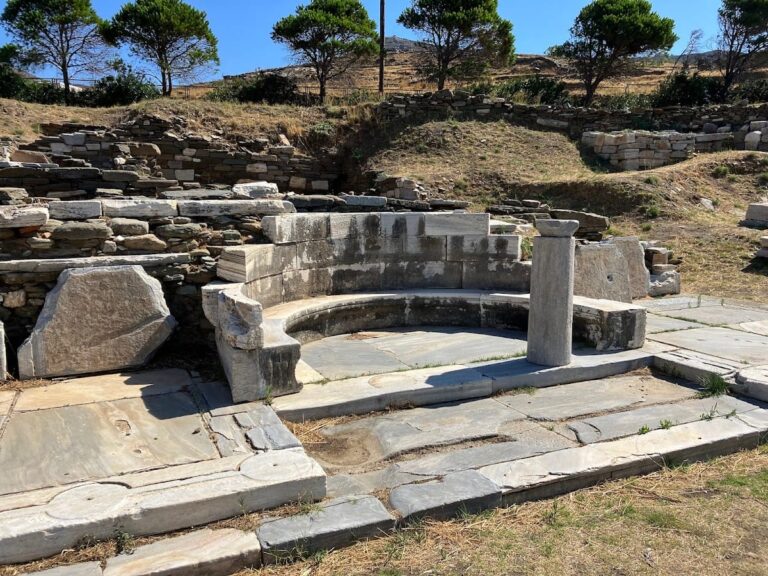
The district around the lake was urbanized mainly during the second century BC. Its residential blocks included large houses, guild houses and public buildings, often arranged according to a more regular plan than the earlier Theatre Quarter. The Terrace of the Foreign Gods contains sanctuaries of Egyptian and Syrian deities, including Sarapieion A, Sarapieion B, Sarapieion C, the Temple of Isis and the sanctuary of Atargatis and Hadad. These buildings belonged to religious communities established by foreign merchants during the Hellenistic period.
Sarapieion A was primarily a private sanctuary. It contained a meeting room, a small temple built over a crypt, three altars and an offering chest. Water reached the sanctuary through a channel from the Inopos reservoir, supporting ritual lustrations associated with Egyptian worship.
Sarapieion C became an official sanctuary around 180 BC. It contains a small temple of Sarapis, partly constructed from bluish marble. The sanctuary was damaged during the destruction of Delos but remained in use into the second century AD.
Temple of Isis
The Temple of Isis was dedicated by the Athenian people around 130 BC. A large statue of Isis stood at the rear of its cella, while a small decorated quadrangular structure in front may have served as an incense altar.
Sanctuary of Atargatis and Hadad
The sanctuary of Atargatis and Hadad was organized around a square court and later expanded with a long terrace and porticoes. Its earliest securely dated dedication is from 128 or 127 BC, while another inscription may indicate activity as early as 150 BC. Small rooms along the terrace probably served ritual banquets.
Mount Kynthos and hillside sanctuaries
Cave and summit sanctuaries
The slopes and summit of Mount Kynthos contain numerous sanctuaries. The Cave of Kynthos occupies a trapezoidal recess in the rock and has a roof formed by ten granite blocks. Finds of feet, a tree trunk and a lion skin from the Hellenistic period have led to its provisional identification as a sanctuary of Heracles.
The Sanctuary of Agathe Tyche consists of a court bordered by two porticoes and a small temple with a pronaos. At the summit, the Sanctuary of Zeus and Athena, known as the Kynthion, occupied the highest part of the mountain. Other hillside sanctuaries included those of the Syrian gods and the gods of Ascalon.
Sanctuary of the Gods of Ascalon
The Sanctuary of the Gods of Ascalon had an east-facing open court. Philostratus of Ascalon dedicated it to Astarte Palaistine Ourania Aphrodite and Poseidon of Ascalon, connecting the building with the religious communities and benefactors who shaped Delos during its cosmopolitan Hellenistic phase.
Athletic, Jewish and water infrastructure
Stadium, gymnasium and hippodrome
The eastern part of the city contained a gymnasium, stadium and hippodrome. The stadium was laid out on a north-south axis and had a track approximately 182 metres long. Its remains include seating, an eastern stairway and a western tribune supported by an external buttressed wall.
Built in the second century BC, the gymnasium included a courtyard with an Ionic colonnade, rooms on its eastern and western sides and a covered training gallery to the north. It ceased to be used in 89 BC. The Xystus, a covered training gallery associated with the gymnasium, was approximately 187 metres long and dated to 111 to 110 BC. An earlier gymnasium from the third century BC occupied part of the same area.
The ancient hippodrome lay between the Archaegesion and the Granite Palaestra and was oriented north-south. Its exact form remains uncertain, and parts of the area may also have been used agriculturally.
Delos Synagogue
The Delos Synagogue lies near the stadium and is generally dated no later than the first century BC. Its identification has been debated, but the building contains four dedications to the Most High God, an eastward orientation, a three-door assembly room, a throne and benches, and a water installation suitable for immersion.
Minoan Fountain and water systems
The Minoan Fountain is a rectangular public well cut into the rock. It has a central column and steps descending to the water. Its present sixth-century BC form was reconstructed in 166 BC according to an inscription.
Delos’s ancient water infrastructure included cisterns, wells, aqueducts, drains and reservoirs. The Inopos watercourse descended from Mount Kynthos, and the Inopos reservoir supplied at least some sanctuaries. These installations supported the city, its sanctuaries and its residential districts across the island.
Materials, sculpture and archaeological finds
Delian architecture used gneiss, granite and marble in changing combinations. Archaic monuments commonly used gneiss, while Naxian buildings employed large, roughly finished granite blocks. Later Classical and Hellenistic construction used more carefully dressed stone, especially for marble walls. Hellenistic buildings often combined elaborate decoration with technically ambitious construction, including superimposed colonnades, marble roofs and pediments. Curved architectural forms, arches, vaults and semicircular openings are also attested.
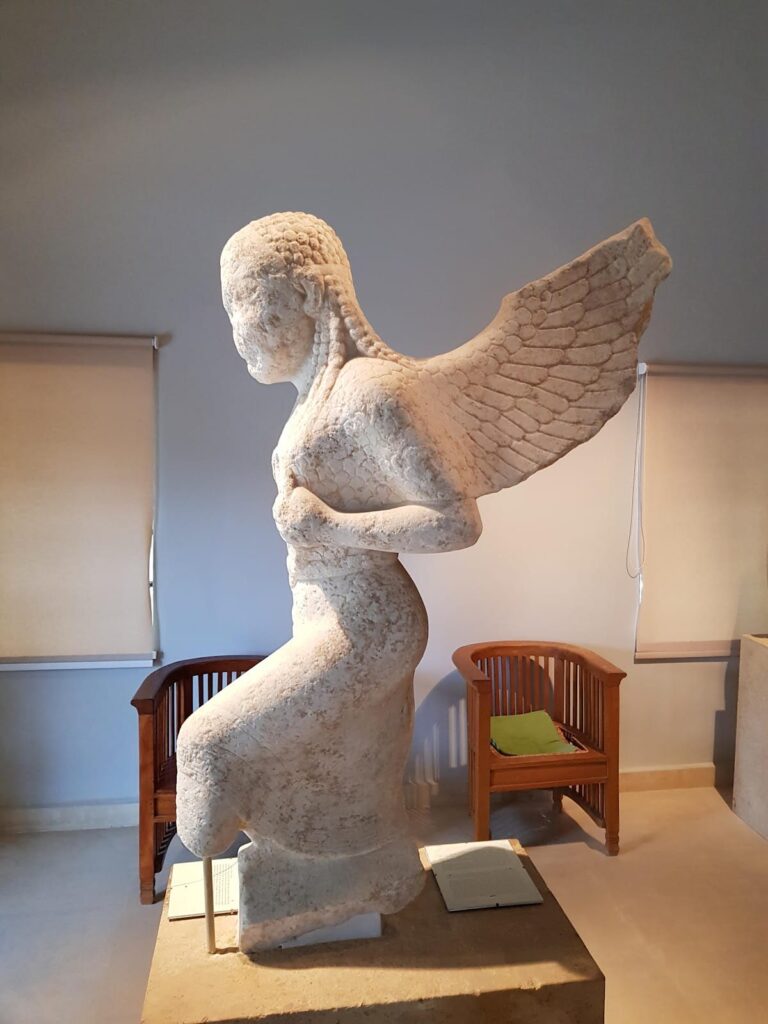
Excavations produced kouroi, korai, sphinxes, Nikai, animals and divine images, mostly in marble and associated with artistic centres on Paros and Naxos. Finds include fragments of statues of Athena, Artemis, Leto, Apollo, Hera and Zeus, along with the relief of Agathodaimon and a relief of Isis Pelagia from Sarapieion C.
The House of the Seals yielded bronze fittings and utensils, including door appliques, fittings from beds and chests, vessels and other implements. Excavations there also recovered approximately 16,000 clay sealings bearing about 26,000 to 27,000 seal impressions, mainly dating from the first century BC.
Pottery from the island includes Cycladic, Attic, Corinthian, Hellenistic and Roman material, as well as lamps and terracotta figurines of humans, Greek and foreign deities, heroes and theatrical figures. Much of the pottery associated with the purification of 426 BC was transferred from Rheneia to the museum at Mykonos. Coins from many regions reflect Delos’s international trade. Between 314 and 167 BC, the Delians minted silver drachms and hemidrachms, and this local coinage ended when Athens regained control of the island in 167 BC.