Cyrrhus: A Hellenistic City and Regional Center in Syria
Site at a Glance
- Popularity
- High
- Country
- Syria
- Primary era
- Classical
- Eras represented
- Classical, Medieval
- Civilizations
- Byzantine, Roman, Seleucid
- Site type
- Settlement
- Remains
- City
On this page15 sections
History
Cyrrhus was an ancient city in Syria, founded shortly after 300 BC by Seleucus I Nicator, a Macedonian general who established the Seleucid dynasty. Its exact foundation year is uncertain, though it fell within Seleucus’s reign, from 312 to 280 BC. This Hellenistic city became the capital of Cyrrhestica, a broad district between the plain of Antioch and Commagene. Its position on routes linking Antioch with the Euphrates crossing at Zeugma gave it strategic and commercial importance.
Seleucid foundations and Roman rule
Cyrrhus was named after a Macedonian city of the same name. Other forms used for the Syrian city include Coricium, Corice, Khoros, and Nebi Huri. A sixth-century explanation associated its name with Cyrus the Great, the Persian king, because the names sounded alike. Other traditions connected it to the Macedonian city or to a commander of King David said to have been buried there. A local tradition linked Nebi Huri to a holy man who lived at a monastery in the area. The city later served as a stopping place for trading caravans. Its Christian associations also brought it the name Hagioupolis, meaning City of Saints.
After the Treaty of Apamea removed Asia Minor from Seleucid control in 188 BC, Cyrrhus became a frontier city. Its civilian role diminished, while it served as a gathering point for armies and supplied soldiers to the kings of Antioch. Tigranes the Great of Armenia took control in 83 BC, during a period of disorder in the surrounding region. Roman forces recovered the city in 69 BC, and it became part of Roman Syria when Pompey took control of the province in 64 BC. Fighting between Roman and Parthian forces reached the city during the Parthian invasion of Syria in 40 BC.
In the first century AD, Cyrrhus served as a Roman administrative, military, and commercial center. Legio X Fretensis, a large Roman military unit, was based there temporarily through roughly the first two-thirds of the century. The city also issued its own coins. As Roman power expanded eastward, Cyrrhus ceased to be a frontier town and became an administrative center for Cyrrhestica. When the regional administrative center later shifted to Manbij, Cyrrhus became subordinate to it, but retained commercial importance as a regional junction.
Cyrrhus was an important center for the worship of Athena and Zeus. Large military forces were stationed there, although their chain of command is uncertain and the city may have been independent. Sasanian Persian forces, rulers of the Persian Empire from the third to the seventh century, captured Cyrrhus several times during the third century. In 257 they briefly occupied it and Antioch before Roman forces regained control. The city remained prosperous and politically and religiously important into the late Roman period.
Christian center and Persian wars
Cyrrhus became a Christian bishopric early in its history. At first its bishop answered to the chief bishop of Hierapolis Bambyce in the Roman province of Euphratensis. Under the Byzantine emperor Justinian, the city became a leading church center directly under the Patriarch of Antioch, without subordinate bishoprics. The Byzantine Empire was the eastern continuation of the Roman Empire.
Bishops from Cyrrhus took part in councils, assemblies of bishops concerned with church doctrine and governance. Syricius attended the Council of Nicaea in 325. Abgar, an Arian who held that the Son was subordinate to the Father, attended the Council of Seleucia in 360. Asterius, also identified as Arian, served during the reign of Valens from 364 to 378, while Isidore attended the Council of Constantinople in 381.
Theodoret, bishop from 423 to 458, became the city’s best-known church leader. He wrote about religious figures in the region, including hermits, and described his diocese as containing 800 churches. He was involved in disputes associated with Nestorianism, a label for teachings distinguishing Christ’s divine and human natures, Eutychianism, which effectively absorbed Christ’s human nature into the divine, and Marcionism, which rejected the Jewish scriptures and distinguished their God from the Father of Jesus. In 476, Bishop Ioannes held a synod against Peter the Fuller, the Patriarch of Antioch. Late in the fifth century, a Nestorian bishop named Sergius was succeeded by another Sergius who held the opposing Jacobite position, a historical name for the Syriac Orthodox tradition. Emperor Justin I deposed the second Sergius in 518. The later Syriac Orthodox patriarch and historian Michael the Syrian listed thirteen further bishops of that tradition at Cyrrhus.
A basilica, or large church, at Cyrrhus housed the relics of Saints Cosmas and Damian, Christian physicians martyred nearby around 283. Their remains were later brought to the city, strengthening its association with the name Hagioupolis. Theodoret also wrote about the virtues and miracles of local holy figures.
After a peace treaty with Justinian in 532, Persian incursions resumed in the first half of the sixth century. Cyrrhus suffered severe damage in 540 and again in 574. The Byzantine emperor Heraclius expelled Persian forces from the region in 630. In 637 the city surrendered without a fight to the Muslim commander Iyad ibn Ghanm, in return for payment of a tax imposed on non-Muslims under Muslim rule.
Muslim rule, Crusader period, and abandonment
Cyrrhus’s position near the Byzantine frontier remained important under the Umayyad and Abbasid dynasties. The Umayyad ruler al-Walid I ordered stone from a church at Cyrrhus to be reused in the Zakariyya Mosque in Aleppo. A Byzantine emperor offered a large sum to recover three columns from the church, but al-Walid refused. Under the Abbasid ruler Harun al-Rashid, Cyrrhus was one of seven frontier strongholds and maintained a large garrison under the administration of Manbij. After Byzantine forces retook the city in 905, Crusaders, participants in medieval Christian military campaigns, captured it in the eleventh century and established a bishopric dependent on Edessa.
In the early twelfth century, the surrounding region came under Armenian Bagrat rule and then, in 1117, under the County of Edessa. Cyrrhus also linked the Crusader principalities of Antioch and Edessa. A major earthquake had severely damaged the city in 1140. In 1150, Nur al-Din Zangi captured it after local Muslims seized the Byzantine commander Joscelin. Fearing a Frankish return, Nur al-Din ordered Cyrrhus destroyed in 1157 and withdrew. By the thirteenth century the city had been abandoned. Travelers in the thirteenth and fourteenth centuries described a large settlement, much of it in ruins.
Excavations began in 1952 under Henri Seyrig, director of the French Institute of Archaeology in Lebanon, and continued for seven consecutive seasons, exposing major buildings and landmarks. The Lebanese-Syrian Archaeological Mission of Cyrrhus has also excavated the site. Following Operation Olive Branch, the Syrian National Army carried out extensive digging and looting of ancient artifacts there.
Cyrrhus is no longer a residential bishopric. Its former see has had Catholic titular titles in the Latin and Maronite traditions; a titular see retains the name of a former bishopric without a functioning residential diocese. The Maronite titular archbishopric was suppressed in 1956.
Remains
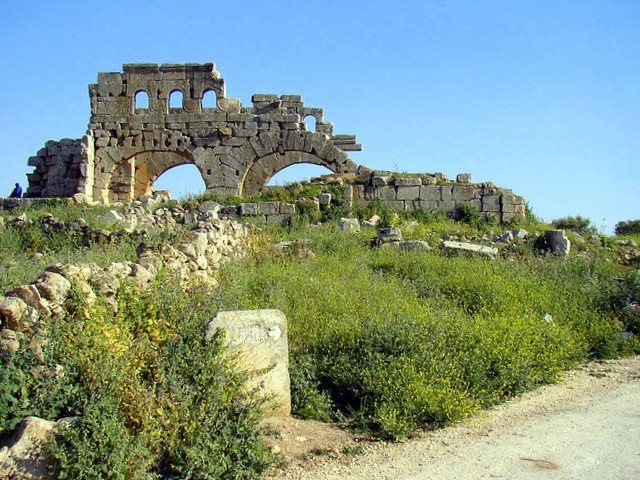
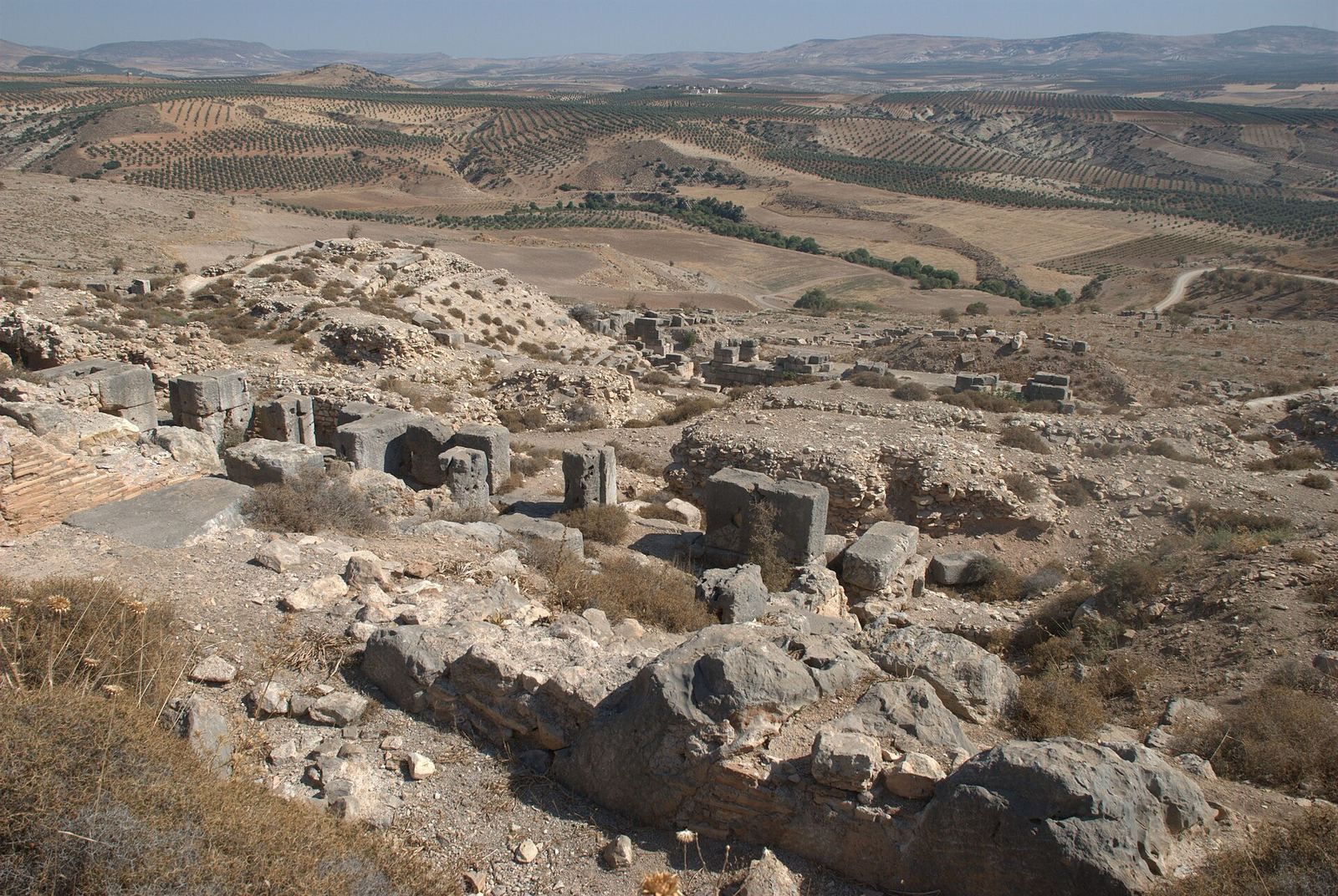
Cyrrhus occupied the lower of two elevated plateaus, with the upper town and citadel on higher ground. A plain extended toward a valley and river, while the surrounding terrain provided natural protection. The excavated city plan is square, with streets laid out in a regular grid. Surviving features include the central street, fortifications, bridges, religious buildings, and tombs.
Urban layout and defenses
Street plan and routes
The city’s grid centered on a main street lined with columns, an arrangement that appears to have remained in use into the Islamic period. A later paved Roman road connected Beroea, the ancient name for Aleppo, with Manbij. Six principal roads led from Cyrrhus toward neighboring districts.
Walls and citadel
A wall built during the Byzantine period enclosed the city and had four gates, one facing each cardinal direction. Towers formed part of its defenses, and an Islamic fortress stood in the upper town. On the hill behind the theater, a Byzantine citadel was built in the sixth century. Its design reflects Greek and Egyptian influences, and it remains largely unexcavated.
Public and religious buildings
Theater and baths
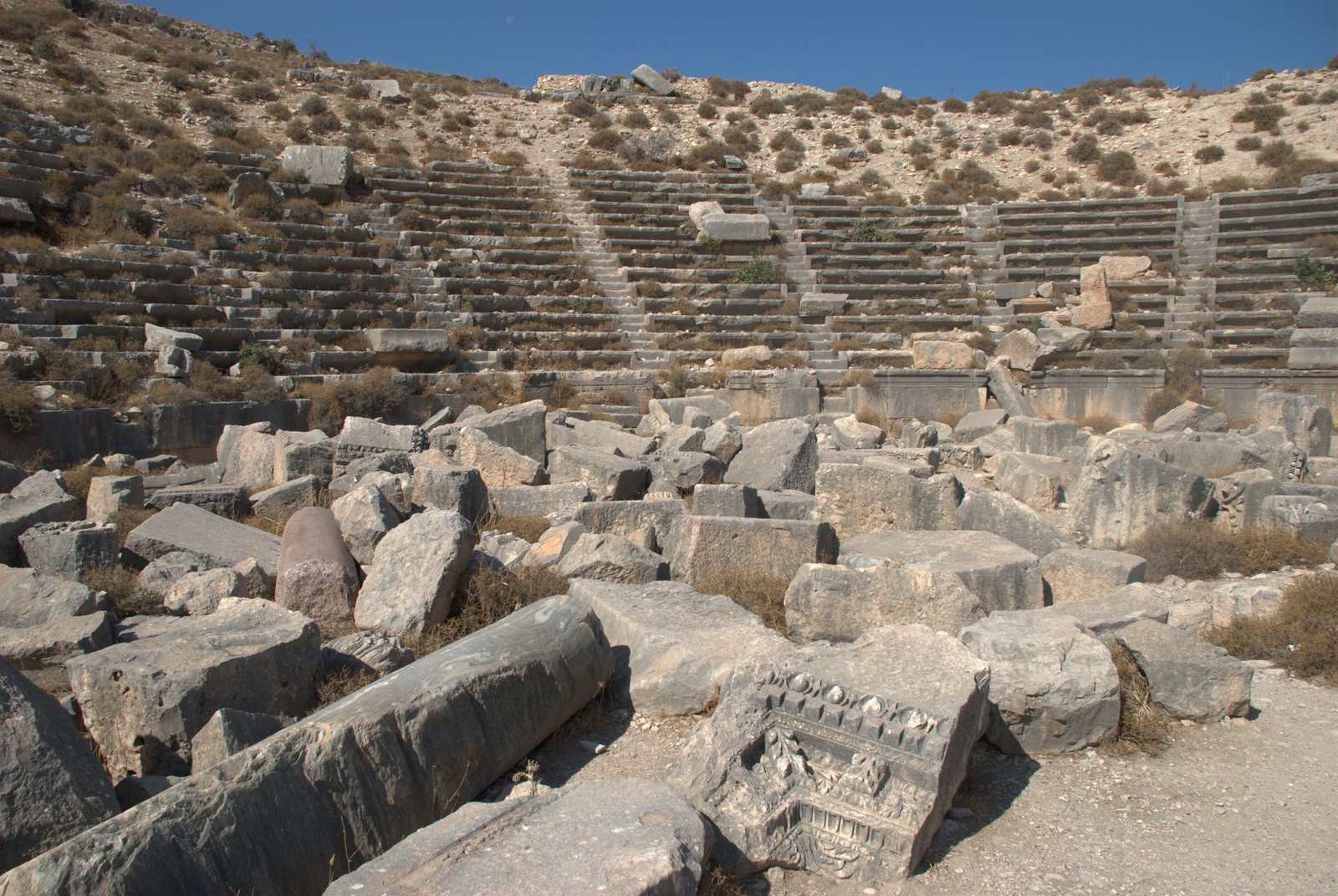
A Roman theater stands outside the town. Dating to the second or third century AD, it is now dilapidated. Baths and other tombs are also among the city’s surviving remains.
Churches
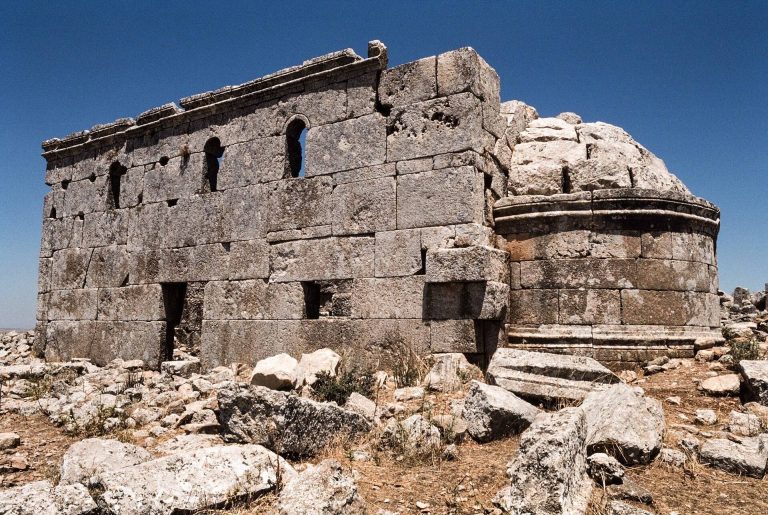
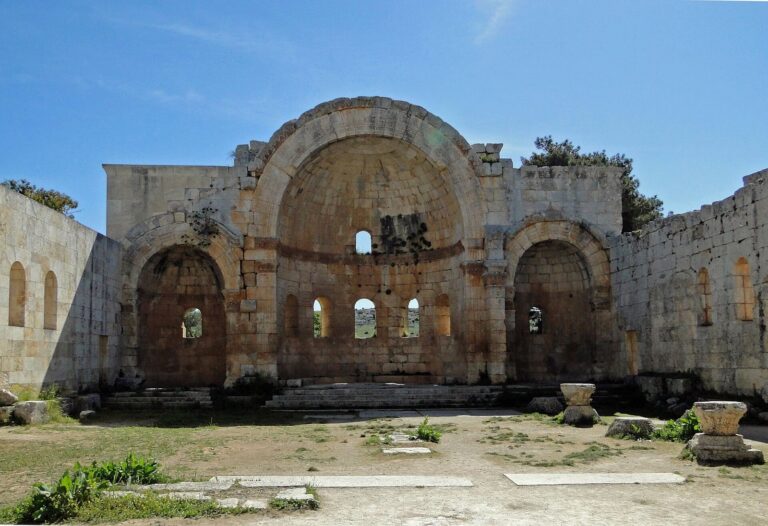
Cyrrhus had ten churches during the Byzantine period. Foundations survive of the basilica associated with Cosmas and Damian. A church dedicated to Dionysius served as a refuge for fugitives during the reign of Emperor Anastasius. A church of Simeon the Zealot was built at Cyrrhus and also served as his burial place.
Temple of Zeus
A temple dedicated to Zeus is believed to have stood on the summit of a mountain beside the city.
Waterways and burial monument
Bridges and river
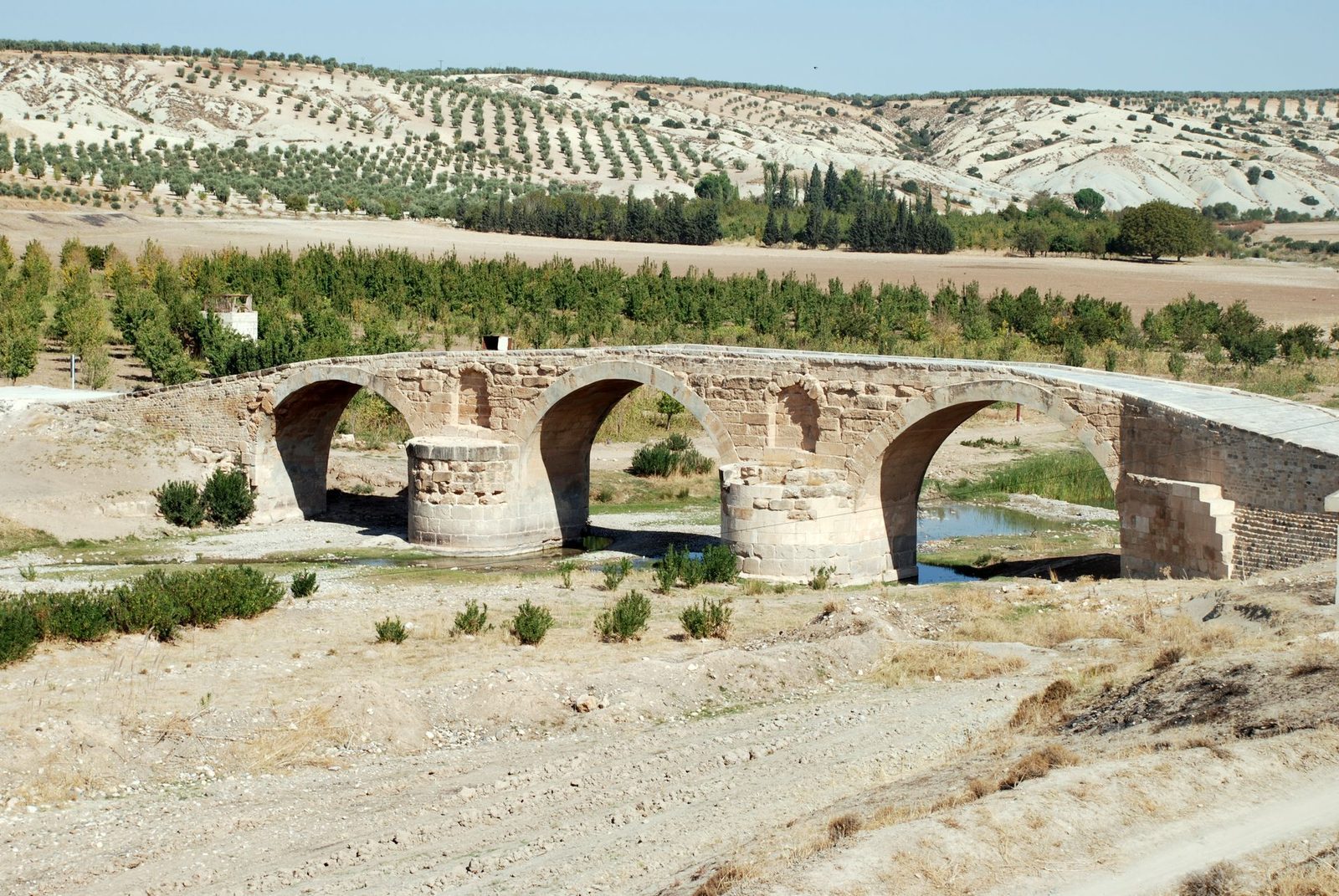
Two Roman bridges at Cyrrhus remain in working order. The Afrin Marsyas, a tributary of the Orontes, flowed near the city and had been dammed by Bishop Theodoret.
Hexagonal tower tomb
At the city’s southwestern edge stands a hexagonal tower tomb attributed to a Roman commander. The tower retains its full structure. A small chamber beneath it contains a later symbolic tomb, and a mosque beside the monument is used by worshippers from nearby villages for Friday and Eid prayers.