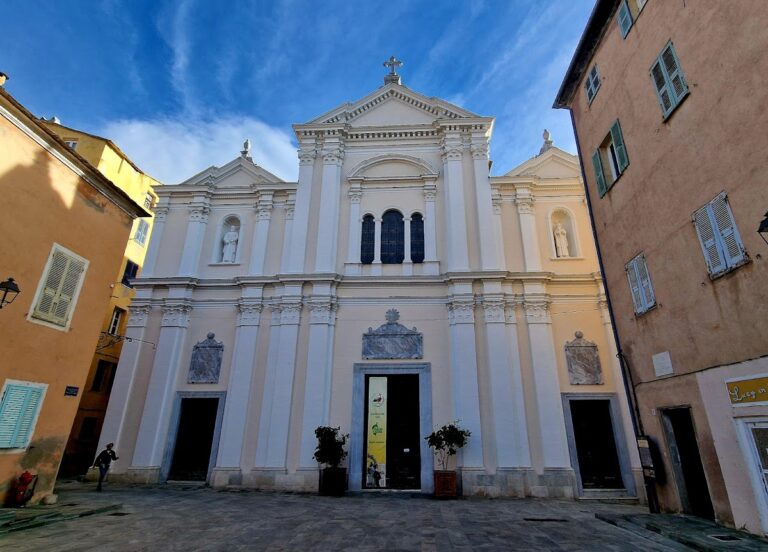
Couvent Saint-Dominique de Corbara: A Franciscan and Dominican Religious Complex in Corsica


Site at a Glance
- Rating
- 4.5
- Popularity
- Low
- Country
- France
- Primary era
- Medieval
- External website
- Open
- Eras represented
- Medieval, Modern
- Civilizations
- French, Genoese
- Site type
- Religious
- Remains
- Monastery
On this page9 sections
History
Franciscan foundation
Couvent Saint-Dominique de Corbara is a historic religious complex in Corbara, France, founded by the Friars Minor of the Observance in 1456 as the Franciscan Convent of Saint Francis of Aregno. The Friars Minor of the Observance were a reform branch of the Franciscan Order that followed a stricter interpretation of its original discipline. The Franciscan writer and churchman Francesco Gonzaga later attributed the construction to Mariano de Muro and Matteo d’Occhiatana.
The convent remained in Franciscan hands until its dissolution during the French Revolution in 1791. Its next major phase began in the nineteenth century, when Toussaint Casanelli d’Istria, Bishop of Ajaccio, encouraged French Dominicans to take up the site.
Dominican revival and religious education
Hyacinthe Besson began planning a Dominican refuge in Corsica in 1855 after Alexandre Vincent Jandel, master general of the Order of Preachers, commissioned him to develop the project. The Order of Preachers, commonly known as the Dominicans, is a Catholic mendicant order devoted to preaching, theological study, and religious education.
Renovation began in 1856, Dominican activity started in 1857, and the establishment formally opened as the Priory of Saint Dominic in 1861. Between 1857 and 1860, the Dominicans added two wings and created a school alongside colleges of philosophy and theology. Hyacinthe-Marie Cormier became prior in June 1861 and directed the convent and its novitiate until July 1865. That year he became the first provincial of the Dominican Province of Toulouse. From 1884, Corbara also trained Dominican friars.
Scholars, preaching, and exile
The convent became associated with Dominican intellectual and religious life. Antonin-Gilbert Sertillanges studied philosophy and theology there and developed his interest in Thomas Aquinas, the thirteenth-century Dominican theologian whose synthesis of Christian theology and Aristotelian philosophy shaped Catholic thought. Sertillanges was ordained a priest at Corbara in October 1888 and became a lector in theology in 1890. After teaching at Corbara and Amiens, he moved to the Convent of the Blessed Sacrament in Paris in 1893.
Henri Didon, a prominent and controversial Dominican preacher and author, was sent to Corbara in exile from 1880 to 1881 after opposing the Dominican hierarchy. He wrote much of Jesus-Christ there, and the book was published in 1881. The novelist Guy de Maupassant visited Didon at the convent in 1880.
War, return, and later communities
The Dominican religious left or were expelled from the convent around 1903–1905, and the buildings remained unoccupied until 1914. During the First World War, the disused complex became an internment prison for civilian nationals of enemy countries, remaining in that role from 1914 to 1920. On 14 October 1914, 400 Alsatian civilians were imprisoned there because of an administrative confusion between Austro-Hungarians and Alsace-Lorrainers. They were released on 19 October after the French Ministry of the Interior confirmed that they were French citizens, while Austro-German civilian internees remained at Corbara.
The Dominicans rehabilitated the convent in 1927 and returned to live there. It also served as a place of relegation for Dominican members considered difficult. Thomas Philippe stayed at Corbara from December 1953 to September 1954 after his exclusion from the Eau Vive community, a Catholic spiritual community.
A forest fire destroyed parts of the convent in 1986. The last two Dominican friars left in 1992, and the Saint John Community established itself there in 1993. Alain Peyrefitte spent a year in retreat at Corbara after converting to Catholicism and drafted plans there for a projected diplomatic, political, and literary career. The convent also received Pascal Paoli, the eighteenth-century Corsican military and political leader.
Protection and management
The conventual buildings, cloister, church, and bell tower were listed as historic monuments in 2011. A registration in 2025 replaced the earlier order, and an order dated 20 January 2026 classified the complex as a historic monument. The Commune of Corbara owns the church, bell tower, and convent, while the Saint John brothers manage the complex. The Fondation du patrimoine has participated in the rehabilitation of the church.
Remains
Conventual buildings and cloister
The conventual buildings contain cellars, a ground floor, and an upper floor. Four wings enclose a rectangular cloister garden, with the surrounding buildings opening onto it through round arches. Two of these wings belong to the Dominican expansion carried out between 1857 and 1860, when the school and colleges of philosophy and theology were established.
Church and bell tower
The church stands along the edge of the southern wing. Its high nave is flanked by side chapels covered with barrel vaults pierced by lunettes. At the east end, the choir has a straight bay followed by an apse covered by a semi-dome, known as a cul-de-four, a quarter-sphere-shaped vault commonly used over an apse.
The bell tower rises to a lantern protected by a dome. Within the church is an arca, a communal burial pit used for the collective burial of members of the religious community.