Columns of Rajajil: A Prehistoric Stone Monument in Saudi Arabia
Site at a Glance
- Rating
- 4.8
- Popularity
- Medium
- Country
- Saudi Arabia
- Primary era
- Stone Age
- Eras represented
- Stone Age
- Civilizations
- Unclassified
- Site type
- Religious
- Remains
- Sanctuary
On this page4 sections
History
The Columns of Rajajil are a prehistoric stone monument in the Qara suburb south-east of Sakaka, Saudi Arabia. They are generally dated to the fourth millennium BCE, during the Chalcolithic, or Copper Age, when copper was used alongside stone tools. Material recovered through excavation supports this dating.
The monument belongs to a wider setting of prehistoric life in northern Arabia. In the interior south of the Nafud, people herded goats, cattle, and sheep, and also hunted and gathered. From around 4000 BCE, pottery-using communities in northern Arabia practiced simple farming as well as hunting and herding. Copper smelting and stone-circle villages, which may have served as seasonal dwellings, were part of this broader cultural sphere. Related traditions of stone circles and standing stones are found across Sinai, eastern Jordan, southern Syria, western Iraq, and the Al-Qassim region.
The purpose of Rajajil remains uncertain. It may have formed part of a ritual complex of small sanctuaries visited by people from beyond the surrounding area. One interpretation proposes that separate pillar groups represented different peoples or tribes and that the site served as a religious center. Other proposals connect the arrangement with astronomical or calendrical observations, including a suggested orientation toward sunrise and sunset, or with a caravan route along the Wadi Sirhan corridor between Yemen and Mesopotamia. Another interpretation assigns the stone forms ritual associations or a role as indicators related to grammar and astronomy.
The name Rajajil comes from a local Arabic word meaning “men,” inspired by the pillars’ resemblance, when seen from a distance, to a gathering of people. The Saudi General Administration of Antiquities and Museums excavated the site in 1975 and 1976.
Remains
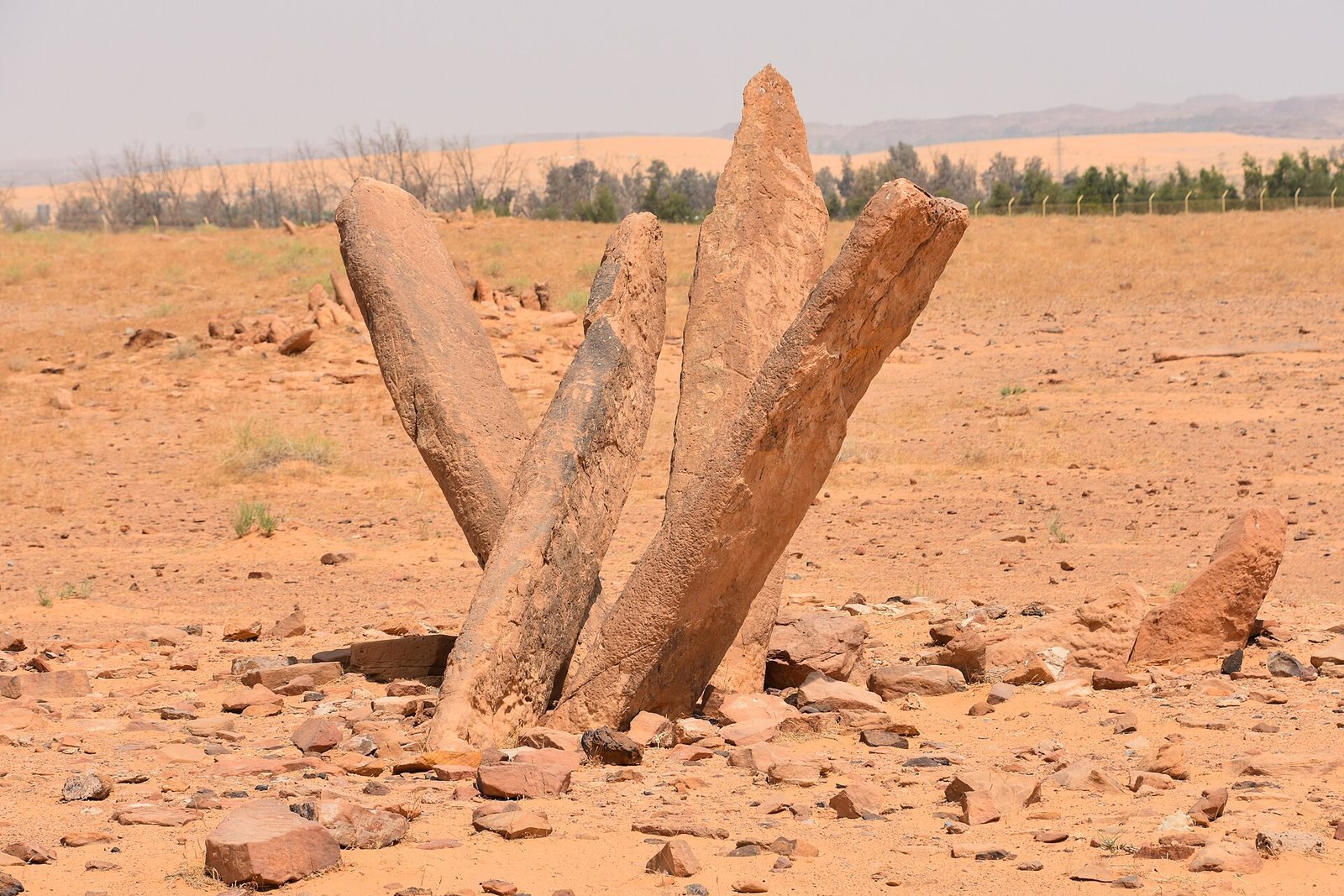
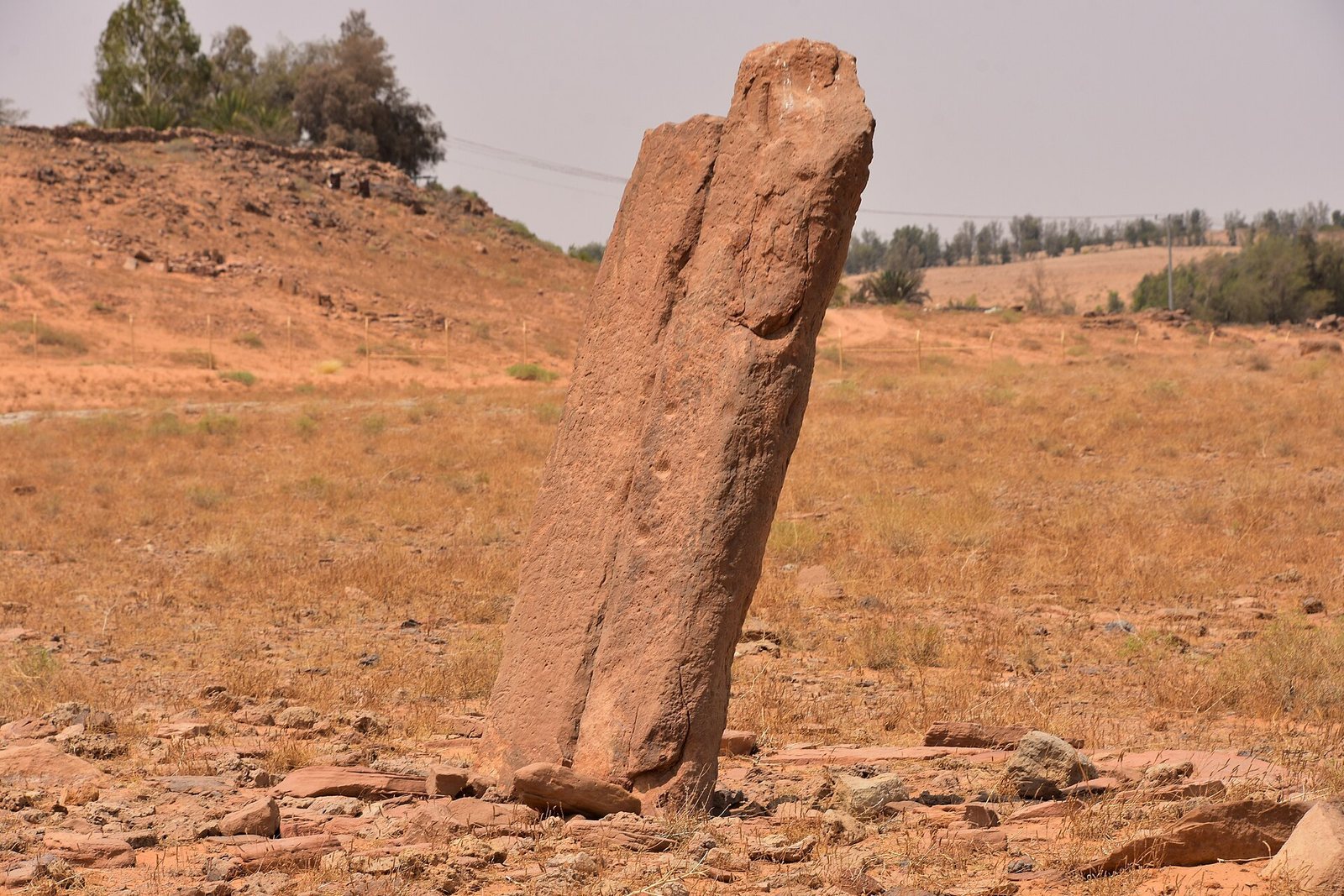
Across a broad sandy plain, roughly 50 groups of sandstone pillars form a large circular arrangement overlooking the surrounding landscape. The pillars were shaped from sandstone, and each group contains at least two.
Standing pillars
Some of the surviving pillars rise more than three metres, with a thickness of about 60 centimetres; others are broken and lie on the ground. Some carry Thamudic inscriptions, a collective term for several ancient North Arabian scripts. Aerial imagery has been interpreted as showing a rough alignment of the groups toward sunrise and sunset. Rajajil has also been compared with Stonehenge and with regional stone-circle traditions. The British examples cited in these comparisons date to the third and second millennia BCE, later than Rajajil’s proposed date.
Wells and excavated finds
Two excavated wells date to the fifth millennium BCE and reached water at depths of four to five metres. Finds from the site include stone scrapers, piercing tools, blades, broad fan-shaped scrapers, and pottery fragments. Other recovered objects include obsidian, a natural volcanic glass, sandstone vessels, burnt ornaments, necklaces, and beads made of metal, shell, and bone.