Collegiate Church of Saints Cosmas and Damian in Covarrubias
Site at a Glance
- Popularity
- Medium
- Country
- Spain
- Primary era
- Medieval
- Eras represented
- Medieval, Early Modern
- Civilizations
- Crown of Castile, Spanish
- Site type
- Religious
- Remains
- Church
On this page19 sections
History
Foundation and rebuilding
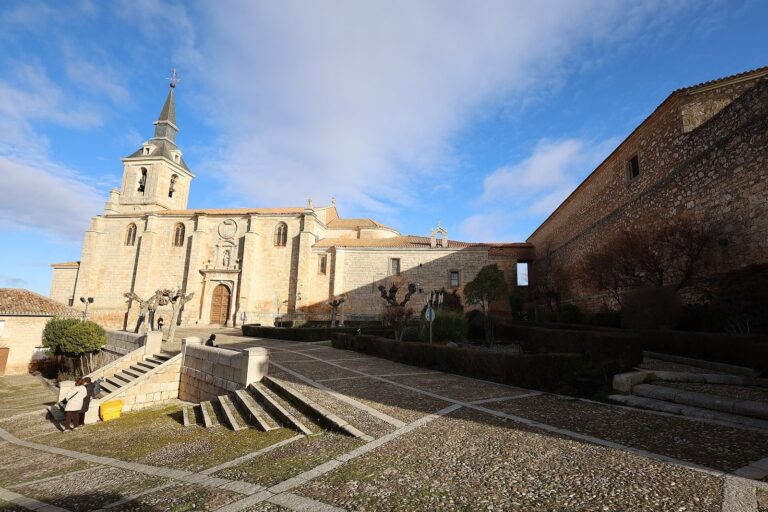
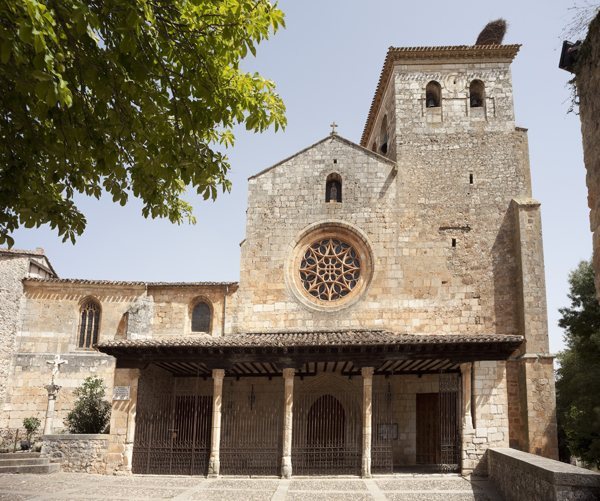
The Collegiate Church of Saints Cosmas and Damian is a Catholic parish church in Covarrubias, Spain. Its foundation is attributed to Chindaswinth, a Visigothic king who ruled in the seventh century. The church’s familiar name preserves its former collegiate status, meaning it was served by a body of clergy called a college of canons.
The present church, built in the late Gothic architectural tradition, was begun in 1474 over an earlier Romanesque church. Abbot Diego Fernández, chaplain to King Enrique IV of Castile, commissioned the new building. Work continued through most of the reign of Isabella I of Castile and Ferdinand II of Aragon, known as the Catholic Monarchs.
On 3 June 1931, a decree designated the church a Historic-Artistic Monument within the National Artistic Treasury. It is also recognized as a Property of Cultural Interest.
Burials and commemorations
In 1841, the remains of Fernán González, count of Castile, and his wife Sancha of Pamplona were transferred from the monastery of San Pedro de Arlanza and reinterred in the church. Two other women of the ruling family, Queen Urraca Fernández, who died in 1007, and Urraca García, who died after 1038, are also buried here. Urraca Fernández was a daughter of Fernán González and Sancha, and successively married the kings Ordoño III, Ordoño IV, and Sancho Garcés II. Urraca García was a daughter of Count García Fernández, Fernán González’s granddaughter, and the monastery’s first abbess.
A fifteenth-century tomb in the presbytery is attributed to Infanta Sancha Raimúndez, who granted Covarrubias local laws and privileges in 1148. The attribution does not identify her burial place: she was buried at the royal pantheon of San Isidoro in León. Infanta Cristina of Norway, who lived from 1234 to 1262 and was the first wife of Infante Felipe of Castile and Swabia, is buried in the cloister. Felipe was a son of Fernando III and brother of Alfonso X. The tomb of Diego Fernández de Castro, an abbot of the church, was transferred to the cloister from the Chapel of Our Lady of the Rosary.
Remains
The church and its furnishings
Plan and vaulting
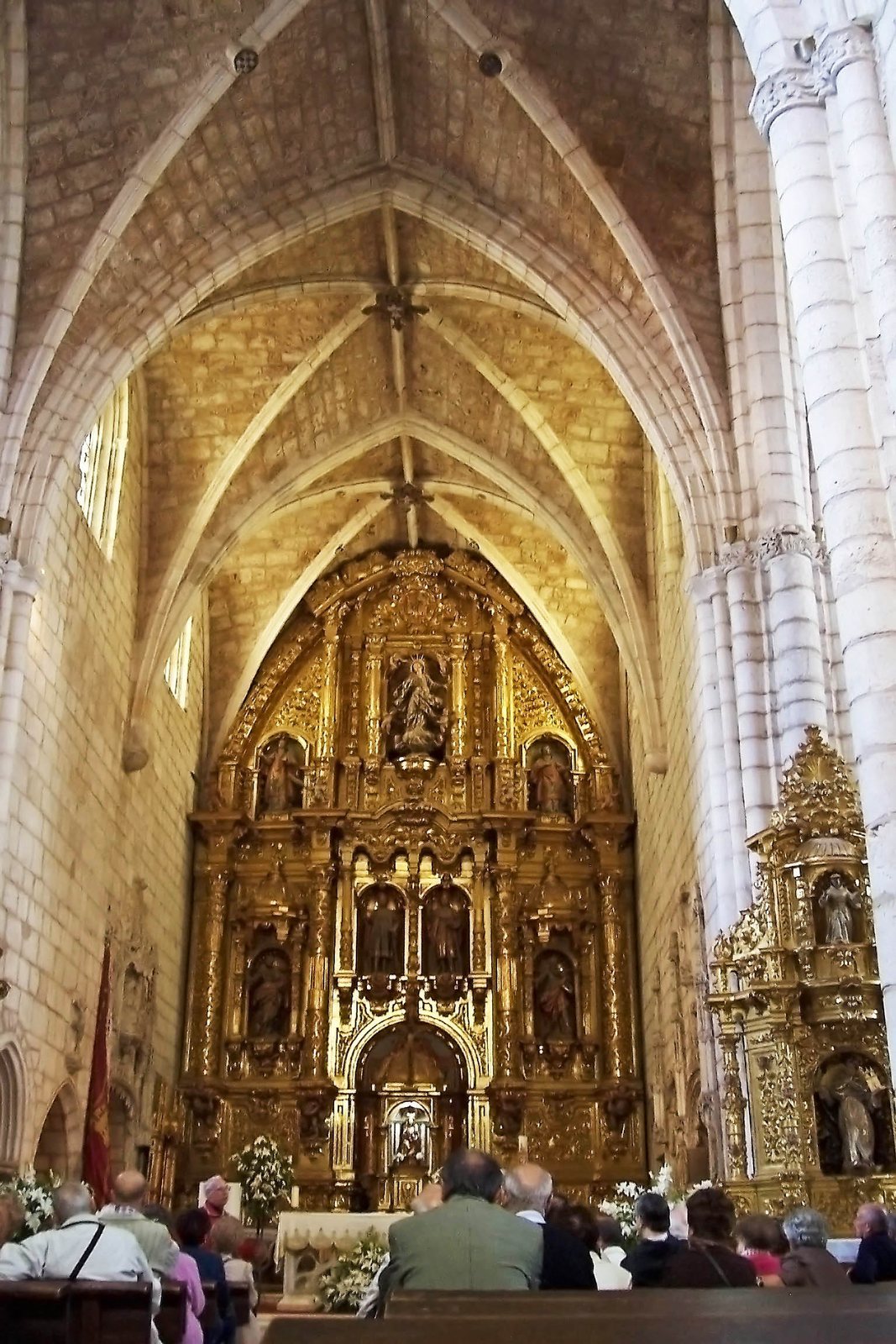
The church has a Latin-cross plan, with three lengthwise aisles and a cross-arm, or transept. The central aisle rises above the side aisles. Vaulted ceilings cover the aisles and transept, with secondary tierceron ribs, extra ribs within the vaults, arranged in six-part divisions or simpler forms.
Main altarpiece
Made between 1751 and 1753 by Luis and Manuel Cortés del Valle and Francisco Echevarría, the main altarpiece is dedicated to Saints Cosmas and Damian. It has three vertical sections, an upper tier, and a predella, the lower part of an altarpiece. At its base, the central section contains a tabernacle and a monstrance, a vessel for displaying the consecrated Eucharistic host. Above these are images of the two patron saints beneath a canopy, flanked by Saints Peter and Paul. The upper tier shows the Assumption of the Virgin between Saints Stephen and Lawrence.
Chapels
The Chapel of the Blessed Sacrament, also called the Chapel of the Holy Martyrs, is at the foot of the church on the Gospel side, associated with the traditional reading of the Gospel. Its altarpiece is headed by processional images of Saints Cosmas and Damian. The chapel’s vault, attributed to Simón de Colonia, has elaborate, crest-like ribs.
The Chapel of Carmen, also known as the Chapel of the Relics, contains a Romanesque baptismal font dated to the eleventh or twelfth century. Its surface has simple quatrefoil decoration.
The Chapel of the Holy Kings once contained the fifteenth-century Triptych of the Magi, now displayed in the parish museum. A sixteenth-century Plateresque altarpiece, a richly ornamented Spanish-style work, dedicated to Saint John the Baptist now stands in its former position.
Other interior features
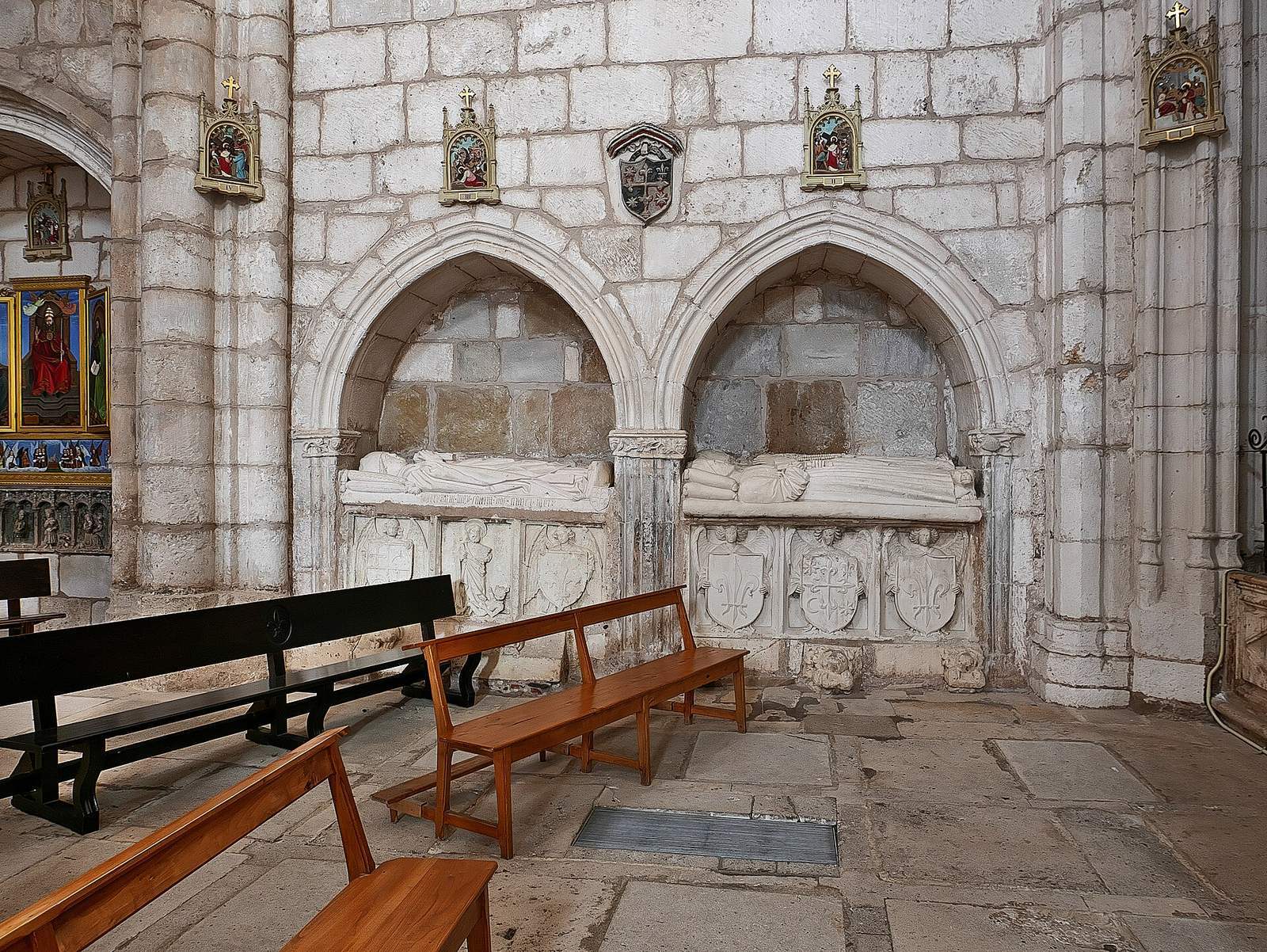
Tombs of the Martínez Lerma, Fernández Velasco, Gil de Ramales, Cisneros, Fernández de Castro, Fernández de Solarana, and Villegas families are distributed through the church. The organ dates to the second half of the seventeenth century.
Tombs, cloister, and bells
Presbytery tombs
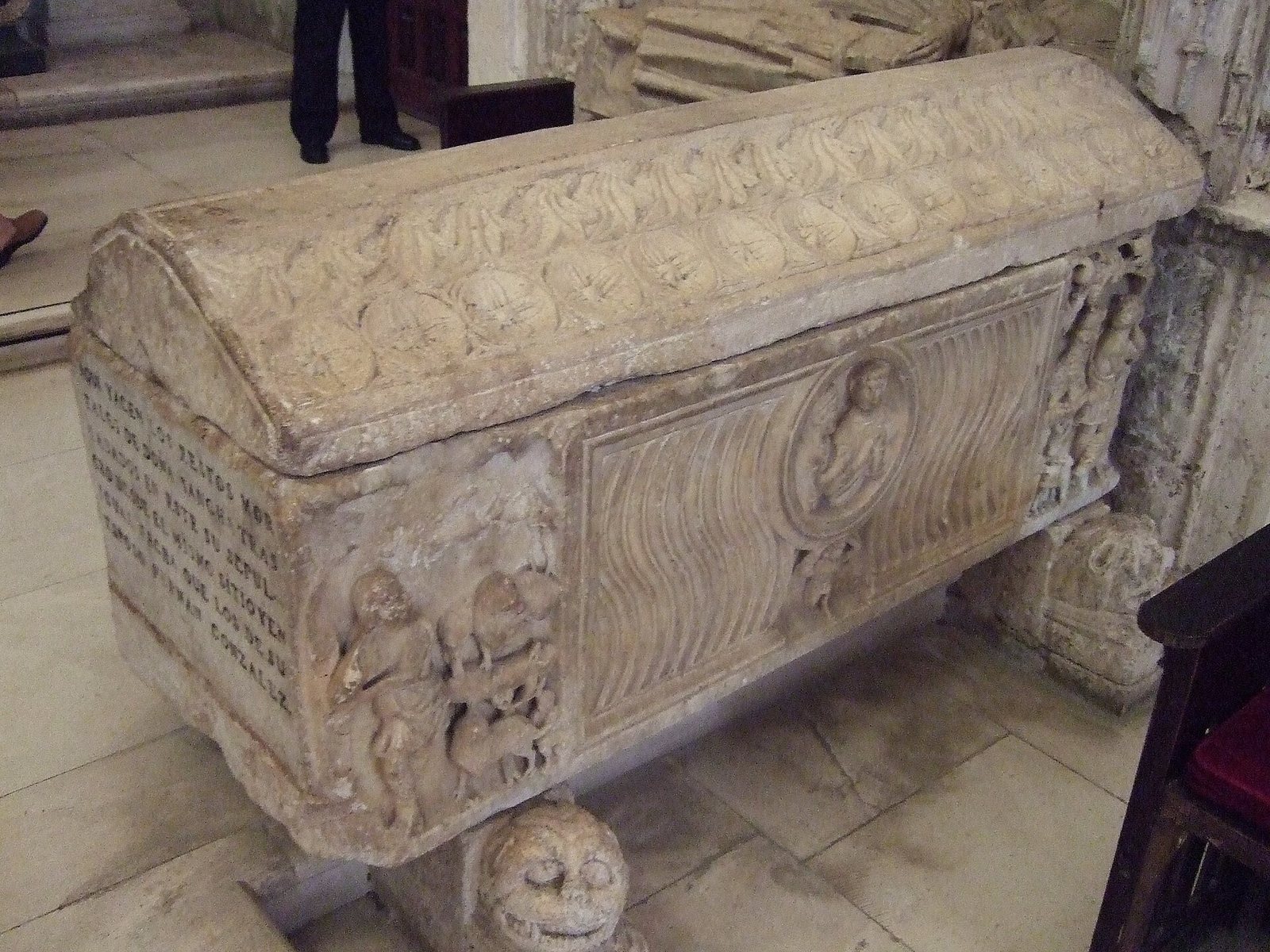
The presbytery, the area around the main altar, contains the tombs holding the remains of Fernán González and Sancha of Pamplona. Fernán González’s remains lie in a fifth-century sarcophagus discovered without its cover in the seventeenth century in a village in the Alfoz de Lara, a historic territorial district. Sancha’s remains rest in a fourth-century sarcophagus from Roman Spain.
On the Gospel side of the main chapel is the tomb of García Alonso de Covarrubias, an abbot of the church. Near the tombs of Urraca Fernández and Urraca García stands the fifteenth-century stone tomb attributed to Sancha Raimúndez. Its lid bears a cross associated with an abbot’s office, and its front carries the quartered arms of Castile and León, granted to Sancha by her brother, the king.
Cloister
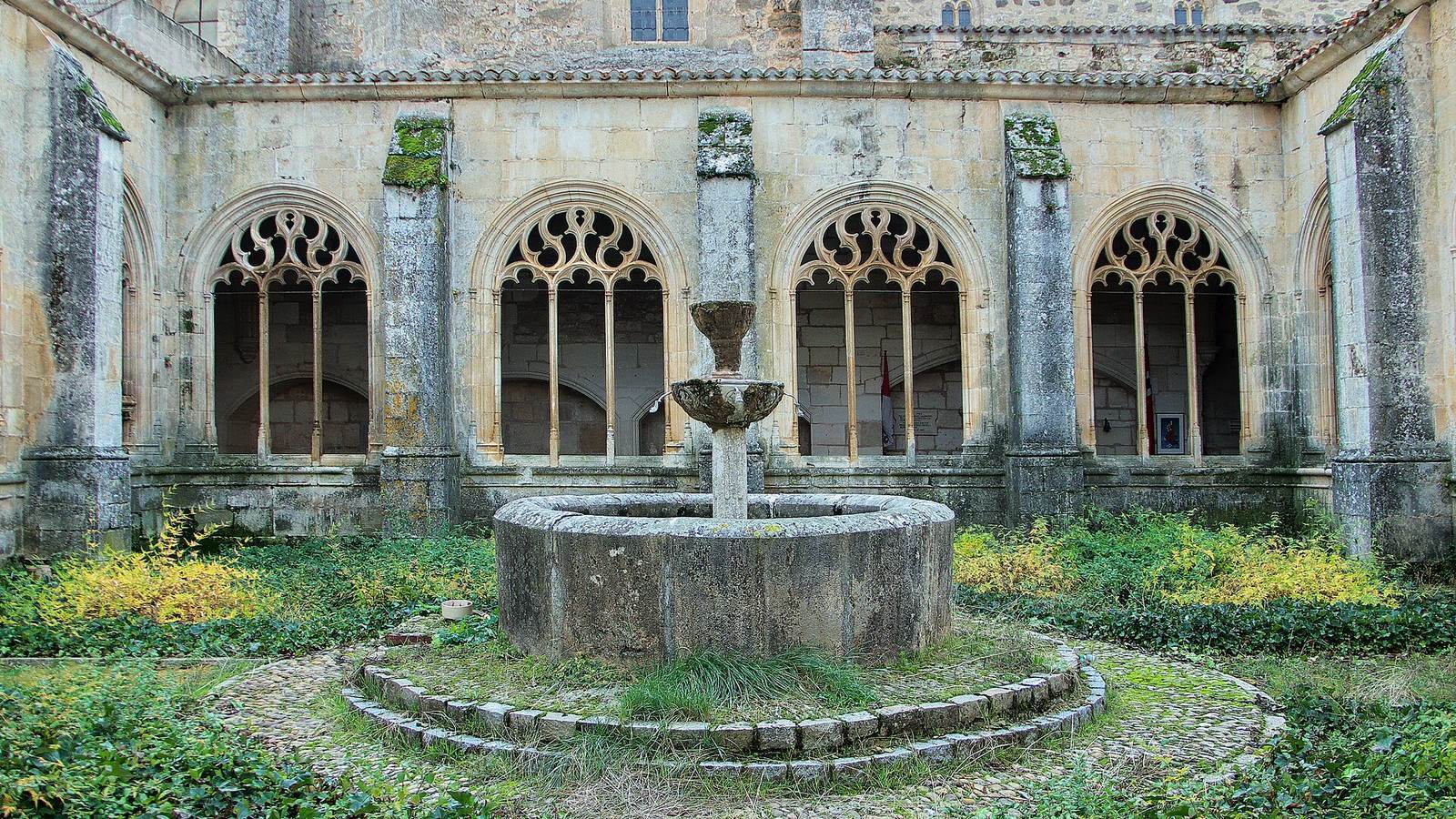
Built in the early sixteenth century, the cloister is a covered walkway around an open courtyard. It contains the Gothic tomb of Infanta Cristina of Norway and, beside it, the tomb of Diego Fernández de Castro.
Bells
A fire in the twentieth century damaged the bells; some survived, while others were lost and replaced by newly cast bells. By 2022, bells 3 through 7 were in the tower, while bell 1 stood unused in the cloister. A decision had been made to restore bell 1, and a new bell was cast for an otherwise empty opening. These two bells have wooden yokes and automatic swinging. The other bells have Perea yokes and are sounded by electric strikers.
Parish museum
The parish museum holds Romanesque capitals, panels by Berruguete, silverwork by the Master of Calahorra, and liturgical vestments dating from the fifteenth to eighteenth centuries. Its collection is arranged across several rooms.
First room
The first room contains a thirteenth-century seated image of Saint James carved in painted stone, as well as thirteenth-century painted wooden images of Our Lady of Redonda and Our Lady of Mamblas. Other works include a restored, late-fourteenth-century painted wooden Virgin of the Cherry; a fifteenth-century painted wooden altarpiece of Saint James; and a fourteenth-century Epiphany predella from an altarpiece in Covarrubias’s parish church of Saint Thomas.
The room also displays an eighteenth-century painted wooden Virgin of the Rosary and an eighteenth-century image of the child Virgin with Saints Joachim and Anne, described as a notable work of the Castilian school.
Second room
A copy of the 978 document establishing the Infantado of Covarrubias is displayed in the second room; the original is kept in the church archive. The room’s relic collection includes three wooden caskets covered in silver repoussé, metal shaped by hammering from the reverse. They came from the monastery of San Pedro de Arlanza. Relics of Saint García of Arlanza are also held here.
Other objects include a seventeenth-century walnut table, a sixteenth-century Immaculate Conception associated with the school of Gil de Siloé, religious objects used in the church, and paintings from different periods. Historical documents once displayed in this room were moved to the church archive for preservation.
Third room
The third room holds liturgical vestments from the fifteenth through eighteenth centuries. Among them is a red sixteenth-century set associated with the Constables, embroidered by the local craftsman Marcos de Covarrubias. The room also contains five pieces of silk taken from Infanta Cristina’s tomb.
Fourth room
The fourth room was formerly the church sacristy. Its paintings include the fifteenth-century Triptych of the Magi by the Master of Covarrubias; Christ among Angels, a panel painting by Diego de la Cruz; and Virgin of the Book, also by the Master of Covarrubias. Both panel paintings date to the fifteenth century.
The room also contains Beheading of Saint Thomas and Saint Thomas in India, fifteenth-century panel paintings by Alonso de Sedano, and Pedro Berruguete’s fifteenth-century panel painting Miracle of Saints Cosmas and Damian. Silver objects include a sixteenth-century processional cross and monstrance, a seventeenth-century chalice with a rock-crystal stem, and a fourteenth-century reliquary of the True Cross made of repoussé silver. Tradition holds that Fernán González carried the reliquary.
Present sacristy
The present sacristy served as the chapter house, a meeting room for a religious community, in the eighteenth century. It retains its walnut choir stalls.