Coldham Hall: A Tudor Country House in Suffolk
Site at a Glance
- Popularity
- Very High
- Country
- United Kingdom
- Primary era
- Early Modern
- Eras represented
- Early Modern, Modern
- Civilizations
- British, English
- Site type
- Domestic
- Remains
- Manor House
On this page9 sections
History
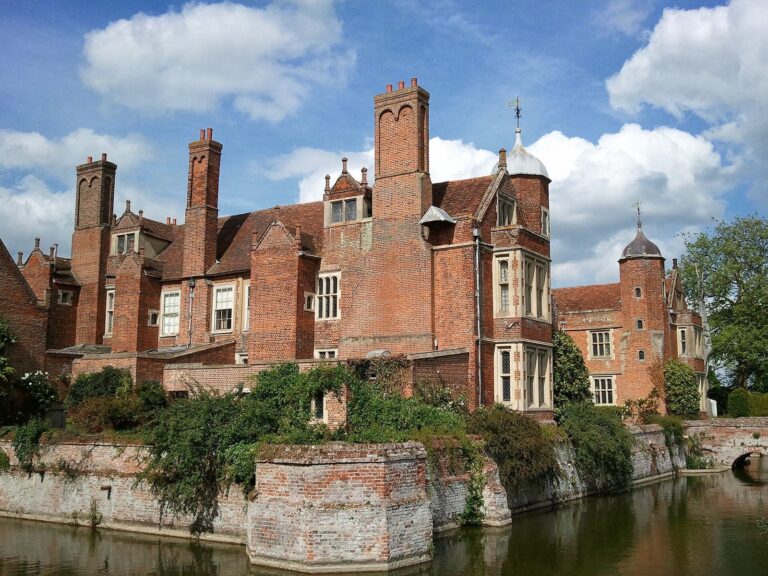
Coldham Hall is a Tudor country house in the parish of Bradfield Combust with Stanningfield, near Lawshall in Suffolk, United Kingdom. Sir Robert Rookwood had it built in 1574. The house became closely associated with the Rookwood family and their Roman Catholic faith.
The Rookwoods and Catholic worship
Local tradition links the Hall’s name to a visit by Elizabeth I, queen of England from 1558 to 1603. According to the story, she was angered when served cold ham. The Rookwoods remained Roman Catholic, and during Elizabeth’s persecution of Catholics, chapels and concealed hiding places at the estate sheltered Catholic clergy. Roman Catholic worship also continued in Stanningfield and Lawshall from the Middle Ages into the modern period, although the surrounding area was predominantly Protestant.
Ambrose Rookwood, Sir Robert’s son and a resident of the Hall, joined the 1605 Gunpowder Plot, a conspiracy to replace the Protestant King James I with a Catholic monarch. Ambrose was executed that year.
Changing ownership and estate use
The estate passed through the female line to the Gages of Hengrave. Robert Taylor rented it in the 1840s, and it was sold in 1869 to Richard Holt-Lomax, whose family owned it until 1893. That year, Lieutenant Colonel Henry Trafford-Rawson bought the estate and developed it for game shooting, expanding existing woodland clumps and planting new blocks. His son, Captain John Henry Edmund Trafford-Rawson of the West Yorkshire Regiment, died at the Somme during the First World War. Colonel Everard Hambro bought the estate in 1918 and lived there until his death in 1952.
Coldham Hall also had close ties to Stanningfield and Lawshall. Local women worked in domestic service, while local men were employed on the farm and as grooms. In the 1920s, children of estate employees attended Christmas parties at Stanningfield’s Emancipation Chapel. A field near the main entrance on Bury Road was used for football and cricket for many years before the clubs moved elsewhere.
Later owners and modern change
Richard Duce bought the estate in 1952 and sold it to David Hart in 1979. Hart, an adviser to Margaret Thatcher, was followed as owner by Danish businessman Jens Pilo. In 2002, film producer and director Matthew Vaughn and model Claudia Schiffer bought the Hall and married there. Schiffer later said that they first used it as a weekend retreat before moving permanently to Suffolk.
Restoration around 1980 reversed much of the mid-nineteenth-century alteration. A fire in 2014 destroyed the estate’s clock tower and several other buildings in the grounds, but did not reach the Hall. Coldham Hall has been a Grade I listed building since 1955. Grade I is England’s highest listing category, for buildings of exceptional architectural or historic interest.
Remains
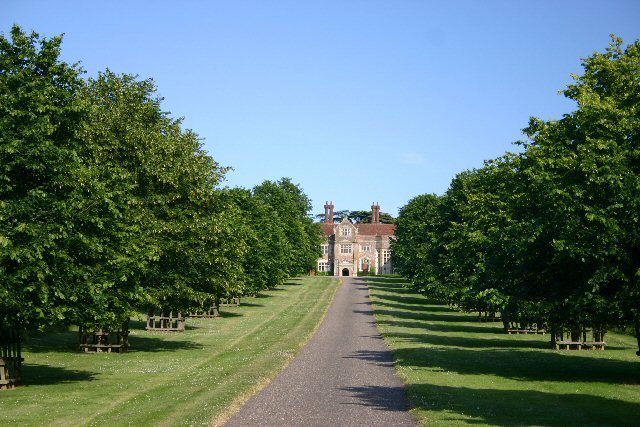
The surviving house is a two-storey Tudor building with an H-shaped plan, understood as a tribute to Henry VIII, king of England from 1509 to 1547. Its interior includes a great hall and a long gallery in the roof space, while the estate grounds retain a landscaped approach and planted woodland.
The house and its interiors
Main house
The house’s H-shaped layout forms its principal architectural feature. Mid-nineteenth-century alterations added roofed, open-sided galleries on the east and south sides; these have since been removed. Altered windows at the rear and a service wing at the north end remain.
Principal rooms and chapels
The great hall is a notable interior space. In the roof space, a long gallery runs about 32 metres from east to west. A Roman Catholic chapel with delicate plasterwork was added beside the gallery around 1770. The estate also had a second chapel and concealed spaces intended to hide Catholic priests.
Approach and grounds
An avenue of trees leads to the house, and the approach crosses two small lakes in the valley bottom. The lakes drain into the River Lark. Woodland clumps were enlarged and new planted blocks added in the late nineteenth century, including some close to the Hall. A footpath runs beside the grounds, from which the mansion can be viewed. Local tradition also tells of a tunnel linking Coldham Hall to sixteenth-century Lawshall Hall, about a mile to the south.