St Edmundsbury Cathedral: A Church of England Cathedral in Suffolk
Site at a Glance
- Rating
- 4.7
- Popularity
- High
- Country
- United Kingdom
- Primary era
- Early Modern
- Eras represented
- Medieval, Early Modern, Modern
- Civilizations
- Anglo-Saxon, British, English, Norman
- Site type
- Religious
- Remains
- Cathedral
On this page15 sections
History
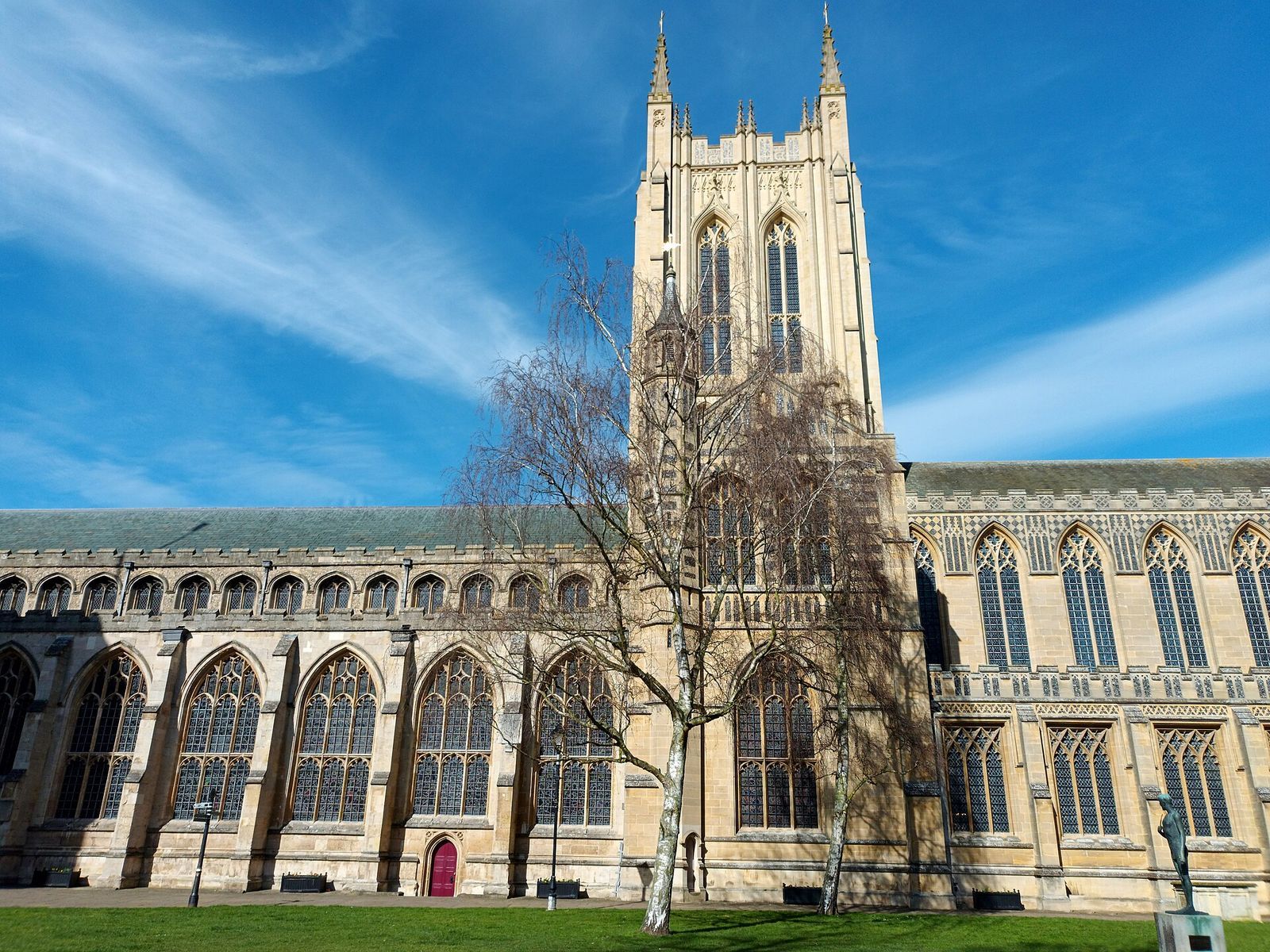
St Edmundsbury Cathedral, formally the Cathedral Church of St James and St Edmund, is a Church of England cathedral and parish church in Bury St Edmunds, Suffolk, United Kingdom. It serves as the cathedral of the Diocese of St Edmundsbury and Ipswich and the seat of its bishop. Its present tradition is Liberal Anglo-Catholicism, an Anglican tradition that emphasizes historic liturgy and sacramental practices. St Edmund was an early medieval king of East Anglia venerated as a Christian martyr.
Abbey church and parish
A church stood within the precincts of Bury St Edmunds Abbey by 1065. In the early 12th century, Abbot Anselm planned a pilgrimage to Santiago de Compostela in Spain along the Way of St James, a network of routes associated with the apostle. When the journey did not take place, he rebuilt St Denis’s Church and dedicated it to St James. The church served the northern part of Bury St Edmunds as its parish church.
Rebuilding and cathedral status
A major rebuilding campaign began in 1503 in the Perpendicular Gothic style, a late English Gothic form marked by strong vertical lines. Further alterations during the 18th and 19th centuries included a new chancel and a hammerbeam roof, a timber structure supported by projecting beams, designed by George Gilbert Scott.
When the Diocese of St Edmundsbury and Ipswich was established in 1914, St James’s Church became its cathedral. In 1952, the building received Grade I listed status, the highest listed-building grade in England, reserved for buildings of exceptional interest.
Expansion and completion
From 1959 to 1970, work adapted the former parish church for cathedral use. The Victorian chancel was demolished and replaced by a new quire, the area traditionally used by clergy and choir. The campaign also brought new chapels, crosswise arms to the church, and covered walks. The cathedral architect, who served from 1943 to 1988, left funds to support completion of the work.
A choir school in the cathedral grounds opened in 1990. Construction of a Gothic Revival tower began in 2000 and finished in 2005; the Chapel of the Transfiguration and East Cloister were completed in 2009, followed by the Crypt Treasury in 2012.
In 1959, the English composer Benjamin Britten wrote Fanfare for St Edmundsbury for a Pageant of Magna Carta held in the cathedral grounds. Issued in 1215, Magna Carta became an important limit on royal authority in England. Miles Mosse, a preacher at St James’s, founded the Ancient Library.
Remains
The cathedral brings together Romanesque work, characterized by rounded arches and substantial masonry, Gothic forms associated with pointed arches and rib vaults, and Gothic Revival, a later return to Gothic designs. Its church and adjoining structures include the former abbey gate tower, later chapels and transepts, and covered walks. St Mary’s Church, of similar size, is about 200 yards away.
Towers and bells
Norman Tower
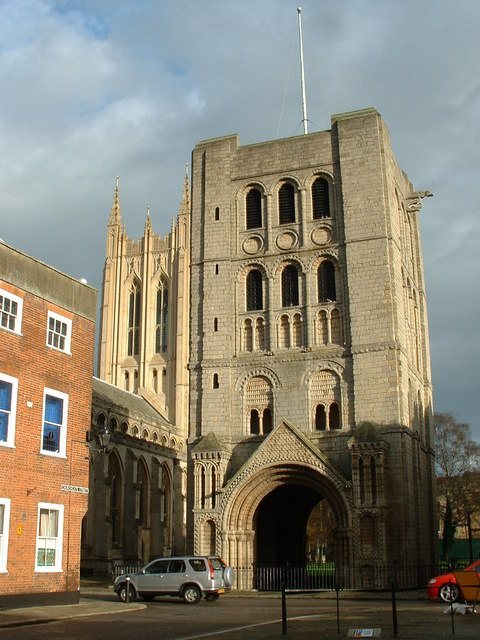
The Norman Tower, the abbey’s former gate tower, stands beside the church and serves as its bell tower. Its original ten bells were cast in 1785 by Thomas Osborn of Downham Market. They were rehung at a lower level in an iron frame in 1973. Two bells were added at Easter 2012, followed by a thirteenth in 2013. The later addition allows beginners to practise a full octave without using the three heaviest bells.
Millennium Tower
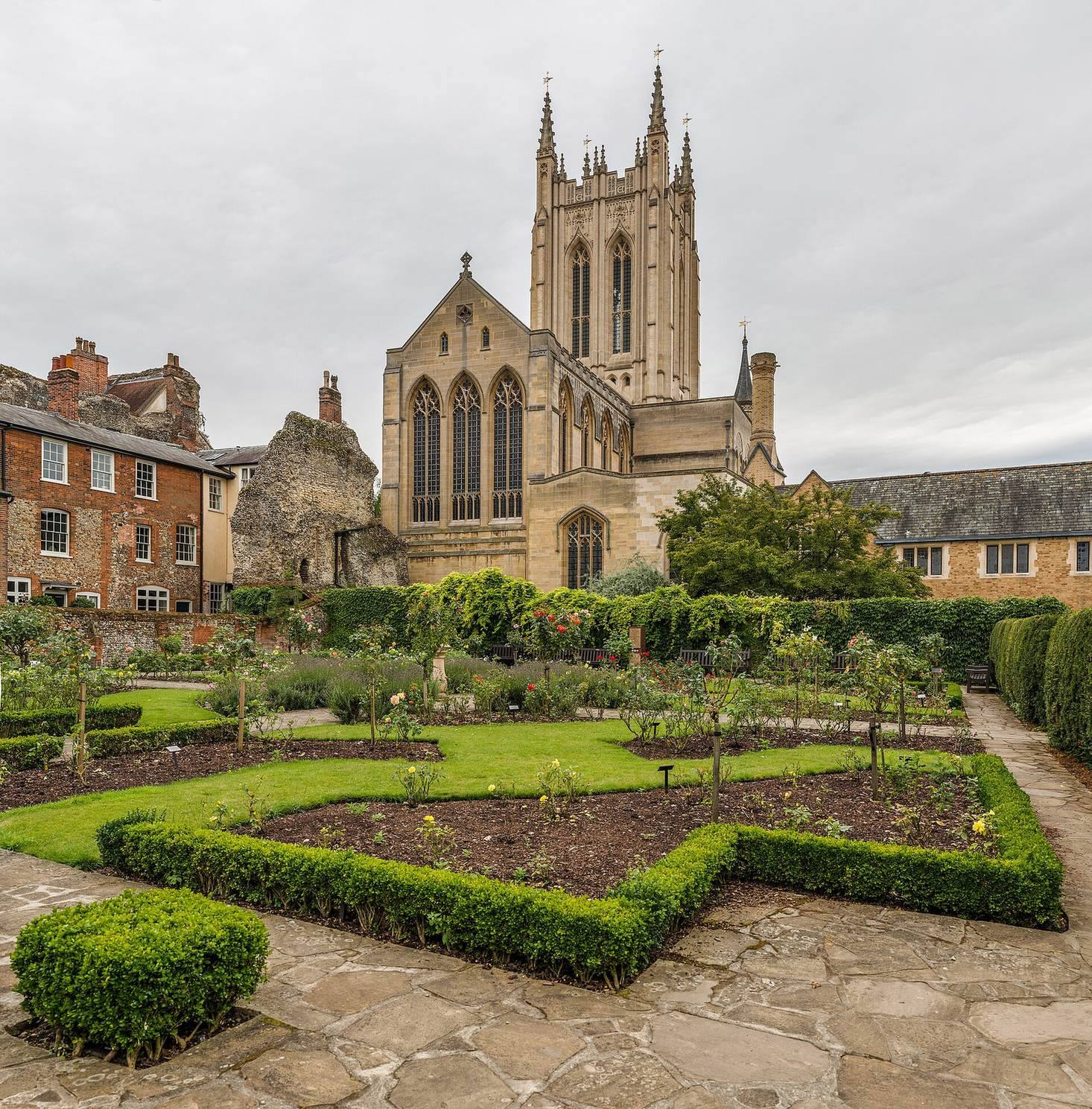
The Gothic Revival Millennium Tower rises 150 feet (46 metres). Its 600,000 bricks are faced with Barnack and Clipsham stone. Hugh Mathew, an associate of cathedral architect Stephen Dykes Bower, designed the tower.
Church additions
The cathedral’s expanded plan includes a cloister, or covered walkway, on the west side, transepts, a Lady Chapel dedicated to the Virgin Mary, and a chapel dedicated to St Edmund. Other parts of the complex include the Chapel of the Transfiguration, the East Cloister, and the Crypt Treasury.
Interior and furnishings
Ancient Library
The Ancient Library occupies a room above the north-west porch.
Font
The baptismal font, designed by George Gilbert Scott in 1870, rests on a medieval support. Frank Ernest Howard of Oxford made its cover, and its decoration was added in 1960.
Stained glass
Most of the stained-glass windows are Victorian. Those along the north side of the nave show scenes from the Old Testament, while the south-side windows depict scenes from the New Testament. The medieval Susanna window has Flemish glass in its lower section and English glass above. The west window, dating to about 1900, depicts the Last Judgment.
Organ and painted ceiling
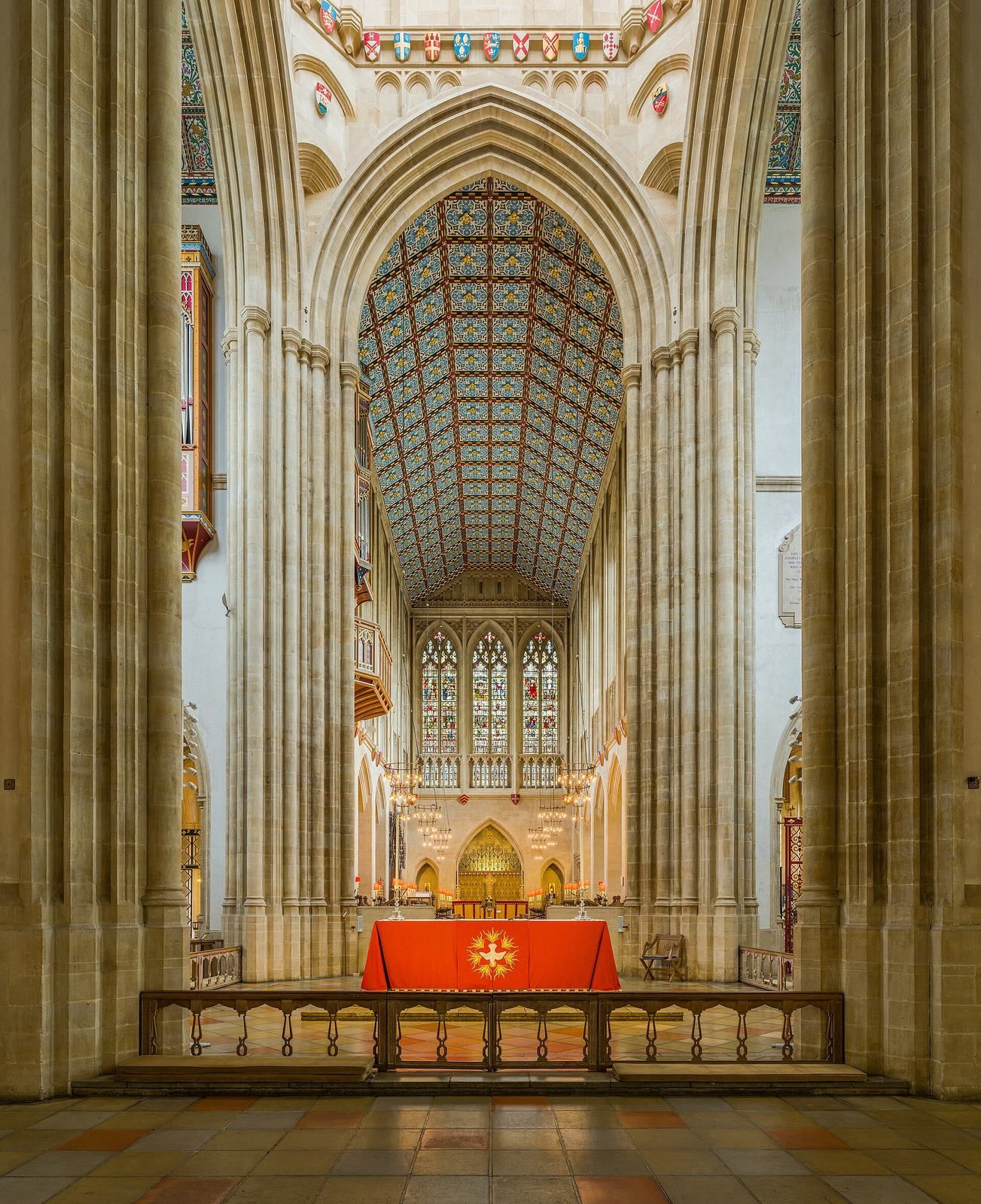
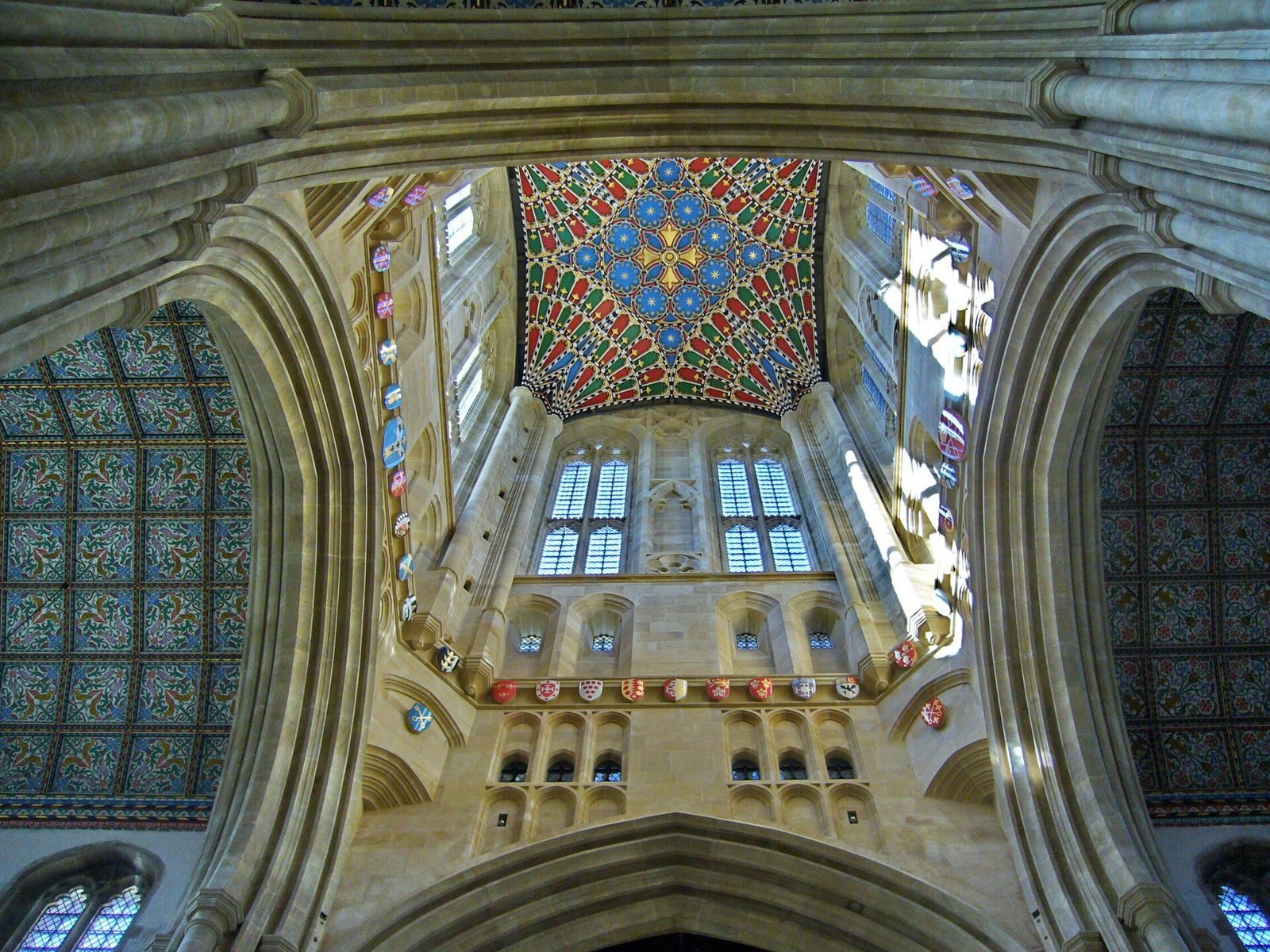
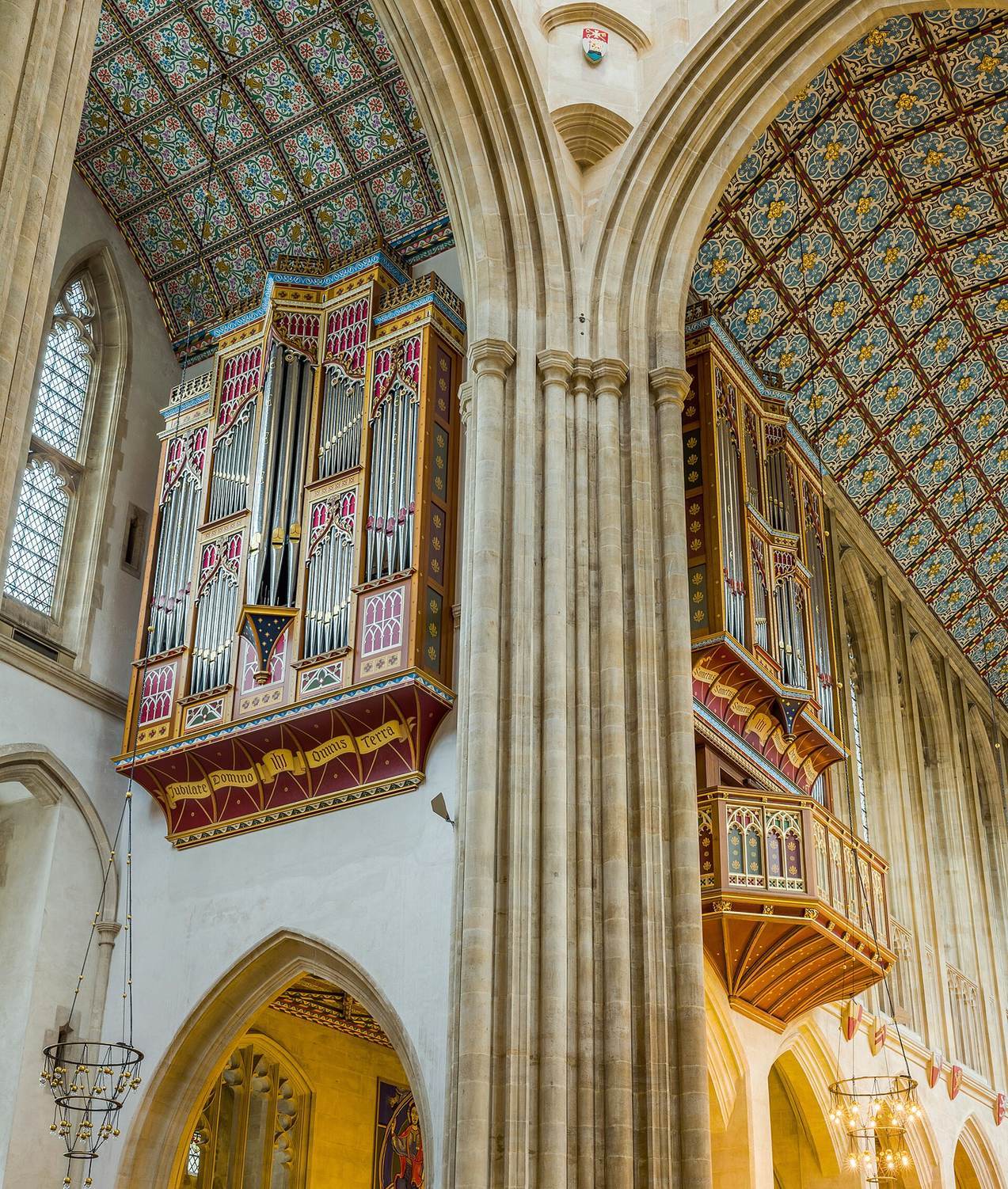
Harrison and Harrison rebuilt the organ in 2010, incorporating pipes from its predecessor. The instrument can also accompany services in the quire. A painted and gilded vaulted ceiling was completed in the same year.
Artworks
Brian Whelan’s painting The Martyrdom of St Edmund hangs in the Lady Chapel. Elisabeth Frink’s sculpture Crucifixion stands beside the Treasury steps.