Church on the Hill: A Gothic Church in Sighișoara, Romania
Site at a Glance
- Popularity
- Medium
- Country
- Romania
- Primary era
- Medieval
- Eras represented
- Medieval, Early Modern, Modern
- Civilizations
- Austrian Empire, Habsburg, Hungarian
- Site type
- Religious
- Remains
- Fortified Church
On this page20 sections
History
Early churches and medieval rebuilding
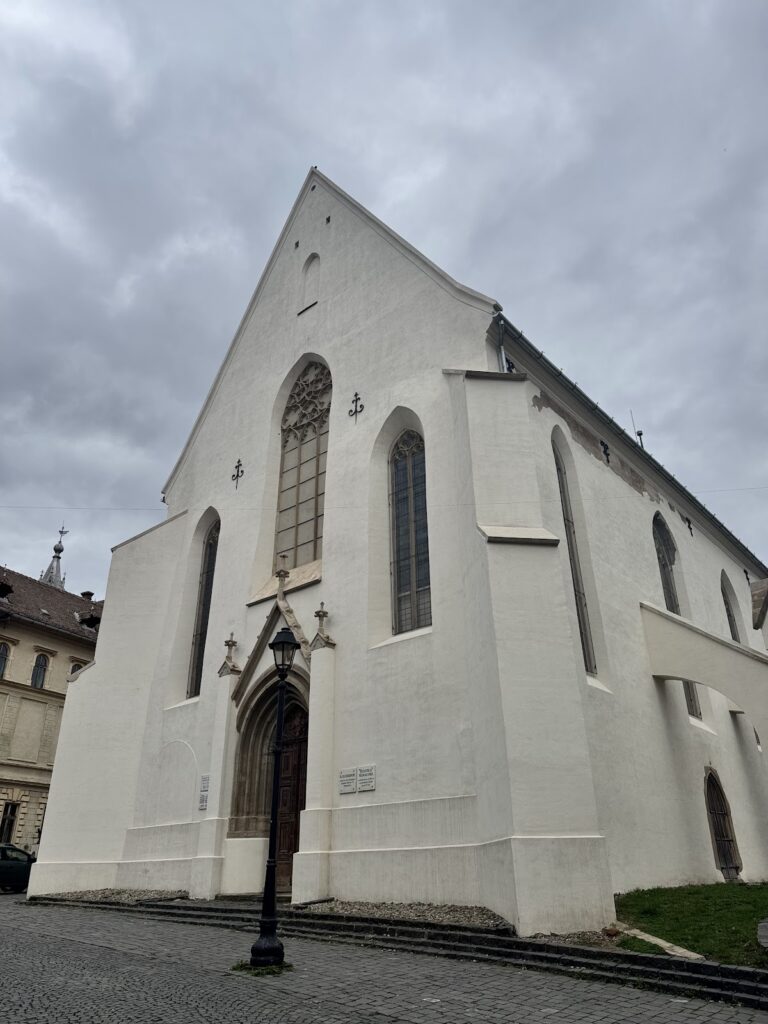
The Church on the Hill is a three-aisled church in the Gothic style, a medieval architectural tradition, on School Hill in Sighișoara, Romania. Its principal late-medieval building campaign began in 1429 and is generally considered complete by 1525. An earlier Romanesque chapel, built in an earlier medieval style, and a defensive tower stood on the hill by the mid-12th century. The chapel probably had one aisle and a semicircular end. A fortified predecessor may have occupied the site before the 13th century.
An early-13th-century basilica, a church with a central nave and side aisles, was built over the earlier church. In the 14th century it was remodelled as a Gothic hall church, in which the side aisles rise nearly to the height of the nave. Pope Boniface VIII issued an indulgence in 1298 in support of the chapel’s construction. In medieval Catholic practice, an indulgence granted remission of temporal punishment for sins under prescribed conditions.
The church’s first written mention comes in a 1345 document. In confirming Sighișoara’s privileges, Louis I of Hungary, also known as Louis the Great, noted that townspeople were building a church dedicated to Saint Nicholas, an early Christian bishop widely venerated as a saint. An inscription on a south window names Michel Polner, then mayor, who probably helped advance the work. Inscriptions also place the start of a major building campaign in 1429, indicate that a side aisle was finished by 1483, and record a building phase completed in 1488 under Jakob Kendlinger of St Wolfgang.
Reformation and early modern events
The Transylvanian Saxons adopted Lutheranism in 1544. In 1630, George Rákóczi I was elected prince of Transylvania inside the church. A storm tore away the roof in 1597, and during unrest in 1601 the church was plundered by Szeklers, a Hungarian-speaking community historically associated with Transylvania. Twelve life-size silver statues of the apostles were stolen. Repairs followed in 1654 and 1655.
A fire that devastated Sighișoara on 30 April 1676 also burned the church, which was rebuilt two years later. During a Kuruc attack on 23 January 1704, insurgents fighting Habsburg rule in the Kingdom of Hungary set fire to the roof and bell tower, destroying the bell. Further repairs took place in 1728. The church’s frescoes were whitewashed in 1777. The large bell was recast by Michael Thallmann in 1797.
Changing use and nineteenth-century damage
The former Dominican monastery church was easier to reach and became the congregation’s principal place of worship. The Church on the Hill consequently declined, despite repairs, and from the late 18th century into the 19th it served the school community. Students cared for its garden, while third- and fourth-year seminary students were required to preach there.
An earthquake in 1838 destroyed the vaults over the choir and church hall. The choir vault was later replaced with a wooden replica. In 1849, troops under Polish General Józef Bem devastated the interior.
Restoration and later use
Frescoes came to light during restoration in 1934. Damage in the 1977 Romanian earthquake, including stones falling from the triumphal arch, made entry unsafe and ended worship at the church for a time. The congregation again relied on the former Dominican church.
A comprehensive restoration carried out from 1992 to 2003 began with structural stabilisation and renewal of the roof structure and covering, then turned to historically important features such as frescoes and furnishings. The church was reconsecrated on 24 April 1999, and the restoration received a Europa Nostra award in the mid-2000s. Following thefts from other churches in 1999, the Evangelical Church of the Augsburg Confession in Romania encouraged congregations unable to secure valuable furnishings to move them to safer churches. As a result, the Church on the Hill received artworks and furnishings from other Transylvanian churches.
The church belongs to the Sighișoara district and parish of the Evangelical Church of the Augsburg Confession in Romania. It is now used mainly for cultural purposes, with occasional worship. Sighișoara’s historic centre, including the church, became a UNESCO World Heritage site in 1999.
Remains
Plan and exterior
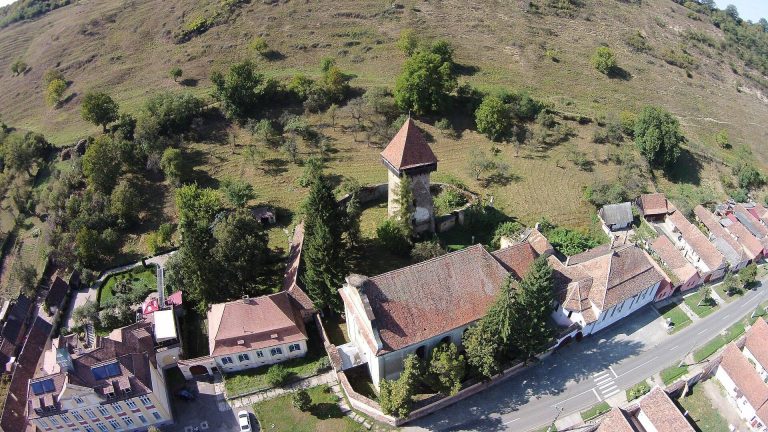
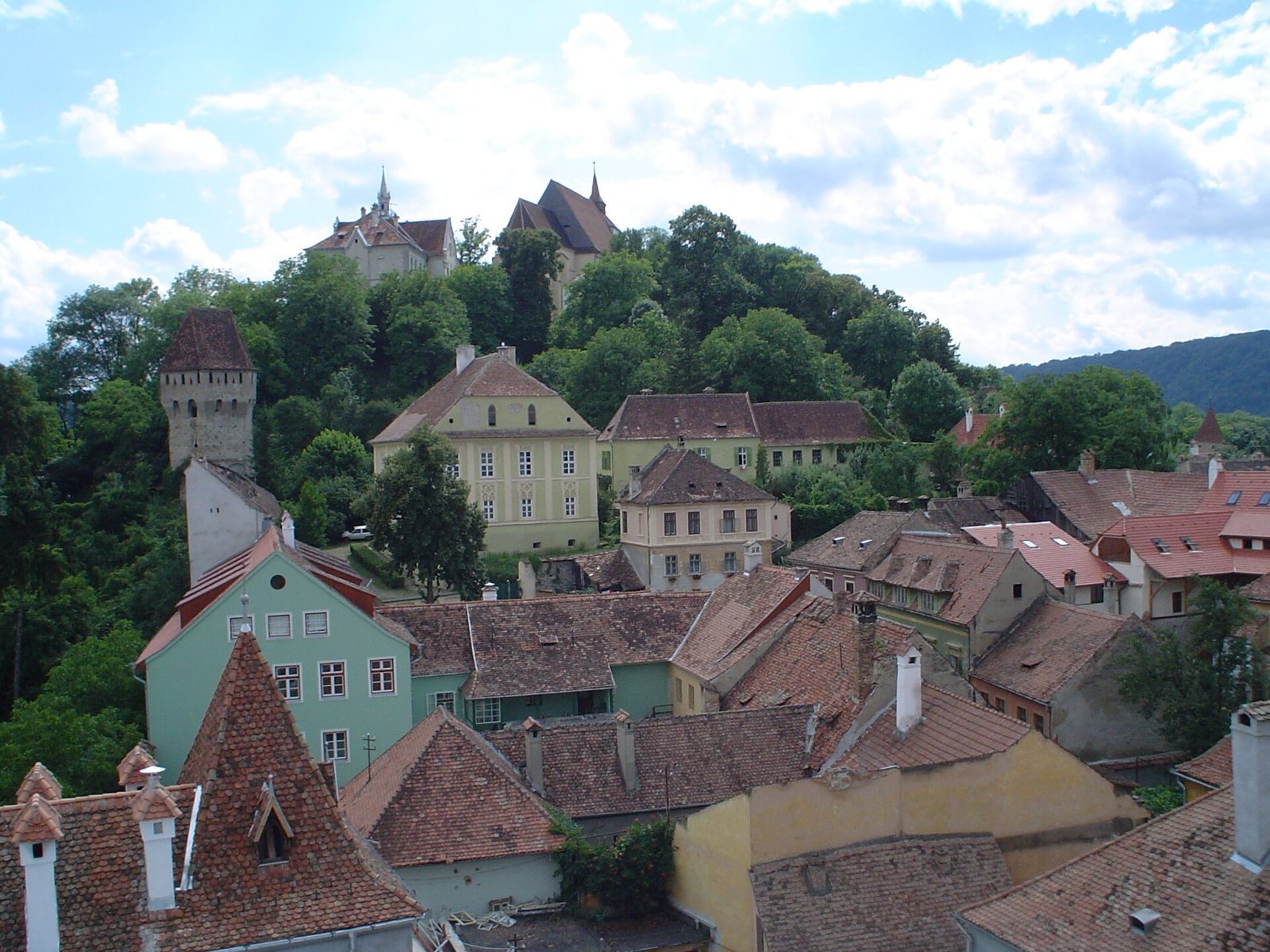
The Gothic hall church stands on School Hill, 429 metres above sea level. The school and associated buildings lie to its north and east, with the cemetery to the south. The building is 53 metres long, and the choir accounts for about a third of that length. It is described as the fourth-largest Gothic church in Transylvania.
Church plan and supports
Octagonal piers divide the interior into a central nave and side aisles. The north aisle is 5.2 metres wide and the south aisle 3 metres wide. Ribbed vaults, vaulted ceilings supported by projecting ribs, cover the interior. Plain external buttresses support the nave. The choir vault is a wooden replica, following the destruction of the earlier vault in the 1838 earthquake.
Bell tower
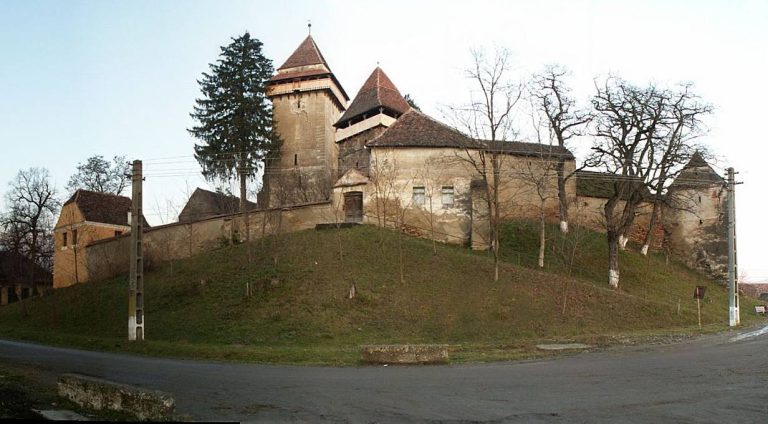
The tower’s base measures 11 metres square. Its rough, unplastered stone shaft rises 24 metres, and the roof-top pavilion and pointed spire bring its total height to 42 metres. The structure leans slightly to the south and has a curved spire. Windows and narrow openings in the tower served as loopholes for firing weapons and throwing objects. The side aisles meet the tower without being bonded into its walls, indicating that they were built later.
Façades and portals
The west front is dominated by the tower, with Gothic sound openings, horizontal bands, and a projecting late-Gothic porch between the aisle walls. Buttresses and three-part windows with stone patterns divide the south façade. Its richly moulded portal has an arch formed by projecting masonry and a triangular decorative gable with small ornaments and a finial, framed by pinnacles. The choir buttresses rise to a cornice below the eaves, where small gables top them; statues beneath canopies stand about two-thirds of the way up.
The north façade follows a similar arrangement. A four-part window above a projecting band draws attention to the north portal, dated 1495. The portal bears the arms of Sighișoara and Władysław II, king of Hungary and Bohemia in the late 15th and early 16th centuries. Its wooden door carries the inscription W.R.U.B. 1495, expanded as Wladislaw Rex Ungarie et Boemiae. The royal arms appear on the left and the town arms on the right. The south portal and its porch date to 1525. Moulded lower courses run along the aisles and choir.
Interior and painted decoration
Crypt and funerary sculpture
Beneath the choir is a Romanesque crypt, an underground chamber, with three windows visible from outside. It is described as the only known crypt beneath a choir in Transylvania. In the 18th century it was converted into a burial chamber, with three rows of coffin niches on each side for priests and wealthy townspeople. The niches were walled up during restoration between 1992 and 1999. Funerary sculpture includes a tomb for an unidentified priest, dated to around 1500, and the tomb of parish priest István Kalmus, dated 1528.
Frescoes and their subjects
Frescoes, paintings made on plaster, once covered interior walls and parts of the exterior. They date from the 14th to the 16th centuries. The earliest, from the late 14th century, include angels carrying instruments of torture and an image of Saint Ursula. Other subjects include the Crucifixion, the Trinity between Abraham and Jeremiah, scenes from the legend of Saint Nicholas, and the Passion, the suffering and death of Jesus. Beneath the arch supporting the south vault, a painting discovered in 1998 arranges the Crucifixion, the Trinity, and Saint Nicholas’s legend in three registers.
Choir and triumphal arch paintings
On the north side of the choir, a kneeling Mary Magdalene is dated to 1483. Scenes of the Passion appear below it and to the left of the stone tabernacle. The triumphal arch, which separates the nave from the choir, bears an image of Veronica’s veil held by two angels, alongside a donor image and the painters’ guild arms. The paintings made around 1483 in the choir and on the arch are probably by Valentinus Pictor.
Aisle and tower paintings
The east wall of the north aisle carries a Last Judgment assigned, on stylistic grounds, to the first quarter of the 16th century and belonging to a Netherlandish image tradition. A scene of Saint George fighting the dragon survives on the north-aisle wall and is broadly dated to the 15th century. Near the north entrance are images of the Archangel Michael and the Apostle Matthew; another shows Michael weighing a soul, and the Matthew painting bears the date 1483. Fragments on the tower’s ground floor depict the life of Saint Francis and the Passion. Beneath the balcony, the north wall shows Saint Christopher carrying the Christ Child, while the south wall depicts the torture of Saint Nicholas. The aisle paintings dated 1488 are probably by Jakob Kendlinger. An Adoration of the Magi is attributed to the Austrian artist Petrus Lantregen.
Furnishings and memorials
Altars and tabernacle
A winged altar, an altarpiece with hinged side panels, dated 1513 stood at the end of the north aisle. A pre-Reformation main altar from the church of Schaas is now in the choir. The choir’s late-medieval stone tabernacle, a fixture for displaying the consecrated host, stands on its north side and retains its original iron grilles and grille door.
Fonts and choir stalls
A baptismal font beneath the triumphal arch bears an inscription dating it to 1480; its maker is unknown. Before the Reformation it served as a holy-water vessel. A separate font, dated 1440, came from Segesd. The choir stalls, carved and inlaid by Johannes Reychmuth in the 1520s, have Sighișoara’s arms at the centre of their crowning cornice. An inscription on the back warns those unable to speak Latin to stay out rather than risk being driven away with a cudgel.
Transferred furnishings and tombstones
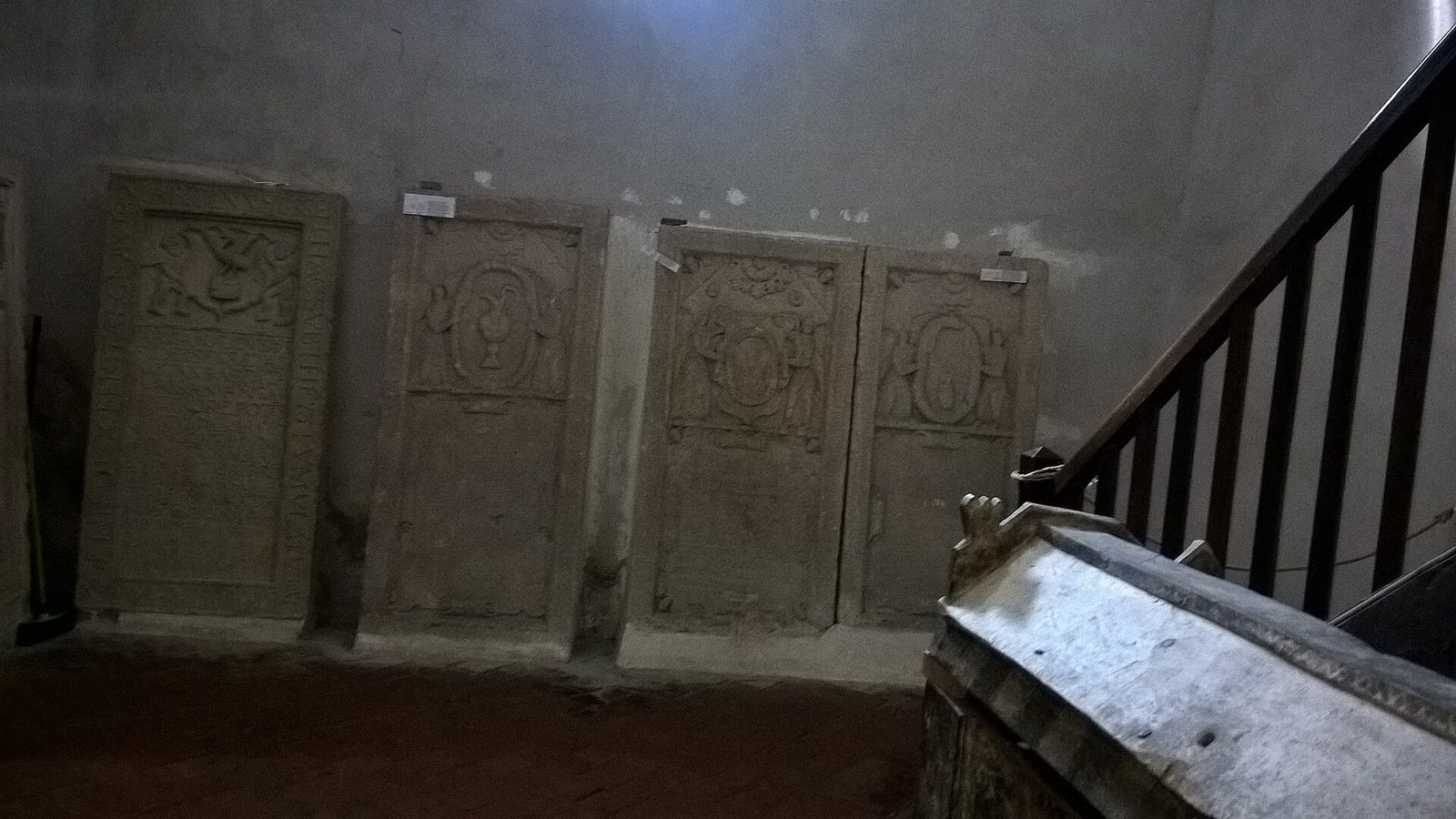
The church holds altarpieces or winged altars from Cund, Segesd, Mese, and Homorod-Bene, as well as furniture from Hégen and Șenereuș. Fonts, tombstones, and altars from abandoned churches include objects from Cund, Șaeș, and Beia. An old altar from Sighișoara’s former Dominican monastery church is also kept here. Among the tombstones carved by Elias Nicolai are those of former mayor Stephanus Mann and Georgius Krauss.
Organ
The installation date of the first organ is unknown. A record from 1839 describes a small, portable positive organ, and an instrument built by Carl Schneider was installed in 1858. It has a four-octave keyboard and nine stops, which select sets of pipes. Its tin pipes were confiscated for the war effort in 1916 and replaced with zinc pipes in 1928.