Church of the Visitation in Sejny: A Dominican Church and Marian Shrine
Site at a Glance
- Popularity
- Medium
- Country
- Poland
- Primary era
- Early Modern
- Eras represented
- Early Modern, Modern
- Civilizations
- Polish–Lithuanian Commonwealth, Russian
- Site type
- Religious
- Remains
- Sanctuary
On this page11 sections
History
The Church of the Visitation in Sejny, Poland, is a Roman Catholic church begun by Dominican friars in 1610 and completed in 1619; its late Renaissance fabric was later transformed in the Vilnius Baroque style. It became a pilgrimage destination associated with devotion to Mary and, for a time, the cathedral of the Diocese of Augustów.
Dominican foundation and Baroque rebuilding
Dominican friars arriving from Vilnius in 1602 established the community that built the church. Jerzy Grodziński, a Polish-Lithuanian nobleman and benefactor, was the principal founder of the Dominican establishment. Bishop Jerzy Tyszkiewicz consecrated the church in 1632 under the dedications of the Blessed Virgin Mary, Saint George, and Saint Hyacinth.
From 1610, the church drew pilgrims, particularly those devoted to Mary. A wooden Madonna and Child figure came to the Dominican community in the early seventeenth century and was placed in the church in 1619. The friars cared for the figure until diocesan priests assumed that responsibility in the nineteenth century. Marian devotion reached a high point in the eighteenth century, when the image was reputed to perform miracles.
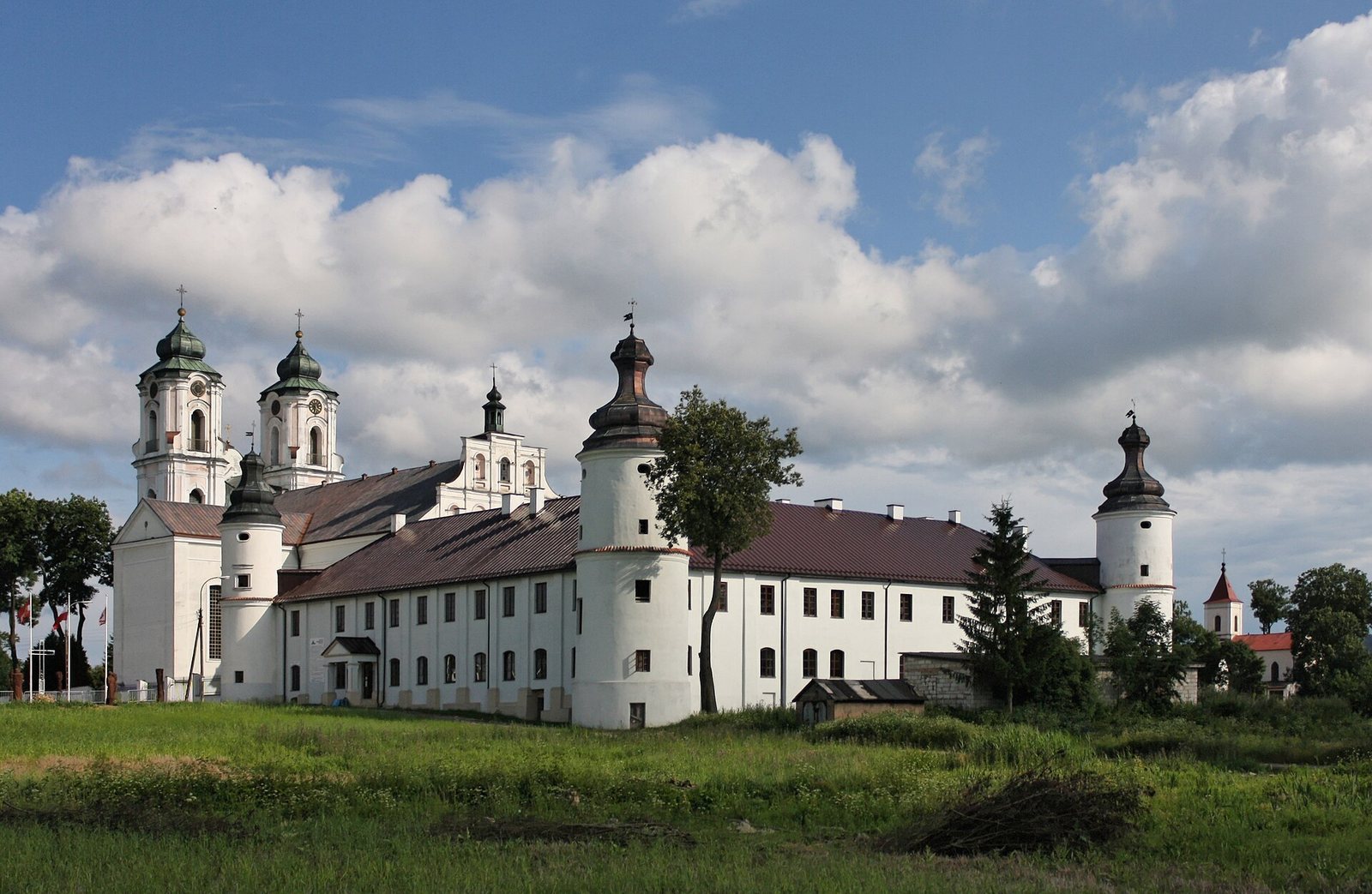
The monastery was completed in 1706. Between 1760 and 1779, Róża z Platerów Strutyńska, its principal patron, supported a substantial rebuilding in the Vilnius Baroque tradition, a regional form of Baroque architecture associated with Vilnius. The work altered the church’s orientation, lengthened its interior by two bays, and replaced the former presbytery with a monumental façade with two towers. Buildings attached beside the nave and presbytery were removed, as was a bell tower north of the church.
Cathedral and seminary
Prussian authorities dissolved the Dominican monastery in 1804, and the church became a parish church. From 1807 to 1817, a lyceum operated in rooms in the monastery under the direction of priest Wojciech Szweykowski, later rector of the University of Warsaw.
In 1818, the church became the cathedral of the Diocese of Augustów, also called the Diocese of Sejny. Pope Pius VII established the diocese after the Diocese of Wigry was suppressed. A diocese is a territorial church district; this one existed from 1818 to 1925 and comprised 12 deaneries, subdivisions of the diocese. Its territory extended from Wysokie Mazowieckie and Łomża in the south to Kalvarija, Marijampolė, and Vilkaviškis in the north. The former monastery buildings housed the bishop, the diocesan curia, or administrative offices serving the bishop, and a seminary, which trains candidates for the priesthood.
A seminary opened there in 1826 after Bishop Mikołaj Manugiewicz secured government support. It educated clergy for the diocese, including future Lithuanian church leaders and activists who contributed to the developing Lithuanian intelligentsia.
Parish and shrine in the modern era
In 1925, following the establishment of the Polish and Lithuanian republics, the Diocese of Augustów was divided between the dioceses of Vilkaviškis and Łomża. The bishops’ residences moved to those cities, and the Sejny church ceased to be a cathedral. It continued as a parish church and local pilgrimage center. During the interwar years, Marian devotion weakened as Sejny became more marginal and its borderland position less central.
A revival of the shrine began in the 1970s. In 1973, the church received the title of minor basilica, an honorific status granted by the Roman Catholic Church, amid plans to develop the Marian sanctuary. The Madonna and Child figure was crowned in 1975. Since 2005, the church has also served as a collegiate church, meaning it is served by a chapter of clergy. It remains a parish church and sanctuary. The former monastery also houses a diocesan and ethnographic museum established and operated by the Sejny Society for the Protection of Monuments.
Remains
Plan and exterior
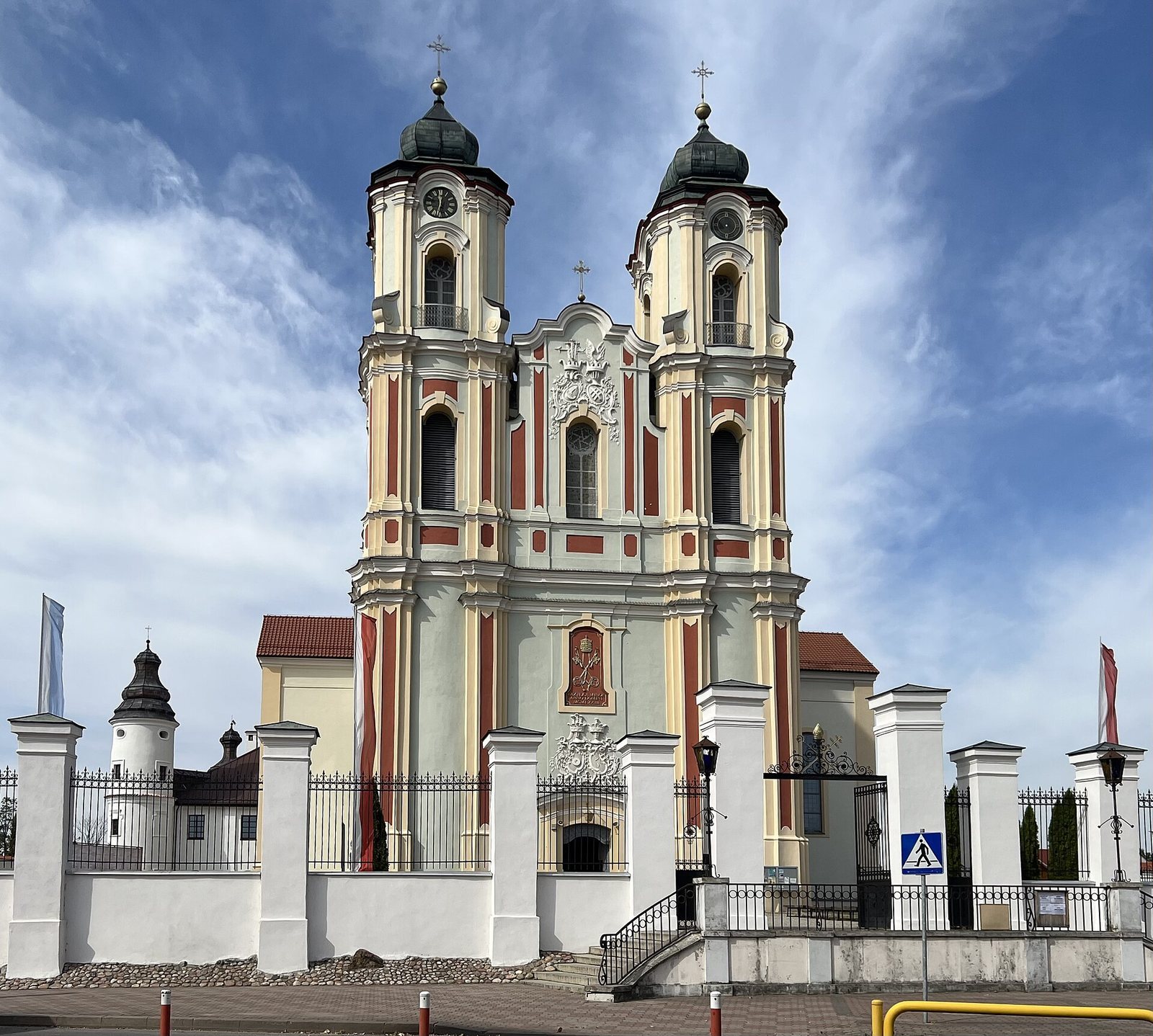
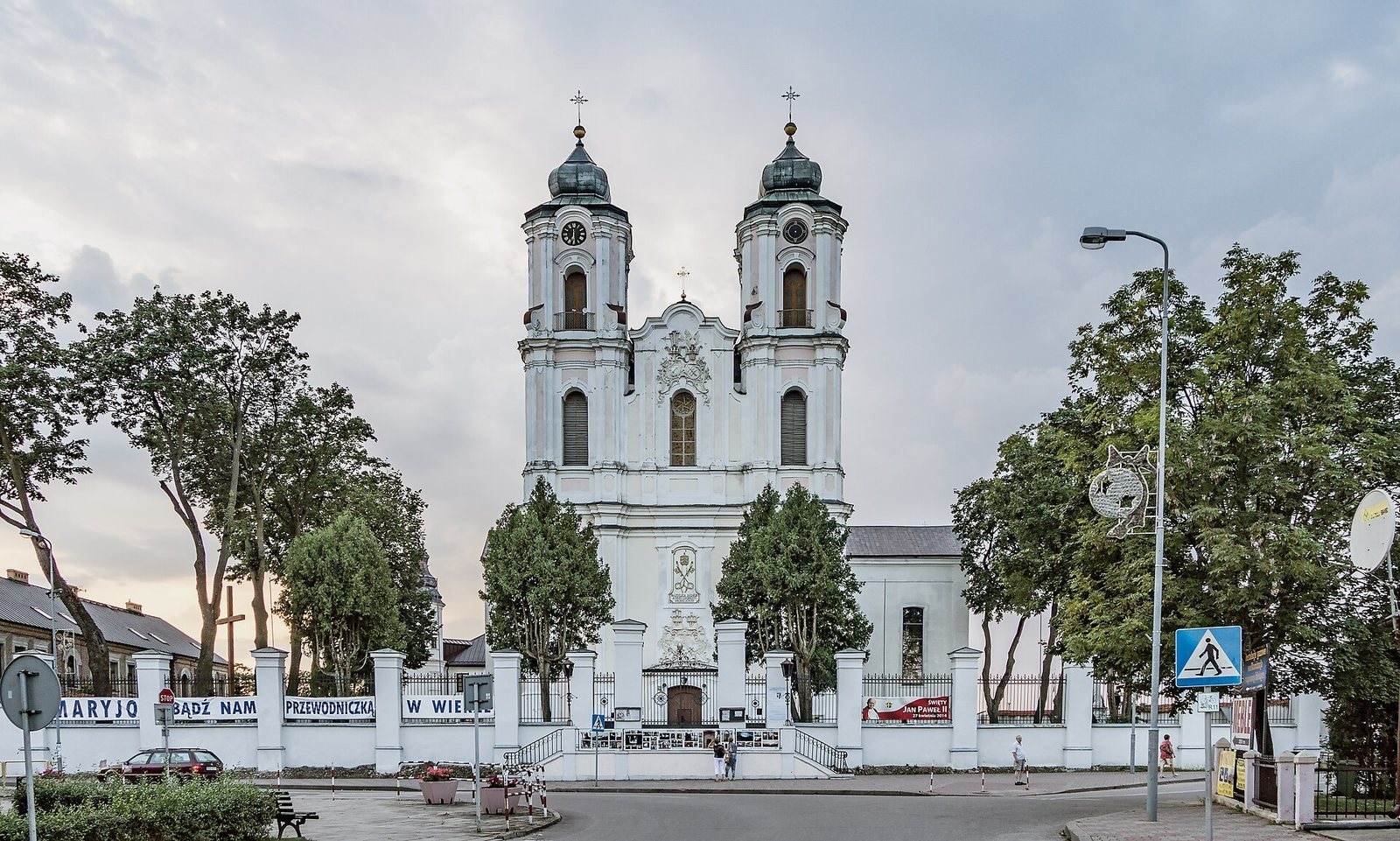
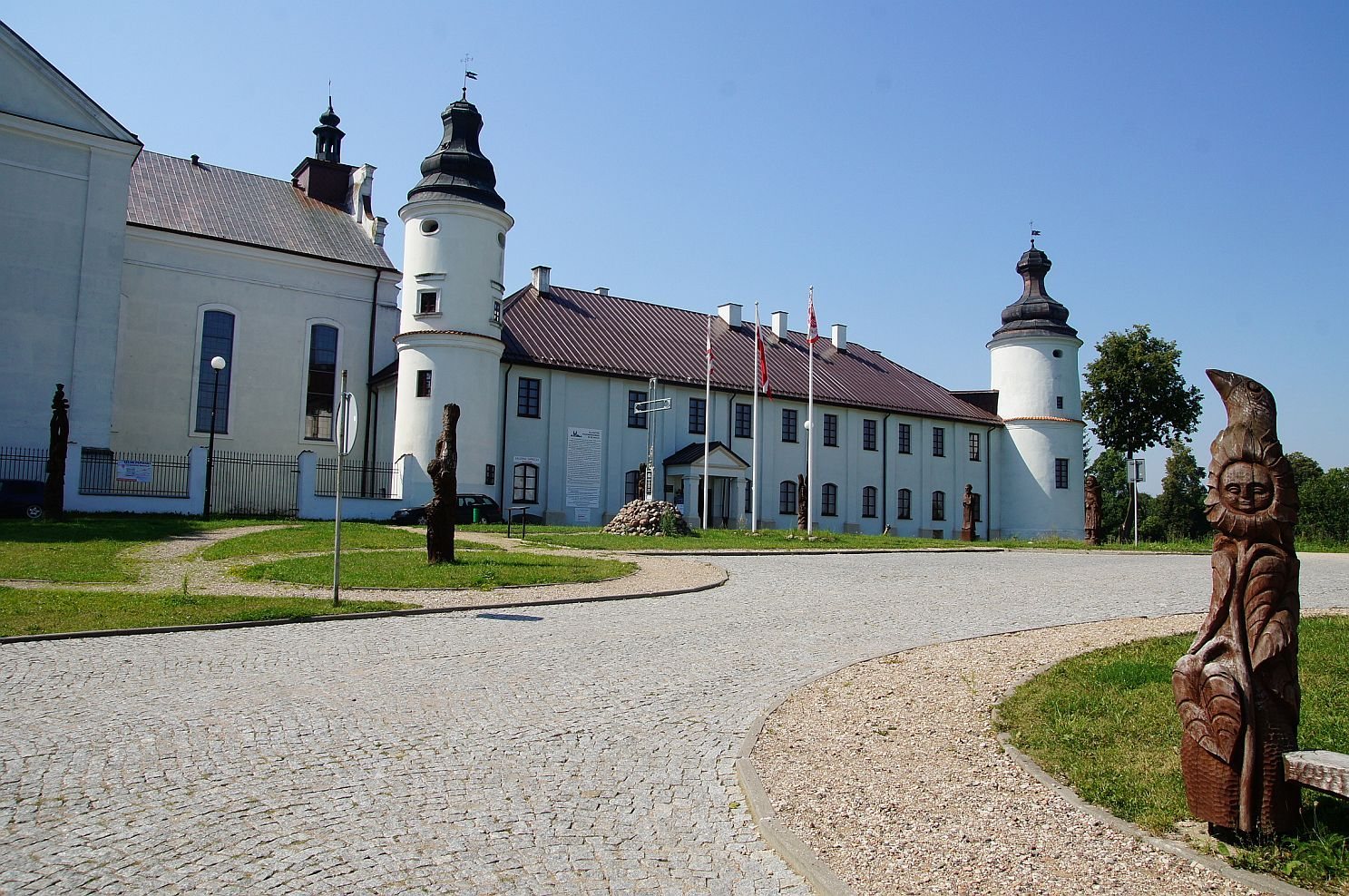
The church forms the eastern part of the former Dominican monastery complex and is built of brick with plastered surfaces. Its plan is an asymmetrical cross, a form attributed to chapels of different shapes. The principal two-towered façade stands at the eastern end, although the building is described as facing west. The façade rises in a strongly vertical, three-part composition, and its towers have Baroque roofs. They rank among the largest in the Podlaskie region.
Interior and furnishings
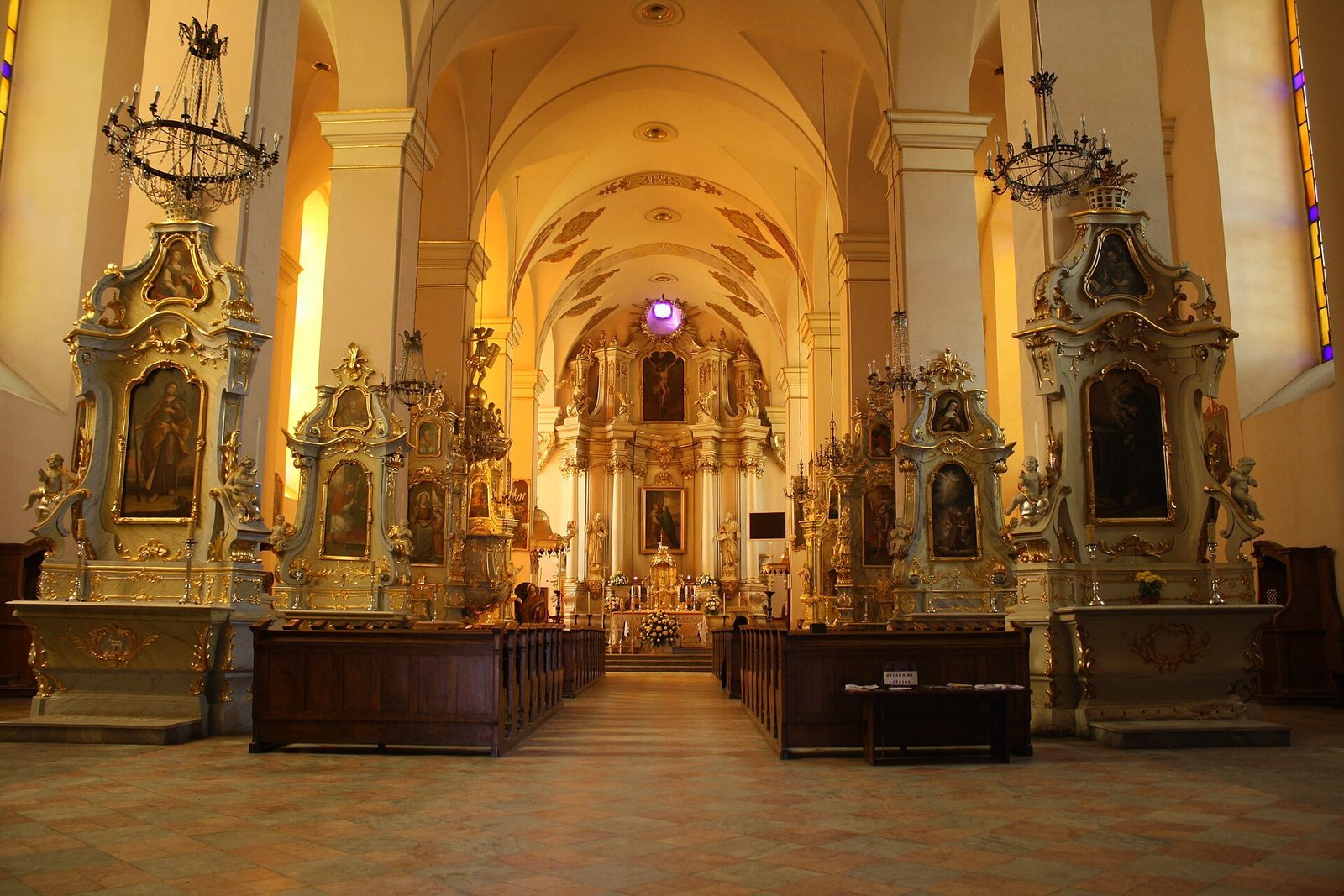
The interior is a six-bay hall, divided into sections by its supports, without a separate presbytery, the area around the altar reserved for clergy. Barrel-shaped vaulted ceilings with curved openings rest on massive square pillars with attached pilasters. In the western bay, a vestibule occupies the ground level and a music choir sits above it.
Chapels
The church contains the Chapel of the Sacred Heart, dating to 1661, and the Chapel of Our Lady, dating to 1881. Their differing forms contribute to the asymmetry of the church’s plan.
Madonna and Child
The wooden Gothic Madonna and Child figure dates to the fifteenth century. It is arranged as a triptych, an object divided into three parts, and is among the church’s particularly valued features. Comparable figures are rare in Europe.
Altars and organ
Most of the altars, paintings, vessels, and other religious furnishings are Baroque, chiefly from the eighteenth century. A Neo-Baroque organ built in 1907 by Jonas Garalevičius stands in the main nave on the site of the former presbytery.
Chapel of Saint Agatha
A separate Chapel of Saint Agatha, dating to 1789, stands in the square in front of the church.