Church of the Assumption: A Late Gothic Pilgrimage Church in Kájov, Czechia


Site at a Glance
- Rating
- 4.8
- Popularity
- Very Low
- Country
- Czechia
- Primary era
- Medieval
- External website
- Open
- Eras represented
- Medieval, Early Modern, Modern
- Civilizations
- Habsburg, Holy Roman Empire, Kingdom of Bohemia
- Site type
- Religious
- Remains
- Church
On this page19 sections
History
The Church of the Assumption of the Virgin Mary is a Roman Catholic parish and pilgrimage church in Kájov, Czechia. Its present building is a major late Gothic monument, constructed in the fifteenth century and later altered with Baroque furnishings and additions. The church belongs to the Czech Province, the Diocese of České Budějovice, and the Český Krumlov Vicariate, and remains associated with the veneration of the Virgin Mary of Kájov.
Origins and medieval development
Local tradition connects the site with Saint Wolfgang, a tenth-century bishop and missionary traditionally associated with the Christianization of parts of Central Europe. During his missionary journey to Bohemia, he is said to have stopped at Kájov and founded a wooden chapel beside a spring believed to possess miraculous powers. In the second half of the thirteenth century, the wooden structure was replaced by an early Gothic chapel dedicated to the Dormition of the Virgin Mary.
In 1263, King Přemysl Otakar II granted Kájov to Zlatá Koruna, a newly founded Cistercian monastery. The Cistercians were a Catholic monastic order whose religious houses emphasized communal worship, disciplined monastic life, and the management of associated estates. At Kájov, the monastery promoted devotion to the Virgin Mary. A new Church of the Assumption was built beside the earlier chapel during the fourteenth century, and a sacristy belonging to this phase is mentioned in 1461.
The earlier Church of the Assumption was burned by the Hussites in 1422. The Hussites followed the reform movement associated with Jan Hus, and the Hussite Wars brought widespread military destruction to Bohemia during the fifteenth century. Michael Pils became parish priest of Kájov on 24 November 1460. After Hilarius of Litoměřice, the administrator of the Prague archdiocese, prohibited popular pilgrimages to a stone near Kladenské Rovné that was believed to bear Saint Wolfgang’s footprints, Pils commissioned a Saint Wolfgang altar in the church in 1466. The altar was intended to direct devotion away from elements regarded as pagan superstition.
Pils began work on a large late Gothic replacement for the burned church in 1471 or 1474. The building was completed in 1485. Late Gothic architecture, the later medieval Gothic tradition, is expressed at Kájov through pointed openings, rib vaults, slender supports, tracery, and elaborate stonework. According to tradition, the high altar of the new church was placed at a spring whose healing water was associated with the late Gothic Kájov Madonna, venerated as the miraculous Virgin Mary of Kájov.
Reformation and the return of pilgrimage
After Kájov became Protestant, pilgrimages ceased. Marian devotion returned to particular prominence during the post-White Mountain Baroque era, after the Cistercians returned in 1656 and Matěj Aleš Ungar became parish priest. Baroque architecture and decoration, added mainly during the seventeenth and eighteenth centuries, favored rich ornament, dramatic altars, and sculptural effects. These changes reshaped both the church and the wider pilgrimage complex.
A hospice for pilgrims was built opposite the church in 1630. It later served as an inn and school. In 1661, a new rectory replaced the earlier parish building, and a chapel dedicated to Saint John of Nepomuk was inserted into it in 1699. Saint John of Nepomuk was a fourteenth-century Bohemian priest and martyr who became an important Catholic saint in Central Europe. The chapel was created because the existing confessionals could not accommodate the number of pilgrims.
The pilgrimage route from Český Krumlov to Kájov was marked in 1667 by fifteen granite columns bearing images of the mysteries of the Rosary. It began behind the enclosure of Český Krumlov Castle and ended below the church. A chapel with a well was built at the route’s terminus in 1686 to 1689, and water from the spring associated with the high altar was conducted there. Pilgrimages took place from spring until winter and were especially connected with Marian feast days. Four principal pilgrimages were held in October and were known as the “Golden” pilgrimages.
Baroque work at the church included a new sacristy and new pews. After lightning struck the tower in 1690, Giovanni Canevale repaired and raised it. The exterior was repainted white, with grey cornices and quoins, and the date 1690 was placed in a medallion on the tower’s eastern side. During the eighteenth century, the church received further furnishings, including its present high altar.
Josephine reforms and later changes
Reforms under Emperor Joseph II weakened Kájov’s pilgrimage tradition. Zlatá Koruna Monastery was dissolved in 1785, the church passed to the Schwarzenberg family, and secular priests took over pastoral care. Pilgrimages were prohibited, while valuable objects and bells were requisitioned for the state in 1793, 1809, and 1914. Pilgrimages were later restored, although their importance changed over time.
The earlier chapel of the Dormition of the Virgin Mary was connected with the church and rectory by a passage in 1769. This allowed priests to reach the sacristy during large pilgrimages. The passage divided the chapel into two parts, creating the Chapel of the Death of the Virgin Mary and the Chapel of Saint Leonard. The partition was removed in the 1930s, but the intervention damaged some vault ribs and Gothic wall paintings.
During the 1930s, German priests of the Oblate order assumed responsibility for Kájov. The Oblates were a Catholic religious family whose members followed an apostolic and missionary religious life. They restored the healing-water well in 1935. The German monks were displaced together with the local German population in 1946, after which the pilgrimage site declined until 1989.
The entire pilgrimage complex was designated a National Cultural Monument in 1995 because of its high artistic value. The parish is administered from Český Krumlov rather than by a resident parish priest. The Sisters of Charity of Saint Vincent de Paul worked at Kájov from 31 July 1996, and their mother house was in Munich. Since October 2012, the Community of the Sisters of Mercy of the Holy Cross has operated at Kájov and has also provided guided tours. The entire complex underwent revitalization in two phases between 2015 and 2022.
Remains
The late Gothic church
Plan, vaults, and exterior
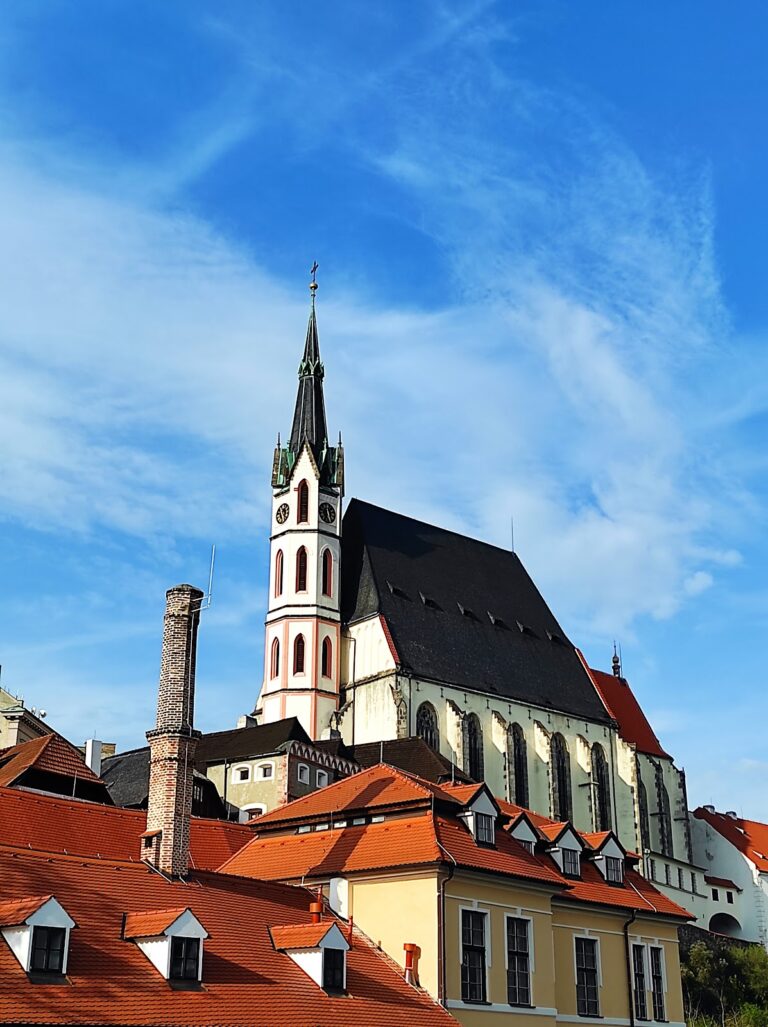
The main church is a masonry late Gothic hall church with two aisles, an elongated presbytery closed on five sides, and a rectangular tower at the southwest corner. The tower was altered in the Baroque period. Along the northern side of the presbytery stand the old and new sacristies, while a vestibule with a northern entrance portal adjoins the church. Stone elements preserve numerous engraved marks made by masons during construction. On the eastern side, a niche between the buttresses contains dates associated with rebuilding.
The presbytery has a net-pattern rib vault known as the Milevsko pattern, modeled on the Church of Saint Giles at Milevsko. Its ribs rise from slender cylindrical shafts with molded capitals and finish in pyramidal corbels. A pointed triumphal arch separates the presbytery from the principal two-aisled space. The star-rib vault rests on two slender octagonal pillars, while a third, asymmetrically placed in the southwest part of the church, supports the tower. The ribs continue into shafts that end in varied corbels. Five-petalled Rosenberg roses are carved at the ends of the triumphal arch.
The western addition contains a stairway to the gallery, which is entered from outside, and the church entrance lies beneath it. The space below the gallery has a net vault, while the area beneath the tower has a star vault. The gallery has a late Gothic stone balustrade with tracery and a Rococo carved grille. Its front, beneath the Baroque organ, preserves fragments of Gothic wall painting around a corbel with an anthropomorphic motif. Two archers flank a stylized knotted branch, suggesting that a statue of Saint Sebastian once stood on the corbel.
Presbytery paintings and high altar
Fragments of fifteenth-century wall painting survive on the northern wall of the presbytery. They include a Madonna in Glory and a Madonna with Donors. Consecration crosses appear on both sides of the altar, and ornamental painting from the first half of the sixteenth century remains on the vaults.
The present Baroque high altar was designed by Andreas Altomonte and built between 1766 and 1769. It rises to the vault and includes a marble mensa bearing the coat of arms of Bohumír Bylanský, abbot of Zlatá Koruna. The late Gothic Kájov Madonna stands at the center, with a Schwarzenberg coat of arms above her. The upper section contains the Holy Trinity and angels, while Saint Joseph and Saint Joachim stand at the sides. Portals beside the high altar carry statues of Saint Benedict and Saint Bernard of Clairvaux. A Latin inscription beneath Saint Bernard records a repair made in 1862.
The presbytery also contains a representation of the Visitation of the Virgin Mary in an ornamental frame matching that of the window opposite the princely oratory. A princely oratory was a reserved worship space for an aristocratic patron, allowing participation in services apart from the main congregation’s seating.
Side furnishings and entrance features
The medieval side-altar mensas carry Neo-Gothic altars from 1881 and 1882. Fourteen Stations of the Cross paintings by Antonín Streer of Freistadt, made in 1749, hang on the walls. Eighteenth-century pews and Baroque ornamental fittings remain inside the church. Other furnishings include a marble baptismal font from about 1485, Baroque door locks in the sacristy, and a Baroque pulpit from 1742 bearing the coat of arms of Abbot Kristian Guschl of Zlatá Koruna.
The Baroque organ was made in 1740, and its case also carries Guschl’s coat of arms. The northern Gothic portal has a pointed opening and a saddle-shaped door frame. It is preceded by a vestibule with a cross vault. Paintings from around 1500 depict the four Evangelists on the vault and scenes of the Last Judgment on the walls.
The vestibule contains wooden doors dated 1480. Their ornamental ironwork is accompanied by the coat of arms of České Budějovice. Above them is a Protecting Madonna sheltering representatives of all social estates beneath her mantle. The coat of arms indicates that the doors were donated by a citizen or the council of České Budějovice, whose members regarded the Kájov Madonna as their protectress.
The southern stone portal uses Romanesque forms as a deliberate historic reference within the late Gothic building. A contemporary Protecting Madonna is painted in its lintel arch. Above the southern Baroque iron doors, another painting shows a Madonna in Glory on red medieval plaster dating from around 1500.
The early Gothic chapel
Chapel of the Dormition
The Chapel of the Dormition of the Virgin Mary is an early Gothic structure from the second half of the thirteenth century. Its rectangular presbytery has two bays of cross-rib vaulting. The rectangular nave originally had a flat ceiling and was entered through a pointed, molded western portal that is now blocked.
Paintings in the Chapel of the Death of the Virgin Mary date from around 1370. They include ornamental vault decoration, saints in the upper wall zones, and fragments of illusionistic architecture in the lower zones, best preserved on the north wall. The principal scene shows the Virgin lying on a bed surrounded by the Apostles. Above them, Christ appears within a mandorla, an almond-shaped aureole, and holds her soul as a small human figure.
Saint Catherine and Saint Sigismund appear beside a window on the chapel’s eastern wall. Beneath them is a marble slab with a Rosenberg coat of arms and a Latin inscription stating that the church was completely finished in 1488. The slab probably relates to the Church of the Assumption and was installed in the chapel later. A Baroque altar from 1708 stands at the center, with a late Gothic relief of the Death of the Virgin Mary made around 1490. The relief was produced with the original altar and commissioned by Michael Pils.
Chapel of Saint Leonard
The Chapel of the Death of the Virgin Mary and the Chapel of Saint Leonard are divided by a triumphal arch bearing paintings. Saint Leonard’s chapel has a flat ceiling and retains its former western entrance, a blocked late Gothic saddle-intersecting portal dated 1488.
Paintings in the Chapel of Saint Leonard probably date from around 1400. Beside the triumphal arch are the Holy Trinity, the Archangel Michael weighing the souls of the dead, and Saint Leonard with miniature liberated prisoners at his feet. Two rows of smaller scenes from the life of Christ survive on the northern wall. They include Christ before Pilate, the Flagellation, the Mocking of Christ, Christ’s Descent into Hell, the Ascension, and Pentecost. Other scenes that probably once extended across the wall were destroyed during Baroque alterations.
The chapel’s Baroque altar was made in 1664 by Hans Sturzenberger, a cabinetmaker from Zlatá Koruna. Its central statue depicts Saint Leonard, flanked by Saint Florian and Saint Achatius. Saint Wolfgang appears in the decorative upper section.
Rectory and chapels opposite the church
The rectory and Chapel of Saint John of Nepomuk
The rectory was built in 1661 as a one-storey, rectangular, three-winged building with a gabled roof. The side facing the church has a masonry gable and is covered with wooden shingles. Its restrained early Baroque façades concentrate projecting elements in the crowning cornice and the cornices of the triangular gables, and their design follows that of the church.
An Eggenberg scribe commissioned a painting of the Passion for the rectory façade facing the presbytery in 1678. Part of the painting was covered in 1762 by the passage that connected the rectory with the Chapel of the Dormition and the sacristy. The rectory retains Gothic cellars, courtyard galleries, and Baroque interior details. Rooms with barrel vaults and lunettes included a dining room, staircase, guest room, servants’ room, parish library, and other spaces. The complex also contains stables formerly used for sheep, horses, cattle, and pigs.
The Chapel of Saint John of Nepomuk was built into the rectory in 1699. It is a rectangular, flat-ceilinged space with cornice decoration and angel heads on the ceiling. Three rectangular windows occupy the west wall, opposite a wooden gallery. An iron stove and an inserted wooden confessional stand beneath the gallery.
The altar followed a design by the Prague painter Křišťan Dittmann and centers on a statue of Saint John of Nepomuk donated in 1694 by Daniel Brejcha, chief trumpeter to the Eggenberg prince. Before the chapel was built, the statue stood beside the church’s first pillar. Statues of Saint Procopius and Saint Edmund, made by Filip Rambler of Friedberg, were later placed beside the altar. A small organ was installed in 1704 as a donation from Jan Křišťan of Eggenberg. After the adjoining chaplain’s house was completed, a small bell turret was added above the chapel in 1724.
Chapel of Saint Thérèse
The Chapel of Saint Thérèse was built in 1752 beside the old mortuary opposite the western entrance of the church. Formerly called the Chapel of the Holy Cross or the cemetery chapel, it is a Baroque square building with chamfered corners, cartouche-shaped windows, and a mansard roof with a dormer.
Its interior has a circular arrangement and an altar from 1930. The altar depicts the Madonna and Saint Thérèse of Lisieux, beneath whom the pilgrimage site of Kájov is represented. Two memorial plaques commemorate victims of the Second World War in Kájov.
Wayside shrine and former cemetery
Granite wayside shrine
A late Gothic granite wayside shrine was moved to the area between the Chapel of Saint John of Nepomuk and the old mortuary from Kladenské Rovné. It probably originally stood beside a mill near the road leading to Saint Wolfgang’s Rock at the foot of Žestovská Mountain.
The shrine probably came from the Rosenberg stoneworking workshop. Its middle shaft section was already missing at its former location. The surviving shaft rises from a square base, changes from a four-sided to an eight-sided form, and has claw-like projections at the transition above the base and at its upper termination. The simple canopy has intersecting gabled roofs and two niches. Original sheet-metal images were replaced by paintings in the late twentieth century.
Several dates are carved on the canopy. The date 1508 probably marks the shrine’s creation, while 1718, 1663 beneath an IHS monogram with a cross, and 1925 may record later interventions or events. A carved cross at the top was replaced by an iron cross.
Cemetery boundaries and surviving crosses
The former cemetery partly surrounded the church. Nine forged-iron crosses from the second half of the seventeenth century survive, together with a stone boundary wall capped with clay tiles between the rectory and the Chapel of the Dormition of the Virgin Mary. The wall has three entrances with Gothic stone surrounds associated with the dates 1741 and 1485.
A panel cycle depicting the martyrdom of the Apostles was formerly kept in the Kájov church. It was later moved to Český Krumlov Castle and is now on long-term loan to the local parish at Zlatá Koruna Monastery.
Setting and surviving complex
The church, chapel, rectory, and associated buildings form a complex on the edge of a strategically prominent slope. The position offered natural defensive advantages and also allowed the complex to function as a landmark in distant views. The church remains the dominant visual element from all directions. Together, the late Gothic church, early Gothic chapel, Baroque rectory and chapels, pilgrimage features, paintings, furnishings, and cemetery remains preserve the long development of Kájov as a parish and Marian pilgrimage center.
Nearby sites