Church of St Peter ad Vincula: The Tower of London’s Chapel
Site at a Glance
- Popularity
- Very High
- Country
- United Kingdom
- Primary era
- Early Modern
- Eras represented
- Medieval, Early Modern
- Civilizations
- English
- Site type
- Religious
- Remains
- Chapel
On this page9 sections
History
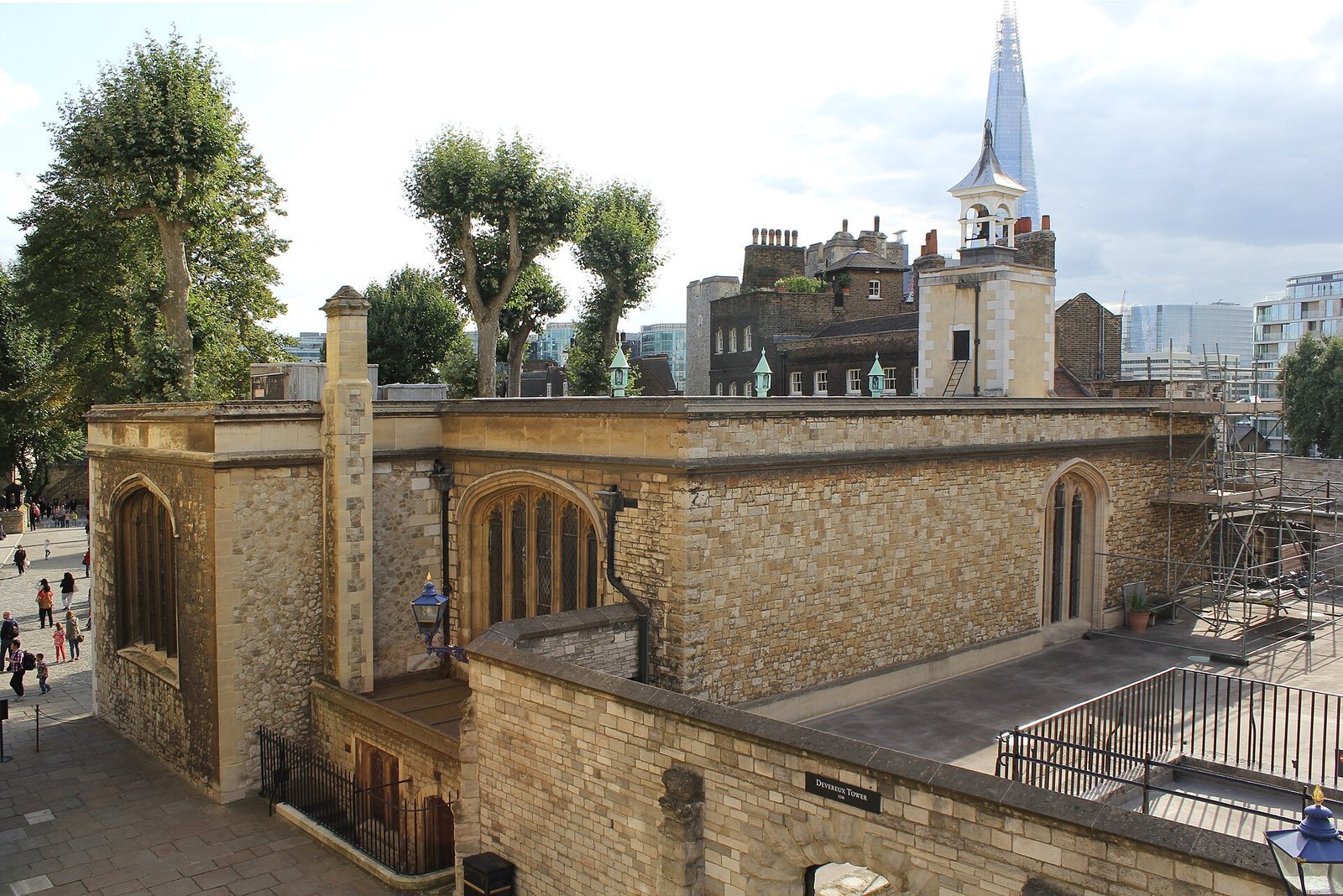
The Church of St Peter ad Vincula is a chapel in the Inner Ward of the Tower of London, United Kingdom. Its present building was rebuilt in 1519–20 in a Gothic style, a broad medieval architectural tradition, with features associated with England’s Tudor dynasty. The name means “St Peter in Chains,” recalling the biblical account of Peter’s imprisonment under Herod Agrippa, a ruler of Judea. The chapel served the Tower’s working community and became a burial place for people executed within the fortress.
Uncertain beginnings and medieval development
The church’s first foundation and location are uncertain. One proposed history places it before the Norman Conquest, the Norman takeover of England in 1066, as a parish church that existed before the Tower became a fortress. Another attributes its foundation to Henry I and suggests it may have been consecrated on 1 August 1110. In that version, it stood outside the Tower’s original walls, allowing the king to worship publicly, while St John’s Chapel inside the White Tower served more private worship.
St Peter ad Vincula served as a parish church for at least a century before becoming a chapel for people working at the Tower in the mid-13th century. It was the fortress’s second chapel, after St John’s. Henry III ordered repairs in 1240. A royal writ dated 10 December 1241 locates the church within the Tower’s bailey, its fortified courtyard, indicating that it had by then been brought inside the walls. In 1286, Edward I ordered a smaller chapel built to replace it.
During Henry III’s reign, at least three recluses, people living a religiously enclosed and solitary life, received support for their expenses at the Tower: Brother William, Idonee de Boclaund, and Geoffrey le Hermit. After 1312, the church probably hosted a ceremonial vigil associated with admission to the Knights of the Bath, a traditional English order of knighthood.
Tudor rebuilding and burials
A fire destroyed the church in 1512. Sir Richard Cholmondeley, then Lieutenant of the Tower, arranged its rebuilding for Henry VIII. William Vertue probably designed the new chapel.
The chapel received the bodies of numerous prisoners executed at the Tower. Among them were Anne Boleyn and Catherine Howard, Henry VIII’s second and fifth wives, and Lady Jane Grey, who was queen for nine days in 1553. Anne’s brother, George Boleyn, was buried there after his execution in 1536. Edmund Dudley and Richard Empson, tax collectors for Henry VII, were buried at the church after their executions for high treason in 1510. Guildford Dudley, Jane Grey’s husband, was interred there after his execution on Tower Green in February 1554.
Sir Thomas More and Bishop John Fisher were buried at the chapel after their executions following conflict with Henry VIII; the Roman Catholic Church later recognized both as martyrs. Philip Howard, imprisoned by Elizabeth I for refusing to abandon Catholicism, died of dysentery in the Tower and was buried at the church before his remains were transferred to Arundel. Other prisoners buried there included Thomas Cromwell, executed in 1540; Thomas Seymour, brother of Jane Seymour, in 1549; and Edward Seymour, Duke of Somerset, in 1552. John Dudley, Duke of Northumberland, and courtier John Gates were connected with the burials following the 1553 dispute over the English succession. James Scott, Duke of Monmouth, was buried there after his execution in 1685.
Royal, regimental, and parish roles
St Peter ad Vincula is a Chapel Royal, serving the royal household, and a royal peculiar, meaning it falls under the monarch’s direct ecclesiastical authority. Its priest is the Tower chaplain, a canon and member of the clergy serving the monarch. The canonry, or office of canon, was abolished in 1685 and restored in 2012, when Roger Hall was installed. The church has had both Roman Catholic and Church of England affiliations.
The chapel is also the regimental church of the Royal Regiment of Fusiliers. Its link with the Tower began when the Royal Fusiliers were raised in 1685 to guard the fortress and its artillery train. Officers of the regiment retain the right to marry in the church.
The chapel served Tower Within, an area outside the ordinary parish system and part of the Liberties of the Tower of London. London’s bills of mortality, records of deaths, began including the area on 16 December 1729. In 1730, inhabitants successfully argued that it lay outside the ordinary parish system, and it was removed from those records. Tower Within became a civil parish, a local-government area, in 1858 under the Extra-Parochial Places Act of 1857. The Tower liberty ended in 1894, and the parish was absorbed into St Botolph without Aldgate in 1901.
Later interpretation and status
In 1848, historian Thomas Babington Macaulay described the chapel’s burial ground as a bleak place associated with the executions and downfalls of prominent people. Renovation work in 1876 uncovered three burials identified as Anne Boleyn, Margaret Pole, Countess of Salisbury, and John Dudley, Duke of Northumberland. The church received Grade I listing in 1989, the highest listed-building category in England, reserved for buildings of exceptional architectural or historic interest.
Remains
The church and its layout
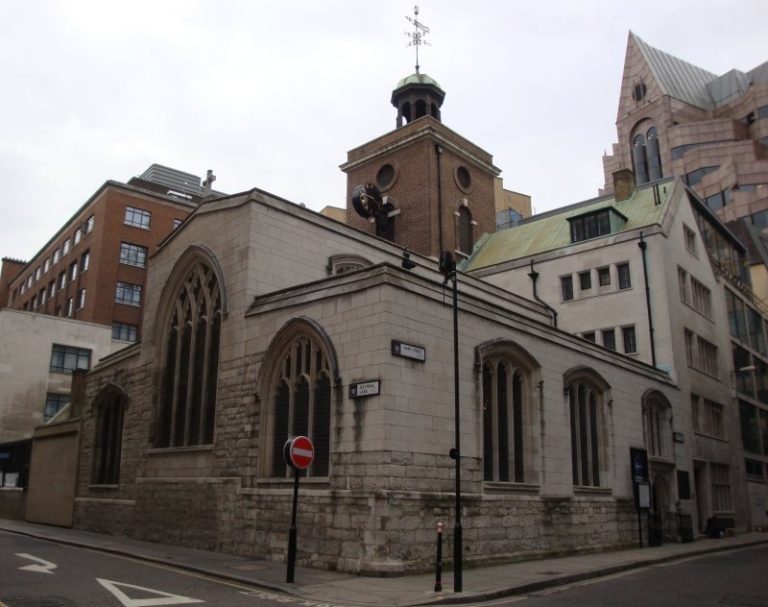
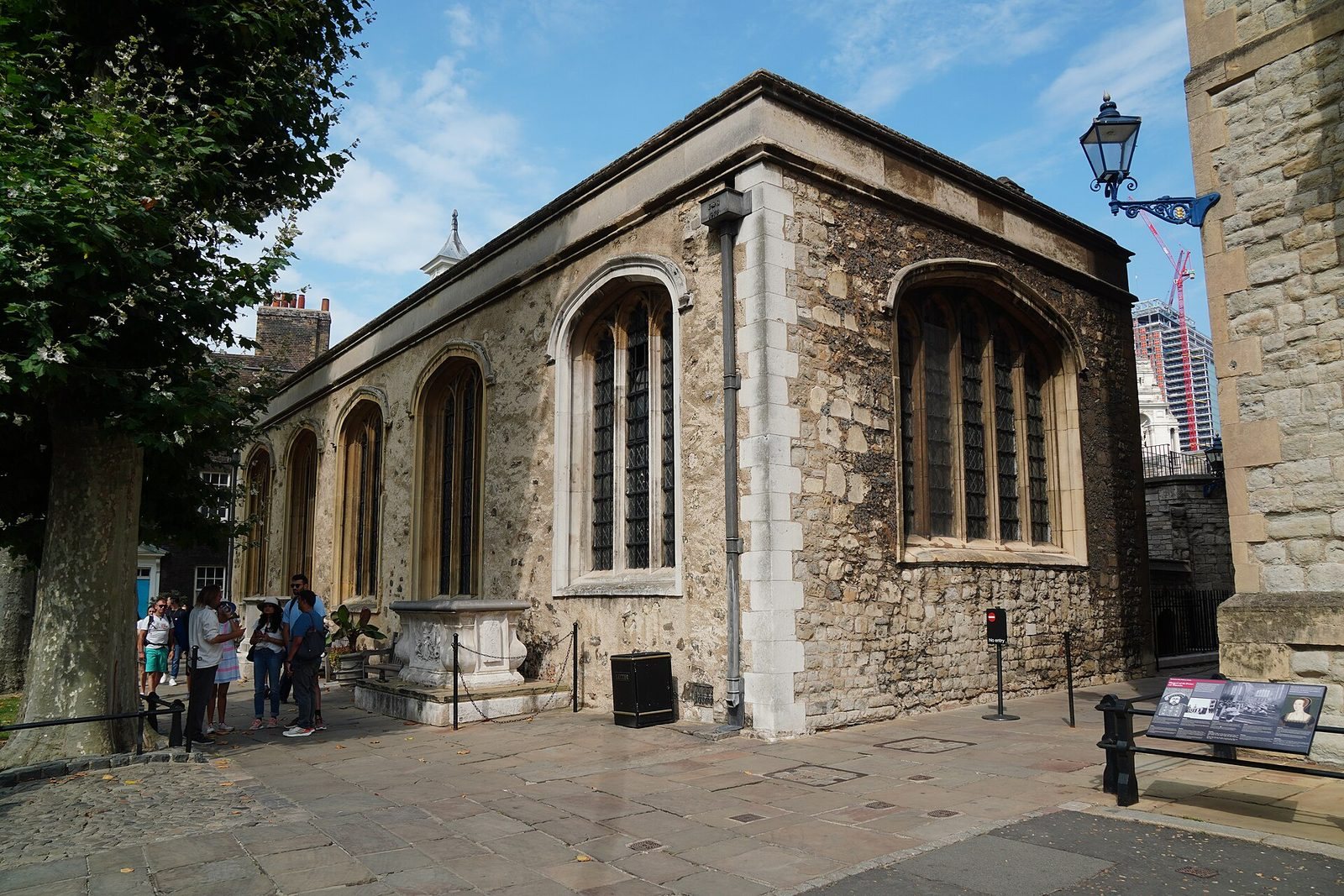
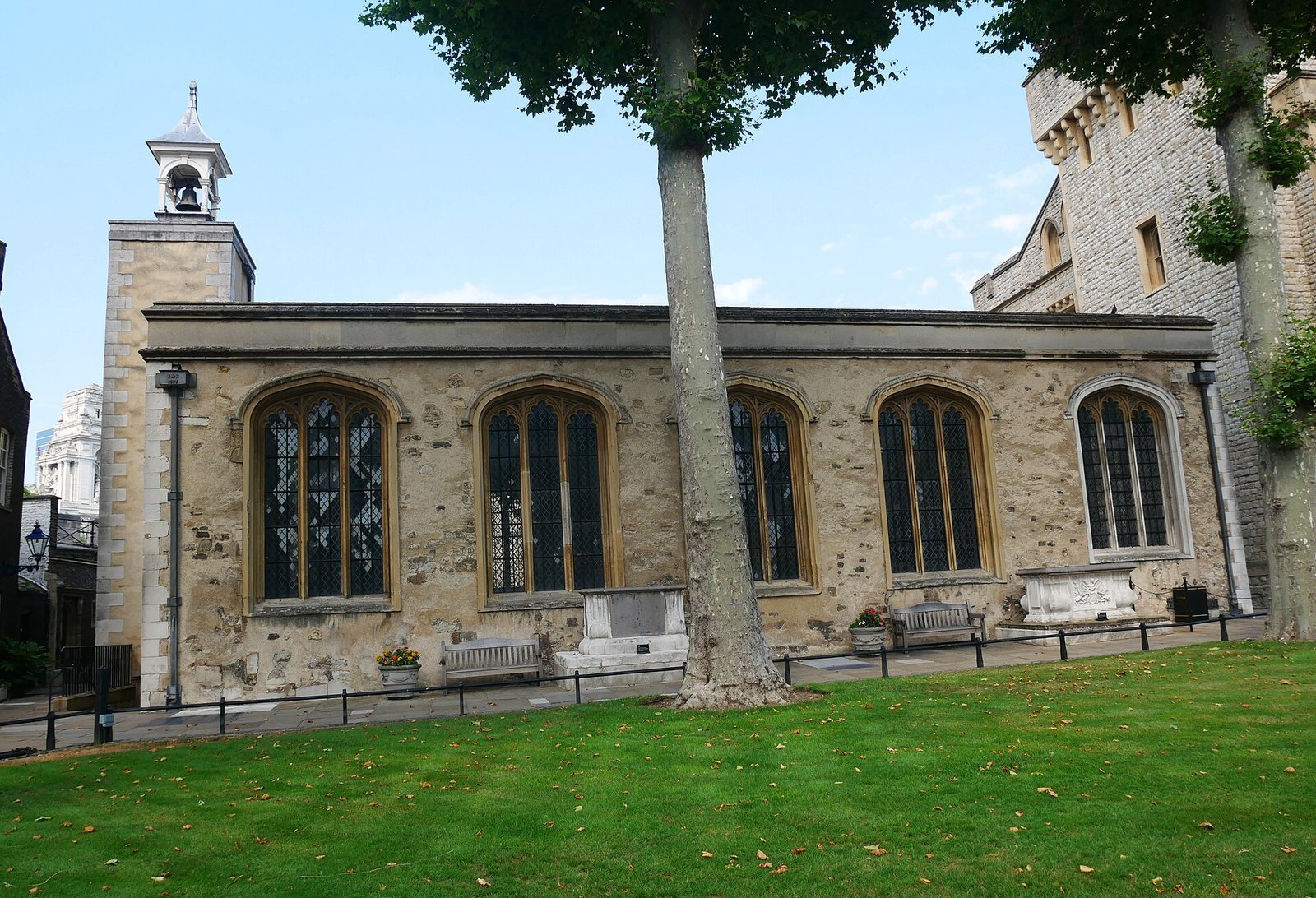
The surviving church is a Gothic building with Tudor features. A short tower stands at the west end and is topped by a bell-cote, a small structure for housing bells. Inside, the main body of the church, the nave, is accompanied by a shorter north aisle of the same width; four arches divide the two spaces. The windows have cusped lights, openings with lobed heads, a form associated with Tudor design.
Medieval features
A crypt, an underground chamber, lies beneath the church and dates to the mid-13th century. The church described in 1241 had two chancels, the areas around the main altar, dedicated to St Mary and St Peter. Painted, panelled royal stalls, or seats, stood in the St Peter chancel. The building also had altars dedicated to St Nicholas and St Katherine. During Henry III’s reign, an enclosed cell for an anchorite, a person living in religious seclusion, was attached to or situated near the church, although its precise relation to the building is uncertain.
Memorials and furnishings
A memorial to John Holland, Duke of Exeter and Constable of the Tower, who died in 1447, stands in the north-west corner. Beneath the central arcade lies an effigy, a sculpted figure, of Richard Cholmondeley, who died in 1521. In the sanctuary, a monument commemorates Sir Richard Blount, who died in 1564, and his son Sir Michael Blount, who died in 1610; both served as Tudor Lieutenants of the Tower. A 17th-century organ bears carvings by sculptor and woodcarver Grinling Gibbons, and a list of people buried in the chapel between 1534 and 1747 is displayed on the west wall. The original Tudor font, a basin used for baptism, is now back in the church. It is believed to have been hidden inside the Cholmondeley–Pennington tomb before parliamentary troops arrived.