Church of St Joseph: An Eighteenth-Century Baroque Church in San Damiano d’Asti
Site at a Glance
- Popularity
- Very Low
- Country
- Italy
- Primary era
- Early Modern
- Eras represented
- Early Modern, Modern
- Civilizations
- Duchy of Savoy, Kingdom of Sardinia
- Site type
- Religious
- Remains
- Church
On this page14 sections
History
The Church of St Joseph is a Roman Catholic church on the main square of San Damiano d’Asti, Italy, in the Diocese of Asti. Following the Roman rite, the principal liturgical tradition of the Latin Church, it is dedicated to Joseph, the husband of Mary and guardian of Jesus. Rebuilt in the Baroque style between 1700 and 1715, it is one of Piedmont’s major eighteenth-century Baroque buildings.
The confraternity and the church
The Confraternity of St Joseph, a lay religious association devoted to the saint, was founded in 1563 and was also known as the Company of the Angels. It first met in an existing chapel. In 1565, its seat moved beside the public clock tower in Piazza Libertà. The confraternity’s old books were lost during French rule, leaving little information about its earliest premises.
The confraternity was later suppressed. The church is now used by the parish of Saints Cosmas and Damian, twin physician saints venerated in Christianity. A restoration took place in 2012.
Remains
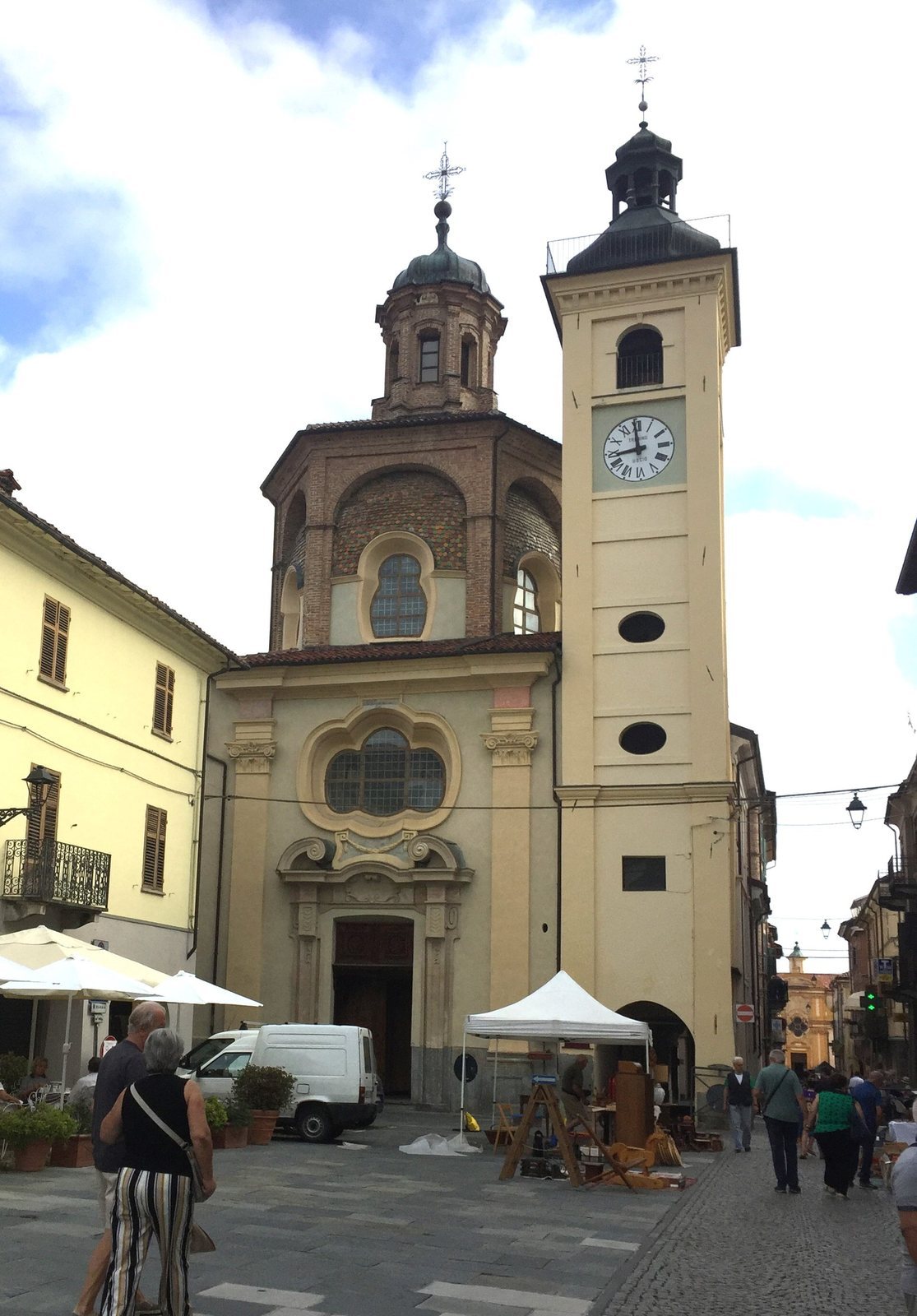
The church combines an exterior of two levels with an interior arranged around two ellipses. Its Baroque features include a steep façade, an ornamented dome, frescoed surfaces, a choir and a richly finished main altar.
Exterior and bell tower
Façade
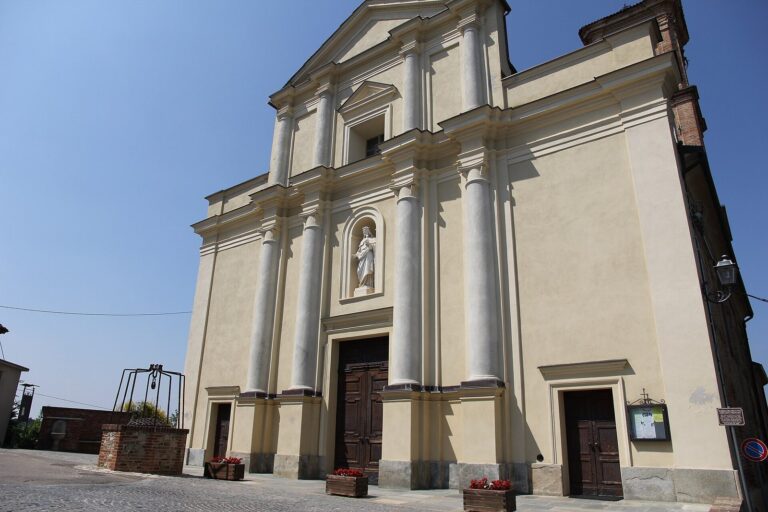
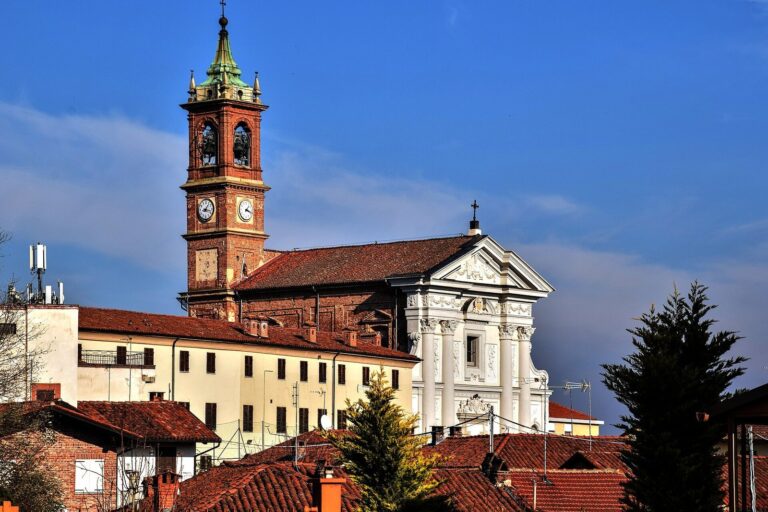
The two-level exterior is articulated by vertical and horizontal pilasters, shallow piers attached to the wall. A portico occupies the ground floor, while rooms above it serve as technical spaces. Limited space gives the façade a steep rise, directing attention to the wooden portal and the four-lobed window above it. An octagonal structure encloses the dome, with a round-arched opening on each side revealing part of its form. The dome is covered with 3,000 red, yellow and green terracotta scales and has curved windows. Above it, a six-opening lantern rises to a small cupola.
Municipal bell tower
The municipal bell tower stands to the right of the church façade, above the old clock tower. Dating to 1700, it has a square plan and reaches about 28 metres, roughly the height of the dome. Horizontal bands divide its height into sections.
Interior plan and decoration
Elliptical plan
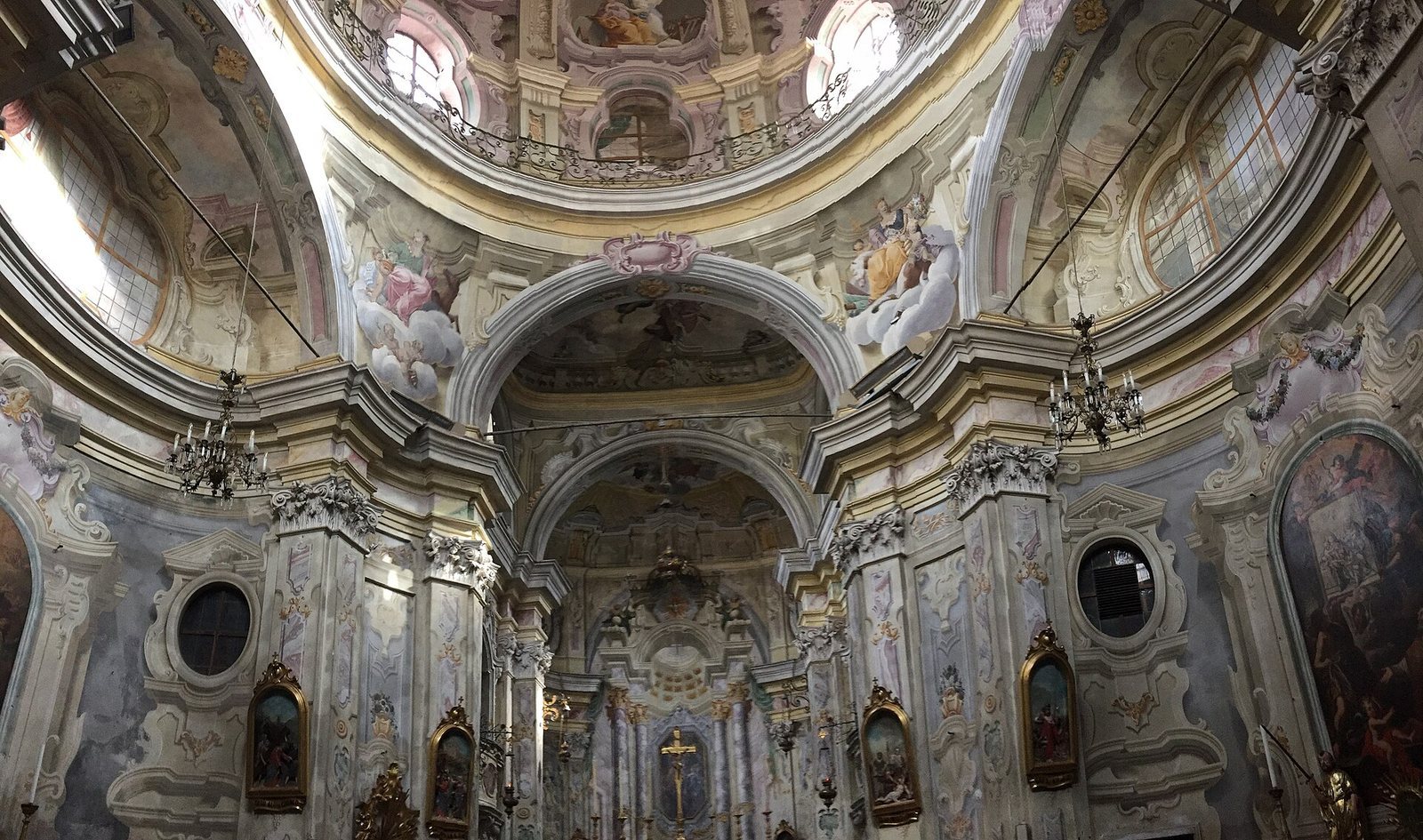
The larger of the church’s two ellipses forms its main body; the smaller one forms the choir. A rectangular space between them contains the main altar. The dome rises over the larger ellipse, reaching a height of 20 metres.
Dome and painted scenes
The dome’s frescoes, attributed to the Bergamo painters Pietro and Antonio Pozzi, were made between 1741 and 1744. Four scenes from Joseph’s life appear in sequence: his marriage, an angel appearing to him in a dream, the Flight into Egypt and his death. At the dome’s base, a cornice and iron railing form a walkable gallery. Above it, the supporting drum has eight openings, with four real windows and four painted to create an illusion of depth. Eight sections of the dome contain floral-patterned coffering and frescoes. The recurring Corinthian design has capitals decorated with acanthus leaves. The small cupola above the dome depicts a triumph.
Pendentives
The curved surfaces supporting the dome depict the four continents then known to Europeans as female figures reclining on clouds. Europe carries a cross, keys and a cornucopia, with books and musical scores at her feet. Asia bears feathers, perfumes, coral and precious stones. Africa is depicted with dark skin, alongside a chained enslaved person and a lion. America appears as a partly nude huntress holding an arrow. The imagery was intended to express the spread of the religious message. The four-continent theme had precedents in classical antiquity and also appears at the Royal Palace and Church of the Mission in Mondovì.
Choir, altar and chapels
Choir
At the back of the church, three rows of benches curve in a semi-ellipse. Only the row beside the wall has high backs, decorated with diamond patterns. The prior’s central seat, the tallest, is divided into three parts by twisted columns. Its kneeler bears the date 1816 and the signature of Carlo Pavarino, its probable maker. Frescoes of the four cardinal virtues, prudence, justice, temperance and fortitude, decorate the choir walls alongside a painting of the Presentation of the Child Jesus in the Temple. A niche behind the painting holds a skull believed to have belonged either to a prior or to a nobleman from San Damiano. The vault depicts Joseph being carried toward Paradise on a cloud borne by winged angels.
Main altar
The altar stands in the rectangular space between the two ellipses, beneath a canopy-like ceiling. It rests on two marble steps and a wooden platform. Its tiers recede upward and end in scroll-shaped curves, while coloured marble is set into its vertical surfaces. At the centre, a tabernacle, a receptacle for the Eucharist, is topped by a gilded wooden cross and surrounded by gilded candlesticks. A winged marble angel is set beneath the altar’s supporting surface. The altar probably dates to 1700; further decoration was added in 1785.
Side chapels
Two chapels occupy the slightly curved walls on either side of the church’s main body. The left chapel is dedicated to the patronage of St Joseph. The right is dedicated to St Avertino, a Christian saint invoked for protection against headaches, and contains a painting devoted to him.