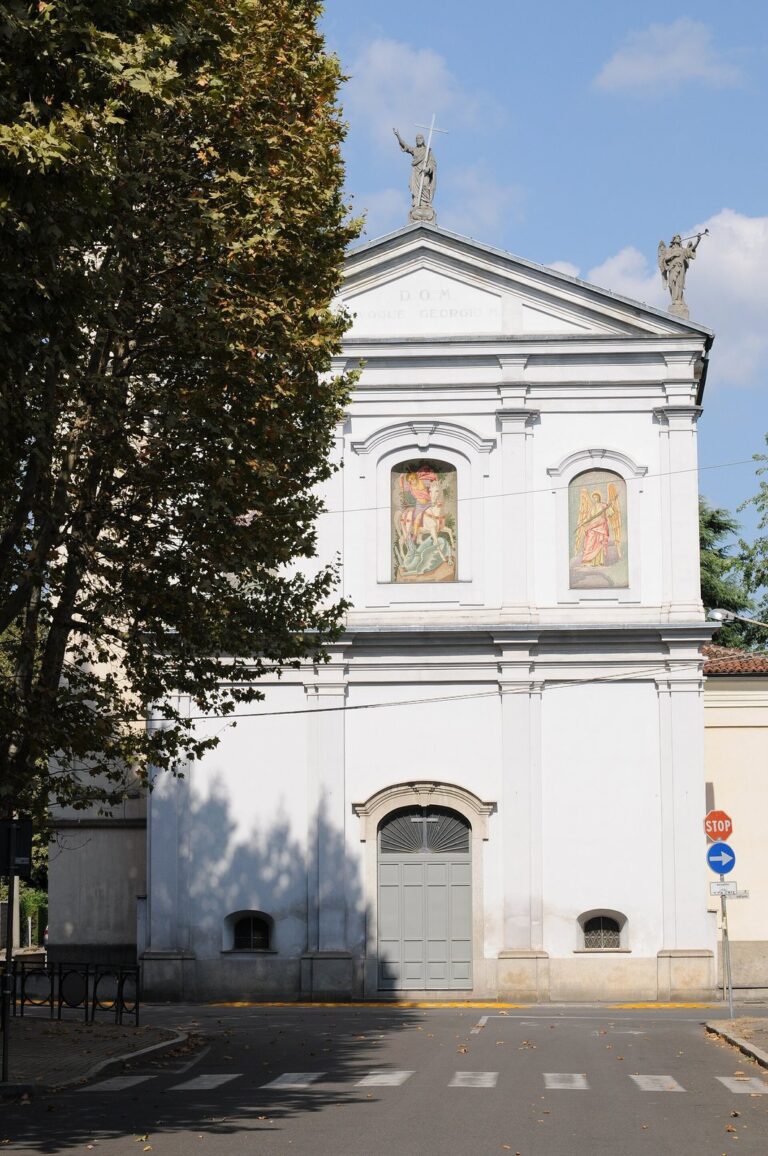
Church of San Giuseppe alla Pagana: An Eighteenth-Century Catholic Church in Rescalda
Site at a Glance
- Popularity
- Very Low
- Country
- Italy
- Primary era
- Early Modern
- Eras represented
- Early Modern
- Civilizations
- Duchy of Milan, Habsburg
- Site type
- Religious
- Remains
- Church
On this page9 sections
History
The Church of San Giuseppe alla Pagana is a Catholic church in Rescalda, a hamlet of Rescaldina, Italy. Built between 1713 and 1715 and consecrated in 1715, it follows the Ambrosian rite, a Catholic liturgical tradition associated chiefly with the Archdiocese of Milan, to which the church belongs.
Foundation and early history
A record of a 1753 pastoral visit by Cardinal Giuseppe Pozzobonelli, archbishop of Milan, recounts that the parish priest Gornato left his assets to the Guzzetti and Raimondi families so they could build a church in honor of St Joseph. Local tradition holds that St Joseph had protected Rescalda from plague. The church is also thought to have been enlarged from a sixteenth-century building, whose bell tower may have been retained.
The church’s first use was monastic. Its position on the road between Rescalda and Nizzolina was strategic, and it may also have allowed farmers to be warned when severe hailstorms approached. A separate tradition says St Roch protected the farmstead during the plague of 1630.
Pagana takes its name from the rural locality and the adjoining farmstead. The name’s origin is uncertain, but it is commonly linked to the Latin paganus, meaning villager or civilian. In the Lombard context, it is more likely to refer to a rural settlement or farming hamlet than to a non-Christian religious identity.
Postwar change and conservation
After the Second World War, residential growth absorbed the church and farmstead into a continuous urban area. This changed their surroundings from an isolated agricultural landscape to a built-up setting.
Work in 1990 renewed the church’s interior floor structures and replaced its window frames. The roof covering was renewed in 2001 after minor water leaks. A restoration begun in March 2019 and completed in February 2022 aimed to make the church accessible to the public again.
The church remains part of local religious observances. On Palm Sunday, a procession starts there and continues to Santa Maria Assunta for Mass, with olive branches distributed on arrival at the parish of Rescalda. The annual March celebration of St Joseph also raises funds for the restoration of the church’s eighteenth-century frescoes and canvases.
Remains
Cascina Pagana complex
Courtyard setting and exterior
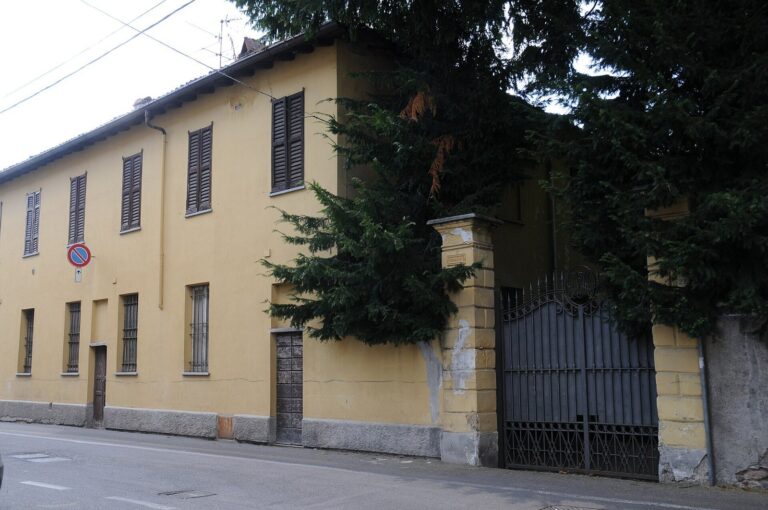
The church stands within the Cascina Pagana farmstead, beside the road linking Rescalda with Nizzolina in Marnate. Its side elevations face the farmstead’s inner courtyard and Via Repetti, while its principal façade faces a later residential building. The complex retains a recognizable courtyard layout and sits somewhat apart from the main urban axes. Cascina Pagana was part of a local network of agricultural farmsteads, including Cascina Prandona, joined by paths.
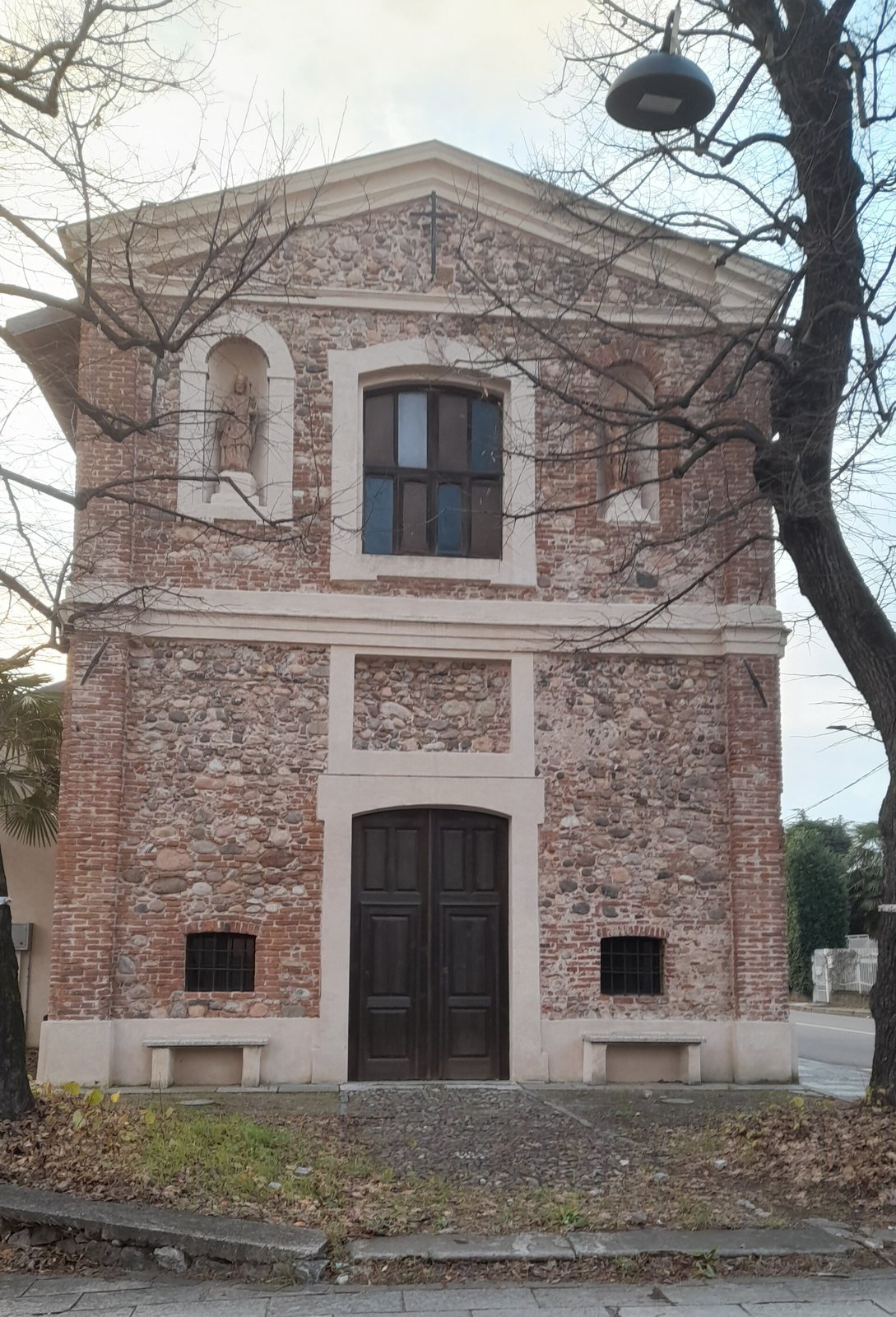
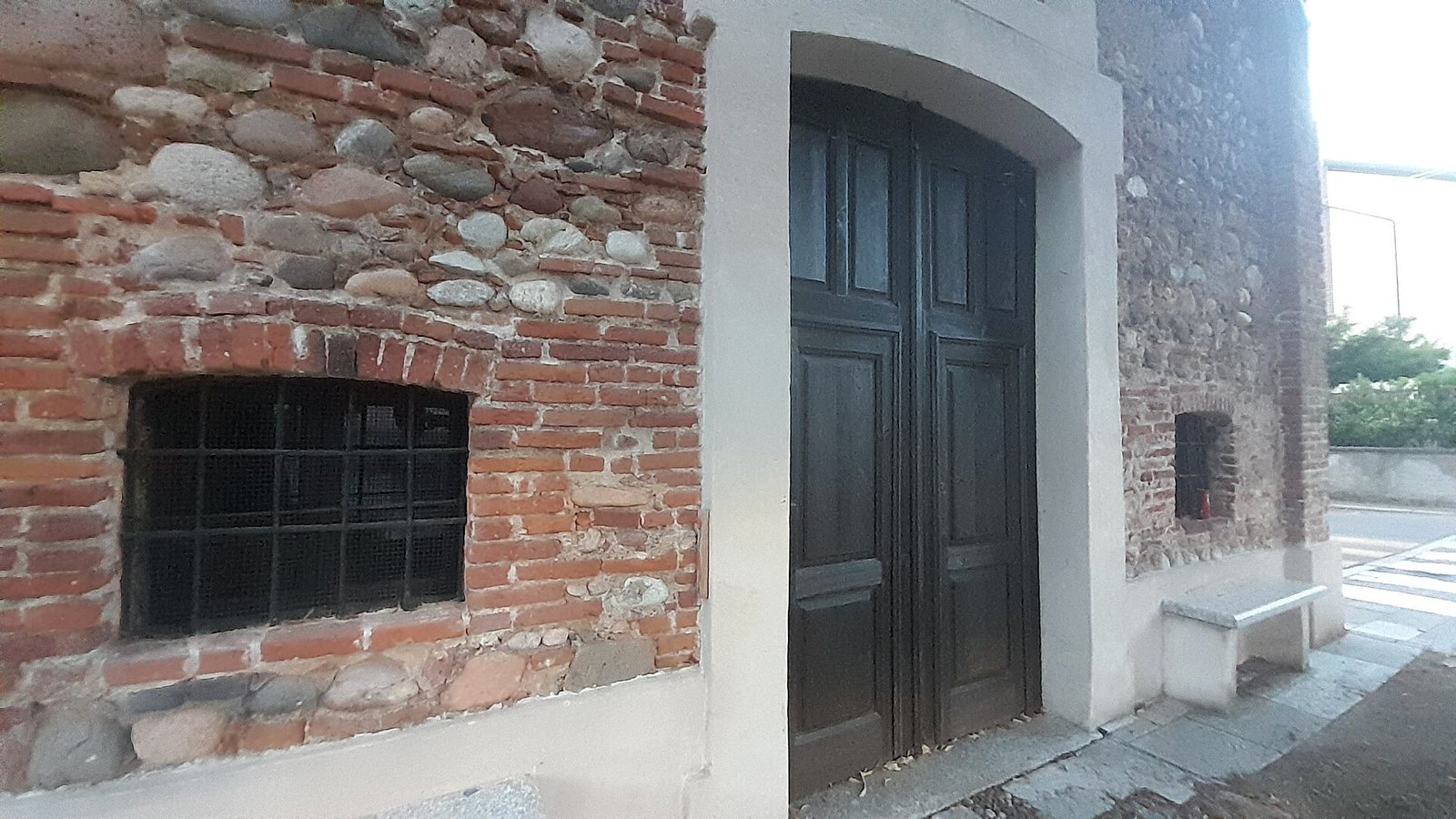
Built in masonry, the church has a gabled form. Two small barred windows flank the entrance portal. Above it, a panel sits below a broad central window; niches on either side contain statues of St Roch and St Gratus of Aosta, associated with protection of fields from storms and hail. Decorative moldings frame the openings and the crowning pediment. The bell tower stands at the junction of the presbytery and the south wall.
Interior plan and finishes
The interior has a single nave, the main body of the church, divided by three barrel vaults with lunettes, curved recesses in the vaulted surface. The presbytery, the area around the altar, has a cross vault formed by intersecting barrel vaults. Its walls are decorated with Doric semi-pilasters, shallow projections in a simple classical column style. The presbytery rises one step above the nave, and two Baroque-style windows in the side walls admit light.
The former lime-and-sand slab floor has been replaced with tiles. The ceilings are concrete and the columns are brick. A bell used for religious services hangs high within the church.
Paintings and devotional features
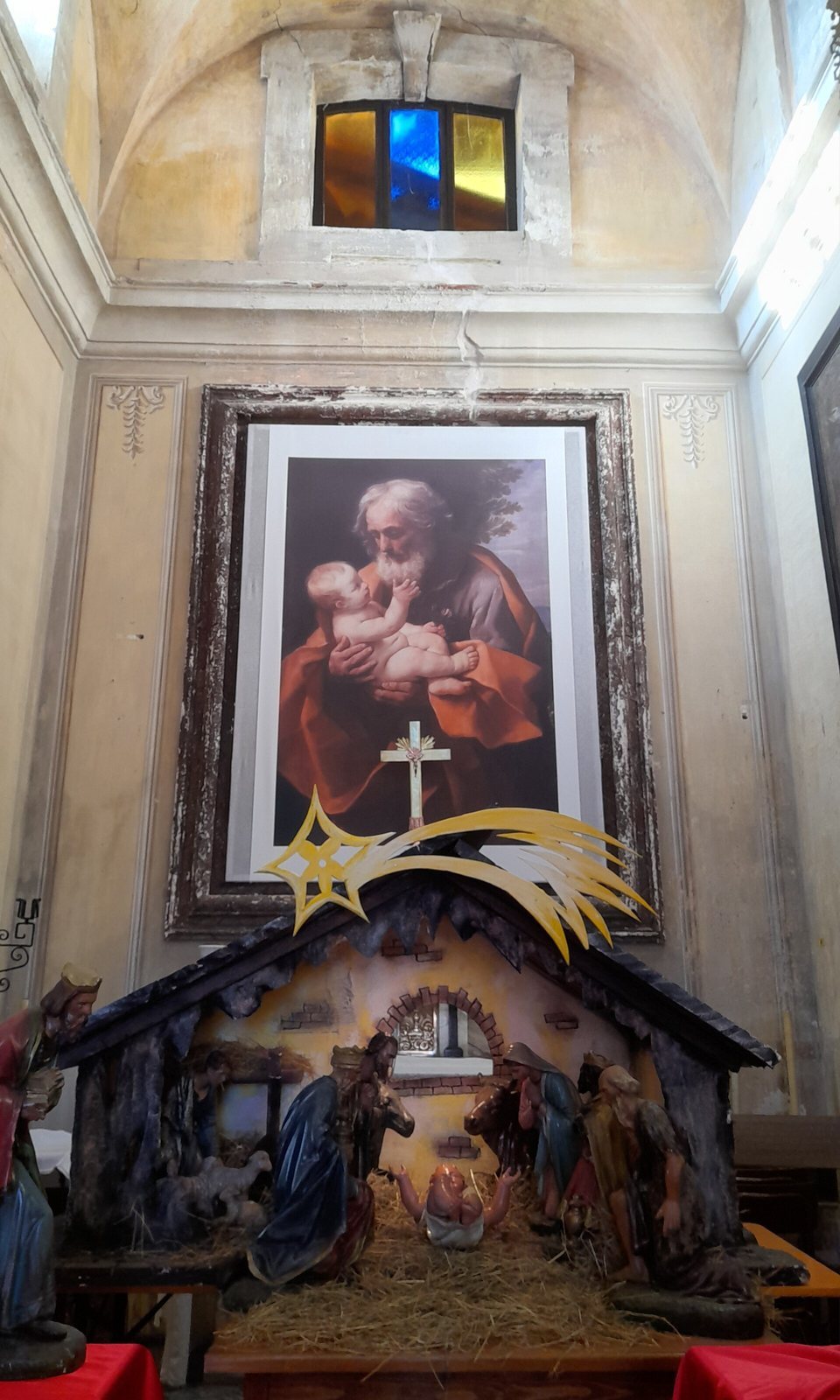
An eighteenth-century canvas above the altar shows the Holy Family, with St Joseph at the center, an angel partly concealed behind him, and Mary holding the infant Jesus. A separate fresco depicts two angels supporting a small crucifix. Another canvas shows St Joseph on his deathbed, attended by Jesus and Mary; Jesus reassures him that he will be welcomed into Paradise, where God the Father awaits. Paintings of episodes from the Way of the Cross line the side walls.
A fresco elsewhere in the farmstead complex is attributed to pupils of Bernardino Luini, a Lombard Renaissance painter.
Former monastery
Behind the church are renovated remains of the former monastery, including an original portico with columns and an upper-storey loggia, a covered, open-sided gallery.