Church of Saint Sergius of Radonezh in Krapivky: A Russian Orthodox Parish Church
Site at a Glance
- Popularity
- Medium
- Country
- Russia
- Primary era
- Early Modern
- Eras represented
- Early Modern, Modern
- Civilizations
- Russian
- Site type
- Religious
- Remains
- Church
On this page14 sections
History
The Church of Saint Sergius of Radonezh in Krapivky, Russia, is a Russian Orthodox church whose oldest surviving section dates to 1678. Its design follows the Russian Baroque, a regional form of Baroque architecture. Dedicated to Sergius of Radonezh, a fourteenth-century Russian Orthodox monk and spiritual leader, the church later served as the Russian representation of the Constantinople Patriarchate.
Early church and expansion
A church dedicated to Sergius of Radonezh stood on the site by the late sixteenth century. Work on a stone building began in 1625, although a description from 1657 still identified the church as wooden. The oldest part of the present structure dates from 1678.
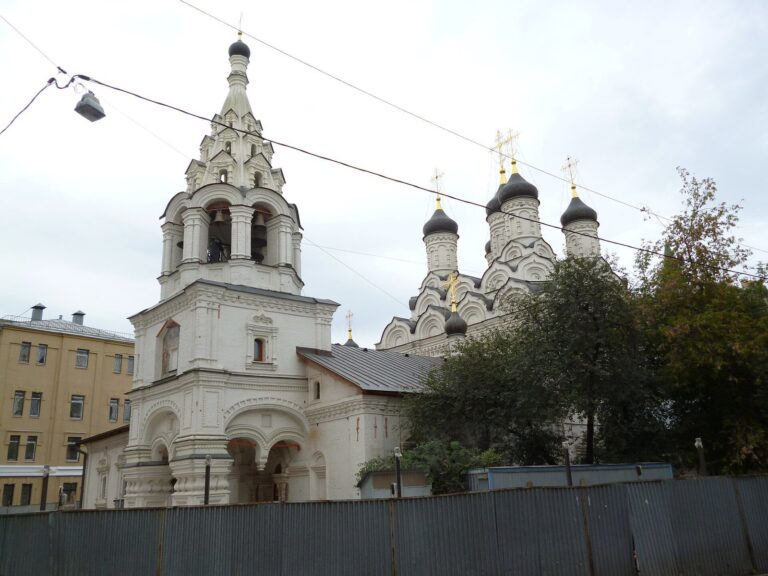
Further building transformed the church over the eighteenth century. A southern chapel dedicated to the Beheading of John the Baptist, the biblical prophet associated with baptizing Jesus, was added in 1702. Work in 1749–1750 raised the older central structure, added a bell tower, and created a northern chapel dedicated to St Nicholas, an early Christian bishop widely venerated as a saint. The design is associated with the architectural school of Dmitry Ukhtomsky, an eighteenth-century Russian architect, and is sometimes attributed to Ukhtomsky himself.
Patriarchal administration and closure
In 1883, the church and the land beneath it passed to the Constantinople Patriarchate’s representation in Russia. The building remained under its jurisdiction until 1936. In 1920, the bell tower was reduced to its lower level. Bolshevik authorities confiscated church valuables on April 25, 1922. The church closed on February 5, 1938, and the patriarchal representation was dissolved.
Industrial use and return to worship
The building was transferred to a metal-products factory in 1960 and housed a skate-manufacturing plant from that year until 1980. Worship resumed in 1991, when the church was reconsecrated. That August, the Kiy Cross was brought to the church. A religious-culture lyceum dedicated to Seraphim of Sarov, a Russian Orthodox monk and saint, opened there in 1993; an affiliated church dedicated to him opened in Izmailovo in 2003.
The church is active in the Russian Orthodox Church’s Moscow Diocese and Iveron Deanery, a local administrative district within a diocese. It also serves as a patriarchal metochion, a local church establishment representing a patriarchate, and has regional cultural-heritage status in Russia.
Remains
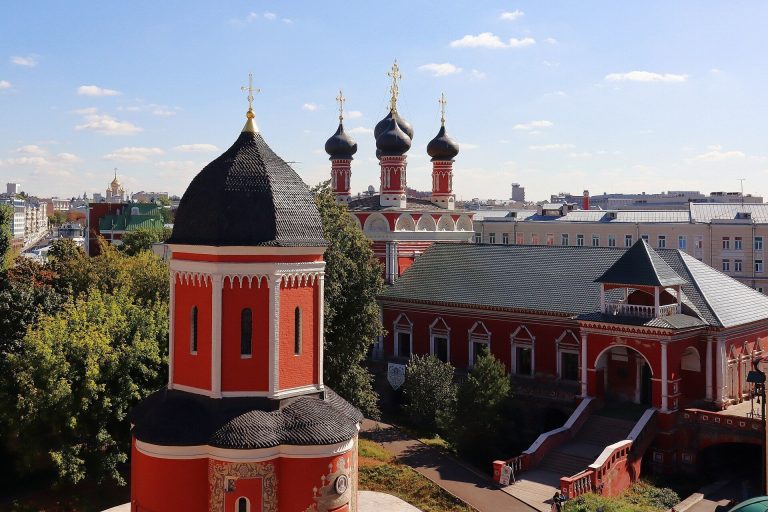
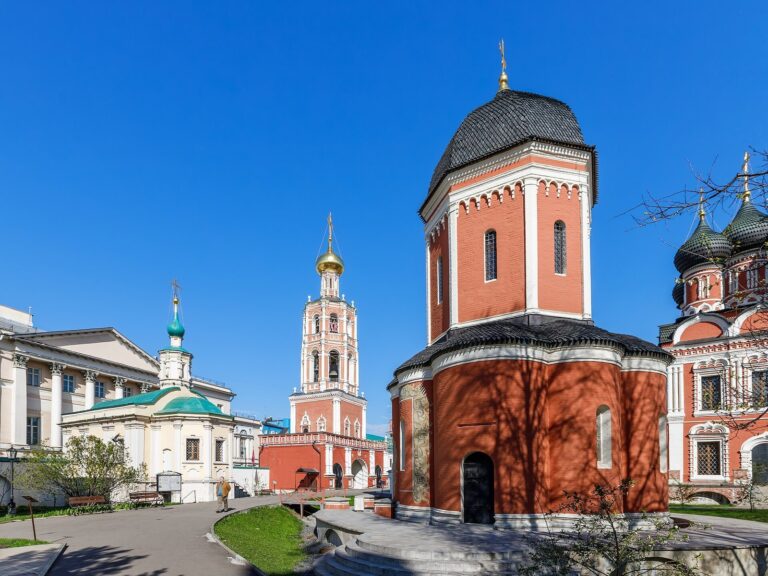
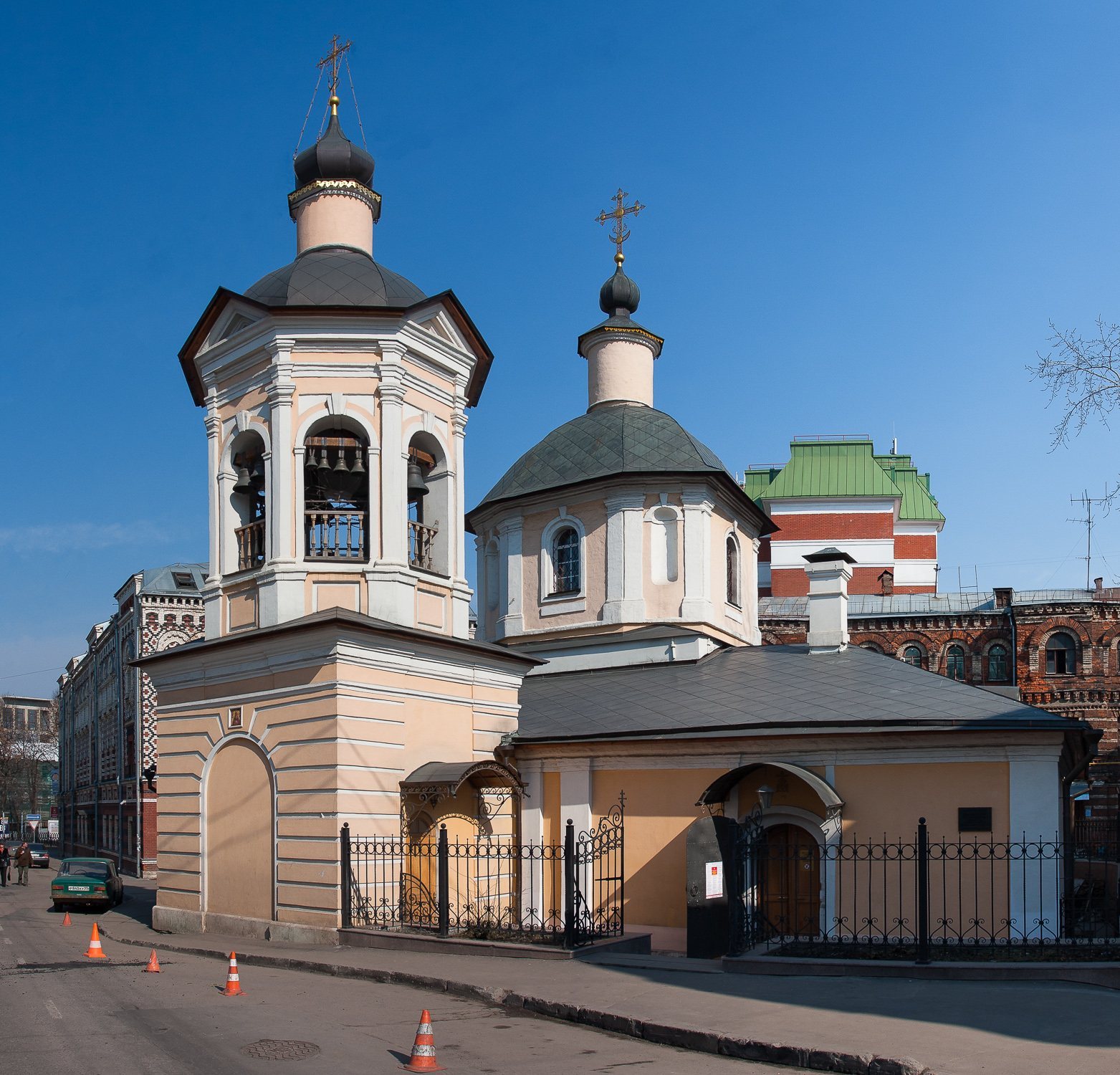
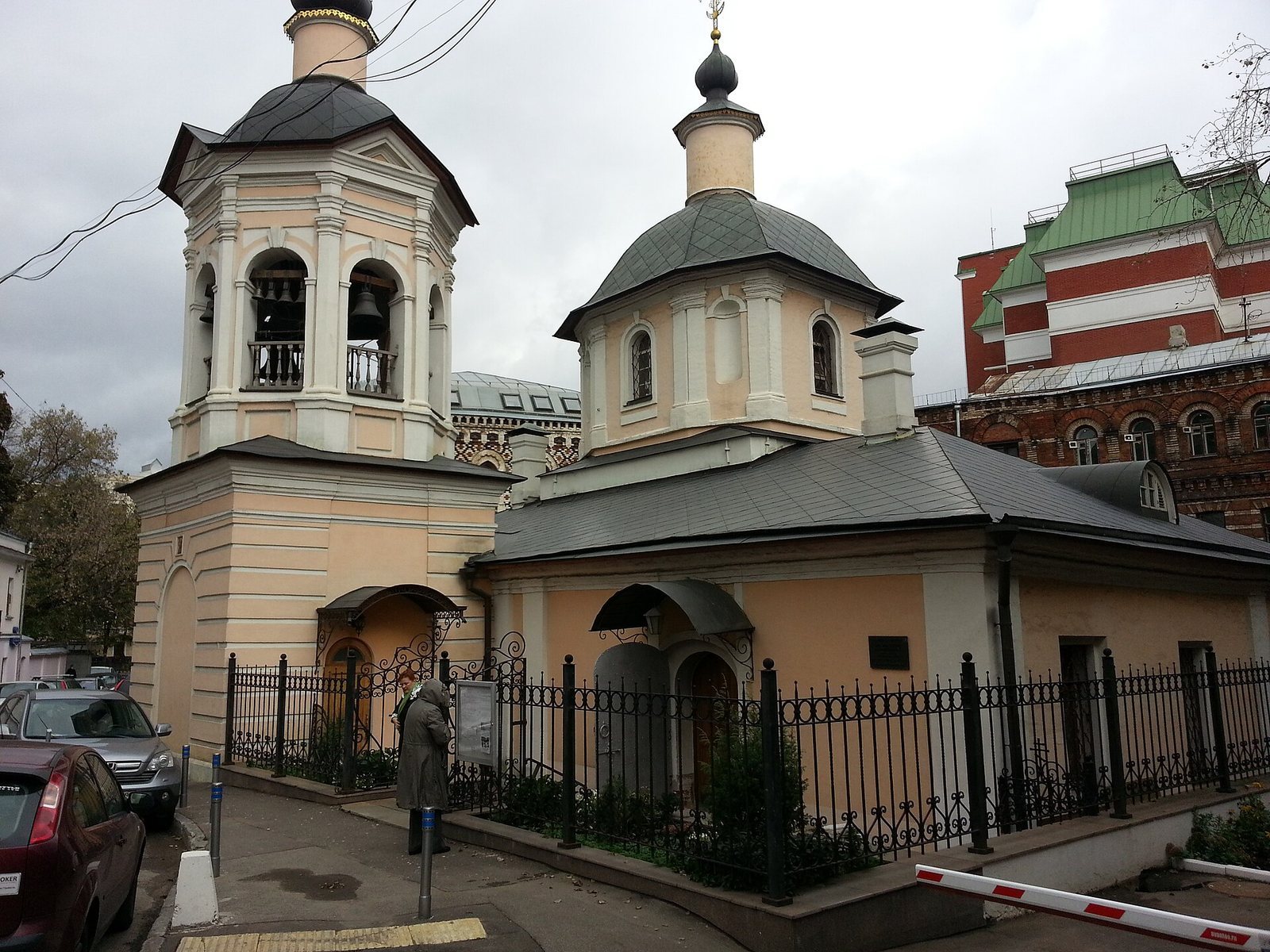
The brick complex is arranged around a central block joined to a refectory, a hall adjoining the church, with an integrated bell tower. A single dome rises above the building on a tall cylindrical base.
Chapels, altars, and memorials
Southern and northern chapels
The broad southern chapel, dedicated to the Beheading of John the Baptist, joins the refectory. The northern chapel, dedicated to St Nicholas, extends alongside both the central block and the refectory. One of the side altars connects with a spacious vestibule.
Altars
The church has three altars. The main altar is dedicated to Sergius of Radonezh, while the side altars honor Seraphim of Sarov and All Saints of the Russian Land, a collective commemoration of saints associated with the Russian lands.
Ukhtomsky family memorials
Princes of the Ukhtomsky family were buried in the church from the sixteenth through the eighteenth centuries. Four stone slabs on the exterior north wall of the Seraphim of Sarov chapel carry inscriptions commemorating members of the family.
Fittings and sacred objects
Icon screens and chapel furnishings
Wooden icon screens, decorated partitions separating the sanctuary from the main worship space, and carved wooden icon cases were made for the chapels in 1997–1998. Before the church closed, the main altar had a five-tier screen, while each side altar had a two-tier screen. Historic openings between the chapels were restored in 2012.
Bell tower and altar painting
The bell tower was restored in 2001. An altar painting in the Seraphim of Sarov chapel, painted by Irina Zaron, was unveiled in 2013.
The Kiy Cross
Made in 1657 at the commission of Patriarch Nikon, the seventeenth-century head of the Russian Orthodox Church, the Kiy Cross is formed from cypress wood said to be more than 3,000 years old. It was created to commemorate Nikon’s escape from a shipwreck. The cross is revered as a wonderworking replica of the Cross of Christ and contains relic fragments associated with 300 saints. After the monastery for which it was made closed, the cross was kept in museums before its transfer to the church.
Revered icons
The Feodorovskaya Icon of the Mother of God is believed to be one of four wonderworking copies. People pray before it for help with childbirth and family well-being. An eighteenth-century icon of Sergius of Radonezh contains a relic fragment. Church tradition connects its reputation for miracles with three occasions when a candle was lit before it at night; a silver-gilt cross containing a relic of Sergius hung on the icon until 1875. A revered icon of Seraphim of Sarov at the church also contains a relic fragment.