Church of Saint Sergius in Rogozhskaya Sloboda: An Orthodox Parish Church in Moscow
Site at a Glance
- Popularity
- High
- Country
- Russia
- Primary era
- Modern
- Eras represented
- Early Modern, Modern
- Civilizations
- Russian
- Site type
- Religious
- Remains
- Church
On this page10 sections
History
The Church of Saint Sergius in Rogozhskaya Sloboda is an active Russian Orthodox parish in the Tagansky District of Moscow, Russia. A wooden church dedicated to Sergius of Radonezh, a medieval monk and spiritual leader later revered as a saint, stood here by the early seventeenth century. A church on the site is recorded in 1625, and a stone church is first mentioned in 1722. The brick building developed in the early nineteenth century in Classical and Empire styles, the latter a monumental form of Neoclassical architecture.
Early church and transport district
The church stood in Rogozhskaya Yamskaya Sloboda, a settlement district that grew densely among Moscow’s craft neighborhoods in the seventeenth century. The church of St Alexius, founded in the early seventeenth century, stood directly opposite. Nearby Nikoloyamskaya Street took its name from the church of St Nicholas on the Yams.
Yams were stations in Russia’s postal and transport network, with places for coachmen to rest, as well as inns and stables. In 1595, Boris Godunov established stations at Moscow’s outskirts. The road from Rogozhskaya Yamskaya Sloboda led toward Vladimir and Nizhny Novgorod, with its first station at Rogozhi, known from records dating to 1389 and now called Noginsk. Moscow’s customs boundary crossed the nearby Rogozhskaya outpost square in the 1740s.
After a severe plague in Moscow late in the eighteenth century, an Old Believer community formed outside the city near the outpost. Old Believers were Russian Christians who kept religious practices that predated seventeenth-century reforms in the Russian Orthodox Church. The community became one of the largest on Moscow’s eastern edge. The church’s dedication to Sergius may have been chosen because Moscow already had many churches dedicated to the Holy Trinity. The nearby Andronikov Monastery may also have influenced the choice: its first head, Andronik, had been a disciple of Sergius.
Rebuilding and parish life
An attached refectory and its chapels belonged to the earlier stone church. Work on the later church began in 1800. The Moscow fire of 1812 badly damaged the building, and French troops looted it. Parishioners financed completion of the nave in 1818. Churchwarden Gavriil Petrovich Smolyansky, a State Councillor, a rank in the imperial civil service, is said to have contributed a substantial part of his fortune. The main volume was reconstructed between 1834 and 1838, and the building also suffered fire damage in 1837.
Wealthy parish merchants gave generously, and Moscow authorities supported the church. Their efforts included drawing nearby Old Believers toward the Orthodox Church, and churches near large Old Believer communities received rich decoration.
Missionary work
From 1899 until the October Revolution, the 1917 Bolshevik seizure of power in Russia, the church served as a center for work aimed at converting Old Believers. A hall built there hosted public religious discussions, moral and religious readings, lectures, and concerts of spiritual music. The parish also maintained strict observance of the Typikon, a rulebook governing Orthodox worship and monastic life. Its choir of blind singers was regarded as one of Moscow’s best.
Closure and return to religious use
In 1922, authorities removed more than five poods, a traditional Russian unit of weight, in silver vessels and other church valuables. The Soviet government closed the church in 1938. During the plundering associated with the closure, most icons and all furnishings were destroyed. Several old icons were saved, including the wonderworking icon known as Soothe My Sorrows, which was transferred to the church of St Nicholas the Wonderworker in Kuznetsy.
After the closure, workshops and storage occupied the building, causing severe damage. In 1985 it was transferred to the Museum of Old Russian Culture and Art named for Andrei Rublev, and restoration began. The church returned to the Russian Orthodox Church in 1991 and was reconsecrated on December 4 that year. Religious use resumed in 1992. It is now an active parish in the Moscow City Diocese and the Pokrovsky Deanery, and is designated a cultural heritage monument of federal significance in Russia.
Remains
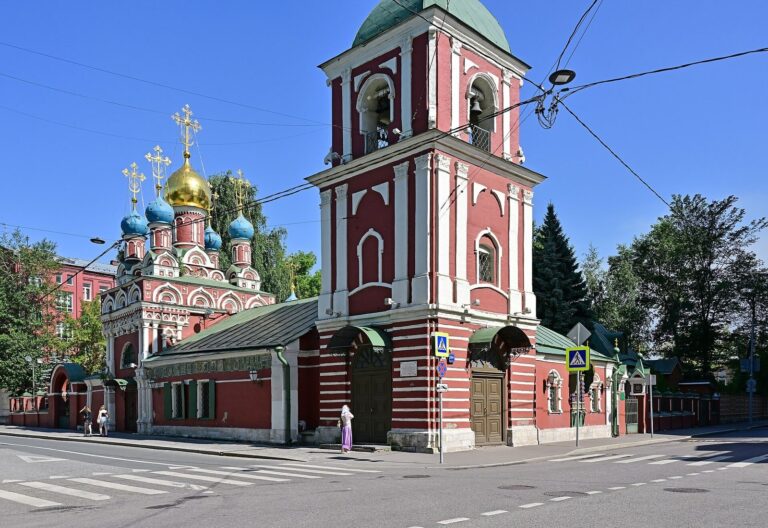
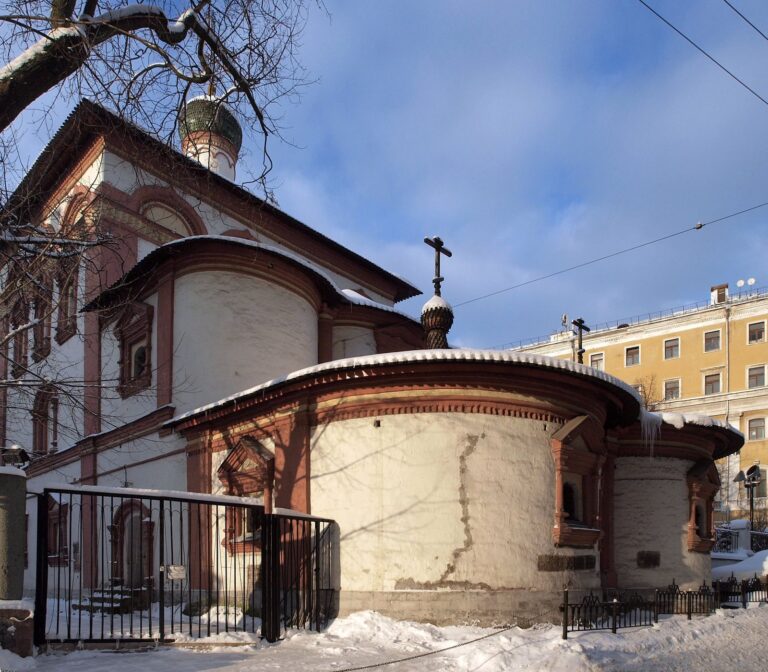
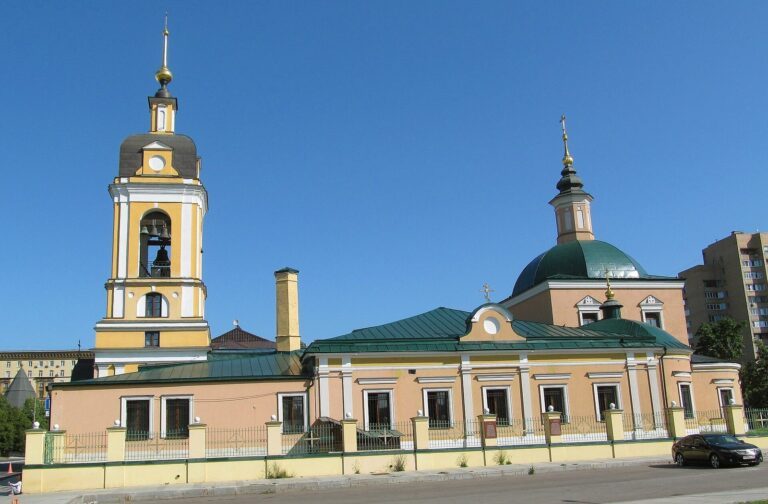
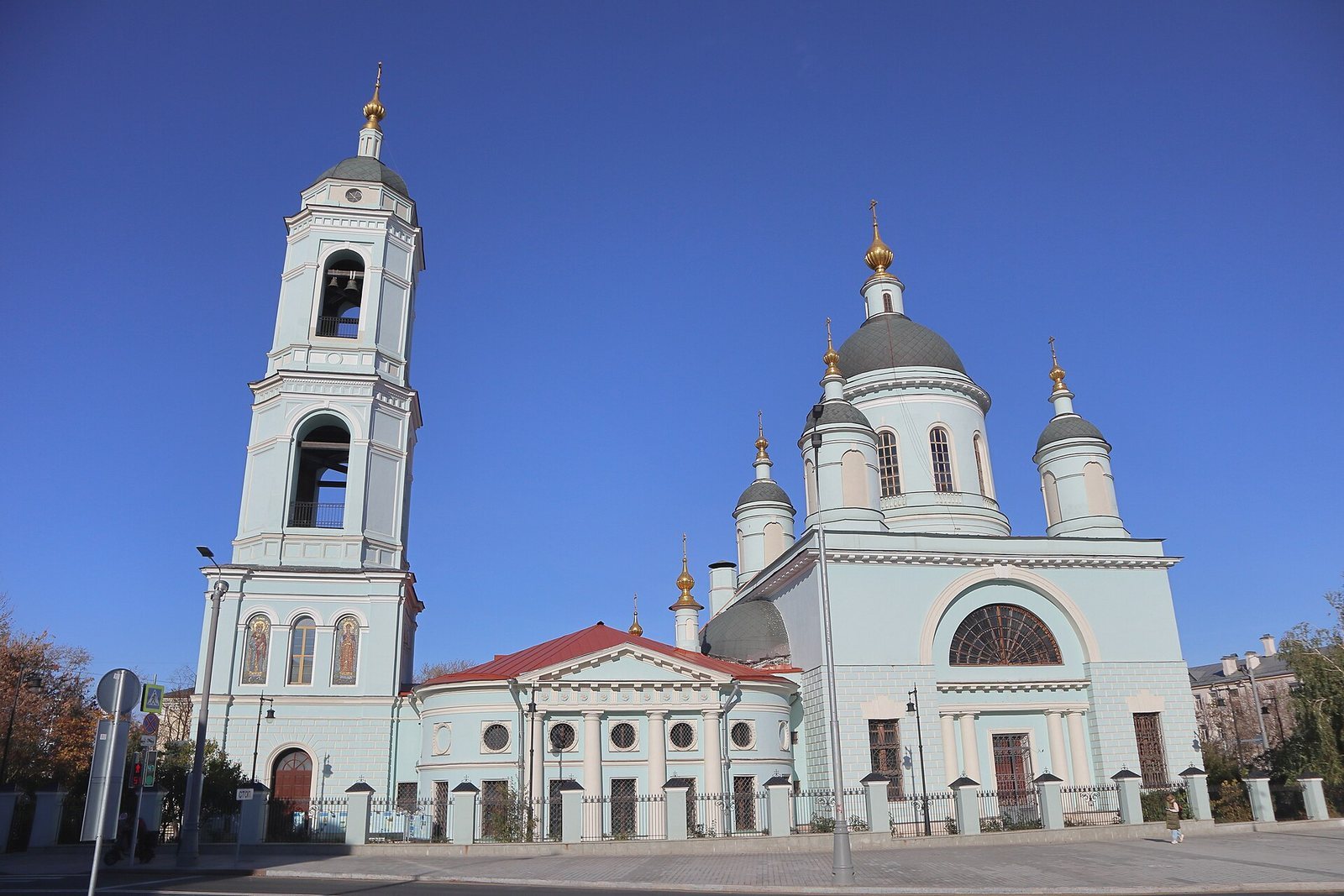
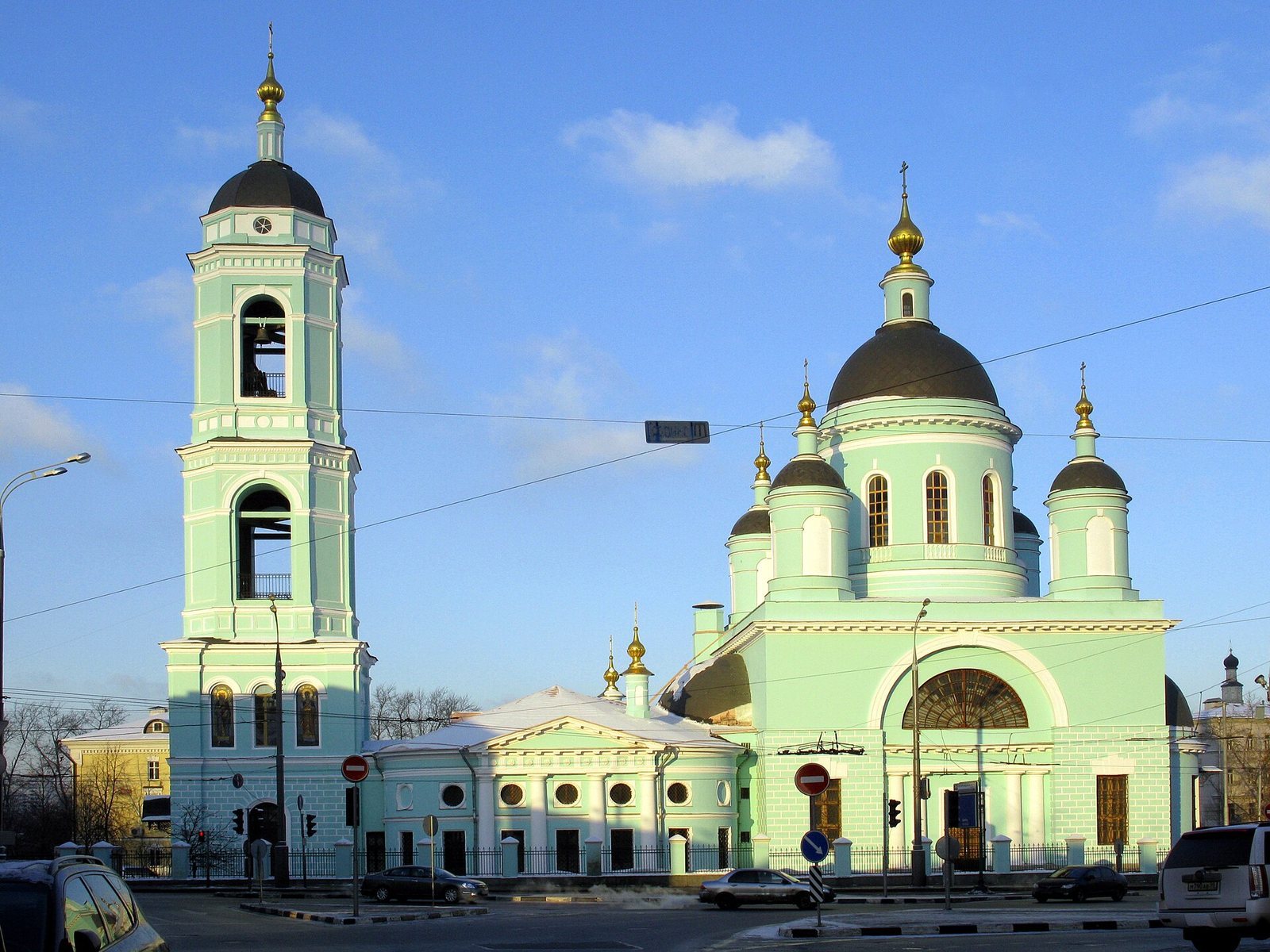
The brick church is organized around a rectangular nave whose plan is close to a square. Five domes crown the main volume, and restrained ornament emphasizes its clear, simple forms. An older attached hall and chapels form part of the building, while the bell tower is integrated into the church.
Plan and exterior
The refectory, an attached church hall, is the oldest surviving part of the building. It dates to 1796 and belonged to the preceding stone church; it contains the chapels dedicated to Sergius of Radonezh and Nicholas the Wonderworker, also known as Nicholas of Myra. The main church has three altars: the central one is dedicated to the Holy Trinity, the Christian belief in God as Father, Son, and Holy Spirit, while the other two honor Sergius and Nicholas. The bell tower was built in 1864.
Interior
Three screens of icons separate the sanctuary from the main worship area. The interior includes paintings made by A. S. Rogozhkin in 1876, further paintings dating to the early twentieth century, and decoration associated with work carried out in 1900.
Mission hall
The hall built at the church could accommodate up to 1,000 people, providing space for the public discussions, readings, lectures, and concerts held there.
Damage from later use
During the building’s use for workshops and storage, deep cracks formed in its walls and floors. Soot accumulated on interior surfaces, and small trees grew on the domes and roofs.