Choceň Castle: A Historic Manor and Castle in Czechia


Site at a Glance
- Rating
- 4.3
- Popularity
- Low
- Country
- Czechia
- Primary era
- Modern
- External website
- Open
- Eras represented
- Early Modern, Modern
- Civilizations
- Habsburg, Holy Roman Empire, Kingdom of Bohemia
- Site type
- Domestic
- Remains
- Castle
On this page7 sections
History
Choceň Castle is a historic manor and castle in Choceň, Czechia, whose documented manor-house phase dates to 1562 and whose later form combines Renaissance, Baroque, and Neoclassical architecture. It probably occupies the site of a medieval fortress reportedly built by the robber knight Nikolaus von Pottenstein. That fortress was destroyed in 1339 by Margrave Charles IV, the Luxembourg ruler who was also king of Bohemia and Holy Roman Emperor.
Medieval Fortress and Renaissance Manor
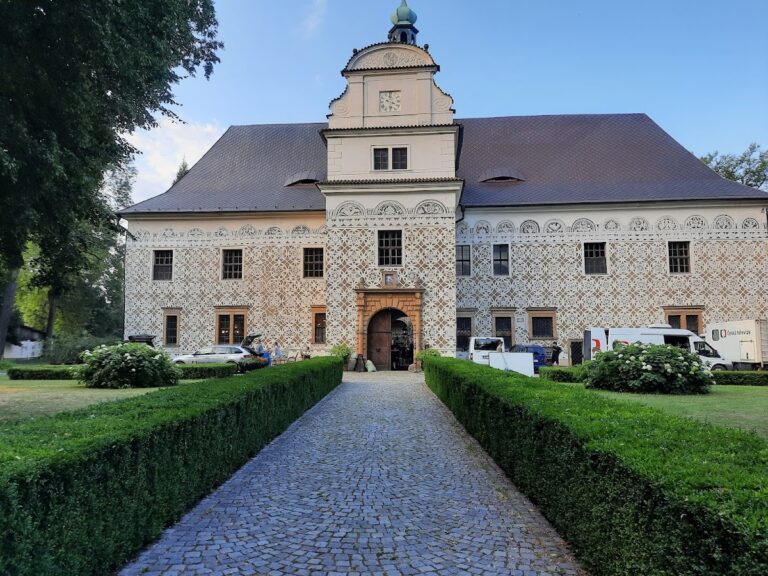
A manor house stood on the site by the mid-sixteenth century. Its construction in 1562 is associated with Sigismund von Schellenberg. During the later sixteenth century, the building was expanded into a closed four-wing Renaissance castle, a plan based on the period’s renewed interest in classical architectural forms.
Kinsky Ownership and Baroque Remodelling
The castle was looted by the Swedish army at the end of the Thirty Years’ War, the major European conflict fought from 1618 to 1648. Under Wenzel Norbert Oktavian Count Kinsky, a member of the Bohemian noble Kinsky dynasty, the castle was remodelled in the Baroque style between 1710 and 1720. Baroque architecture is associated with dramatic composition and ornament. Count Stephan Kinsky was raised to princely rank in 1746.
The castle remained Kinsky property after the abolition of serfdom and continued in the possession of the Kinsky princely family until its confiscation in 1945. After 1918, the municipality of Choceň pursued expropriation through the courts so that the castle could be used for a school.
Rebuilding and Wartime Uses
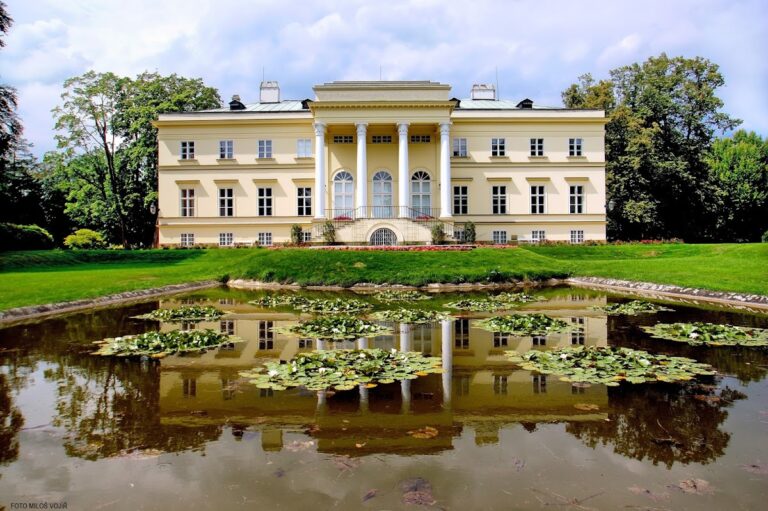
A fire in 1829 led to the castle’s complete rebuilding in the Neoclassical style, which revived the simplicity of classical architecture. The Vienna architects Heinrich Koch and Friedrich August von Stache designed the reconstruction. The post-fire work also included the Neo-Gothic chapel dedicated to the Assumption of the Virgin Mary, built in 1849 and 1850 at the initiative of Wilhelmine von Kinsky. Neo-Gothic architecture uses forms inspired by medieval Gothic buildings.
During the German occupation in the Second World War, the castle served first as a facility for the Hitler Youth and then as a camp for French prisoners. Toward the end of the war, it became a dormitory for employees of the Hermann Göring Works. The castle was confiscated in 1945. Its south wing was assigned to the newly established music school, while its north wing became a museum. The building is protected as a cultural monument of the Czech Republic under catalogue number 1000136701.
Remains
Castle Complex
Choceň Castle stands in the centre of Choceň on the left bank of the Orlice River, at the northern end of its grounds beside the bridge leading toward the town centre. The park extends behind the building. The castle developed from a single-wing manor house into a closed four-wing Renaissance plan, while its present appearance combines Renaissance, Baroque, and Neoclassical elements.
The Neo-Gothic castle chapel, dedicated to the Assumption of the Virgin Mary, forms part of the post-1829 rebuilding phase and was completed in 1849 and 1850. A mid-sixteenth-century inscription was carved into the lintel of the former outer portal. The lintel was later moved to one of the castle’s ground-floor rooms.
Castle Park
The castle park occupies the site of a formal Baroque garden established at the instigation of Prince Stephen William Kinsky in 1719 and 1720. A lime-tree avenue planted in the highest part of the park in 1733 originally contained more than 800 trees and survives. After 1840, the Kinsky family transformed the French-style garden into a landscape park, a designed garden intended to resemble natural countryside. The park expanded to approximately its present form.
In 1845, the southern part of the grounds was altered to permit construction of the Olomouc to Prague railway line. The enlarged park now functions as a municipal urban park, while the castle and its grounds form a distinctive architectural feature outside Choceň’s historic core.
Nearby sites