Chiesa Rupestre di San Nicola: A Medieval Rock-Cut Church in Italy

Site at a Glance
- Rating
- 4.5
- Popularity
- Very Low
- Country
- Italy
- Primary era
- Medieval
- Eras represented
- Medieval
- Civilizations
- Knights Hospitaller, Norman
- Site type
- Religious
- Remains
- Church
On this page13 sections
History
Chiesa Rupestre di San Nicola is a medieval rock-cut church in Italy, excavated around the ninth century at Lamaderchia near Mottola in the Magliari district. Its Byzantine basilical plan and position at the summit of the cave settlement place it within the religious landscape of medieval southern Italy. Near an ancient consular road, the church served local residents and pilgrims traveling toward the Holy Land through Brindisi.
Lamaderchia and the medieval road
Lamaderchia developed as a settlement of about 80 caves. Their relatively stable temperature, around 15–16°C, the availability of food and medicinal herbs, and the protection offered by rugged terrain encouraged habitation. The road near the church linked the cave settlements of Palagianello, Laino, Lamaderchia, Casalrotto, Petruscio, and Massafra. During the Middle Ages it became an important alternative to the marsh-affected Via Appia.
The church’s elevated position had both practical and symbolic value. Its summit location made it a guide for the surrounding community, while its proximity to the road gave it a religious role for travelers. The excavation probably reused and reshaped a chamber tomb from the classical period, creating a Christian place of worship within an earlier rock-cut space.
Benedictine ownership and early paintings
The first known historical reference dates to 1081. Richard of Hauteville, a Norman ruler, and Giovanni, bishop of the newly established Diocese of Mottola, donated the church to the Benedictine Abbey of the Most Holy Trinity of Venosa. The deed names it ecclesia Sancti Nicolai de Lama dicta Ria. The Benedictines were a Western Christian monastic order governed by the Rule of Saint Benedict.
The church was mentioned again in 1187 in connection with the sale of land near Lamaderchia. It probably also appears in the 1324 tithe list as “S. Nicolai de Francis,” a name in which “Francis” has been interpreted as a reference to the Normans, the medieval ruling population that established political control in parts of southern Italy.
The Benedictine phase, dated from 1081 to 1297, produced several of the church’s earliest paintings. They included the Deesis, Saint Peter on a pillar, early layers showing Saint Nicholas and Saint Stephen, an unidentified saint on a pillar, Saint Theodore, and two painted diptychs. One diptych shows Saint Peter with Pope Leo the Great, while the other shows Saint Helena with an unidentified bishop. Saint Nicholas of Myra was a fourth-century Christian bishop and saint; Saint Stephen was traditionally regarded as the first Christian martyr.
Hospitaller rededication
In 1297, the Hospitallers of Saint John of Jerusalem acquired territories in Mottola. This medieval military-religious order combined religious practice with the care and protection of pilgrims. The order adopted the pre-existing church as a religious center and temporarily rededicated it to Saint Stephen. A church of Saint Stephen at Mottola is recorded in documents from 1373, 1384, and 1412.
The Hospitaller period added a substantial group of images, including two representations of Saint George, Saint Parasceve, later layers of Saint Stephen and Saint Nicholas, two images of the Archangel Michael, the Dormition of Saint John the Evangelist, the Vision of Saint Stephen, and the Parable of the Wise and Foolish Virgins. Other paintings included Saint Nicholas in the left aisle, Virgins with the Child, Saint Basil, Saint Lawrence, Saint Peter, Saint Lucy, Saint Pelagia, and Saint Julian. The imagery reflects the order’s charitable and caregiving aims, together with medieval Christian spirituality and concern with the destiny of the soul.
After the Hospitallers left the area, the church returned to the name of Saint Nicholas. Popular use of that name may have continued while the official dedication was Saint Stephen. San Nicola is named again in a 1603 document, which records the sale of the church and its land by a couple from Taranto to Marcantonio Caracciolo, lord of Mottola.
Rediscovery, conservation, and religious use
Charles Diehl, a French Byzantinist, rediscovered the church in 1894 and gave its first description. Archaeologists, medieval historians, and art historians continued to study it during the twentieth century. In the 1970s, the historian Cosimo Damiano Fonseca called it the “Sistine Chapel of the rock-cut churches,” referring to the quality and preservation of its frescoes.
The frescoes were restored in 1972, after the thefts of 1986 in 1989, and again in 2008. A further restoration was scheduled under a regional law of 30 December 2021. Studies connected with conservation found that earlier repair plasters were incompatible with the original surfaces. Differences in water and vapor permeability encouraged salt efflorescence, reduced breathability, and caused detachment. The more porous original plasters were more durable because they allowed moisture rising through the rock to dissipate.
The church was formerly Catholic and belonged to the former Diocese of Mottola. It is now Orthodox and follows the Greek rite. Organized groups of pilgrims, particularly from Russia, continue to visit and celebrate the liturgy there.
Its fame also brought damage. On 4 March 1986, the heads were detached from several frescoes and later found near the church and near the ravine of Castellaneta. Between 3 and 5 October 1988, the floor was excavated in several places by people searching for presumed hidden treasure.
Remains
Rock-cut setting and entrance
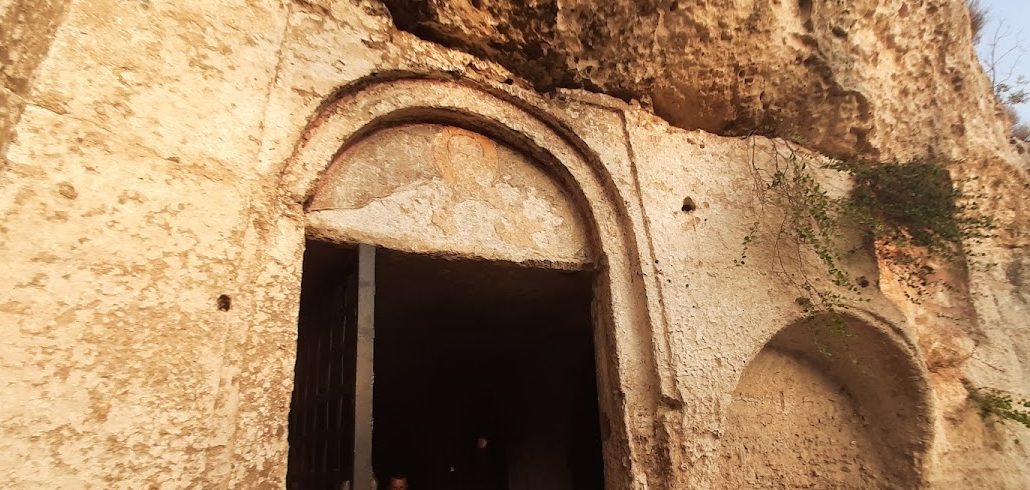
The church is carved into the rock at the summit of Lamaderchia. Rock-cut stairs lead to the entrance, whose safety was improved with an iron structure installed by the Superintendency. A large cave to the left contains two rooms and a well. It served as a custodian’s room, a function commonly associated with rock-cut churches. On the right, a niche holds a fresco of the Calvary.
The entrance has a rectangular frame above which is a double-ring lunette with traces of fresco. Its single opening is plain and rectangular. This form is characteristic of an earlier phase of rock-cut church entrances and supports a date around the ninth century for the beginning of the excavation.
Plan and sanctuary
The interior follows a Byzantine basilical arrangement, with a Latin cross cut into the rock. The apses face east. Three aisles divide the nave, or assembly area, while the raised presbytery, known in Orthodox worship as the bema, forms the sanctuary. Fragments of liturgical screens remain in this area. The central aisle is twice as wide as the lateral aisles, and the pillars contain stone seats used by worshippers during celebrations.
Altars and carved ceiling
The central rectangular apse preserves the remains of a monolithic Greek altar. The apses at the ends of the lateral aisles contain two Latin-type altars. In the Orthodox rite, these served as the prothesis, where Eucharistic offerings are prepared, and the diaconicon, the adjoining service space. A small pit in the right-hand altar may have served as a baptismal font, an interpretation supported by the altar’s dedication to Saint John the Baptist. Carved forms divide the presbytery ceiling into three different types of roofing.
Frescoes and crosses
The church contains 29 frescoes, including one ex voto, a devotional offering made in fulfilment of a vow or in thanksgiving, together with 12 crosses. Their imagery combines different cultural traditions. The eleventh-century Deesis shows Christ Pantocrator between Mary and John the Baptist. A Deesis presents Christ centrally, with Mary and John the Baptist interceding beside him, while Pantocrator identifies Christ as the all-powerful ruler. The Deesis and the images of Saint Nicholas retain explanatory inscriptions in Greek, despite Mottola’s position under Norman rule and within a Latin cultural environment.
Benedictine paintings
The earliest principal group belongs to the Benedictine phase. It includes the Deesis, Saint Peter on a pillar, the first painted layers of Saint Nicholas and Saint Stephen, an unidentified saint on a pillar, Saint Theodore, and two diptychs. The diptychs show Saint Peter with Pope Leo the Great and Saint Helena with an unidentified bishop. Saint Theodore, previously identified as Saint Sabinus, appears among these early painted figures.
Hospitaller paintings
The later group belongs to the Hospitaller phase and includes two images of Saint George, Saint Parasceve, later layers of Saint Stephen and Saint Nicholas, two depictions of the Archangel Michael, the Dormition of Saint John the Evangelist, the Vision of Saint Stephen, and the Parable of the Wise and Foolish Virgins. The group also includes Saint Nicholas in the left aisle, Virgins with the Child, Saint Basil, Saint Lawrence, Saint Peter, Saint Lucy, Saint Pelagia, Saint Julian, the exterior Calvary, and crosses associated with the church’s rededication.
Solar illuminations
An exterior gnomon, an element that directs sunlight to indicate solar positions, is carved within the Calvary and measures about 19 centimetres in diameter. It dates to the eleventh century, around the time of the first layer of the Saint Nicholas fresco. The arrangement uses the solar cycle so that sunlight reaches particular symbolic points on selected days.
The solar illumination associated with Saint Stephen appears from 14 to 19 December between 14:30 and 16:00, when sunlight reaches the saint’s abdomen. The arrangement seems to have been designed for 21–26 December under the Julian calendar, the calendar used in medieval Europe before the Gregorian reform, placing the phenomenon between the winter solstice and Saint Stephen’s feast day.
A second illumination reaches the heart of the Saint Nicholas fresco from 12 to 21 March and from 16 to 23 September between 16:30 and 17:30. The spring occurrence may relate to the saint’s birth, given as 15 March 270. Two less prominent effects have also been identified: sunlight reaches the blessing hands of the figure in the Dormition fresco on 14 September, and another beam reaches the heart of Saint Theodore, shown as a warrior saint, on 6 November. The exact symbolic meaning of these solar manifestations remains uncertain.