Church of San Giovanni Battista: Baroque Parish Church of Morbegno
Site at a Glance
- Popularity
- Medium
- Country
- Italy
- Primary era
- Early Modern
- Eras represented
- Early Modern
- Civilizations
- Unclassified
- Site type
- Religious
- Remains
- Church
On this page10 sections
History
The Church of San Giovanni Battista is a Roman Catholic collegiate church in Morbegno, Italy, dedicated to John the Baptist and built in the Baroque period. A collegiate church is served by a college of clergy, commonly called canons. The church belongs to the Diocese of Como, a territorial jurisdiction of the Catholic Church, and follows the Roman rite. It has served as Morbegno’s parish church since 1560 and is a major religious center in the town and an important Baroque church in Valtellina.
A New Church for Morbegno
The present building replaced an earlier church dedicated to John the Baptist, which stood on the site of the current forecourt. Archpriest Giovanni Battista Castelli di Sannazzaro, a senior priest with ecclesiastical responsibilities, judged that the town needed a larger church. Canons Luigi Castelli di Sannazzaro, Cesare Parravicini, and Giocondo Parravicini purchased meadows north of the old church for the new building.
Castelli di Sannazzaro laid the first stone on 14 April 1680. Construction lasted 35 years. From 1714, furnishings were transferred from the sixteenth-century church as work progressed, while the earlier building was gradually demolished. The new church was consecrated on 24 June 1780. Its architects are not securely identified, although some scholars attribute the design to Gerolamo Quadrio.
Two confraternities, lay associations for devotional activity, maintain Holy Week traditions at the church: the Confraternity of the Blessed Sacrament and the Confraternity of the Assumption, formerly known as the Battuti, a name associated with a penitential confraternity tradition. In March 1993, thieves took 37 paintings from the church.
Remains
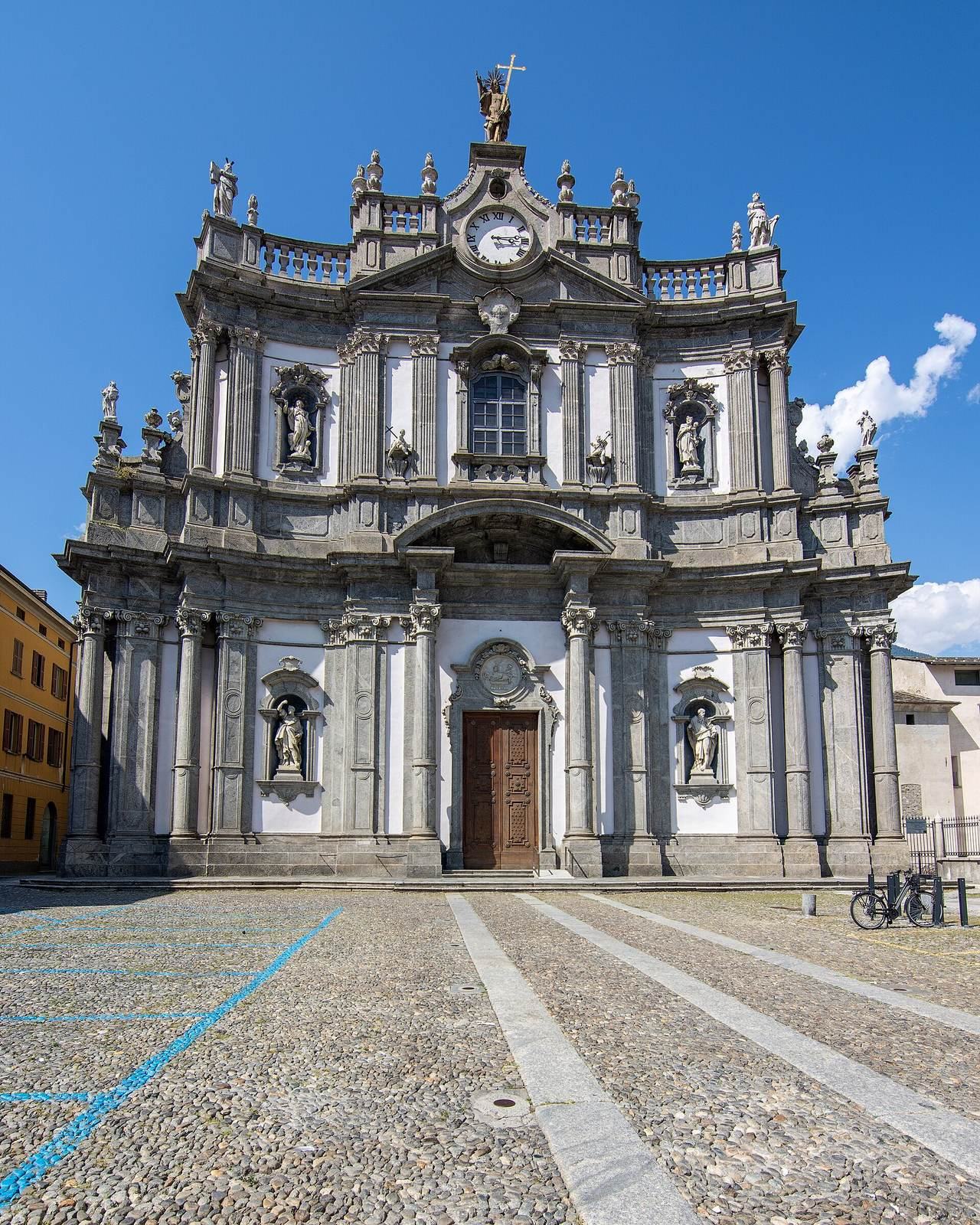
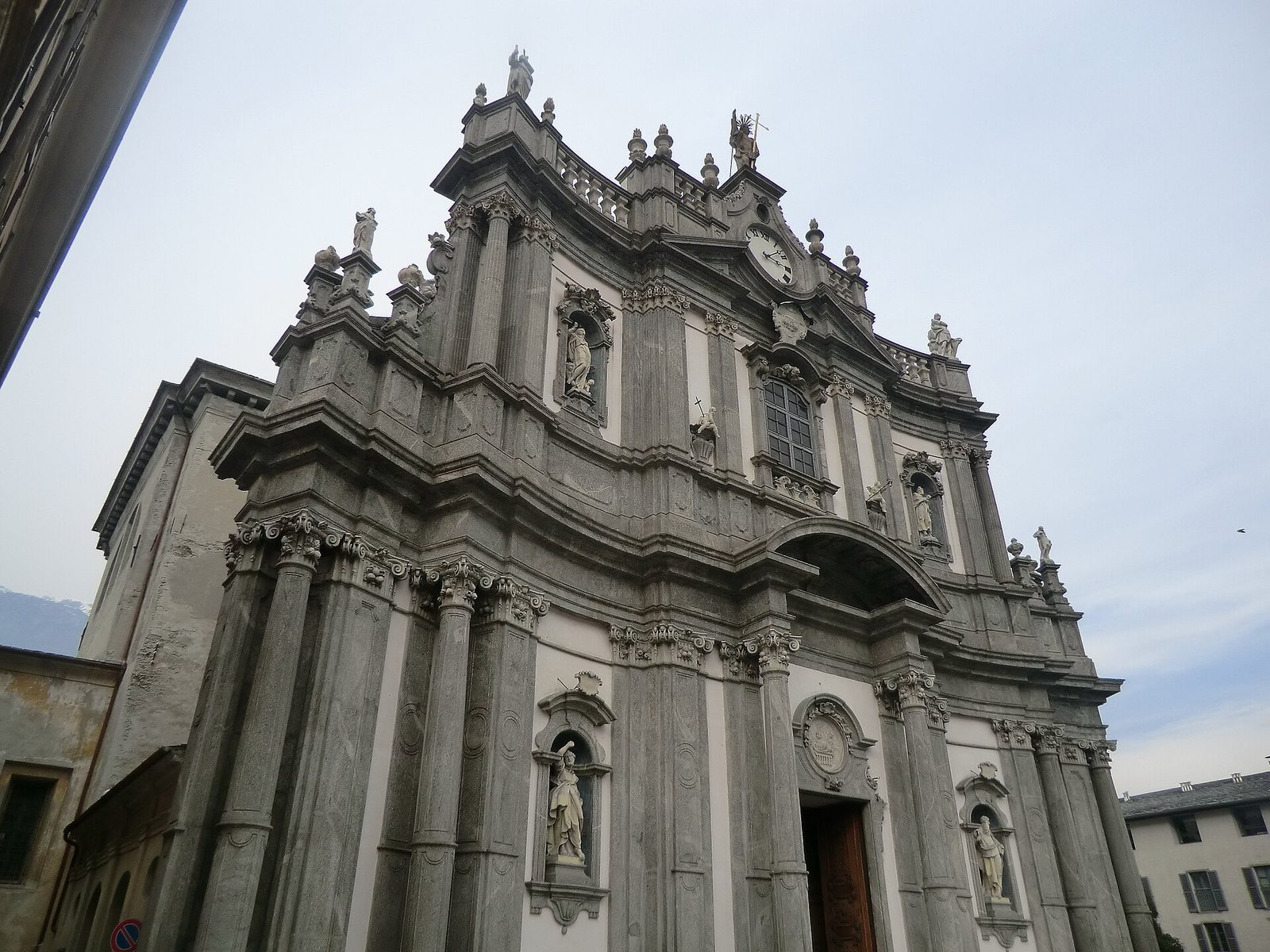
The church is oriented north to south and has a Greek-cross plan, with four arms of roughly equal length, about 39 metres. Its hall is bordered by side chapels that give the interior a multilobed elliptical outline. A broad, raised forecourt paved with cobblestones fronts the slightly concave principal façade, which is in the Barocchetto style, a lighter and more delicate development of Baroque design.
Exterior and Layout
Forecourt and Plan
The raised cobblestone forecourt occupies the position of the earlier church. Beyond it, the arms of the Greek-cross plan extend around a central hall, with the side chapels shaping its curved perimeter.
Principal Façade
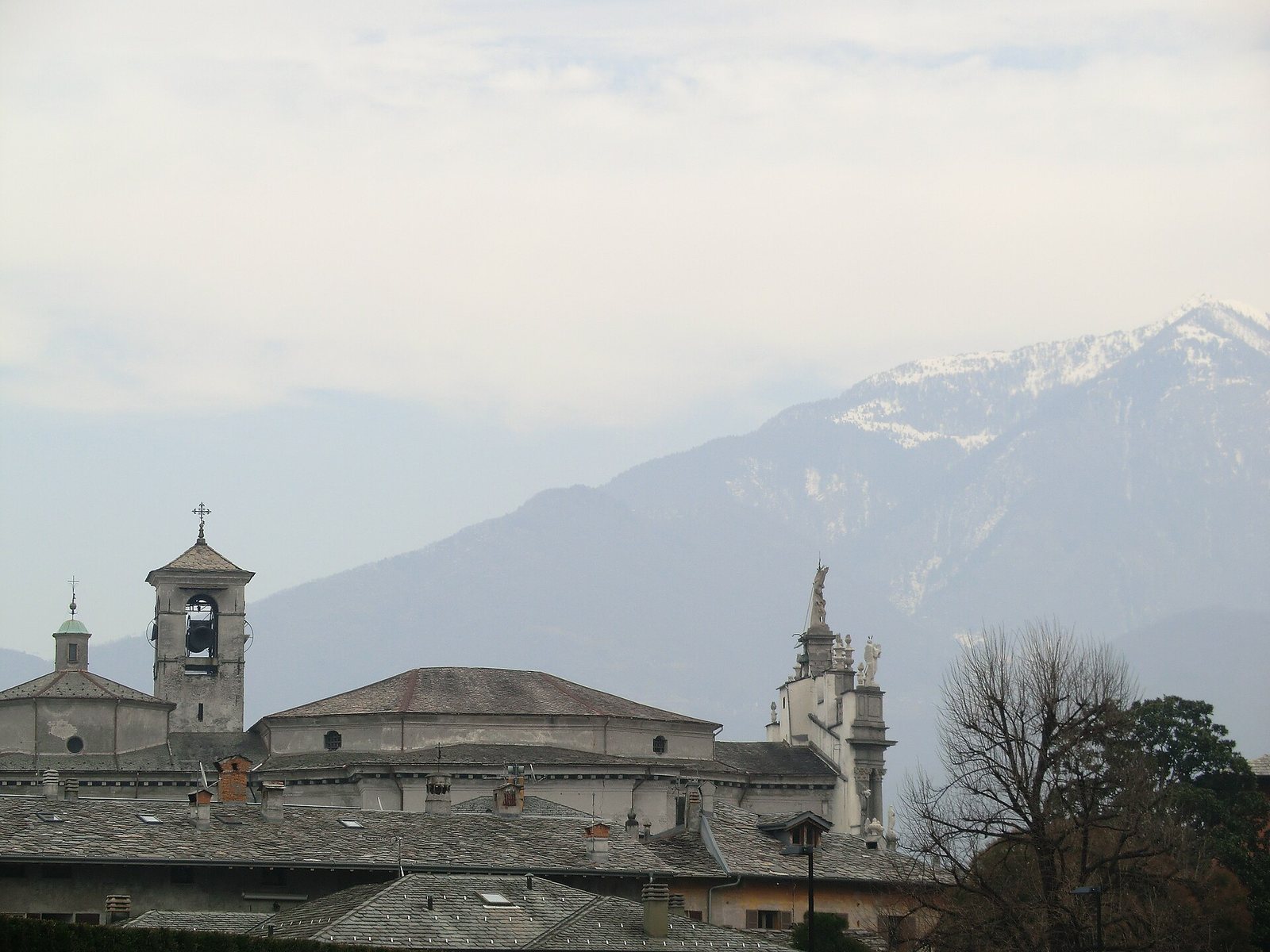
The façade’s design is attributed to Cesare Ligari, and its execution to Stefano Salterio. Work began in the 1730s, with phases dated 1738–42 and 1765–80; Salterio’s work is also dated 1780–82. The year 1779 appears at the top of the façade. Ten statues made by Salterio are arranged symmetrically around its center. In the niches, the Assumption, the belief that Mary was taken bodily into heaven, stands above Saint Peter on the left; Saint Joseph with the Child stands above Saint Paul on the right. Two child figures between the upper niches and the central window represent Hope and Faith. At the outer corners, Saint Elizabeth stands below Moses on the left, while Saint Mary Magdalene stands below King David on the right.
A further statue at the summit represents the redemption brought by Jesus; its sculptor is unknown. Above the entrance, a medallion bears the Lamb of God, a Christian symbol of Christ, designed by Giovan Pietro Romegialli.
Interior and Sacred Art
Paintings and Frescoes
The church’s paintings include Giovanni Battista Pittoni’s Madonna and Child with Saint Filippo Neri, painted in 1740, 36 oval paintings, some by Giuseppe Antonio Petrini of Carona, and Andrea Lanzani’s Death of Saint Joseph. Numerous works by Valtellinese artists Cesare and Pietro Ligari have also led to the church being called a Ligari temple.
Pietro Ligari began painting the apse frescoes of the church’s patron saint in 1727. His altarpieces include the Pentecost of 1733 and the Descent of Jesus of 1736. Gianolo painted frescoes in the chapels of Saint Joseph and the Madonna of Carmel. In the main sacristy, frescoes are attributed to Pietro Bianchi, known as Bustino; Petrini painted a scene of a miracle of Saint Vincent Ferrer there in 1750–51.
Sculpture and Sacred Objects
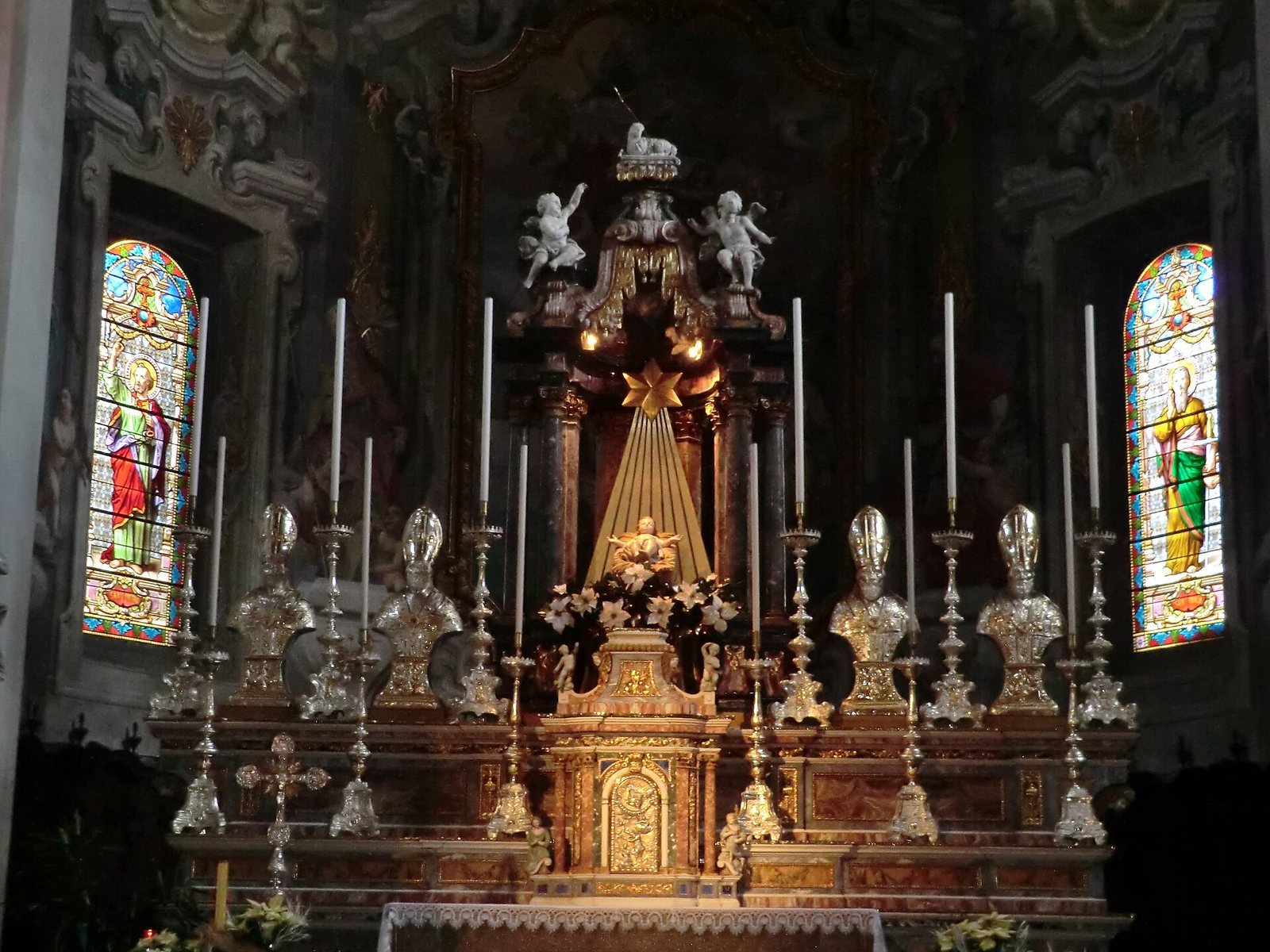
Works moved from the earlier church include a statue by Giovanni Angelo Del Maino and statues of Saints Roch and Sebastian from the Carmine chapel, made by Pietro Bussolo’s workshop. A rediscovered Madonna by Del Maino belonged to a Lamentation over the Dead Christ commissioned by Giovanni Maria Rusca in 1518. Elia Vincenzo Buzzi made the praying angels beside the high altar.
A reliquary, a container for a religious relic, holds a Holy Thorn from Christ’s crown donated by Bishop Feliciano Ninguarda. The church also preserves the remains of Blessed Andrea Grego da Peschiera and the body of Saint Costantina. Its furnishings include sacred silverware, eighteenth-century banners, and liturgical vestments.
Holy Week Catafalque
A large wooden Baroque catafalque, a raised structure for supporting a coffin or funerary urn, stands in the middle of the hall during the Holy Week observance. The urn holding the deposed Christ is placed on it.