Chiesa di Maria Santissima del Rosario: Mother Church of Palma di Montechiaro
Site at a Glance
- Popularity
- Medium
- Country
- Italy
- Primary era
- Early Modern
- Eras represented
- Early Modern, Modern
- Civilizations
- Kingdom of Sicily, Spanish
- Site type
- Religious
- Remains
- Church
On this page14 sections
History
Palma di Montechiaro and the church’s foundation
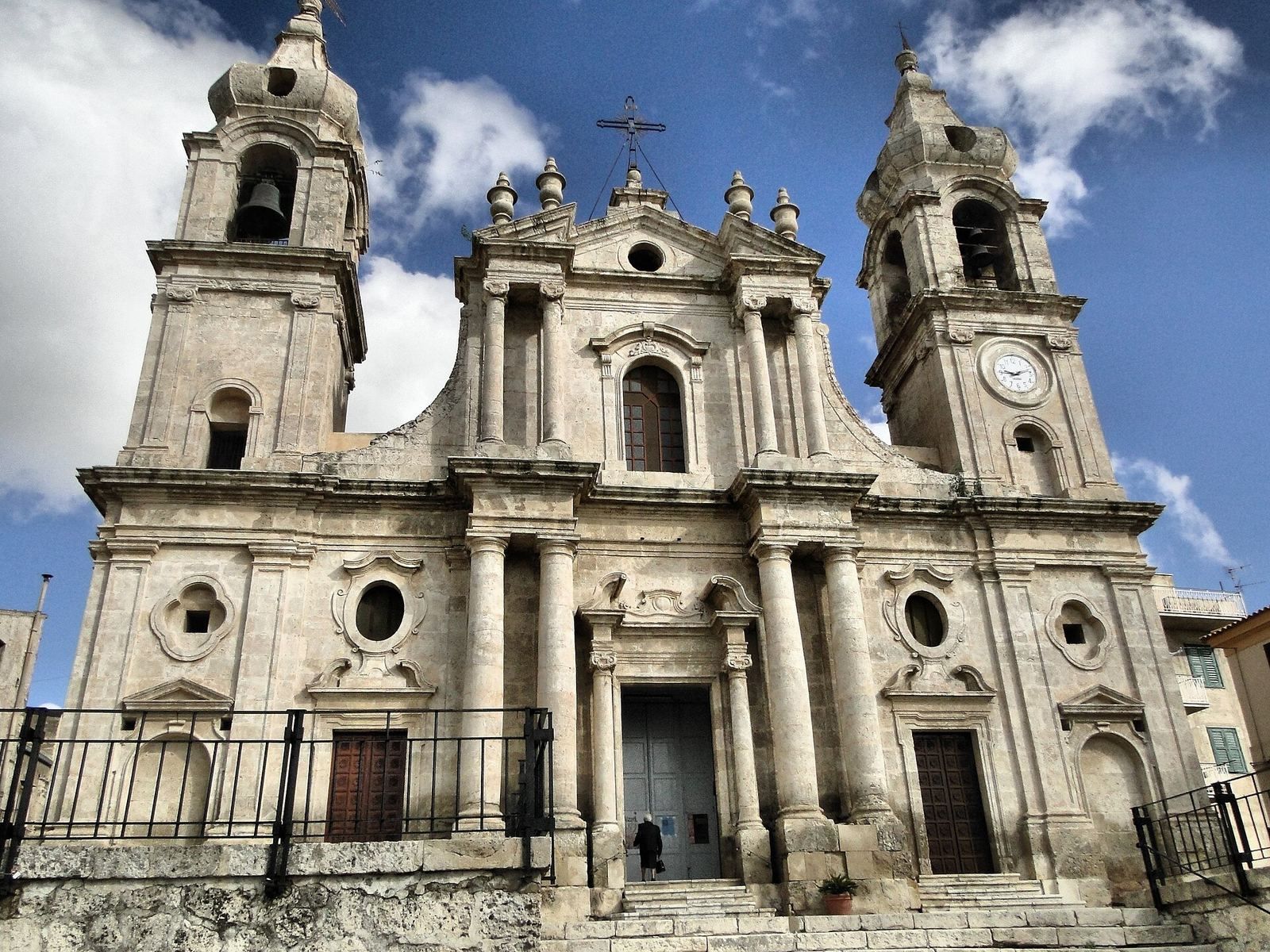
The Chiesa di Maria Santissima del Rosario is the Roman Catholic mother church of Palma di Montechiaro, Sicily, Italy. The act establishing the present church was made on 2 October 1666, and its façade reflects Sicilian Baroque, the regional form of the ornate Baroque style. The Tomasi family founded Palma in the late 1630s as noble landowners settled Sicily’s large estates; the family also governed the town as its feudal lords.
A chapel dedicated to Saint Joseph had stood on the church site from 1644. It was founded by Don Vincenzo Ottaviano, a priest who had arrived in Palma with the Tomasi family, and was later demolished. The town’s principal church had previously been the palatine chapel in the original ducal palace, a chapel attached to a ruler’s residence. After the palace became a monastery, Santa Rosalia’s church held that role for a time, but it fell into ruin.
Giulio Tomasi commissioned and financed the new church, leaving 1,000 onze, a historical Sicilian unit of money, in his will toward its completion. Local builder Francesco Scicolone carried out the work under the supervision of engineer Calogero Bennica of Girgenti, the older name for Agrigento. Jesuit architect Angelo Italia is credited with the design, although some attributions restrict his role to the façade.
Confraternities and later changes
Two religious associations, or confraternities, formed in Palma in 1638. Duke Giulio Tomasi established the Confraternity of the Virgin of the Rosary on 5 September. Its oratory served as its meeting place through the eighteenth century, and members gathered there to pray the Angelus, a Catholic prayer recalling the Annunciation. Carlo Tomasi, Giulio’s brother, founded the Confraternity of the Blessed Sacrament. From the late seventeenth to the early eighteenth century, its oratory received extensive artistic decoration. The confraternity organized observances for Corpus Christi, a feast honoring the Eucharist, as well as the Good Friday procession and Easter celebrations that included U Scontru, meaning “the Encounter.”
The church’s two bell towers were completed in 1779. The Tomasi family’s right of patronage once gave it a say in the appointment of the church’s archpriests. Canon Monsignor Rosario Di Benedetto was the last appointed under this arrangement; later appointments were made by the archbishop of Agrigento. The church belongs to the Archdiocese of Agrigento. Giuseppe D’Orsi led a renewal of the Blessed Sacrament confraternity between 1960 and 1962. Later safeguarding work restored its oratory for use and began cleaning its central altarpiece and canvases.
Remains
Exterior and plan
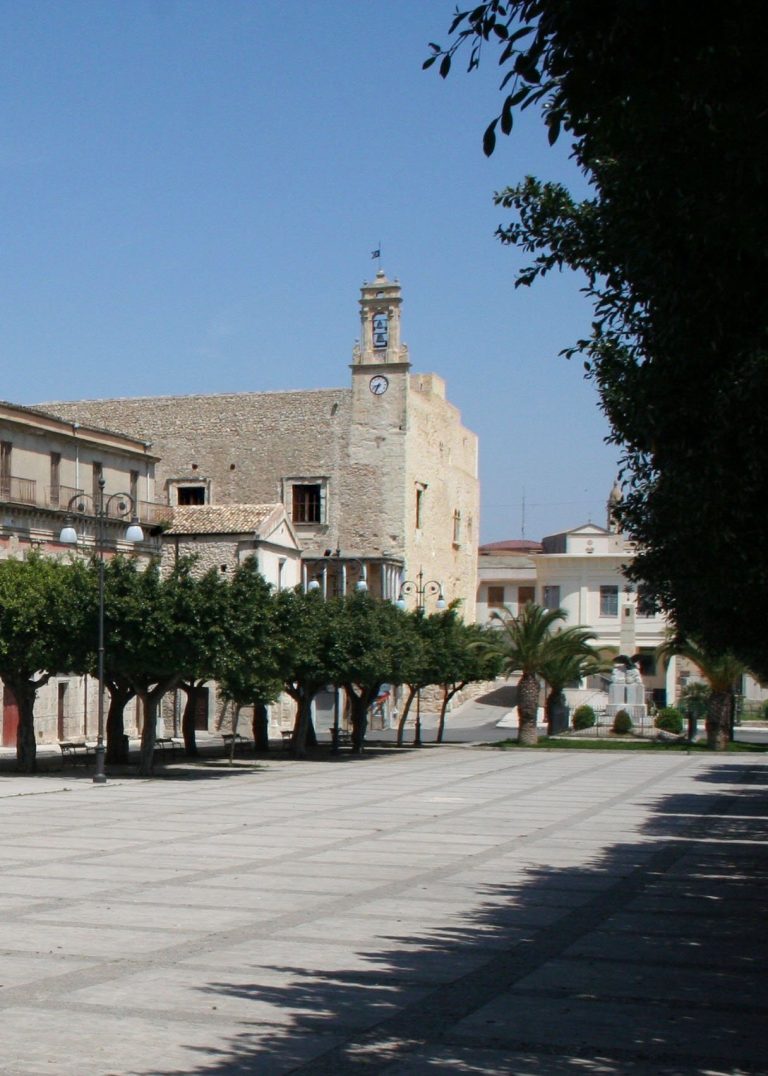
The church stands above a broad staircase. Its façade is built from dressed blocks of stone from the nearby Cassarino quarries. Two tiers of columns project from the wall, while broken pediments frame the central entrance and two smaller doorways; the bell towers rise above them. Inside, the building follows a long plan with three naves, or lengthwise sections, a crosswise arm, and a dome. This arrangement may have influenced later churches built after the 1693 earthquake, including the façade of Noto Cathedral.
Interior layout
Short columns divide the three broad naves. They have a red-marble finish and Doric capitals, a classical Greek column style. A spacious dome covers the area over the crosswise arm, and plasterwork throughout has Neoclassical decoration inspired by Greek and Roman forms. At the end of the naves, the broad presbytery, the area around the main altar, was once enclosed by ornate iron railings.
Chapels and burial spaces
The church includes chapels dedicated to Our Lady of Sorrows, a title of Mary emphasizing her suffering, and the Virgin of the Rosary. Small doors in both chapels lead to their associated confraternities. The first chapel on the left contains an image of Our Lady of Fatima, a title associated with Catholic devotion at Fatima, Portugal, and an urn holding relics, or remains associated with a saint, of Saint Traspadano, venerated as a Christian martyr. Cardinal Sforza Pallavicino gave the relics to Carlo Tomasi in 1666. The chapel also contains the remains of Giovanni Battista Hodierna, a seventeenth-century Sicilian priest and astronomer. An altar to Saint Joseph stands in the first chapel on the right, recalling the earlier chapel on the site. A marble slab in the central nave covers an entrance to underground burial chambers beneath the church. Other relics kept in the church include those of Saint Cecilia, an early Christian martyr, and Saint Pio of Pietrelcina, a twentieth-century Italian Capuchin friar, as well as a small piece of the Virgin Mary’s veil and relics of other saints.
Altars and artworks
Main altar and organ
Giuseppe Allegra of Palermo made the main altar, which depicts the supper at Emmaus. The carved wooden organ gallery, finished with gold leaf, was made by Calogero Provenzani, the father of painter Domenico Provenzani.
Paintings in the church
In 1784–85, Domenico Provenzani and his teacher Gaspare Serenari made paintings that include the Sacred Heart of Jesus with Saint Philip Neri, Saint Joachim with Saint Anne and the child Mary, and the Sacrifice of the Bull. A large painting of the Coronation of the Immaculate Conception is traditionally attributed to Serenari, a pupil of Italian painter Corrado Giaquinto. In the second half of the nineteenth century, Raffaele Manzelli painted ceiling scenes of the Trinity, the Evangelists, and the Transfiguration, among other subjects. His choir-wall paintings show the Payment of Judas and Jesus in the Garden of Gethsemane. A large painting at the high altar presents the Virgin of the Rosary with Cardinal Giuseppe Maria Tomasi, later canonized as a saint, and Saint Dominic. It replaced a similar work by Domenico Provenzani that had burned.
Sacristy
The sacristy holds a painting of the Martyrdom of Saint Traspadano attributed to Domenico Provenzani senior, along with portraits of the town’s dukes and archpriests. Its collection also includes a notable portrait of Giulio Tomasi.
Confraternity oratories
The Oratory of the Virgin of the Rosary and the Oratory of the Blessed Sacrament occupy positions crosswise to the church at its sides. An oratory is a chapel or prayer space associated with a religious group.
Oratory of the Virgin of the Rosary
On the east side, this oratory is dedicated to the Virgin of the Rosary, patroness of the Palma territory. It has a rectangular plan and a barrel vault, a continuous curved ceiling, decorated with biblical frescoes. Its interior also contains stucco work, frescoes, canvases by Domenico Provenzani, and a painting of the Virgin of the Rosary by an unknown artist, restored by a local artist. Statues of Our Lady of Sorrows and the Virgin of the Encounter are kept there.
Oratory of the Blessed Sacrament
This oratory contains a central altarpiece with a carved wooden frame made by cabinetmaker Don Calogero Provenzani, father of Domenico Provenzani. Its other contents include canvases by Domenico Agresta, frescoes, carved wooden choir stalls, chalices, and monstrances, vessels for displaying the consecrated host. The collection also includes covered vessels for consecrated hosts, incense burners with their small boats, imprints, emblems of the Blessed Sacrament, halos, and statues of the Risen Christ and the Dead Christ. A Holy Urn made by local or Sicilian craftsmen is preserved there, as are an underground crypt and papier-mâché statues of the Dead Christ and the Risen Christ.