Cheonghaejin: A Silla Maritime Headquarters and Fortress in South Korea
Site at a Glance
- Rating
- 4.4
- Popularity
- Low
- Country
- South Korea
- Primary era
- Medieval
- Eras represented
- Medieval
- Civilizations
- Silla
- Site type
- Military
- Remains
- Fort
On this page16 sections
History
Foundation and Maritime Expansion
Cheonghaejin was a Silla military headquarters and fortified maritime center established in 828 on Jangdo near present-day Wando in South Korea. It belonged to the Unified Silla period, the era after Silla had united most of the Korean Peninsula in the seventh century. King Heungdeok authorized its creation in the third year of his reign after Jang Bogo requested a base from which to suppress piracy and protect coastal communities.
Jang Bogo, a Silla commander and maritime magnate, had served in the Tang military at Xuzhou before returning to Silla. His experience of pirates abducting Silla residents and selling them as slaves shaped his request for a permanent naval stronghold. He was appointed commander of Cheonghaejin in April 828 and received 10,000 soldiers.
The settlement initially protected coastal residents and merchant fleets, but it soon developed into a major port and maritime-trade center. Its position brought together sea routes around the southern and western shores of the Korean Peninsula, routes from China’s Jiangnan region, and the maritime connection between Tang China and Japan along the southern Korean coast. Jang Bogo dispatched commercial and cultural envoys and accumulated considerable wealth through his control of this traffic.
Cheonghaejin’s setting supported both commerce and defense. The waters within the island offered relatively calm conditions, while nearby mountains strengthened the site’s defensive position. Connections with the inland areas around Gangjin and Haenam gave the port access to a wider hinterland.
Political Power and Closure
Jang Bogo used the headquarters to suppress piracy and extend his military and political influence. His forces became involved in Silla’s succession struggles and helped Shinmu take the throne in 839. During that conflict, they killed King Minae, a ruler caught up in the contest for power.
Jang Bogo’s influence later brought him into conflict with the royal court. His proposal that his daughter become a secondary consort of King Munseong was rejected. Jang Bogo was then killed by the assassin Yeom Chang in 846. Cheonghaejin was abolished in 851, and its remaining inhabitants were moved inland to Byeokgolgun, an administrative district of Silla. The closure of the port and the relocation of its population ended its role as a maritime center.
The twelfth-century Korean chronicle Samguk Sagi lists Cheonghaejin among Silla’s sites receiving a state-sponsored medium-level ritual. It gives Joeumdo as another name for the island and explains that it was later known as Wando.
Rediscovery and Protection
After the port’s abandonment, the site remained buried for a long period and was used as farmland by nearby residents. Wooden defensive posts exposed after Typhoon Sarah in 1959 brought the remains to wider attention. Excavations conducted by the National Research Institute of Cultural Heritage from 1991 to 1996 resulted in the restoration of the site.
Cheonghaejin was designated Historic Site No. 308 on September 1, 1984. The protected archaeological area covers approximately 482,884 square metres.
Remains
Island Fortress and Defenses
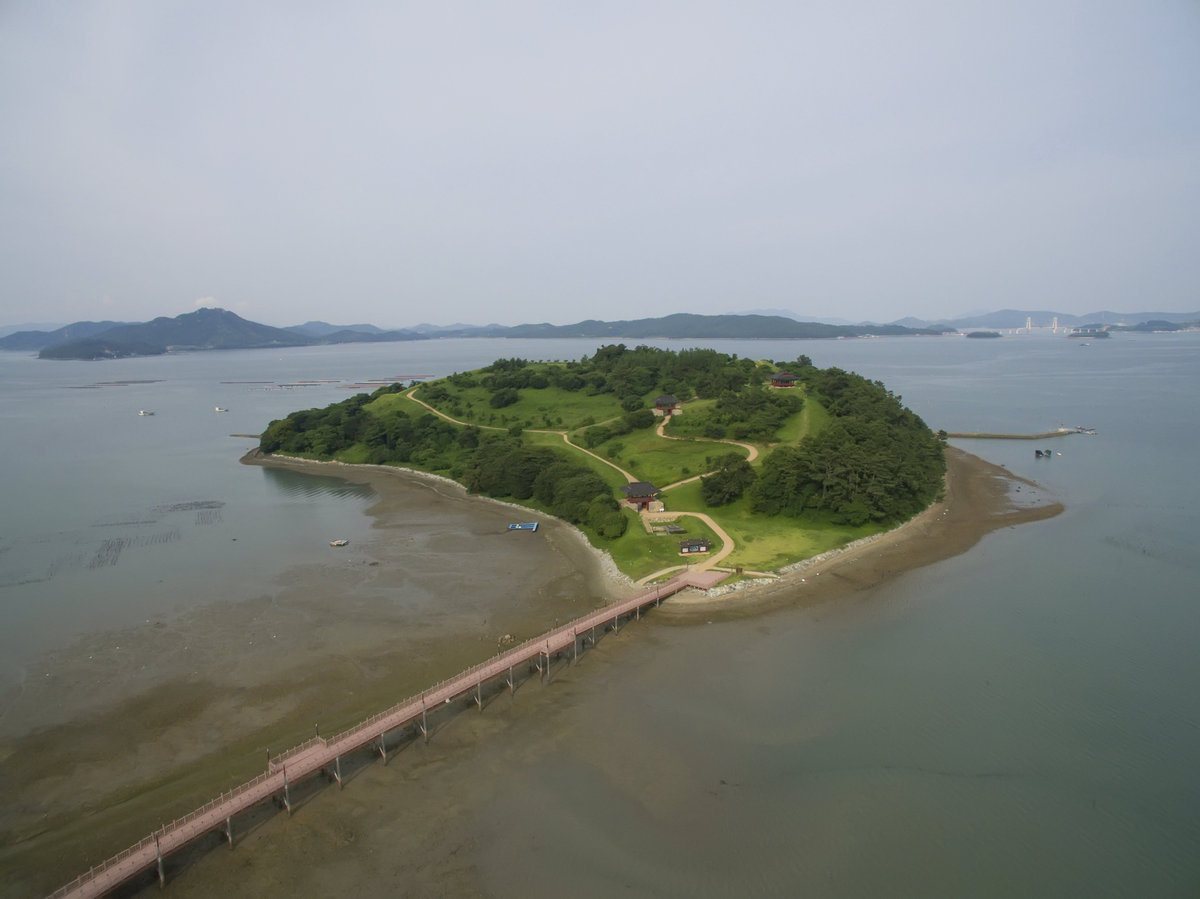
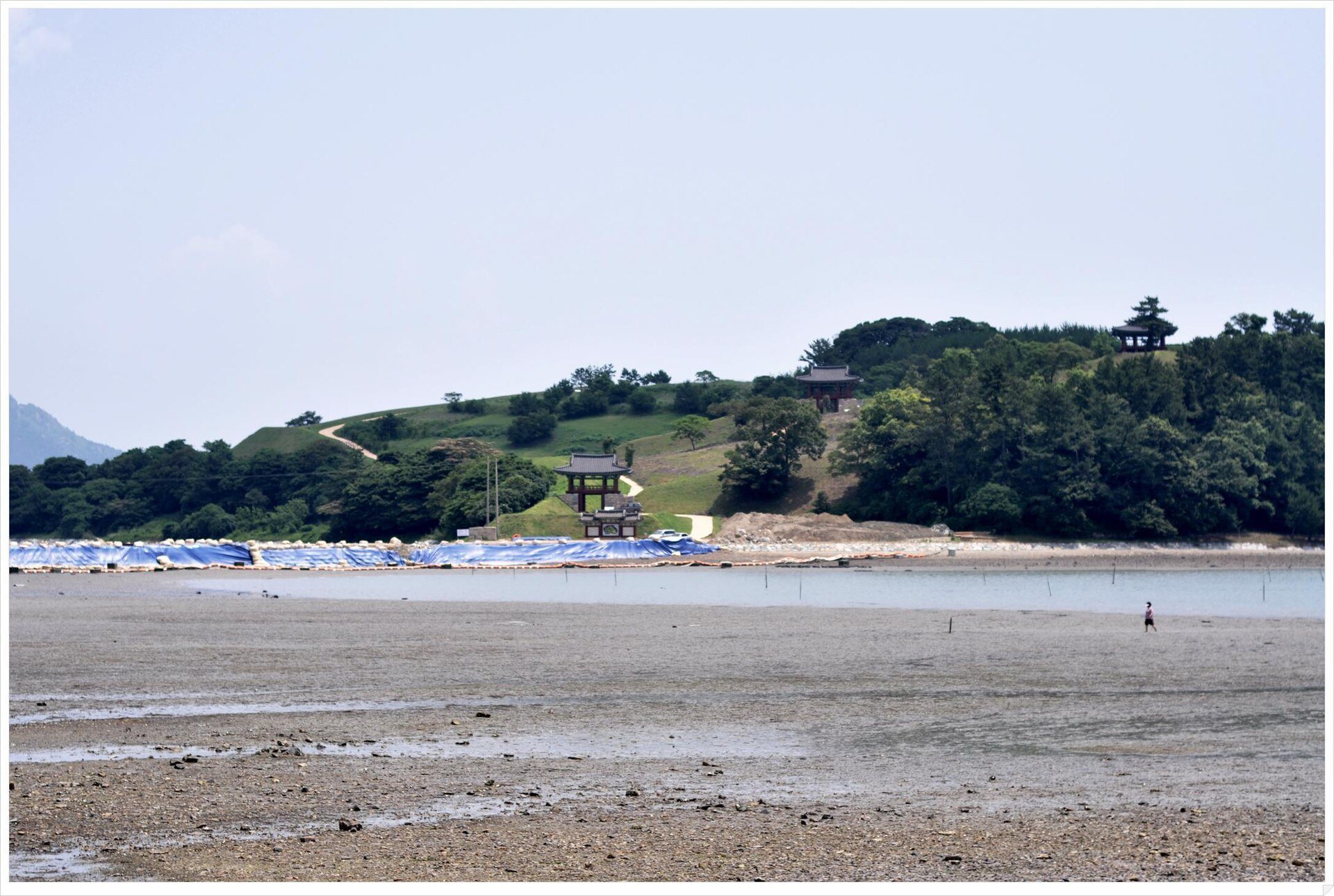
The historic fortress occupies Jangdo, an island connected to Wando by a wooden bridge. Jangdo lies about 180 metres from Wando. At low tide, the seabed is exposed and the distance can be crossed on foot twice each day. The surviving remains combine timber defenses at the island entrance with an extensive rammed-earth fortress.
Entrance Fence
A defensive wooden fence extends for about 331 metres from the island entrance. It consists mainly of oak posts. Radiocarbon analysis of sampled timber places the wood around the middle of the ninth century, close to the period when Cheonghaejin served as Silla’s maritime base.
Rammed-Earth Castle Walls
Cheonghaejin Castle extends for approximately 890 metres. Its walls were built by arranging one or two parallel rows of stones between five and six metres apart, then filling the intervening space with surrounding soil and compacting it repeatedly in layers. Some sections have been cut away or exposed so that this method of construction can be seen. Two chi, projecting sections of the fortress wall used to strengthen defenses and improve observation, also survive.
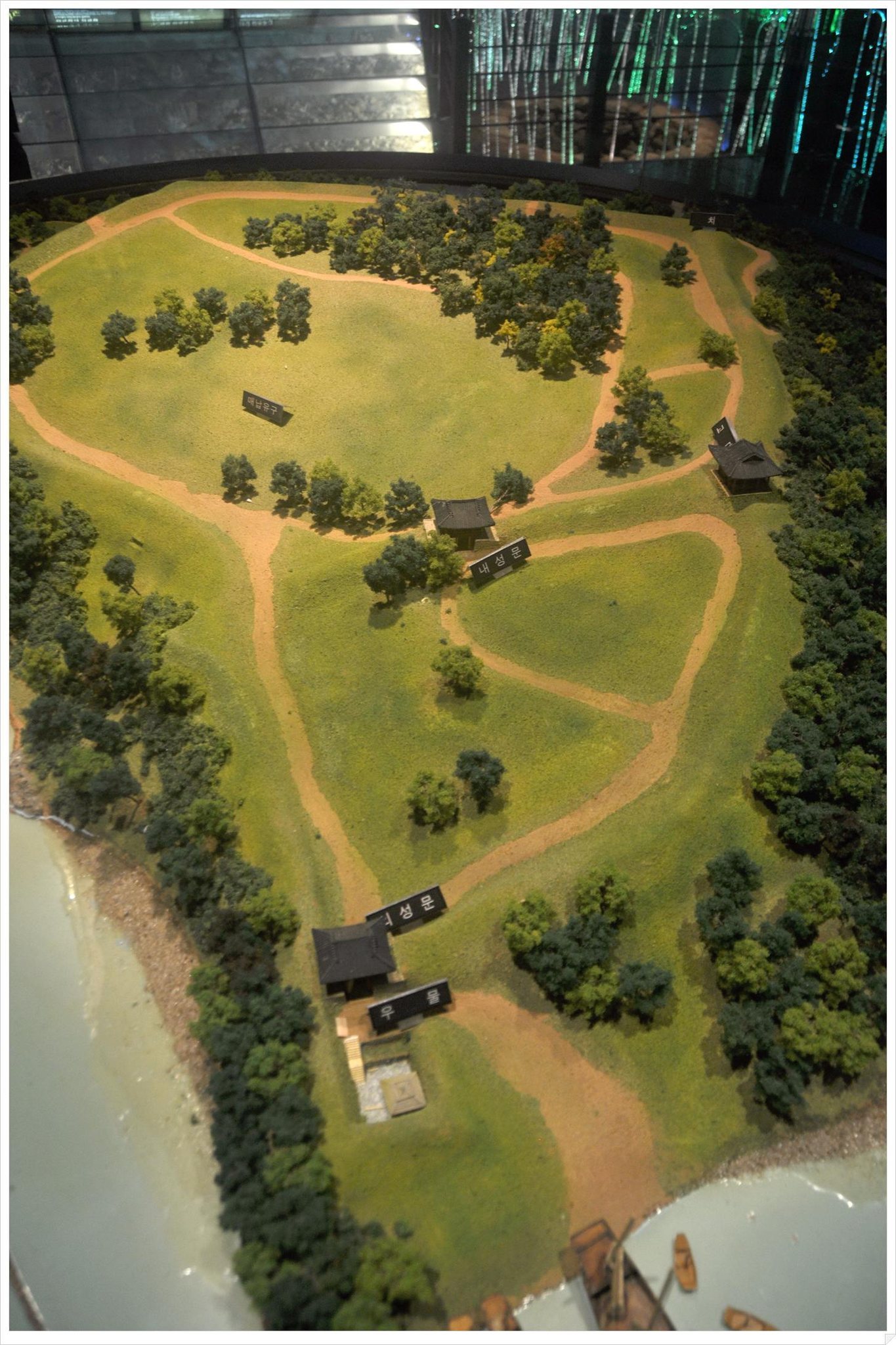
Outer and Inner Gates
The outer castle gate formed the passage between the area inside the fortress and the space beyond it. Its defensive arrangement was intended to obstruct attacks while allowing defenders to counterattack or drive intruders back. A double fortress wall reinforced the gate. The inner castle gate formed a second entrance farther within the castle and served another defensive purpose.
Godae
Godae stands at a high point along the east-to-west southern wall. From this position, defenders could observe the inland route leading from the coast and watch merchant ships and pirates offshore. Its location made the elevated point part of the fortress’s surveillance system.
Water Supply and Coastal Structure
D-Shaped Coastal Structure
A D-shaped rammed-earth structure stood along the coast. It protected a well and strengthened the outer castle gate. This form of construction is described as unusual in Korea, with no known parallel in China or Japan.
Well and Excavated Objects
The well survives to a depth of 5.8 metres. Excavation around the well or its pit produced earthenware flasks, iron objects and fragments, and bronze bottles believed to have served ceremonial purposes. These objects add evidence for the activities carried out within the fortified maritime settlement.
Religious and Commercial Remains
Beophwasa
The former site of Beophwasa lies at the foot of Sanghwang-bong behind Jangjwa-ri. Tradition holds that it was built in imitation of Beophwawon, a Buddhist establishment founded by Jang Bogo at Chishan in Shandong Province. Its construction was reportedly financed with revenue from maritime trade.
Trade Finds and Commemorative Features
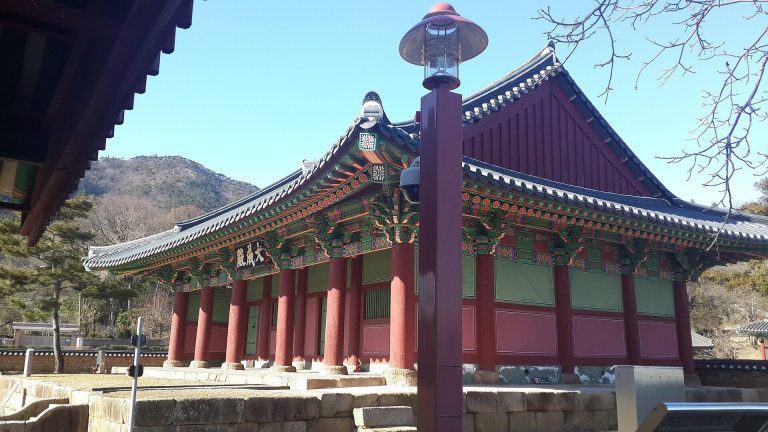
Excavations recovered remains of commercial goods and plates, contributing to an understanding of life at the Silla maritime base. A stele commemorates the relocation of Cheonghaejin’s residents to Byeokgolgun. A shrine is also shown within the reconstructed site area near the outer and inner gates.