Château St. Gerlach: A Former Monastery and Country Estate in the Netherlands


Site at a Glance
- Rating
- 4.5
- Popularity
- Medium
- Country
- Netherlands
- Primary era
- Early Modern
- External website
- Open
- Eras represented
- Medieval, Early Modern, Modern
- Civilizations
- Holy Roman Empire, Spanish
- Site type
- Domestic
- Remains
- Castle
On this page11 sections
History
Château St. Gerlach is a former monastery complex and country estate in the Netherlands, in Houthem in the Geul Valley. Its history began in the mid-twelfth century around the hermit Gerlachus, and the site became a regional pilgrimage destination before developing into a Norbertine monastery and church.
Gerlachus and the monastery foundation
Gerlachus withdrew to the Geul Valley for a life of prayer. He also regularly travelled to the tomb of Servatius of Maastricht, an early Christian bishop whose burial place was an important pilgrimage destination in the region. After Gerlachus died in 1165, people came to his grave because miracles were attributed to him. Following his canonization, Gosewijn IV, the lord of Valkenburg, commissioned a Norbertine monastery and church at the tomb. Norbertines belonged to the Premonstratensian order, a Catholic religious order whose communities combined communal worship with pastoral work.
The grave continued to give the monastery a religious focus. Charles the Bold, Duke of Burgundy from 1467 until his death in 1477, visited the site as a pilgrim and prayed at Gerlachus’s tomb.
From monastery to convent
In 1345, the monastery became a convent for noblewomen. Such institutions allowed women from aristocratic families to live according to religious rules without necessarily becoming fully professed nuns. Many noble families sent daughters to St. Gerlach who could not, or did not wish to, marry.
The monastery was destroyed in 1574 during the Eighty Years’ War, the prolonged revolt of the Netherlands against Habsburg Spain that lasted from 1568 to 1648. Mercenary troops commanded by Louis of Nassau destroyed it during a campaign or raid in the Lands of Overmaas.
Political transfers and eighteenth-century expansion
The Treaty of Partition of 1661 divided territories in the region between the Dutch Republic and Spain. Under its terms, the monastery came under Spanish-Habsburg sovereignty. During the eighteenth century, the complex was expanded, including the surviving farm buildings. The Aachen architect Johann Joseph Couven designed this expansion.
In 1786, an exchange brought the complex under the control of the Dutch Republic. The convent’s noblewomen subsequently moved to the vacant Carthusian monastery of Bethlehem in Roermond. Carthusian monasteries belonged to a contemplative order known for its strongly solitary form of religious life.
Secular ownership and changing uses
After the French invasion of 1795, monasteries in the occupied Netherlands were confiscated. Notary Schoenmaeckers, who had acted as the sisters’ agent, later purchased the complex and transformed it into a château-like country estate. The former monastery church was transferred to the parish of Houthem and became the parish’s new church.
The estate was successively occupied by the Corneli and De Selys de Fanson families. Robert, the last member of the De Selys de Fanson family, lived at the château until 1979, when he bequeathed it to the church council of Houthem parish. After his death, the château and several ancillary buildings fell into serious disrepair.
War damage, restoration, and later development
During the Second World War, German forces occupied the château. After liberation, American soldiers used it. A pistol shot fired by an American soldier left a hole in the large mirror above a mantelpiece, a physical trace of this period of military occupation.
In 1994, Limburg hotelier Camille Oostwegel purchased the complex and began an extensive renovation. Pieter van Vollenhoven opened the restored complex on 15 September 1997 as a hotel, restaurant, and conference center. In February 2002, twelve European central-bank presidents met there and planted twelve plane trees as a memorial. The trees became the Europalaan, and the Euromonument, made by the Benedictine brother Leo Disch, was unveiled there in 2003.
The former seventeenth-century Broers castle farm was acquired in 2015 and incorporated into a hotel expansion completed in 2016. A conference pavilion was also built on its grounds to a design by Francine Houben. Flooding from the nearby Geul in July 2021 damaged the hotel’s technical installations and forced it to close for several months. Château St. Gerlach, Sint-Gerlachus Church, and the surrounding gardens include several designated national monuments, and the complex forms part of Buitengoed Geul & Maas.
Remains
Layout and setting
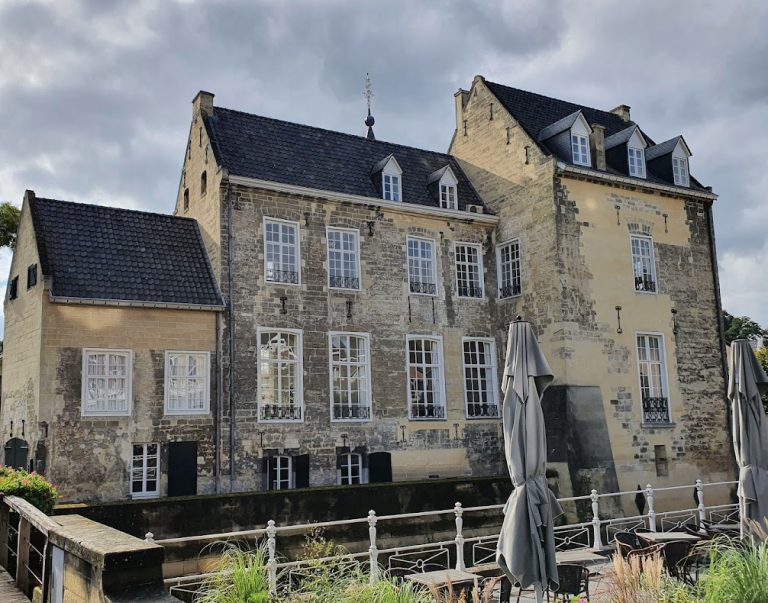
The complex lies in Houthem in the Geul Valley, beside Ingendael and near the Geul River. Its principal elements are arranged around a rectangular main building, a coach house, and a castle farm. Sint-Gerlachus Church and the surrounding gardens form additional parts of the historic complex.
Church and tomb of Gerlachus
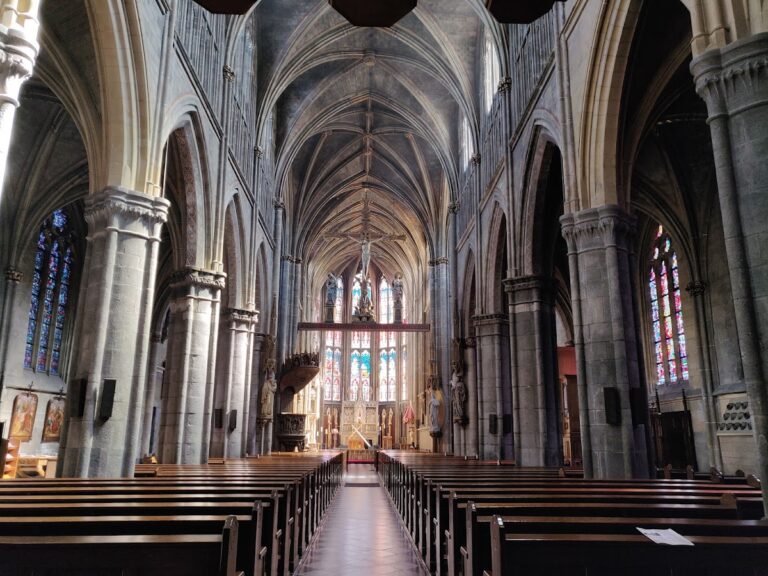
The former monastery church now serves as the parish church of Houthem. Its most important surviving religious feature is the monumental tomb of Gerlachus, whose grave gave the site its original pilgrimage purpose and remained central to the monastery’s identity.
Farm complex and conference pavilion
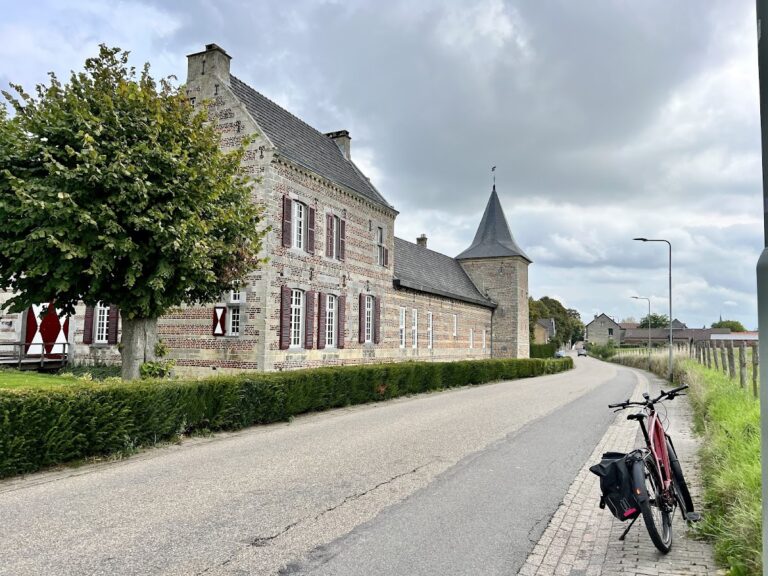
The surviving farm complex belongs to the eighteenth-century expansion designed by Johann Joseph Couven. The Broers castle farm, a seventeenth-century building, was incorporated into the hotel expansion completed in 2016. A conference pavilion designed by Francine Houben stands on the farm’s grounds.
Memorial features and surviving traces
The twelve plane trees planted in 2002 by the participating European central-bank presidents form the Europalaan. The Euromonument, created by Leo Disch, was unveiled there in 2003. Inside the château, the hole in the large mirror above a mantelpiece preserves a physical reminder of the American military occupation after the Second World War.