Château du Perron: A Nineteenth-Century Residence in Normandy


Site at a Glance
- Rating
- 4.8
- Popularity
- Very Low
- Country
- France
- Primary era
- Modern
- External website
- Open
- Eras represented
- Modern
- Civilizations
- French
- Site type
- Domestic
- Remains
- Elite Residence
On this page8 sections
History
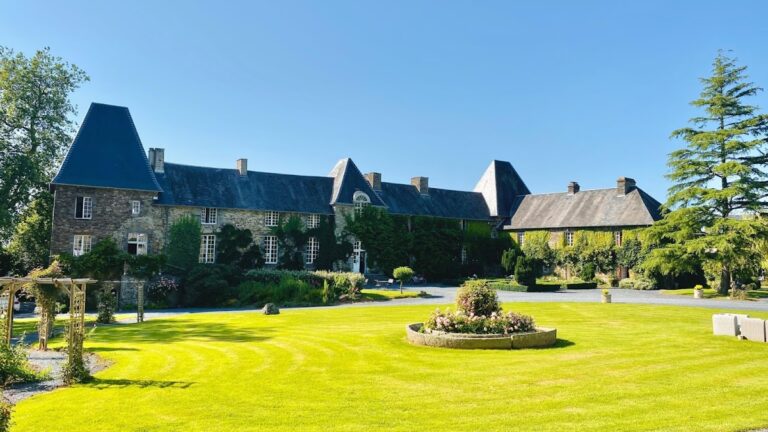
Château du Perron is a nineteenth-century residence in Saint-Sauveur-Villages, France, in Normandy. It stands on the former commune of Saint-Aubin-du-Perron and was rebuilt in 1860 by Count Jules d’Auxais. Local tradition holds that the residence replaced the older manor of La Hézardière. Its history reaches back to the medieval fief of Perron, which belonged to the Davy family from at least the fourteenth century.
The Davy family and the fief of Perron
Jean Davy was recorded in 1399 as lord of Perron and Virville and as lieutenant-general of the Viscount of Coutances. He was followed by Jean II Davy and Jean III Davy, while Jean IV Davy was named lord of Perron in 1505. When Jean V Davy died without issue in 1533, his brother Jacques inherited the fief.
On 5 July 1533, Jacques Davy rendered homage to King Francis I for Perron. Homage was the feudal act through which a vassal recognized the authority of a superior lord, often the king. In an acknowledgment dated 24 July 1536, Jacques described Perron as a freely and nobly held fief and seigneurial jurisdiction. It possessed its own court, justice rights, customary rights, and assembly of vassals.
Jacques’s son Jean VI inherited Perron and rendered homage to the king in 1559 for Perron and La Champagne. Through his marriage to Anne d’Anneville, the Davy family also acquired the lordship of Quettreville. Their son Bernard Davy acknowledged his tenure in 1607, but financial difficulties led him to sell Perron and La Champagne on 15 July 1608 for 54,000 livres tournois to his cousin Jean Davy (1565–1621). Jean Davy was a councillor of state, lord of La Guette, and later archbishop of Sens. After his death, his possessions were divided between his sisters Marie Davy and Anne-Mary Davy on 17 May 1622.
The Châtellenie du Perron
Perron changed hands again on 10 August 1659, when it was sold for 30,000 livres to Charles Lemennicier de Martigny, lieutenant-general in civil and criminal matters at Saint-Lô. He rendered an acknowledgment for Perron in 1661. An aveu, or formal acknowledgment of a fief and its obligations, placed the lord’s rights and responsibilities within the feudal system.
In June 1676, letters patent issued by Louis XIV united Perron, La Hazardière, Hotot, and Creveuil into a single lordship called the Châtellenie du Perron. A châtellenie was a seigneurial jurisdiction centered on a castle or lordship. In this case, it also included the Grente, Manne, and Rohard mills on the Taute, together with ecclesiastical patronage rights. The grant was presented as a reward for Lemennicier de Martigny’s services to the state and to Kings Henry III, Henry IV, and Louis XIII.
The d’Auxais estate and the nineteenth-century rebuilding
Jean-Paul-François d’Auxais, lord and patron of Saint-Aubin-du-Perron, died at Perron on 13 December 1794 and was buried in the cemetery of Saint-Aubin-du-Perron. His daughter Marie-Françoise d’Auxais, the widow of Thomas Desmaretz, later bequeathed the château to Count Jules d’Auxais when she died in 1831.
Count Jules d’Auxais (1818–1881) held the Perron estate from 1831. A deputy, senator, and mayor, he rebuilt the château in 1860. His daughter Marie (1848–1929), who married Count Arthur de Hercé, inherited Perron. Their daughter Germaine (1876–1965) was the châtelaine in 1913, meaning the female holder or mistress of the château estate, and was married to Marquis Jean de Foucault-Malembert. Their son, Count Jean de Foucault de Malemebert, later inherited the estate and sold it to André Gaultier on 29 October 1973.
Wartime use and later ownership
During the Second World War, the château was requisitioned to house German officers. At the Liberation in July 1944, General Dwight D. Eisenhower stayed there for eight days in his camp trailer. Eisenhower was the senior Allied commander in Western Europe and later became president of the United States.
Mr. and Mrs. Russel purchased the Perron in 1989 and sold it in 2017 to Hubert and Véronique Manson. These successive transfers continued the estate’s modern history after its long association with the Davy and d’Auxais families.
Remains
The château stands on flat ground southeast of Périers and about 3 kilometres north of the church of Saint-Aubin-du-Perron. Its west side faces a pond. Relatively modest in size, the building has two stories above a partly underground basement. A broad, flat horizontal band divides the floors, while the façades follow a carefully symmetrical composition. The building is architecturally comparable to older châteaux at Carneville, Annoville, and Carantilly.
Principal façade and pavilions
The east-facing principal façade is arranged around a central section three windows wide. Two pavilions, each two windows wide, flank this center and complete the balanced elevation. Their tall Mansard roofs have two slopes on each side, with the lower slope steeper than the upper one, creating additional roof space. Dormer windows and small oculi, or usually circular openings, pierce the roofs and add detail to the upper portions of the pavilions.
Pond-facing façade
The west façade presents a different central arrangement toward the pond. Its middle section projects distinctly from the wall in a semi-hexagonal plan and is three windows wide. The openings have segmental-arched lintels. Decorative sculptures appear above the central windows, giving this elevation a more concentrated ornamental emphasis than the regular east front.
Nearby sites