Château de Lutzelbourg: A Medieval Castle Ruin in France


Site at a Glance
- Rating
- 4.5
- Popularity
- Very Low
- Country
- France
- Primary era
- Medieval
- External website
- Open
- Eras represented
- Medieval
- Civilizations
- Duchy of Burgundy, Holy Roman Empire
- Site type
- Military
- Remains
- Castle
On this page10 sections
History
Château de Lutzelbourg is a medieval hilltop castle ruin at Ottrott in France, built mainly during the first half of the thirteenth century. It forms part of the Castles of Ottrott, a group that also includes the Old Lutzelbourg and Rathsamhausen ruins. Its position and defenses reflect the political struggle between the Hohenstaufen, a powerful dynasty that supplied several rulers of the Holy Roman Empire, and the episcopal authorities of Strasbourg.
Old Lutzelbourg and the Early Thirteenth Century
Excavations have revealed the foundations of a predecessor castle between the present Lutzelbourg and Rathsamhausen ruins. Known as Old Lutzelbourg, it was probably built before 1076 on the initiative of the Counts of Eguisheim, who held the advocacy of Hohenbourg Abbey. The Hohenstaufen destroyed it in the early twelfth century, then rebuilt it immediately afterward. In 1196, they granted it as a fief to Conrad of Lutzelbourg, a nobleman associated with the Lutzelbourg lineage. The Eguisheim-Dabo family burned the structure in 1198.
The present Lutzelbourg probably belongs to the building period around 1200–1250. A major phase began in the early thirteenth century under Otho II of Burgundy, the duke of Burgundy, who sought to reassert control over the region. Construction probably continued beyond 1220, and the castle now called Lutzelbourg was built below Rathsamhausen around the middle of the thirteenth century. Historians have proposed that Henry of Stahleck, bishop of Strasbourg, initiated the work to bring imperial possessions under episcopal control.
Conflict and Changing Lordship
Lutzelbourg’s defenses were directed toward neighboring Rathsamhausen, which remained in Hohenstaufen hands. During construction, the defenders of Rathsamhausen built a substantial keep facing Lutzelbourg. After Hohenstaufen influence in the Empire declined at the end of the thirteenth century, a political settlement probably developed between Rudolf I of Habsburg, a medieval German king and Habsburg ruler, and the episcopal party.
In 1392, Lutzelbourg was granted to the Counts of Andlau. They transferred their rights the following year to the Rathsamhausen-Ehenweier family, which already held the neighboring castle. The family rebuilt both castles in the early fifteenth century. Lutzelbourg was destroyed at an uncertain date before 1570 and was at least partly in ruins by that year. It was later pillaged and left ruined during the Thirty Years’ War, the seventeenth-century conflict that devastated much of Central Europe.
Ruins and Protection
A restoration took place in 1856–1857, followed by further work in 1991–1992 with the participation of volunteers from the Chantiers histoire et architecture médiévales association. The Castles of Ottrott are privately owned. Lutzelbourg has been protected as a French historic monument since 1985, although a new registration order dated 2 September 2025 abrogated the earlier registration order. Later historical usage associated the castle with the name Rathsamhausen. One historical account states that it was known by that name by the middle of the sixteenth century, and the name has continued to be used.
Remains
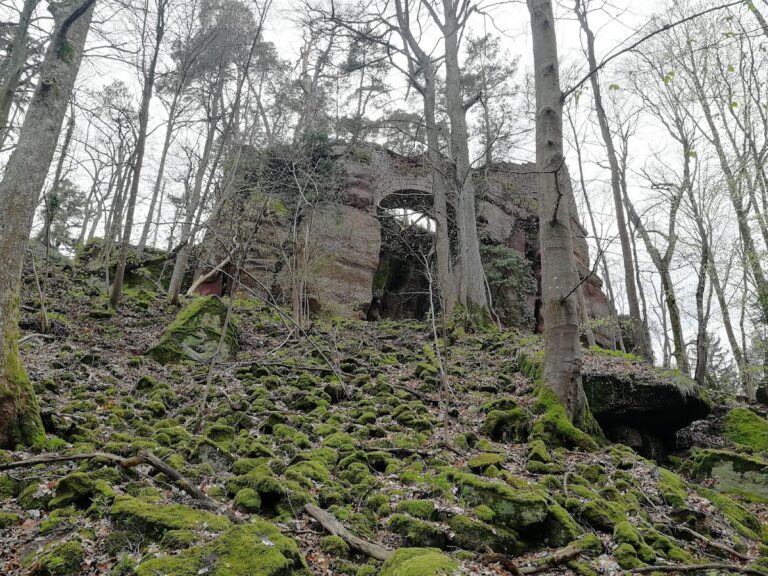
Château de Lutzelbourg stands on the Elsberg plateau, approximately 500 metres above the surrounding land. The well-preserved ruin has a pentagonal plan and is built from reddish sandstone conglomerate. Rathsamhausen lies about 50 metres to the west, while Lutzelbourg occupies the eastern position. The castle is organized as a mantle-wall fortress, meaning that its outer wall forms the principal defensive shell, and it is almost entirely surrounded by a lower defensive enclosure.
Fortifications and Internal Features
Keep and Shield Wall
The surviving defenses include a round keep and a shield wall, a particularly strong section of fortification. Together with the surrounding lower enclosure, these elements formed the main defensive structure of the hilltop castle. A barbican, an advanced defensive structure protecting an entrance, stands on the north side.
Arrow Slit Facing Rathsamhausen
A thirteenth-century arrow slit is directed toward Rathsamhausen. The opening, intended for the use of bows or crossbows, has a niche that provides additional internal space and a wall cupboard, a small built-in storage recess. Its orientation reflects the castle’s defensive relationship with the neighboring fortress.
Archaeological Foundations
Old Lutzelbourg
Between the two surviving castle ruins, archaeological excavations have identified the foundations of Old Lutzelbourg. These remains mark the earlier castle that preceded the present thirteenth-century structure and help distinguish the site’s earlier phase from the later hilltop fortress.
Nearby sites