Château de Villeneuve-Lembron: A Late-Medieval Château and Pleasure Residence



Site at a Glance
- Rating
- 4.5
- Popularity
- Low
- Country
- France
- Primary era
- Medieval
- External website
- Open
- Eras represented
- Medieval, Early Modern
- Civilizations
- French
- Site type
- Domestic
- Remains
- Castle
On this page9 sections
History
Château de Villeneuve-Lembron is a historic château in France, built at the end of the fifteenth century for Rigaud d’Aureille. Its late-medieval design combined defensive features with the character of a pleasure residence. D’Aureille was bailiff of the Auvergne Mountains, a royal judicial and administrative officer, and master of the household to Kings Louis XI, Charles VIII, Louis XII, and Francis I. He also served as an ambassador to Maximilian of Austria.
The d’Aureille and Montmorin families
At the beginning of the sixteenth century, the land of Villeneuve passed to the Montmorin family. Gaspard de Montmorin added painted decoration to the château, including work in the formal hall and the great stables. These additions introduced Renaissance imagery, reflecting the period’s renewed interest in classical artistic and architectural forms.
The Dufour transformation
Isaac Dufour, treasurer of France at the finance office of the généralité of Riom, acquired Villeneuve-Lembron in 1643. He remodeled the building, reshaped the interior courtyard, created a gallery supported by a portico, and decorated ceilings and fireplaces on the first floor.
In 1754, Élisabeth Catherine Dufour de Villeneuve married Michel Pellissier de Féligonde, bringing the château into the Pellissier de Féligonde family. Their great-granddaughter Léontine Pellissier de Féligonde married Adrien de Roquecave d’Haumières, Baron of Thuret, in 1855. The barons of Thuret retained the château until 1919.
State ownership and preservation
Georges Tixier, the last private owner, donated the château to the French state in 1937. The Centre des monuments nationaux, the state institution responsible for managing and presenting major historic monuments, has managed it on the state’s behalf since then and carried out major restoration work.
The château, its surrounding moats, the entrance gate of the neighboring farm, its interior decoration, and a painted vaulted room have been listed as historic monuments since 25 May 1926. State ownership and later restoration preserved the building as a place where its architectural development and decorative history can be interpreted together.
Remains
Wings, towers, and courtyards
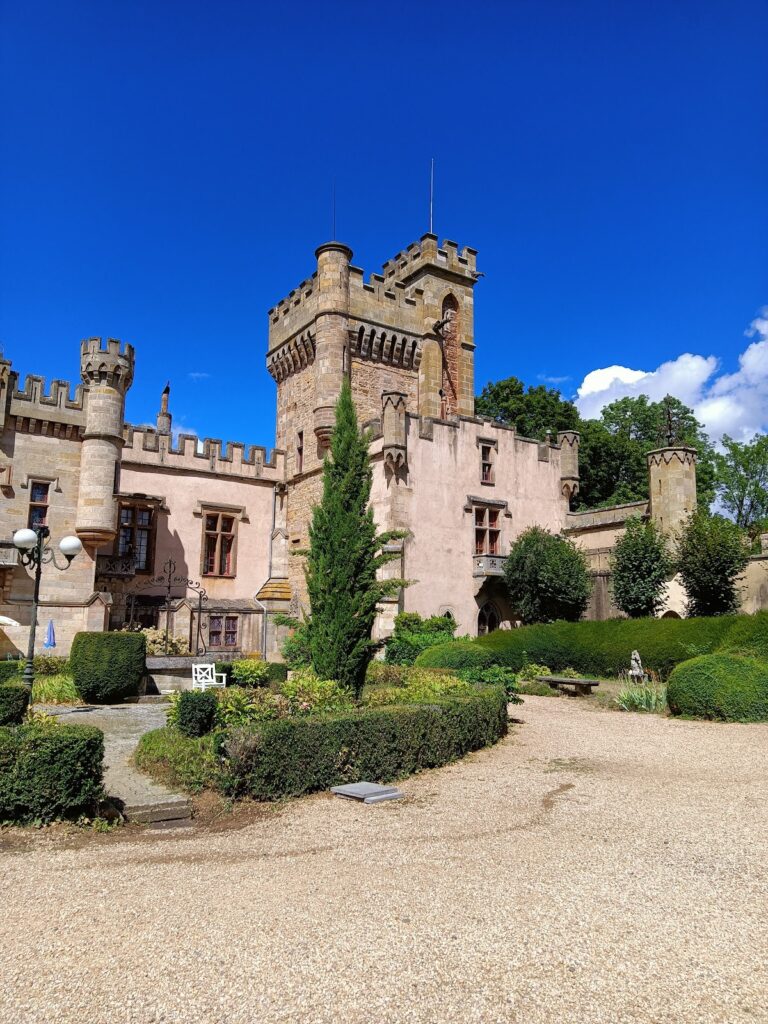
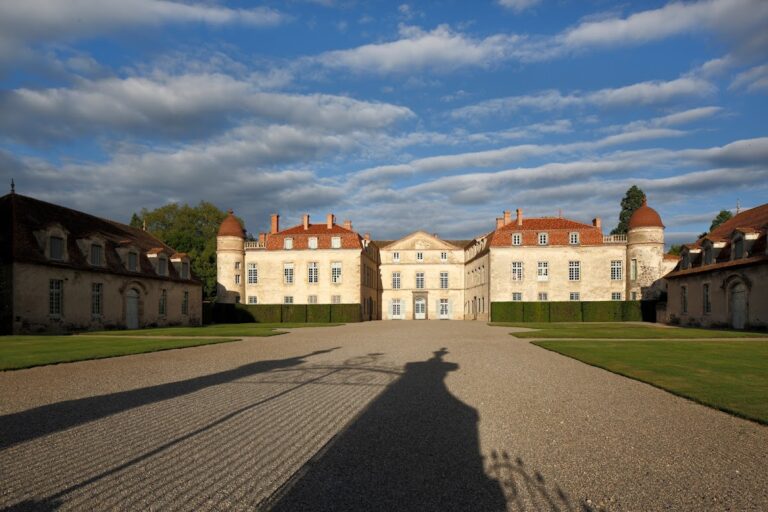
Three residential wings surround an interior courtyard, while a terrace forms the fourth side. Four cylindrical towers stand at the corners of the residential enclosure, which is itself surrounded by moats. A basket-handle entrance gate leads into a lower courtyard. The broad moats and round towers retain a defensive conception, while the courtyard arrangement and residential interiors express the château’s role as a place designed for enjoyment as well as protection.
The woodwork and ironwork of the residential wings date from the fifteenth century. The east and west wings were built under Louis XIII, king of France from 1610 to 1643, and their doors and windows were later remade. A porticoed gallery borders the courtyard, following the seventeenth-century remodeling associated with Isaac Dufour.
Painted decoration and portraits
Courtyard and stable paintings
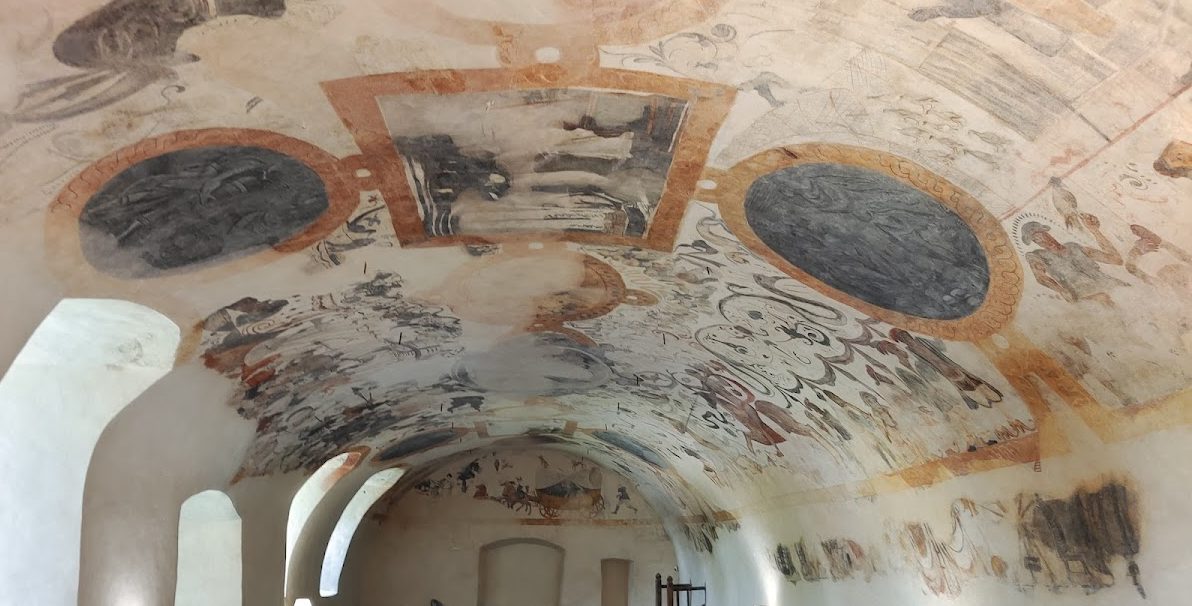
The ground floor beneath the courtyard gallery carries humorous frescoes. Their mural program includes a portrait of Rigaud d’Aureille and scenes from satirical tales known as the “Tale of Bigorne,” the “Tale of Chiche Face,” the “Tale of the Astrologer,” and the “Tale of the Old Master of the Household.”
Renaissance imagery and the White Salon
Painted decoration added by Rigaud d’Aureille’s successors appears elsewhere in the château. The stable vault is covered with murals expressing the opposition between good and evil, while figures from Roman mythology occupy the window embrasures. The state also bought back eight portraits of members of the Pellissier de Féligonde family. After the Baron of Thuret dispersed the collections at the beginning of the twentieth century, the portraits were acquired for reinstallation in the White Salon.
Nearby sites