Château de Saint-Bernard: A Medieval Fortified Castle in France


Site at a Glance
- Rating
- 4.5
- Popularity
- Low
- Country
- France
- Primary era
- Medieval
- External website
- Open
- Eras represented
- Medieval, Early Modern
- Civilizations
- French
- Site type
- Military
- Remains
- Castle
On this page7 sections
History
The Château de Saint-Bernard in France is a medieval fortified castle whose surviving form dates from the late thirteenth or early fourteenth century. Originally a seigneurial residence, the principal home and administrative center of a feudal lord, it became the historical center of the lordship of Saint-Barnard, a territory governed by a lord.
From the Palatins to the Church of Lyon
The site belonged originally to the Palatins of Riottiers and already existed at the beginning of the thirteenth century. In 1250, Guillaume Palatin sold the castle to Guichard V, lord of Beaujeu. Guichard V transferred it with all its dependencies to the Church of Lyon in May 1264 for 6,050 livres. The Church of Lyon, the ecclesiastical institution that held the lordship after this sale, retained control until the end of the sixteenth century.
Conflict and Seigneurial Ownership
The castle was attacked during regional conflicts. In 1376, inhabitants of Trévoux and Reyrieux captured and pillaged it by force. In 1468, troops led by the lord of Sornas seized it again for the Count of Comminges, governor of Dauphiné, during a campaign conducted in the name of Louis XI against Philippe of Savoy, Count of Bresse.
In 1599, the Church of Lyon sold the lordship to Martin de Covet, lord of Montribloud. His descendants still possessed it in 1801. Quirin-Henri de Cazenove acquired the castle that year and sold it to Daniel Bellet de Tavernost in 1808. Ownership then passed by inheritance to Daniel’s daughter Louise-Augustine, wife of Gabriel Bourlier, Baron d’Ailly, and subsequently to their daughter Marie-Thérèse, wife of Count Jules de Murat de Lestang.
Artists and Modern Protection
Antoine Goujot-Pontet of Amplepuis bought the castle in 1917 and sold it in 1923 to the painters André Utter and Suzanne Valadon. Their son, the painter Maurice Utrillo, repeatedly depicted the castle, the church, and the village restaurant. The family retained the property until 1948.
The castle was remodeled in the seventeenth century and restored in the nineteenth. In 1873, Saint-Bernard was enclosed by walls and surrounded by moats, with access controlled by two gates. One gate’s arch survives, while the other became ruined. The castle, its bailey, an enclosed area associated with a castle, and the ground occupied by the former moats were classified as historic monuments in France by an order dated 10 April 1997. The property is privately owned.
Remains
Enclosure and Residential Building
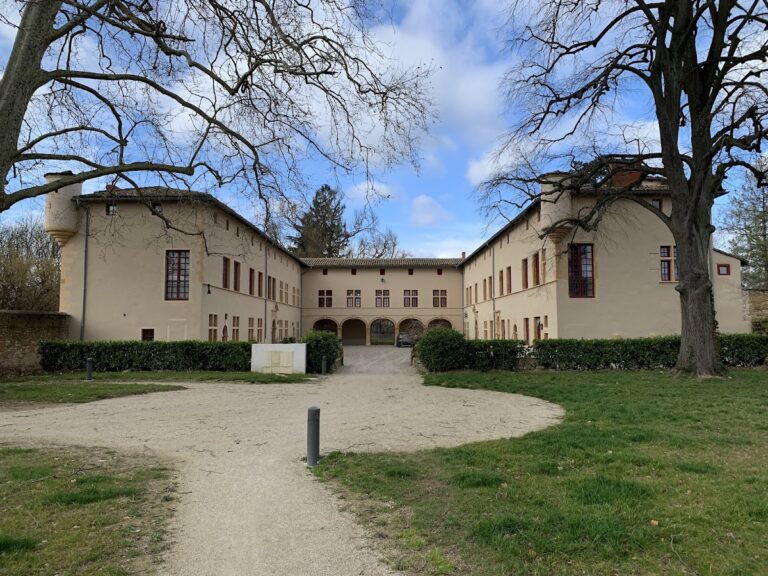
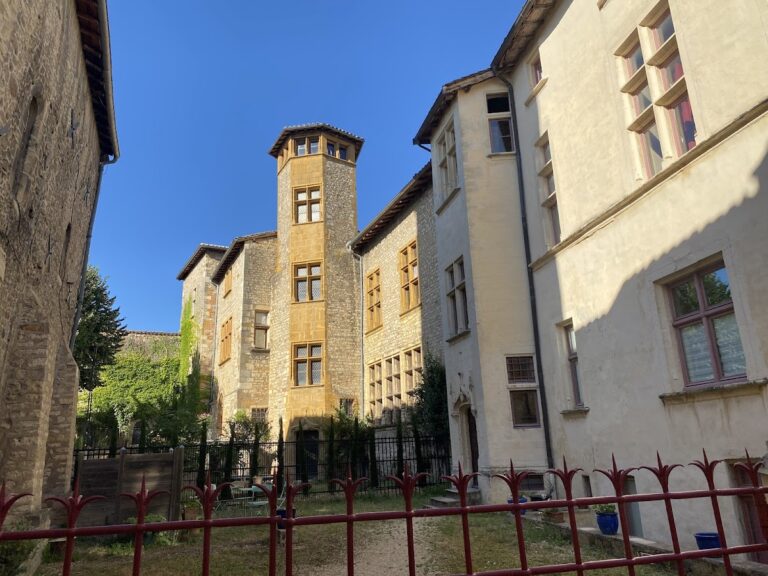
The surviving castle is organized largely as a rectangular enclosure. Two round corner towers stand at the ends of one short side, while the opposite side is formed by a high residential building. This building was formerly crowned by a wall walk, a passage along the top of a defensive wall, carried on corbels whose projecting supports extended outward from the wall.
Gate Tower and Defensive Works
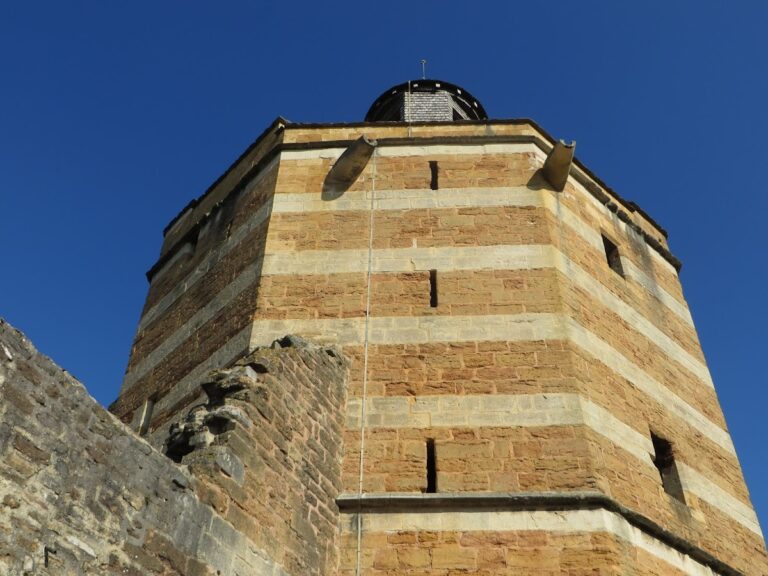
A square gate tower opens into the courtyard at the middle of one long side of the enclosure. The wider defensive system comprised enclosing walls, two access gates, and surrounding moats. The arch of one former gate remains, while the other gate survives in ruined condition. Together, these elements express the castle’s original arrangement as a fortified seigneurial residence in Saint-Bernard, in the Ain department of the Auvergne-Rhône-Alpes region.
Nearby sites