Château de Plessis-lez-Tours: A Royal Residence in France


Site at a Glance
- Rating
- 4.4
- Popularity
- Low
- Country
- France
- Primary era
- Medieval
- External website
- Open
- Eras represented
- Medieval
- Civilizations
- French
- Site type
- Domestic
- Remains
- Palace
On this page9 sections
History
Château de Plessis-lez-Tours is a former royal residence in La Riche, France, built and enlarged under Charles VII and Louis XI in the International Gothic style. The site, formerly called Montils-lez-Tours, developed from an eleventh-century fortress into a royal center associated with several French monarchs and important political events.
From seigneurial domain to royal residence
Montils-lez-Tours was originally a seigneurial domain, meaning land held under the authority of a lord, belonging to the House of Amboise, a noble French family. In 1412, the marriage of Péronnelle d’Amboise to Hardouin VIII de Maillé transferred the lordship to the Maillé family. The domain became a royal residence in 1444, and Charles VII stayed there repeatedly. On 15 April 1454, he ordered the drafting of an ordinance intended to bring the customary laws of the kingdom of France into a common framework.
Charles VII had already commissioned works at the fortress when his son and heir, Louis XI, purchased the lordship and domain from Hardouin IX de Maillé on 15 February 1463 for 5,300 écus. Louis planned a new residence, while the Maillé family was allowed to unite the lordships of Maillé and Rochecorbon with the viscounty of Tours under a single feudal allegiance. New buildings and prisons were constructed until 1470. Louis also enlarged the residence, enclosed it with a double wall, and created a park.
The residence of Louis XI
After the building works, Louis XI established Tours’s first silk workshop at the château and brought seventeen workers from Italy to operate it. Plessis became his favorite residence, and he died there on 30 August 1483. The complex included aviaries, a kennel for hunting dogs, and the new prisons associated with the royal residence.
Saint Francis of Paola, Louis XI’s confessor, came to Plessis in 1483 at the king’s request during his final illness. With the support of Charles VIII, he founded the Couvent des Grands Minimes du Plessis in 1489. The Minims were a Roman Catholic order founded on ideals of humility and extreme austerity, and this was the first Minims monastery in France. Francis of Paola died there on 2 April 1507 and was buried in the monastery.
Royal family and political assemblies
Charles VIII and Anne of Brittany lived at Plessis after their marriage in 1491. Their children Charles Orland, Charles, and François were born there, although none survived. Charles VIII and Louis XII continued to stay at the château. During a long convalescence in 1505, Louis XII resided there, and the Estates-General met at Plessis in 1506. This representative assembly of the clergy, nobility, and commoners granted him the title “Father of the People” and arranged the marriage of his daughter Claude of France to Francis of Angoulême, the future Francis I.
The Estates-General had also met at Tours in 1308, 1468, and 1484. The 1484 meeting was summoned by Anne of Beaujeu, Louis XI’s daughter, who governed as regent during the minority of her brother Charles VIII.
Sixteenth-century stays and negotiations
In 1538, Jeanne d’Albret was raised at the château under the direction of her uncle, Francis I. Jeanne was queen regnant of Navarre, while Francis I was king of France. He had removed her from her father’s control to prevent a marriage alliance that could have placed the Albret family’s possessions under Spanish influence and strengthened the position of Charles V, the Habsburg emperor, in relation to the Kingdom of Navarre.
Francis I, Claude of France, Catherine de’ Medici, Charles IX, and Henry III later stayed at Plessis. During Henry III’s reign, the château also accommodated Francis of Alençon and Philip of Marnix during negotiations connected with the Treaty of Plessis-lèz-Tours, signed on 19 September 1580. The agreement offered Francis of Alençon sovereignty over the Dutch Republic under the title “Defender of the Liberties of the Netherlands,” but it was soon abandoned.
On 30 April 1589, Henry III and his cousin and successor, Henry of Navarre, the future Henry IV, reconciled at Plessis after a political dispute. Their agreement allowed them to fight together against the Catholic League, a Catholic political and military coalition active during the French Wars of Religion. Henry III had made the meeting possible by assassinating the Duke of Guise, the League’s leader, but Henry III himself was assassinated a few days later.
Decline, destruction, and restoration
Henry IV and his son Louis XIII subsequently stayed at the château. Henry IV encouraged the silk industry by having Provençal mulberry trees planted in the park. Later monarchs enlarged and remodeled the residence, but the gradual departure of the royal court from Touraine led to its decline. Repairs were carried out in the seventeenth century, and from 1781 the château served as Tours’s depot for the city’s beggars.
The French state sold the château as national property in 1790. This term refers to property confiscated and sold during the Revolutionary period, including former royal and ecclesiastical possessions. By 1796, approximately three-quarters of the complex had been destroyed. A judge from Tours acquired the property in 1797, after which it remained threatened with demolition.
During the nineteenth century, the surviving buildings were used successively for a factory producing shot for hunting, a company depot, and a farm. These uses contributed substantially to the deterioration of the complex. Julien Petit de Vauzelles and his wife, Marie-Thérèse de Quinemont, later acquired and restored the château. In the twentieth century, Dr Edmond Chaumier installed a vaccine institute there and directed another restoration campaign. A further campaign in 1932 was followed for a time by a museum devoted to the history of silk weaving in Touraine. The château has been registered as a historic monument since 12 April 1927.
In 2016, the city of Tours attempted to sell the château because of maintenance costs, but withdrew it from sale after substantial opposition. Since 1998, Groupe K–Compagnie José Manuel Cano Lopez has used the site as the base for a theatre company. Its “Ouvertures” project, pursued from 2019, brought together artistic residencies, training, and cultural events. Since 2022, the Groupe K, a French nonprofit association formed under the country’s legal framework for voluntary organizations, has developed the Plessis Tiers Lieu, a shared cultural and humanist community organized around the arts, biodiversity, artistic and cultural education, and history and heritage.
Remains
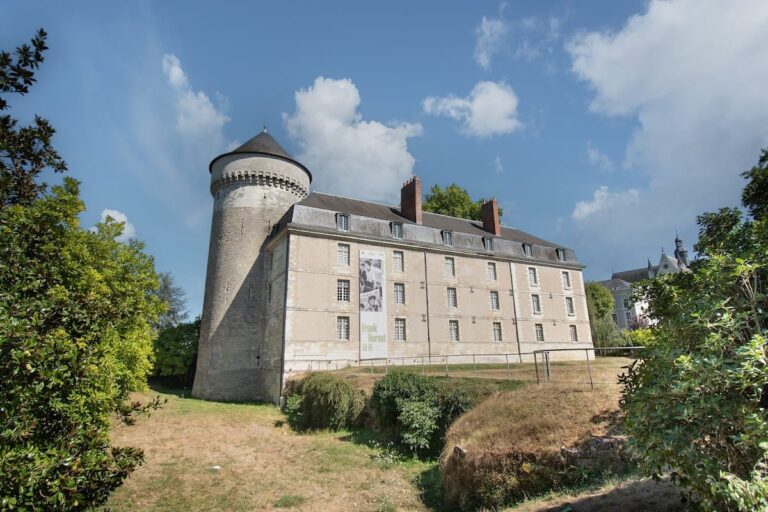
The surviving château is the eastern wing of the former royal residence, which was destroyed by approximately three-quarters. It consists of a rectangular, two-storey residential building forming the southern part of the former royal residential wing. Brick and stone give the structure its characteristic appearance, while a polygonal stair tower projects from the building and has light-colored stone quoins at its corners.
The surviving royal wing
The building belongs to the International Gothic tradition, a late medieval style known for refined ornament, elaborate detail, and courtly forms that spread across Europe. Its construction under Charles VII and Louis XI involved masons from Béthune, and it is identified as the first brick building in the Loire Valley. The present appearance reflects restoration during the nineteenth and twentieth centuries and has been compared with the Louis XII wing of the Château de Blois. Earlier elements are only faintly visible, while the interior has been extensively remodeled.
Prison chamber and cages
The prison room known as La Balue is a vaulted chamber with a semicircular barrel vault. A staircase provided access to the room, beneath which Cardinal Jean Balue was traditionally said to have been confined. Balue was a high-ranking Catholic churchman and royal adviser in fifteenth-century France.
Metal prison cages also survive at the château. They were apparently misidentified as “filètes,” a term that more accurately referred to heavy chains weighted with balls, used to restrain prisoners before they were placed in suspended cages. The cages were too low for a prisoner to stand upright, and tradition holds that Cardinal Balue spent eleven years in one. Historical views from 1699 show the château from the main entrance, the courtyard, and the park.
Nearby sites