Montfa Castle: A Medieval Fortified Castle in France


Site at a Glance
- Rating
- 4.5
- Popularity
- Very Low
- Country
- France
- Primary era
- Medieval
- External website
- Open
- Eras represented
- Medieval
- Civilizations
- County of Toulouse, French
- Site type
- Military
- Remains
- Castle
On this page9 sections
History
Montfa Castle is a medieval fortified castle in Montfa, France, first recorded in 1255 as the seat of a barony. In 1257, it belonged to the principal branch of the Lautrec family, the viscounts of Lautrec, and it remained associated with that lineage until the twentieth century. The site may have earlier origins, since Montfa was mentioned as a fortified village in the succession from Viscount Frotard III to Sicard VI.
The Lautrec barony
In the thirteenth century, the castle was held by Viscount Isarn IV de Lautrec, who died at Montfa in 1275, probably within the castle. The barony then passed to his son Frotard V and later to Guillaume. When Guillaume died without a male heir in 1352, the domain went to his grandson Jean I d’Arpajon, who was also Viscount of Lautrec. During the fifteenth century, Montfa came into the possession of the counts of Foix.
The Lautrec family recovered the castle in 1430 through Viscount Pierre VI de Toulouse-Lautrec. He exchanged properties with Hugues III d’Arpajon, including the castles of Montredon and Castelfranc. Montfa then passed to Pierre’s son Antoine I and his grandson Antoine II. Pierre de Toulouse-Lautrec, Antoine II’s younger son, later inherited the castle but died defending Metz in 1552. His elder brother Jean-François succeeded him, followed by Jean I.
Wars of Religion
Because the Lautrecs were Catholics, Montfa was repeatedly attacked during the French Wars of Religion, the sixteenth-century conflicts between Protestant and Catholic factions in France. On 13 June 1569, the Protestant commander Gontaud de Biron razed the castle. After it was reconstructed, the Protestant vicomte de Turenne, Henri de La Tour d’Auvergne, besieged and captured it on 29 August 1580. The castle immediately returned to the Lautrecs, but Protestant troops from Castres captured it again on 3 November 1591.
The baron of Montfa later opposed Henri I de Montmorency, a French nobleman and military leader. As a consequence, Gilbert III de Lévis, Duke of Ventadour and Henri’s son-in-law, imprisoned the baron at Château de Vénès.
Later ownership and decline
During the first half of the eighteenth century, Montfa became the property of the Brunet de Castelpers family. A lawsuit won by the Toulouse-Lautrecs subsequently returned the estate to their possession. During the French Revolution, Joseph-Constantin de Montfa was expelled from the castle by revolutionaries in 1791.
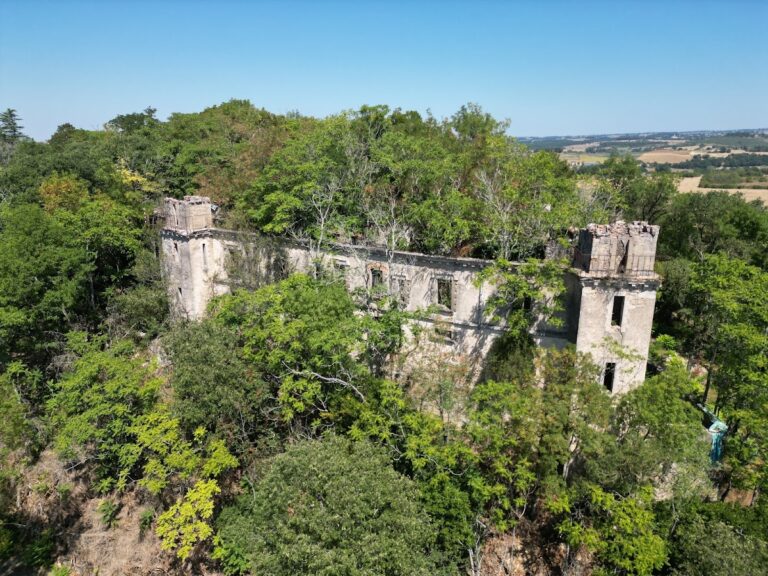
At the beginning of the twentieth century, the castle still belonged to Alphonse de Toulouse-Lautrec, the father of the painter Henri de Toulouse-Lautrec. After Alphonse died in 1913, the building was abandoned, looted, and used as a source of building stone. In 2017, after more than a century of abandonment, a preservation enthusiast purchased the property. The association Les Amis du Château de Montfa was founded in September of that year to safeguard and restore the site and develop it as an educational venue. Following the property’s resale in 2019, Sophie Peyruc and the association Château de Montfa – Art, Culture et Patrimoine continued the preservation work. The castle remains ruined but is undergoing restoration.
Remains
Layout and residential buildings
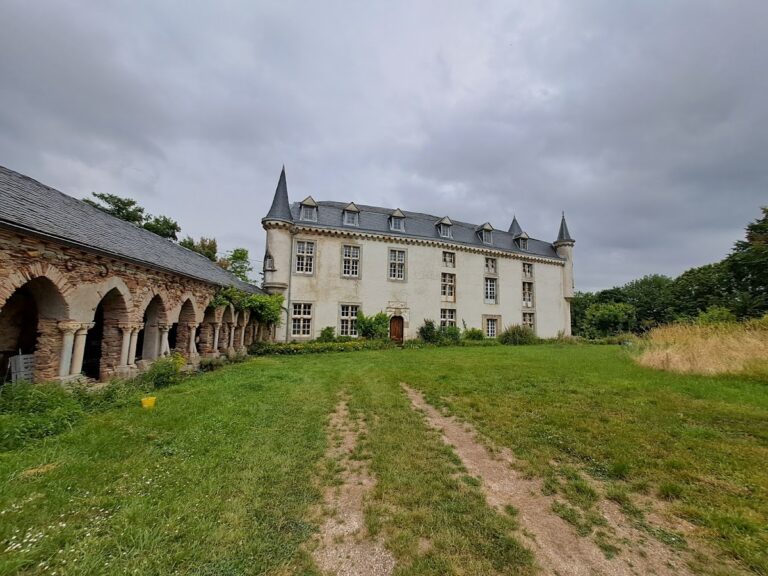
Montfa Castle follows a rectangular plan arranged around a central courtyard. A fortified enclosure surrounded the main buildings, while the northern side was occupied entirely by the principal residential block. The block was framed by a square tower on the west and a semicircular tower on the east, preserving the outline of the castle’s defensive and residential organization.
Towers
A broad square tower stood at the northwest corner above the western residential building. Probably an early part of the castle, it was supplemented by a small projecting sentry turret. A circular tower from the thirteenth century occupied the southwest side. Its surviving structure contains the chapel of Saint Eugene, which has been completely restored.
Service buildings
Several ovens were located in the southeastern part of the castle. Among them was a lime kiln, a furnace used to make lime by heating limestone. The kiln has been restored, providing a surviving feature of the castle’s former service area.
Outer defenses and surrounding grounds
Former dry moats surrounded the castle. A stone bridge now crosses them where the original drawbridge stood. A second fortified enclosure protected the surrounding hill, extending the defensive organization beyond the inner castle. The area around the ruins has been laid out as a medieval orchard, a rose garden, and an apple orchard.