Château de Montchaude: A Renaissance Castle in France


Site at a Glance
- Rating
- 4.3
- Popularity
- Very Low
- Country
- France
- Primary era
- Early Modern
- Eras represented
- Early Modern, Modern
- Civilizations
- French
- Site type
- Domestic
- Remains
- Castle
On this page8 sections
History
Château de Montchaude is a privately owned Renaissance castle at Montmérac in France. Its construction date and patron remain uncertain, but the building is associated with a Renaissance design and was substantially remodelled during the nineteenth century.
Medieval Lords of Montchaude
The land of Montchaude belonged to the lords of the Barbezieux family during the Middle Ages. Arnaud de Montchaude appears in the Baignes cartulary, a medieval collection of legal and administrative documents, around 1075. Around 1350, Hugues de Montchaude gave Vibrac to his daughter Jovide as her dowry.
The estate later passed through the Mareuil and Bouchard d’Aubeterre families before coming to the Saint-Gelais of Lusignan, a French noble lineage. Hélie de Céris may also have become an owner after marrying Jehanne de Saint-Gelais.
Renaissance Construction and Saint-Gelais Ownership
The origins of the present castle are debated. One interpretation places its construction on an earlier foundation around 1550 to 1560, under Emery Bouchard d’Aubeterre. Another dates the building to the late sixteenth century, when it was erected for the Saint-Gelais family, possibly by Antoine Fontan, who may also have worked on Château de La Rochefoucauld. The castle was then surrounded by a moat.
The Saint-Gelais family held Montchaude from 1576 until Jean de Saint-Gelais died in 1732. His daughters, Henriette and Marie Henriette, transmitted the castle to the Gourdon de Genouillac and De Crevant families. Later inheritance and sales carried it through the Verdeau, Constantin, Arnous, Guiet-Thomas, and Banasiak families.
Nineteenth-Century Alterations and Later Restoration
Louis-Eugène Arnous, a Bonapartist deputy from Barbezieux and therefore a supporter of the Bonaparte family’s political tradition in France, purchased the castle in 1889. He commissioned extensive alterations, first under Édouard Warin and later under Raymond Barbaud. The roof was raised during this nineteenth-century remodelling.
Fahd bin Mahmoud al Said, vice prime minister of the Sultanate of Oman and a direct cousin of Sultan Qaboos bin Said, bought Château de Montchaude in 1986. He restored the property over more than ten years and stayed there with his family during the summer for several years. A young Canadian couple acquired it on 15 July 2013. A fire one week later partially destroyed the castle, and the damaged section was restored between 2014 and 2015 by the Bordeaux architectural firm Brachard de Tourdonnet.
Remains
Castle Layout and Architectural Features
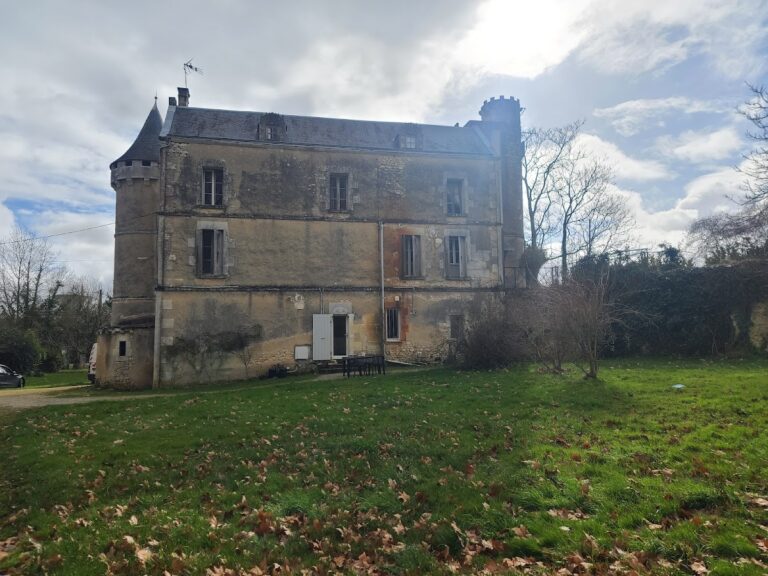
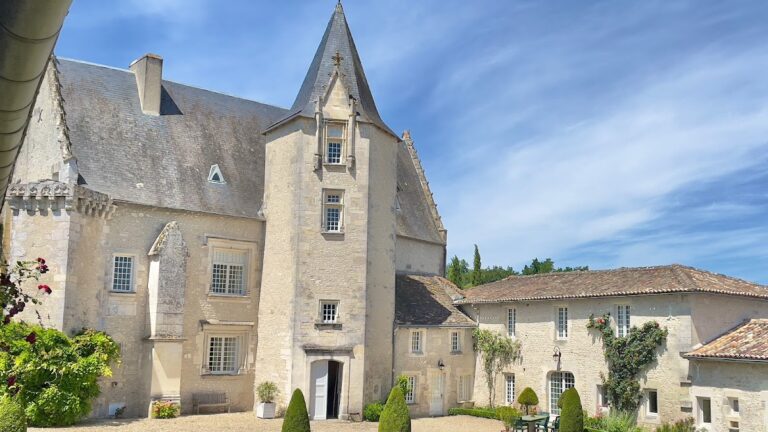
Château de Montchaude is arranged around a main residential block flanked by two pavilions. The building has one upper floor and an attic beneath a slate roof with long, broken slopes. The roof’s raised form reflects the nineteenth-century alterations. A terrace extends from the château, while a garden and park surround the property.
Residential Block and Pavilions
The principal facade is shown from the north. The château also includes an eastern lateral elevation and a western side of the main residential block. Its dormer windows are richly ornamented with floral motifs, arabesques, and coats of arms, bringing concentrated Renaissance decoration to the upper part of the building.
Detached Dovecote
A large, round dovecote stands apart from the château. A dovecote is a purpose-built structure for keeping pigeons, and on French château estates it could form part of the agricultural installations. Its detached position distinguishes it from the main residential buildings and contributes to the surviving arrangement of the estate.
Nearby sites