Château de Meyrargues: A Historic Fortress in France


Site at a Glance
- Rating
- 4.1
- Popularity
- Very Low
- Country
- France
- Primary era
- Medieval
- Eras represented
- Medieval, Early Modern
- Civilizations
- County of Provence, French
- Site type
- Military
- Remains
- Castle
On this page9 sections
History
Château de Meyrargues is a castle in Meyrargues, France, whose first defensive structure was probably built during the tenth century between the Arcs valley and the present village. Initially conceived as a fortress, it later underwent major alterations in the fifteenth and seventeenth centuries while retaining a sober exterior associated with Provençal architecture.
Medieval fortress and noble owners
During the Middle Ages, the Baux held the castle before ownership passed to the Allagonia family. The Allagonias added four defensive towers, strengthening the medieval fortifications. Aliénor de Comminges, Viscountess of Turenne and Lady of Meyrargues, was among the castle’s notable owners. She was the wife of Guillaume III Roger de Beaufort and the mother of Raymond VIII of Turenne.
At the beginning of the fifteenth century, the castle belonged to Jean II Le Meingre, known as Boucicaut, a prominent French military commander and Marshal of France. He commissioned building works between 1406 and 1408. The Allagonia family remained associated with Meyrargues from the fifteenth century, before the Valbelle family acquired the estate during the seventeenth century.
Seventeenth-century succession
Louis d’Alagonia, Lord of Mayrargues, was arrested in Paris and executed by decapitation on 19 December 1605 after being convicted of plotting against Henri IV, King of France from 1589 to 1610. Louis left no children, so his property was confiscated and then returned to his brother Honoré d’Alagonia, a Knight of Malta, through letters patent issued by Henri IV on 31 January 1606. Louis’s death ended the male line of his family.
On 20 October 1637, Honoré d’Alagonia, who had no descendants, transferred the fief of Meyrargues to his relative Léon de Valbelle, Lord of Cadarache. The property later passed to the Albertas family, whose members belonged to the Parlement and also owned a townhouse in Aix.
Modern uses and protection
After serving for decades as a four-star hotel and restaurant, the castle was sold in 2015 to a real-estate company specializing in the rehabilitation of historic monuments. From 2016, it was divided into 26 apartments, including five designated as social housing, and its current function is residential. The privately owned castle was registered as a historic monument in 1990. Its park has been included in the inventory of protected sites since 10 April 1952 and belongs to the commune.
Remains
Fortifications and grounds
Defensive towers
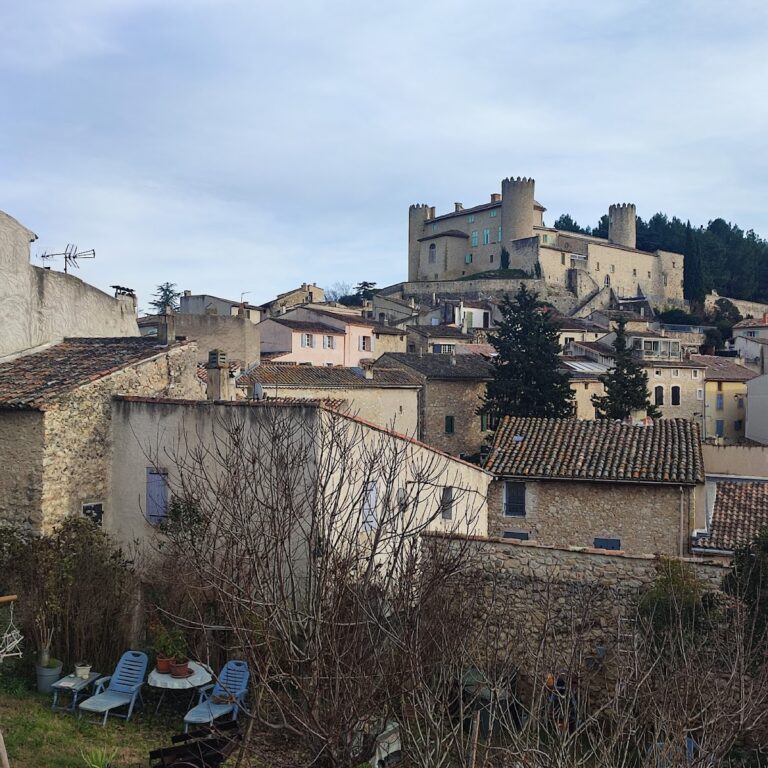
The castle retains the severe, restrained exterior of a Provençal defensive fortress. Four towers added by the Allagonia family form part of the surviving medieval fortification history and express the castle’s original military purpose.
La Garenne enclosure
The enclosure wall known as La Garenne was built in 1764. It forms part of the later physical development of the castle grounds, which also include a terrace and a park associated with the residence.
Principal interiors
The protected elements include the complete façades and roofs, the terrace, a ground-floor room with a monumental sixteenth-century fireplace, and interior decoration. The interiors were substantially adapted when the building became a hotel, before the later conversion into apartments.