Château de Marchais: A Historic Royal Residence in France

Site at a Glance
- Rating
- 4.1
- Popularity
- Very Low
- Country
- France
- Primary era
- Early Modern
- Eras represented
- Early Modern
- Civilizations
- French
- Site type
- Domestic
- Remains
- Castle
On this page10 sections
History
Medieval origins
The Château de Marchais is a historic château in Marchais, France, whose first fortification was built between 1096 and 1099 during the First Crusade, a Western European military expedition to the eastern Mediterranean. The stronghold belonged to the Baron of Eppes and formed the medieval foundation of the later estate.
Royal pilgrimages
Marchais became associated with the French monarchy through royal journeys to Notre-Dame-de-Liesse, a Marian pilgrimage sanctuary in northern France. Charles VI was the first recorded king to visit the château. Louis XI followed, and Francis I came on 28 August 1528 and again in 1538.
By about 1540, the earlier château had largely fallen into ruin. Nicolas de Boussu, an associate of Francis I, built a substantially new residence on the site. In 1553, Charles, Cardinal of Lorraine, purchased the château. A senior Catholic cleric and prominent member of the powerful House of Guise, he remodelled it as a Renaissance residence.
The château under the House of Guise
On 13 June 1554, Charles of Lorraine received King Henry II, the queen, and the royal princes at Marchais. Henry II returned in 1557 while preparing the relief of Saint-Quentin, a military operation during the wars between France and the Habsburgs. In July 1558, he came again to review the troops of the Duke of Guise, whose forces extended for approximately 1.5 miles around the château. Henry had previously visited twice with his father and returned once more in 1559 during a pilgrimage to Notre-Dame-de-Liesse.
Charles IX stayed at Marchais three times. He first came after his coronation at Reims, then returned in 1564 and 1566. On each occasion, his mother, Catherine de’ Medici, accompanied him.
Plundering and restoration
The château was repeatedly plundered by Reformed forces occupying the Laon area. These were Protestant forces associated with the Reformation, whose conflicts with Catholic forces formed part of the French Wars of Religion. Henriette de Joyeuse later acquired Marchais as her dower property, a possession assigned within a marriage settlement or for a widow’s support, and restored the château so that she could receive Marie de’ Medici in 1602.
Marie de’ Medici visited Marchais to give thanks at Notre-Dame-de-Liesse for the birth of the future King Louis XIII. This was the last royal visit to the château. The Guise family did not live there afterward, and passing troops later reduced the residence to ruins. The property then came into the possession of the Condé family, who never visited it.
From the Revolution to the Grimaldi family
After the French Revolution, the château passed through several ownerships before coming to the Count of Pourtalès. Senator Achille Joseph Delamare owned it from 1836 to 1854. In 1854, Antoinette of Monaco, the wife of Prince Charles III of Monaco and formerly Antoinette de Merode-Westerlo, purchased the estate.
Marchais has remained in the possession of the Grimaldi family, Monaco’s ruling princely dynasty. Prince Albert II of Monaco is identified as its owner. The estate also became part of the family’s personal history: Prince Albert I of Monaco married Lady Mary Victoria Hamilton there in 1869, and Prince Charles III of Monaco died at the château in 1889.
Scientific, wartime, and later history
Prince Albert I later used the estate as a hunting rendezvous and invited Carlos of Portugal there. In June 1906, Maurice Léger settled at Marchais to develop a helicopter prototype. On 13 June 1907, the machine rose approximately 80 centimetres with a pilot aboard, but the experiments ended soon afterward.
Léon-Honoré Labande, archivist of the Prince’s Palace of Monaco, published a history of the château and barony in 1927. During the Battle of France in 1940, Louis II, Prince of Monaco, remained at Marchais until the advance of German forces compelled him to leave on 17 May.
In the mid-1980s, Prince Rainier III of Monaco acquired a group of camels, an African buffalo, and two guanacos from a bankrupt zoo and placed them at the château. The animals became part of the estate’s later history.
Remains
The Renaissance château
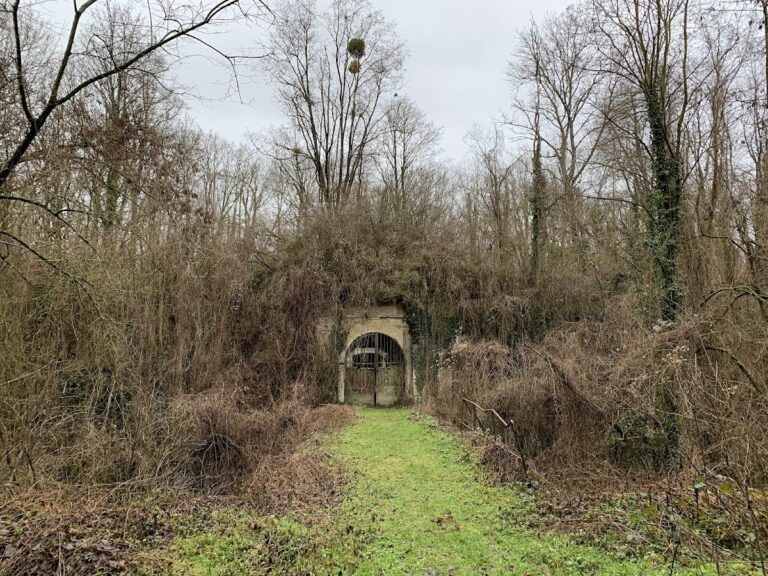
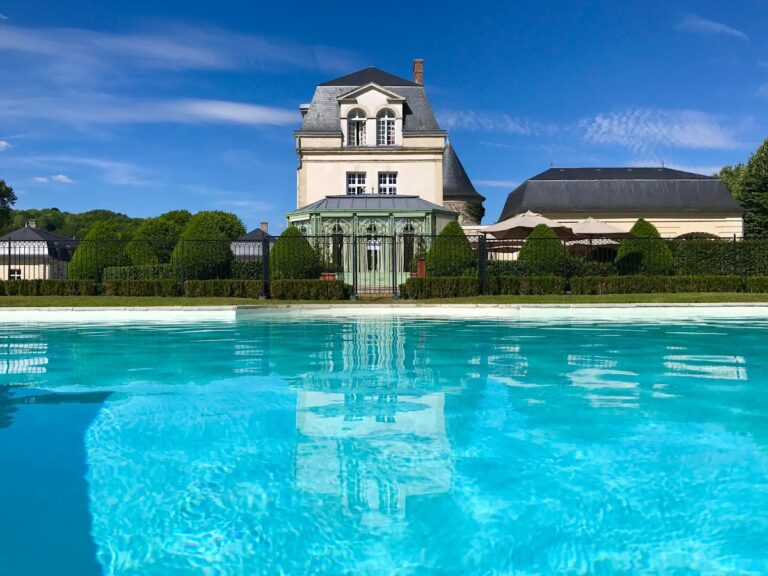
The present château estate incorporates the site of the medieval fortification and the substantially new residence erected around 1540. The sixteenth-century building was remodelled as a Renaissance château under Charles, Cardinal of Lorraine. Its physical history therefore combines the medieval defensive foundation with the later residence created after the earlier complex had fallen into ruin.
The surrounding estate
The estate includes two farms and approximately 700 hectares of agricultural land. Its area is described as roughly six times that of the Principality of Monaco. Since the mid-1980s, the grounds have also housed camels, an African buffalo, and two guanacos placed there by Prince Rainier III.