Château de la Tenaille: A Former Cistercian Abbey and Estate in France
Site at a Glance
- Rating
- 4.7
- Popularity
- Very Low
- Country
- France
- Primary era
- Medieval
- Eras represented
- Medieval, Early Modern, Modern
- Civilizations
- Duchy of Aquitaine, French
- Site type
- Religious
- Remains
- Monastery
On this page10 sections
History
Foundation and pilgrimage
Château de la Tenaille is a former Cistercian abbey and later estate in France, founded on heathland south of Pons. Around 1125, the religious Géraud de Salles planned a community there near the road to Blaye. In 1137, Gérard de Blaye granted land to Guillaume de Conchamp, abbot of Fontdouce, who sent twelve monks to establish La Tenaille. It was a daughter house of Fontdouce, part of the Cistercian Order, a Catholic monastic community that emphasized an austere way of life. Local peasants protested the land grant and received land in compensation.
The Via Turonensis, the western French pilgrimage route from Tours toward Santiago de Compostela, passed by the abbey. La Tenaille also drew pilgrims because it held a nail said to be from Christ’s cross and the pincers said to have removed it. People swore oaths on these relics, and litigants before the Parliament of Bordeaux continued the practice into the sixteenth century.
The abbey gained support from regional lords. In 1160, Guillaume de Maingot, lord of Surgères and Dompierre-sur-Boutonne, made a donation to the community. The lords of Pons, Barbezieux, and Archiac also contributed. In 1189, Abbot Guillaume II agreed with Aldebruge, abbess of the Abbey of the Ladies at Saintes, over a saltworks near Brouage. In 1197, Guillaume II witnessed a ducal act in which Othon, duke of Aquitaine, renounced dues owed to him by Surgères’s office of charitable relief.
Landholdings and medieval fortunes
La Tenaille’s reach extended beyond its main site. It had a priory at Bourdenne, a monastic house under an abbot’s authority, and held authority over the church of Saint-Sigismond-de-Clermont. The abbey received salt marshes near Hiers from the lord of Broue, though their ownership led to a dispute with the abbess at Saintes. It also controlled part of the pilgrimage route between its hermitage at Recroze and Petit-Niort, and maintained a hospital at La Bergerie.
Eleanor of Aquitaine and John Lackland granted concessions to the abbey. A date of 1264 is associated with John’s concession, but it cannot be correct: he was king of England from 1199 to 1216 and died in 1216, so the date of the grant remains uncertain. In 1294, the lord of Mirambeau allowed the abbey to use heathland for fuel for the communal oven at Saint-Sigismond-de-Clermont. Pernelle de Mosnac, lady of Jonzac, left 125 livres, a pre-decimal French currency, in 1354 to fund an annuity and weekly masses in perpetuity.
The Hundred Years’ War, the prolonged conflict between England and France in the fourteenth and fifteenth centuries, damaged the abbey’s income. In 1401 its authorities described the surrounding country as impoverished and afflicted by calamity. From 1444, the abbots tried to repopulate their estates by attracting families from Poitou and Anjou. On 17 January 1470, Pierre and Jacques Marsaud leased two journals of land, traditional measures of area, at the Moulin d’Isaac near Clion. In return, they owed thirty quartieres of wheat, a grain measure, two hens, a fat goose, and a cake at Epiphany. The abbey gave up distant holdings such as salt marshes while defending nearby property, including a meadow at Saint-Paul in a 1467 dispute with Guy de Pons.
In 1521, the abbots owed the baron of Mirambeau, lord of Plassac, 300 livres in rent for lands at La Chateineraye. By 1582, when the abbey was described as empty and without income, its dues included 75 livres in church levies and an exceptional charge of 21 livres, 7 sols, and 1 denier. The assessment led to a dispute with tax collector Thomas Dreux.
Disorder and the end of the monastery
In July 1542, the Parliament of Bordeaux ordered reform at La Tenaille and nearby abbeys after monks were accused of abandoning religious duties, traveling armed, and committing robbery and other misconduct. Abbots and priors had two months to keep their monks within their establishments or face fines and seizure of income; wandering monks could then be imprisoned. La Tenaille’s abbot, Jacques II de Catrix, had been given the position in 1539 at the age of ten. His appointment placed him under the guardianship of two neighboring abbots, with full responsibility deferred until he was twenty-seven. The abbey’s standing declined after these events.
In 1582, during the French Wars of Religion, conflicts between Catholics and Protestants, Jacques de Pons, lord of Plassac and a convert to Calvinism, expelled La Tenaille’s last eight monks. One was killed, and the buildings were ruined. Abbot Jacques II de Catrix fled to relatives near Châteauneuf-sur-Charente, where he soon died. De Pons took control of the abbey’s revenues and placed their administration in the hands of Géraud de La Roche.
Jesuit administration and the later estate
On 13 November 1615, the new lord of Plassac, the Duke of Épernon, returned La Tenaille’s revenues to the Church by assigning them to the Jesuit-run college at Saintes. The Jesuits were members of the Catholic Society of Jesus. The duke also paid 13,943 livres, 5 sols, and 4 deniers to compensate for income appropriated by his predecessors. Pope Paul V confirmed the gift in 1617, but the transfer remained contested: in August 1616, the abbey’s salt marshes were still held by René Claveau, one of the duke’s trusted men, rather than the college’s administrator.
La Tenaille became the college’s principal source of support. In the seventeenth century, the abbey held houses in Pons, land and a furnace at Saint-Sigismond-de-Clermont and Nieul-le-Virouil, estates at Saint-Fort-sur-Gironde, land at Brettes, mill rents, and shares in salt marshes at Le Gua. It also received part of the income from six parish churches. A 1648 survey valued its revenues at 3,000 livres, while a lease of its lands in 1701 brought in 700 livres. In 1723, the Jesuits began farming the abbey’s vineyards directly. The work cost 500 livres and returned 2,100 livres to the college.
After the Jesuits were expelled from France, the Parliament of Bordeaux ordered their property seized. La Tenaille’s property was taken on 7 June 1762, and Pierre Chachereau was appointed its receiver and revenue manager on 28 June. Sales of goods from La Tenaille and the priory of Saint-Genis raised 2,414 livres, 3 sols, and 3 deniers that August. A royal edict assigned the abbey’s revenues to a new college in March 1763; in 1786, that college’s superior sold some of La Tenaille’s trees.
During the French Revolution, the abbey and its associated properties were confiscated and sold by the state as national property to Armand de La Barre. He built a manor house and its dependencies. The abbey’s archives, held at the college in Saintes, were destroyed when the college burned in 1793. In 1832, after a seizure, the court at Jonzac awarded the abbey’s remains to Alexis Martin de Bonsonge of Marennes. The estate then included a manor house, service buildings, a farmer’s house, and 100 hectares of land. Bonsonge’s granddaughter married Count Étienne Lunet de Lajonquière; they lived at the château, where he served for several years as mayor of Saint-Sigismond-de-Clermont.
A spring near the abbey became the focus of a local story recorded by Gautier in 1839. The tale held that monks had diverted the spring and used underground conduits to make wine flow instead of water. Local people long repeated that wine had poured from the ground at La Tenaille for twenty-four hours. In 1958, the chapel received historic-monument classification, while the château and stables were registered under France’s heritage protections.
Remains
The surviving complex
The surviving ensemble comprises the chapel, eighteenth-century storehouses, a large residence, and stables. Its building fabric spans the twelfth, eighteenth, and nineteenth centuries, with Romanesque architecture dominant. Romanesque buildings commonly use rounded arches and substantial masonry. The storehouses stand opposite the chapel, while the residence and its associated buildings form the château complex.
Abbey chapel
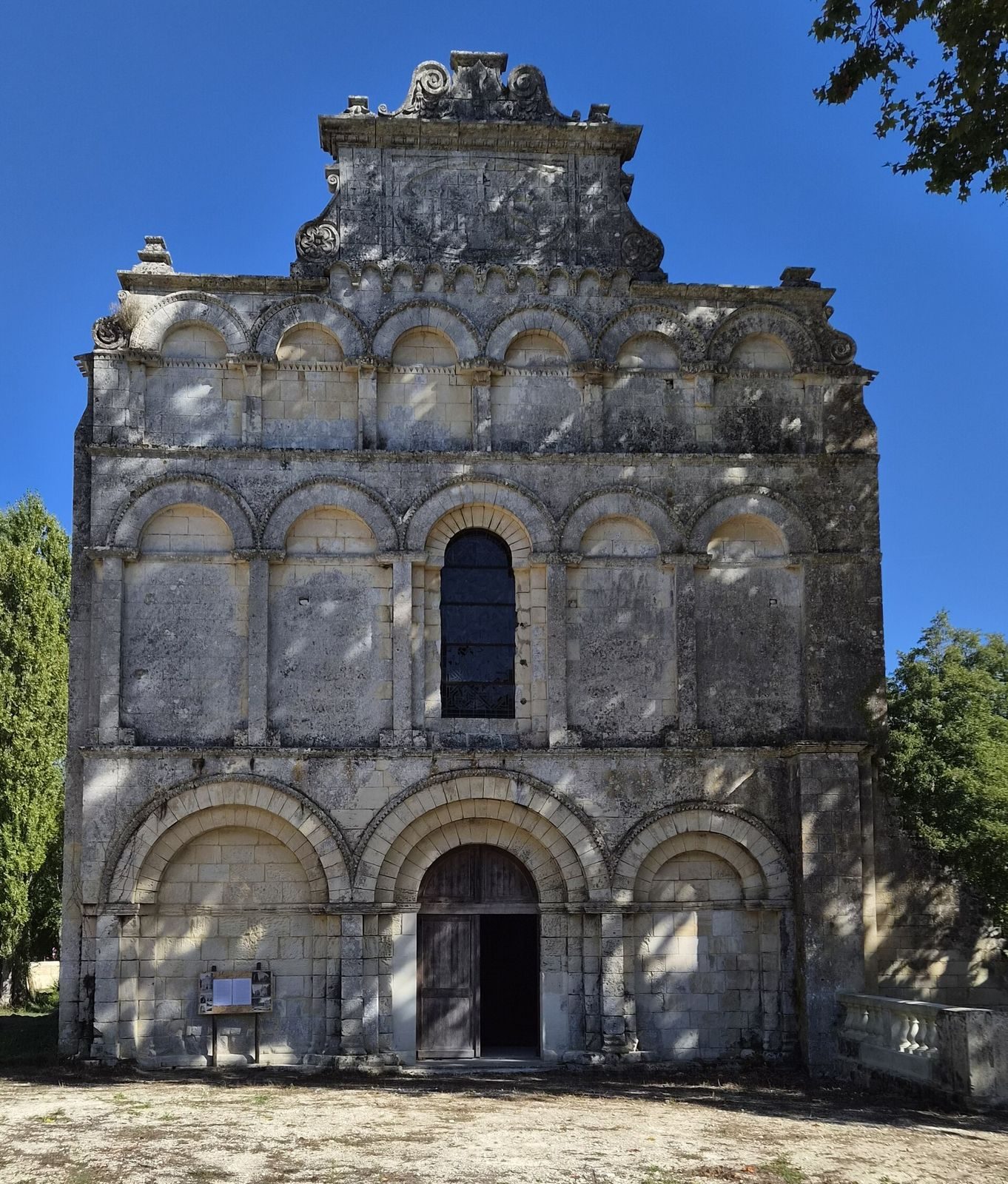
The chapel is built of finely dressed stone. Its façade has arcades on three levels, and its portal combines Roman and Byzantine influences. An eighteenth-century Baroque pediment, an ornate gabled feature, rises above the portal. The eastern portion of the chapel was lost during the Wars of Religion. The nave is described as domed and was formerly arranged with three domes in a row. Those domes have disappeared; a stone pyramid topped by pincers replaced the first.
Storehouses
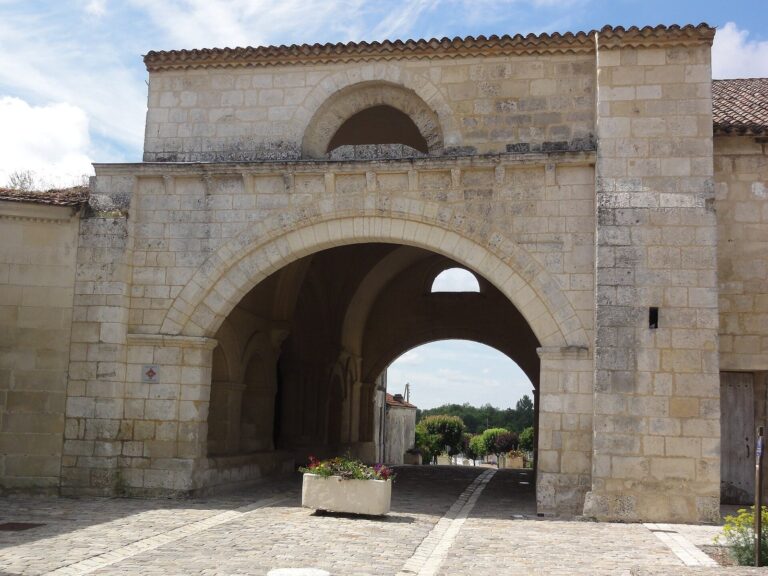
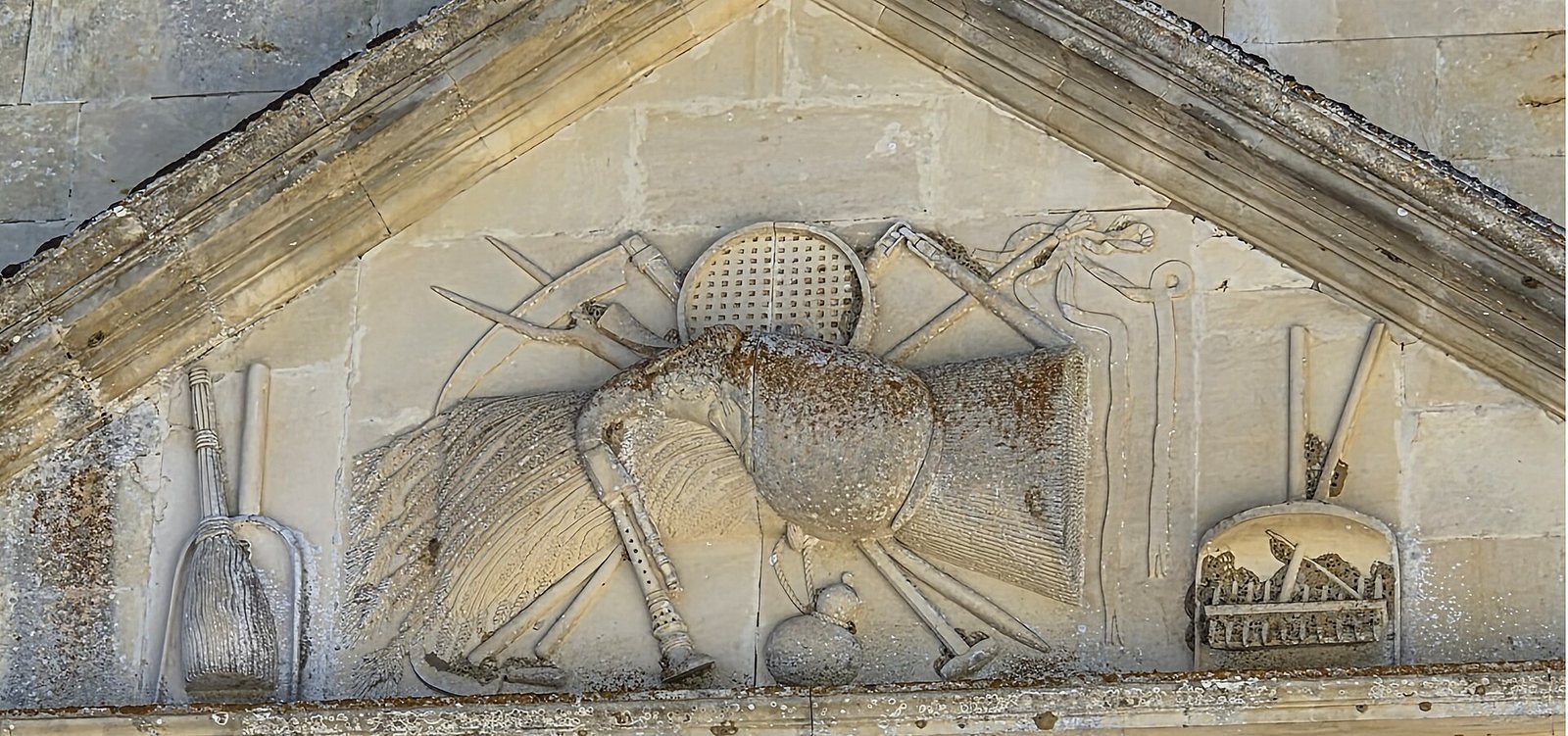
The eighteenth-century storehouses opposite the chapel have dressed-stone façades. Their gabled ornaments are carved in a Greek style and decorated with agricultural tools, including a flail, scythe, sickle, and rake.
Château and stables
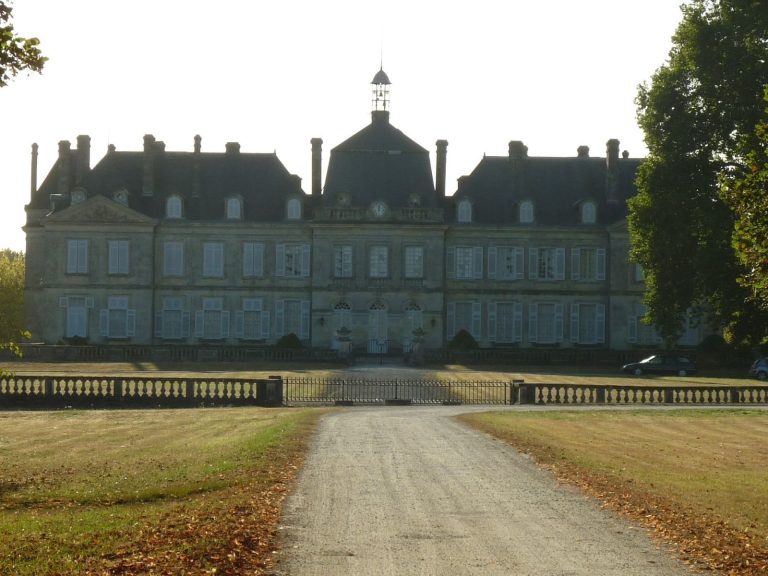
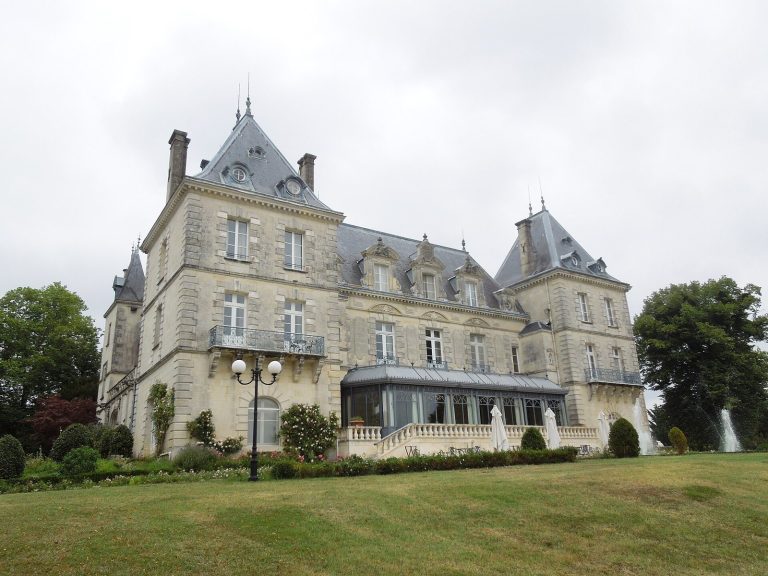
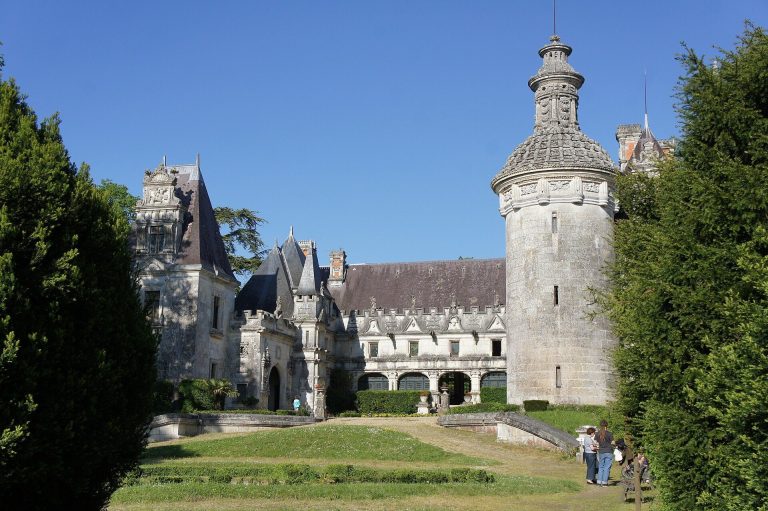
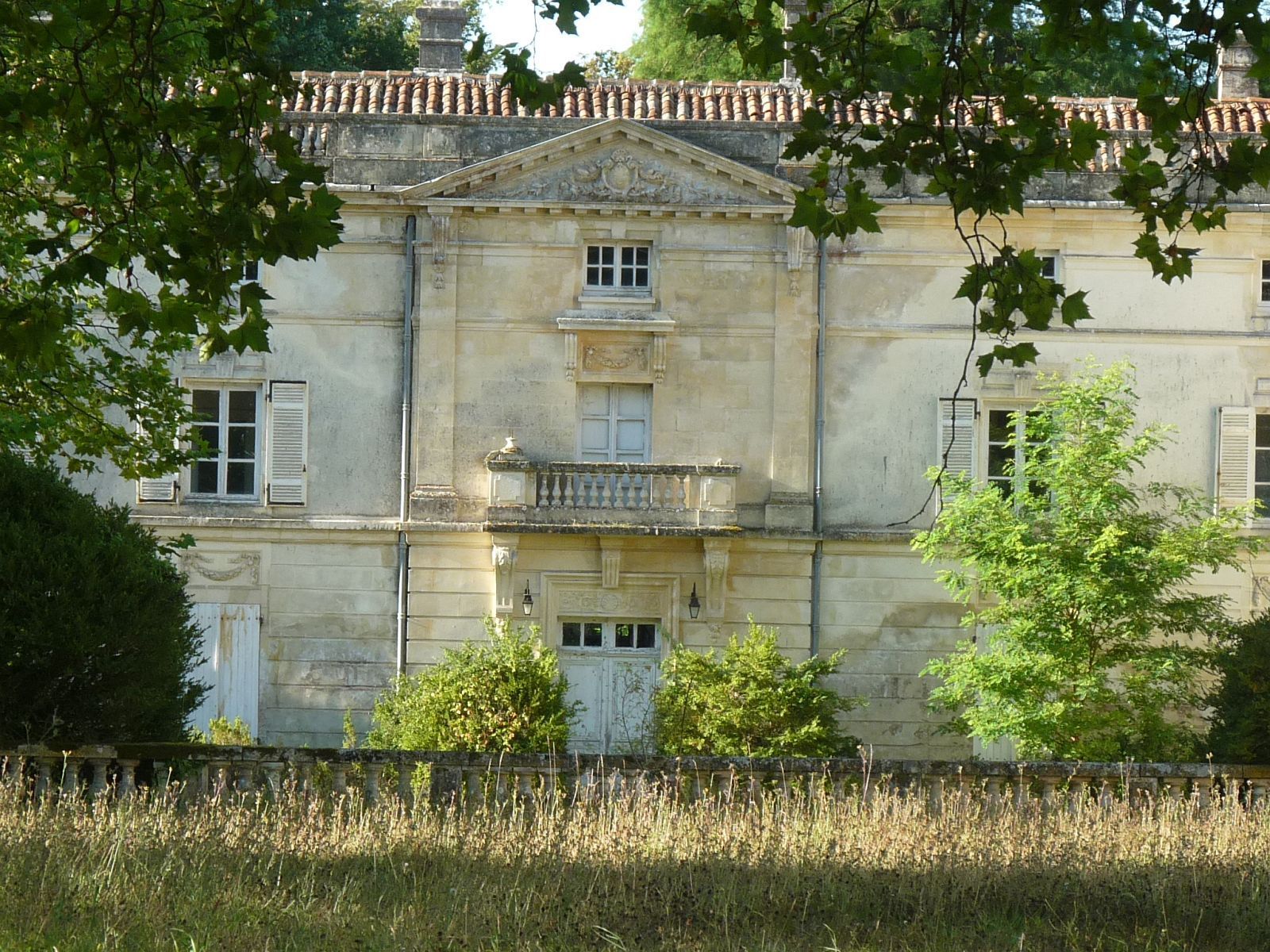
The château is largely an eighteenth-century residence. Its exterior includes Greek-style pediments, balustrades, and garland decoration. The façade and Italianate roof are among the protected features of the complex. Stables also form part of the château estate.