Château de Naves: A Medieval Fortified Castle in France


Site at a Glance
- Rating
- 4
- Popularity
- Very Low
- Country
- France
- Primary era
- Medieval
- External website
- Open
- Eras represented
- Medieval
- Civilizations
- French
- Site type
- Military
- Remains
- Castle
On this page6 sections
History
Château de Naves is a medieval fortified castle in France, built around 1100 in the commune of Naves in the Allier department. A fortified castle was a defended medieval residence intended to protect its occupants and control the surrounding area. The castle later became an important residence for the Archbishops of Bourges, who held it at the boundary of their diocese, the territory administered by a bishop or archbishop.
Transfer to the Archbishops of Bourges
In 1147, Hugues de Naves, lord of the area, gave the castle and its lordship to Pierre de La Châtre, Archbishop of Bourges. The transfer followed Hugues’s conflict with Archambaud VII of Bourbon, a medieval lord of Bourbon. The archbishops subsequently enlarged and strengthened the castle, which they used as a residence until at least the end of the fifteenth century.
The Cœur alterations
Jean Cœur, Archbishop of Bourges and son of the merchant and royal financier Jacques Cœur, commissioned further alterations to the castle. The arms of the Cœur family, emblematic designs identifying the family, remain visible on the facade and on fireplace mantels, the horizontal architectural elements above fireplaces.
Château de Naves was listed as a French historic monument in 1931. The castle remains privately owned.
Remains
Position and surviving structure
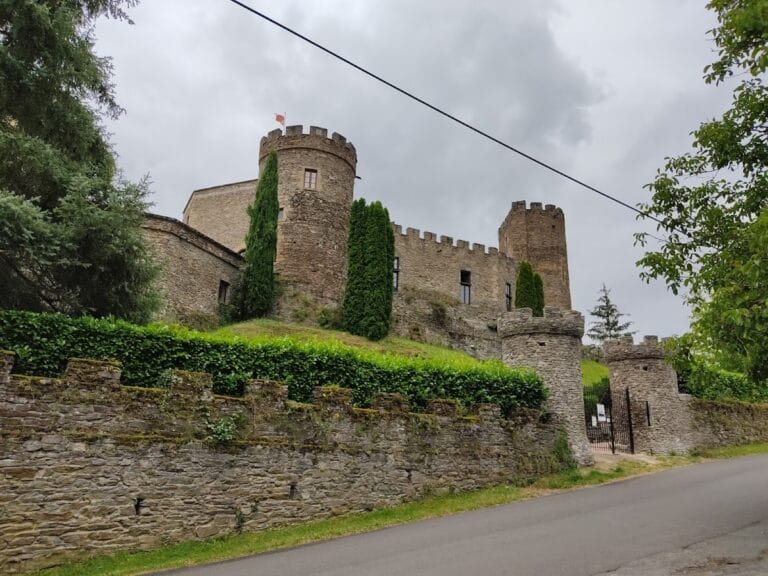
The castle stands within the built-up area of Naves, below the settlement’s highest point. It occupies the southeastern slope of the valley that descends toward the Naves pass. Much of the fortified castle is now in ruins, although substantial remains survive. One wing has been rehabilitated and remains habitable.
Cœur family heraldry
The Cœur family arms remain visible in two parts of the surviving structure, on the facade and on fireplace mantels. These heraldic details preserve a physical reminder of the alterations commissioned by Jean Cœur.