Château de Beaucaire: Medieval Fortress and Rhône Citadel


Site at a Glance
- Rating
- 4.2
- Popularity
- Medium
- Country
- France
- Primary era
- Medieval
- External website
- Open
- Eras represented
- Medieval, Modern
- Civilizations
- County of Toulouse, French
- Site type
- Military
- Remains
- Castle
On this page11 sections
History
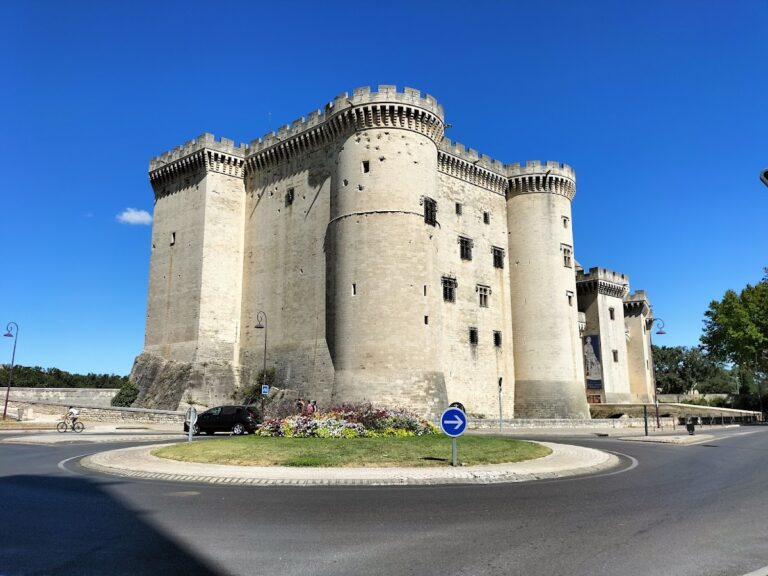
Château de Beaucaire is a former fortified castle in Beaucaire, France, built over a Roman settlement and developed during the medieval period beside the Rhône. Its construction is associated with the Counts of Toulouse and is dated to around 1180. Positioned opposite Château de Tarascon, the stronghold helped defend Beaucaire after repeated invasions and formed part of the competition between the two riverbank fortresses.
From Roman settlement to medieval stronghold
The medieval castle arose on a site already occupied during the Roman period. Its growth was connected with the defense of Beaucaire after attacks by groups including the Visigoths and Burgundians. Its position beside the Rhône also gave it a direct relationship with Tarascon Castle on the opposite bank.
At the beginning of the Albigensian Crusade, a thirteenth-century campaign against Cathar communities and their supporters in southern France, troops led by Simon de Montfort captured and occupied the castle in 1209. Raymond VII retook it in 1216, during the siege of Beaucaire. The besieged defenders reportedly used burning pitch or tar to destroy the wooden siege engines brought against them.
Royal rebuilding and administration
After Languedoc was annexed in 1229, the castle was demolished and completely rebuilt under Louis IX, king of France from 1226 to 1270. The new fortress became a powerful citadel, and Beaucaire was made the seat of one of two seneschalships in the region. A seneschalship was a royal administrative and military jurisdiction overseen by an official representing the crown. The other regional seat was at Carcassonne.
The castle also served as a place for political settlement. On 7 May 1251, a treaty was signed there that ended disputes between the city of Avignon and Alphonse of France, Count of Poitiers and Toulouse and Marquis of Provence.
War, dismantling, and civic transformation
The fortifications were substantially rebuilt during the Hundred Years’ War. The ramparts were extended in 1350, and the city walls were widened in 1355. In 1385, the stronghold was besieged by Italians, Gascons, and English forces. English and Burgundian forces later gathered beneath the walls of the town and castle in 1419 and erected siege engines, but they were repulsed.
The town and castle suffered heavily during the Wars of Religion. In 1632, the fortress was dismantled on the orders of Cardinal Richelieu, chief minister of Louis XIII and a leading figure in the monarchy’s efforts to strengthen royal authority. The cleared area was later used by tanners and by the town for bullfighting.
Protection and nineteenth-century gardens
The city purchased the castle grounds from the state on 2 June 1830. The creation of the historic-monument system ended the site’s earlier uses, and Prosper Mérimée described the castle after visiting it in 1835. The chapel was classified as a historic monument in 1846, while the castle itself received protection during the nineteenth century under the designation Château de Beaucaire, reference PA00102980.
Between 1844 and 1846, the city was required to maintain the castle, improve its principal entrance, and create gardens designed by the architect P. Renaud. A gardener was appointed in 1847, and these works established the site’s general present form. The gardens were administered as a public garden. Work undertaken by the intermunicipal association Beaucaire Terre d’Argence reopened the main gate in 2014, after which it opened onto the cleared area beyond the entrance. The castle remains in ruins, arranged as a historic site for public visitation.
Remains
Château de Beaucaire occupies a rocky spur beside the Rhône. The trace of its former fortified boundary can still be followed, while the surviving façades of the keep rise above steep or sheer drops. The ruins are integrated with gardens and an arboretum covering three hectares on the slope below the fortress.
Fortress structures
Triangular keep
The keep has a triangular plan, an unusual configuration described as unique of its kind, and is also characterized as a strange polygonal tower. Prosper Mérimée regarded it as the most curious surviving part of the rebuilt fortress. Its first-floor great hall contains flattened ogival vaults, meaning vaults formed with pointed-arch geometry, whose curves follow the irregular shape of the tower’s plan. A fine round corner tower forms another surviving element of the complex.
Saint-Louis Chapel and entrance
A staircase within the fortified boundary leads to the small Saint-Louis Chapel, a Romanesque building with a sculpted tympanum, or carved panel above an entrance. The chapel and access gate are preserved as parts of the castle interior. The main gate was originally intended for the entry of the garrison. Its reopening in 2014 restored access through the principal entrance and opened a panorama over the surrounding landscape.
Roman and medieval remains
Restoration work revealed material connected with the earlier Roman occupation, including a Gallo-Roman funerary stele known as the Centonaires, a capital, and fragments of medieval columns. These remains add archaeological evidence of the settlement and building phases that preceded and accompanied the surviving fortress.
Arboretum and historic gardens
The grounds contain romantic gardens and a three-hectare arboretum laid out on the steep slope of the former fortifications. Two lower and upper avenues run along the western and eastern sides, shaded by ash trees and arborvitae. Lawns, a shaded path, and stairways define the northern and southern areas, while other paths wind among laurel shrubs and numerous Aleppo pines. Some of the pines apparently survive from the original plantings. The grounds also include seasonal flowers, almond trees, olive trees, and hackberries.
The Jardin de Vignasse opened in 1982. Its southern orchard gives the garden the character of a classified landscape site. Nearby, the Musée Auguste Jacquet presents exhibitions on the region, archaeology, and popular arts and traditions, with archaeological displays extending back more than 40,000 years.