Château d’Usson: A Ruined Cathar Fortress in France


Site at a Glance
- Rating
- 4.4
- Popularity
- Low
- Country
- France
- Primary era
- Medieval
- External website
- Open
- Eras represented
- Medieval, Early Modern
- Civilizations
- French
- Site type
- Military
- Remains
- Castle
On this page6 sections
History
Château d’Usson is a ruined castle in France, near Usson-les-Bains in the commune of Rouze. Regarded as the southernmost of the Cathar castles in southern France, it was first recorded in 1035, although its origins probably reach back to the tenth or early eleventh century.
Medieval Frontier and Cathar Refuge
During the twelfth century, the castle marked the eastern boundary of the County of Foix, a medieval feudal county in what is now southern France. It belonged to the So and Alion families. After the Albigensian Crusade of 1209 to 1229, a papally supported military campaign against Cathar communities and their political allies, Château d’Usson became a refuge for Cathars. The Cathar bishop Guilhabert de Castres reportedly stayed there, and in the early 1240s the castle supplied weapons and food to Cathars who had taken refuge at Montségur.
Cathar tradition holds that six Cathars escaped to Usson on 15 March 1244, one day before Montségur surrendered and its defenders were burned. The same tradition says that an alleged Cathar treasure had been transferred to the castle several months earlier, though this account remains uncertain.
Bernard d’Alion and the Inquisition
Bernard d’Alion, lord of the castle and a vassal of the Count of Foix, supported Catharism despite having sworn loyalty to Simon de Montfort, the principal military leader of the Albigensian Crusade. Captured in 1257 or 1258, he was condemned for heresy after an inquisitorial trial and burned at Perpignan.
Frontier Fortress and Eighteenth-Century Rebuilding
Château d’Usson later served as a frontier fortress during conflicts between France and Spain. These struggles ended with the Peace of the Pyrenees in 1659, followed by the marriage of Louis XIV, king of France from 1643 to 1715, to Maria Theresa of Spain in 1660.
In 1711, Louis XIV gave the castle to the new Marquis d’Usson. A marquis was a high-ranking noble title traditionally associated with authority over a border territory. The marquis commissioned the architect Victor Canas to rebuild the fortress as a château, and the work took place in 1712 and 1713.
Revolution and Preservation
During the French Revolution, the château was sold as surplus property and was subsequently used as a source of building stone. Preservation measures were undertaken during the twentieth century, and Château d’Usson has been listed as a French historic monument since 1978. The former eighteenth-century stables were converted into a museum in 1999, displaying finds from excavations at the castle along with reconstruction drawings and other interpretive material.
Remains
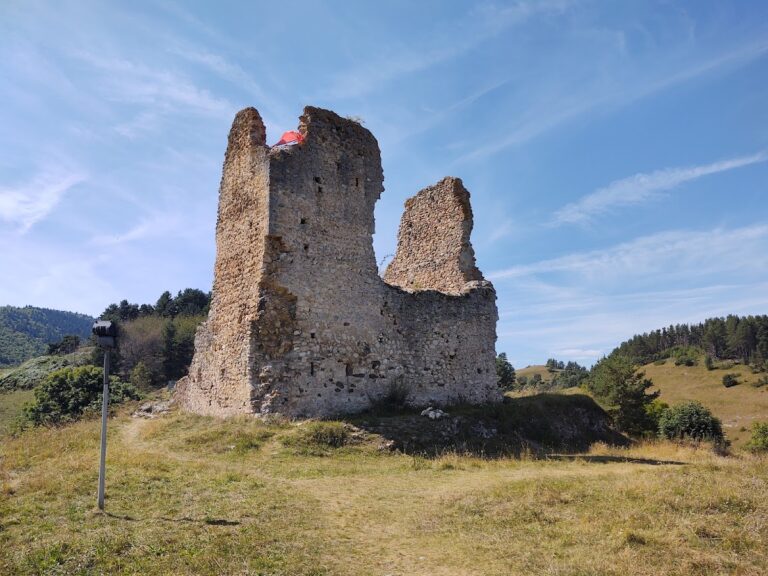
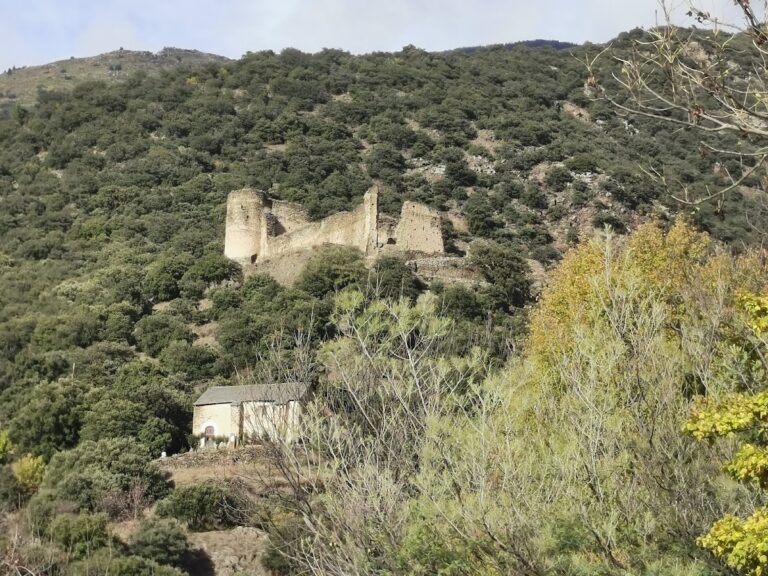
The ruins occupy a rocky summit or spur approximately 920 metres above sea level, above the valley of the Aude. The site lies in the upper Ariège area of Donezan, on the territory of Rouze. Its surviving fabric includes a pentagonal donjon, the principal fortified tower of a medieval castle, together with remains of the castle palace.
The former stables belong to the eighteenth-century phase of the site and now house a museum. Archaeological objects recovered during excavations are displayed there with reconstruction drawings and interpretive material. A castle tower on the rocky spur was opened to the public in 2020.