Certosa of Ferrara: A Carthusian Monastery and Cemetery
Site at a Glance
- Popularity
- High
- Country
- Italy
- Primary era
- Early Modern
- Eras represented
- Medieval, Early Modern, Modern
- Civilizations
- Duchy of Ferrara, Italian, Papal States
- Site type
- Burial
- Remains
- Necropolis
On this page15 sections
History
The Certosa of Ferrara is a former Carthusian monastery and cemetery in Ferrara, Italy, founded in 1452 by Borso d’Este, duke of Ferrara and Modena. Borso began construction that year and offered the monastery to the Carthusian Order in 1461. The monks, members of a Catholic order known for secluded, contemplative life, took possession immediately. The monastery belonged to the Tuscan Carthusian province and became Ferrara’s principal burial ground after its conversion to a cemetery.
Foundation and construction
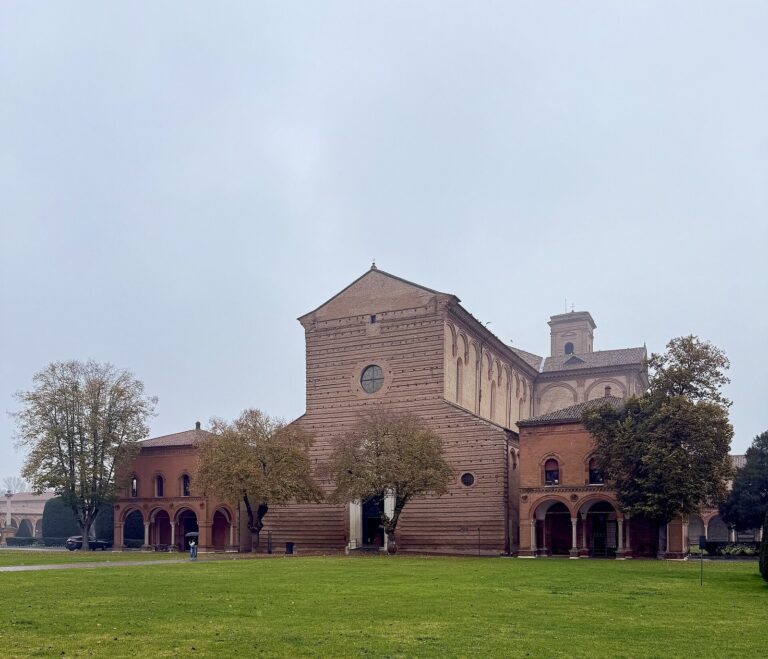
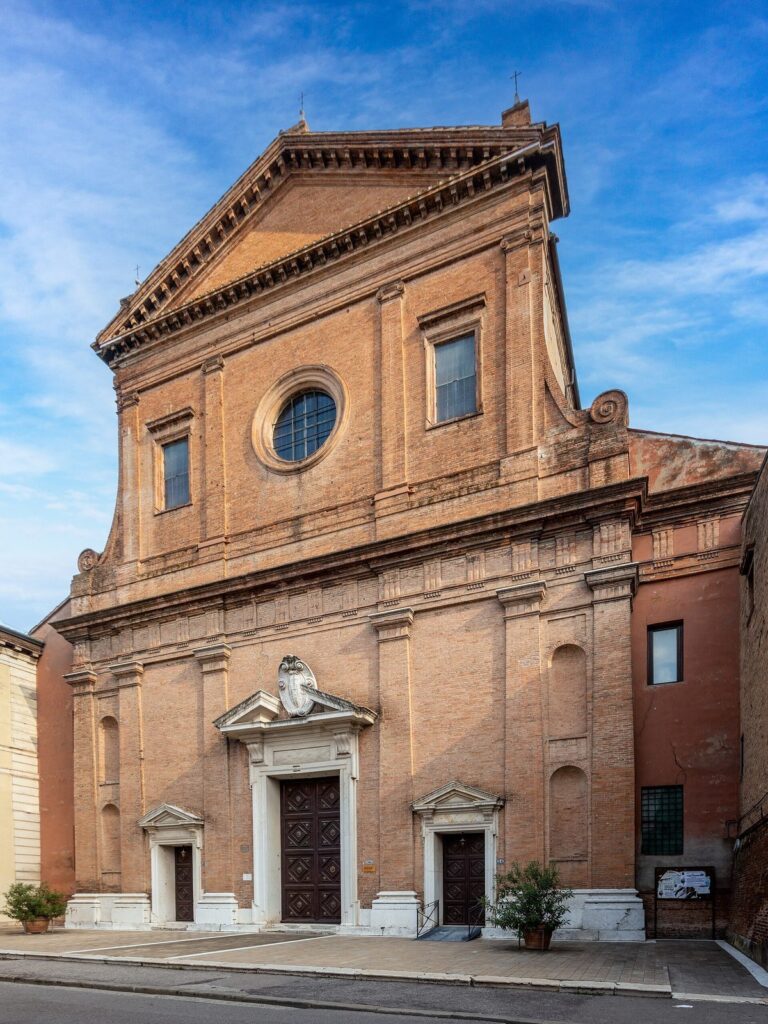
The monastery was established beyond Ferrara’s walls, in keeping with Carthusian practice. The city’s later Addizione Erculea, a major Renaissance-era expansion, extended Ferrara and its walls around the site. A new church was begun beside the original monastic church in 1498. It opened for worship in 1551 and was attributed to the Ferrarese Renaissance architect Biagio Rossetti. The church needed restoration after the earthquake of 1570.
Suppression and cemetery
The monastery was suppressed in 1804, and its monks were expelled. The buildings became military barracks, while the church and monastery passed into city ownership. In 1813 the grounds were made into a public cemetery, and the church was reconsecrated for continued use. Ferdinando Canonici laid out the cemetery. Former monastic cells were gradually adapted as family tomb chapels, and the grounds were enlarged during the 1930s, 1950s, and 1970s. The cemetery serves people of multiple religious confessions.
War, memorials, and damage
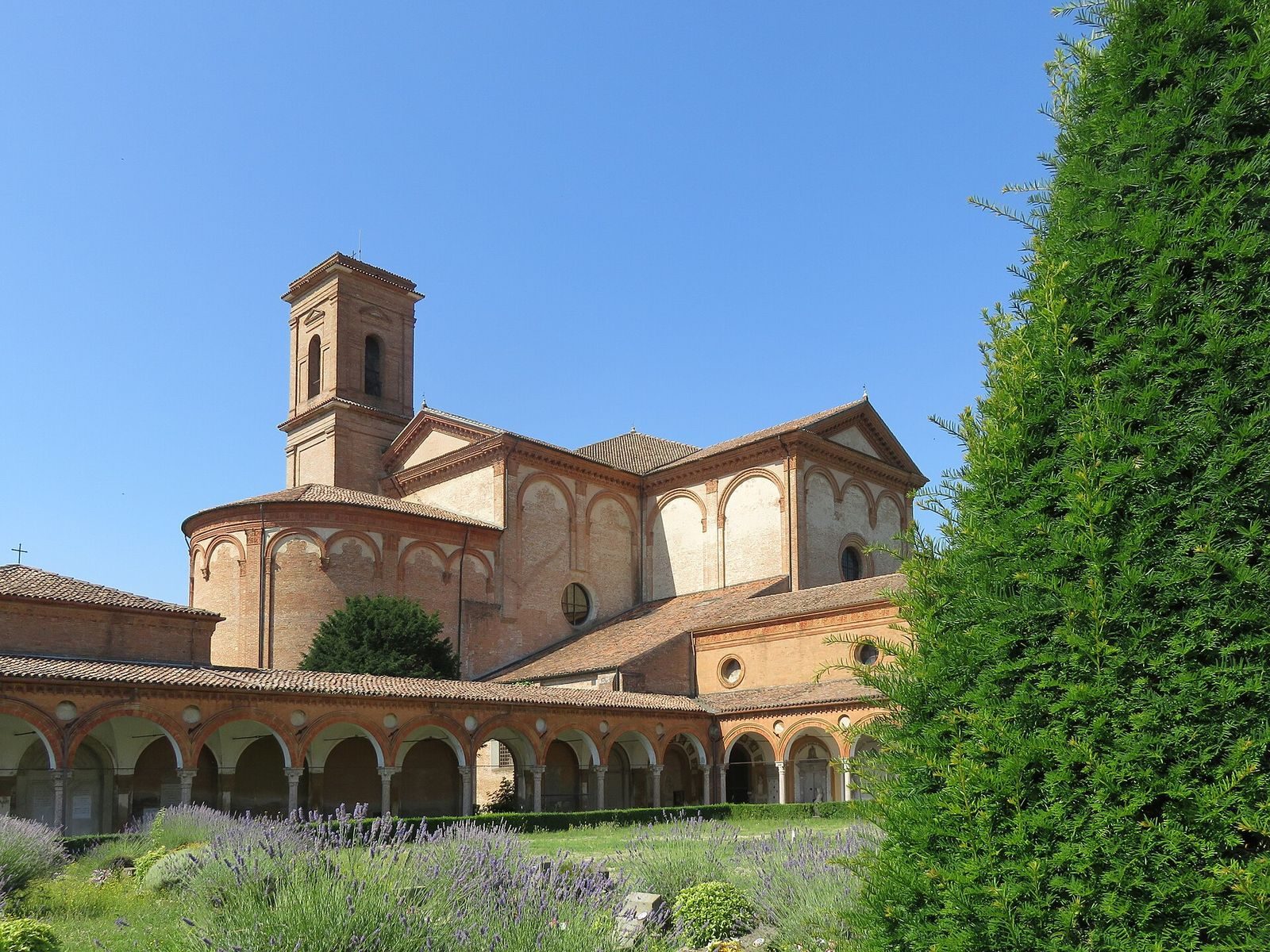
During the nights of 11 and 20 August 1944, partisans were killed in a Fascist reprisal in front of the Certosa, under Italy’s authoritarian Fascist regime. A stone memorial on Via Borso marks the killings. Aerial bombing later that year damaged the church’s apse, the rounded end of its choir, as well as its choir, bell tower, and south side.
Carlo Savonuzzi designed the Second Great Cloister in 1933. Its War Dead Memorial Hall was intended chiefly for those killed in the First and Second World Wars. Work began on 20 August 1956, and the hall was completed after the Second World War. Restoration of the church after the 1944 bombing was still incomplete when earthquakes on 20 and 29 May 2012 further damaged foundations and other parts of the historic complex. The church was declared unusable, areas were closed because of collapse risks, and work followed to secure the complex.
Remains
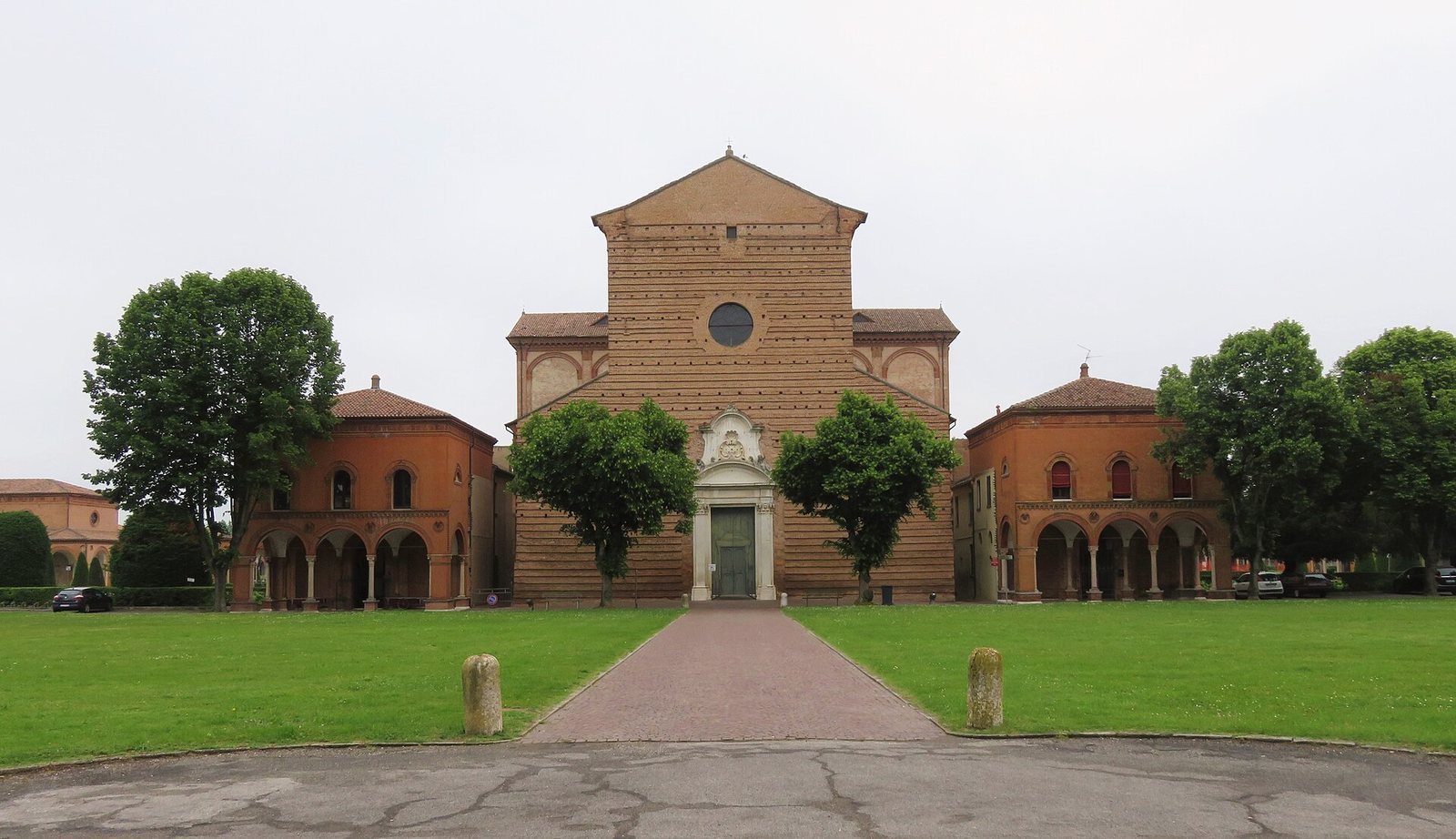
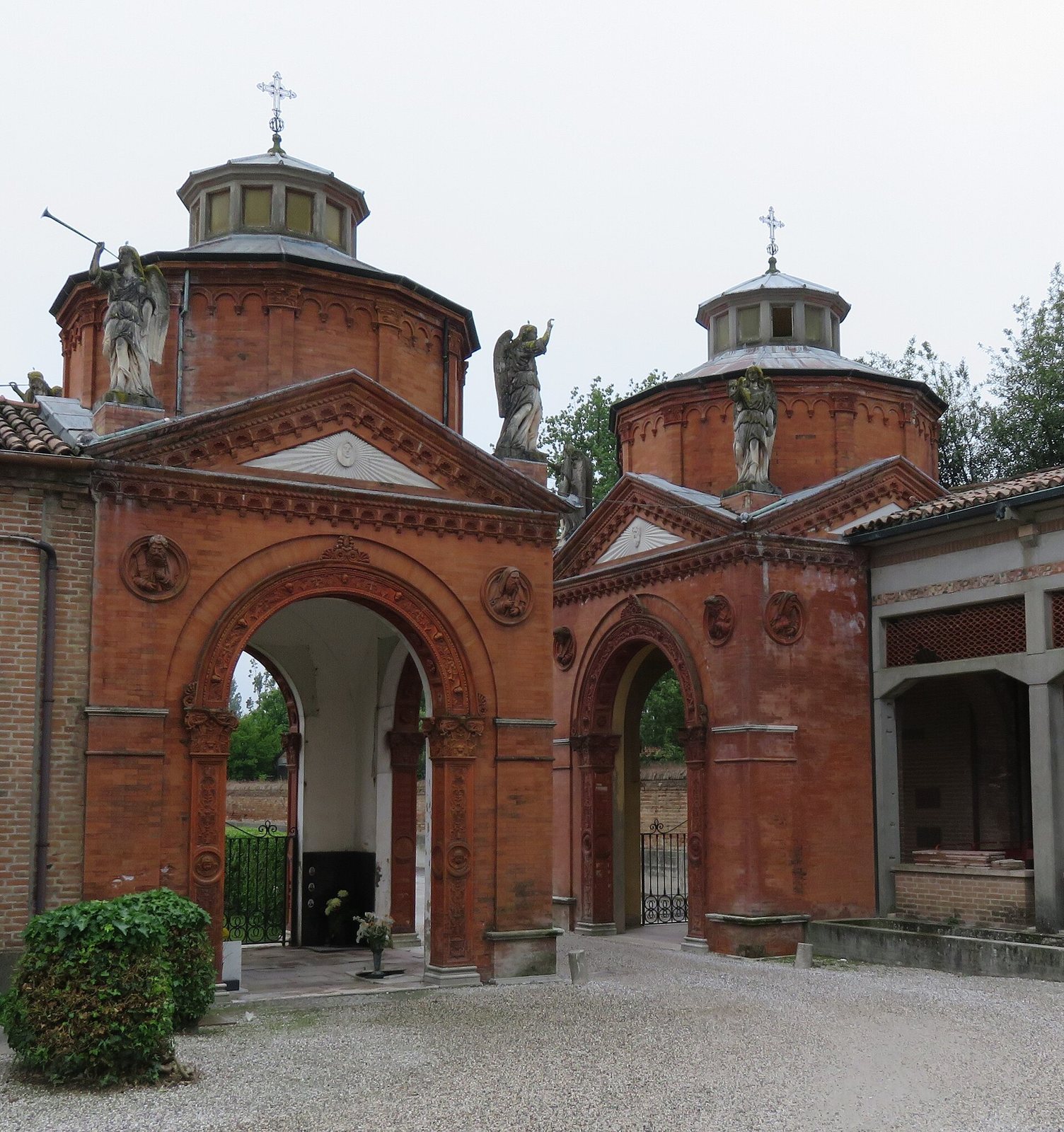
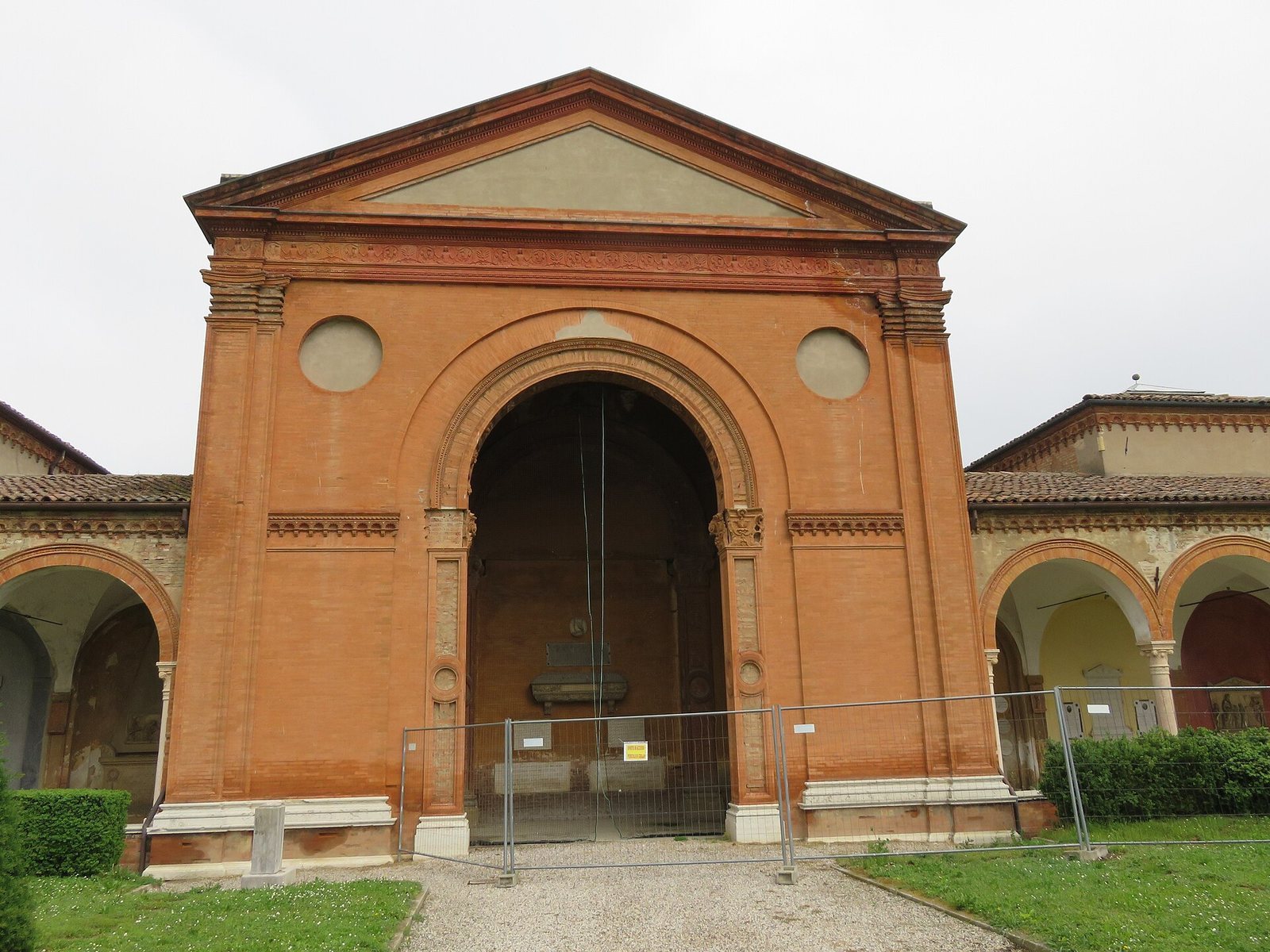
The complex brings together the church, two great cloisters, cemetery grounds, and later memorial spaces. Curved porticoes frame a broad green lawn leading toward San Cristoforo and the cemetery’s two principal entrances. Carlo Bassi compared the lawn before the church with the Piazza dei Miracoli in Pisa.
Church and monastic architecture
San Cristoforo alla Certosa
The later church, San Cristoforo alla Certosa, has a Latin-cross plan, with a long nave intersected by a transept, and six side chapels. Its west front remains incomplete. A marble entrance portal added in 1769 was designed by Gaetano Barbieri and sculpted by Pietro Puttini, with angels by Francesco Zoppi. Niccolò Roselli decorated the side altars, which included an altarpiece made in 1570 by Bastianino.
First Great Cloister
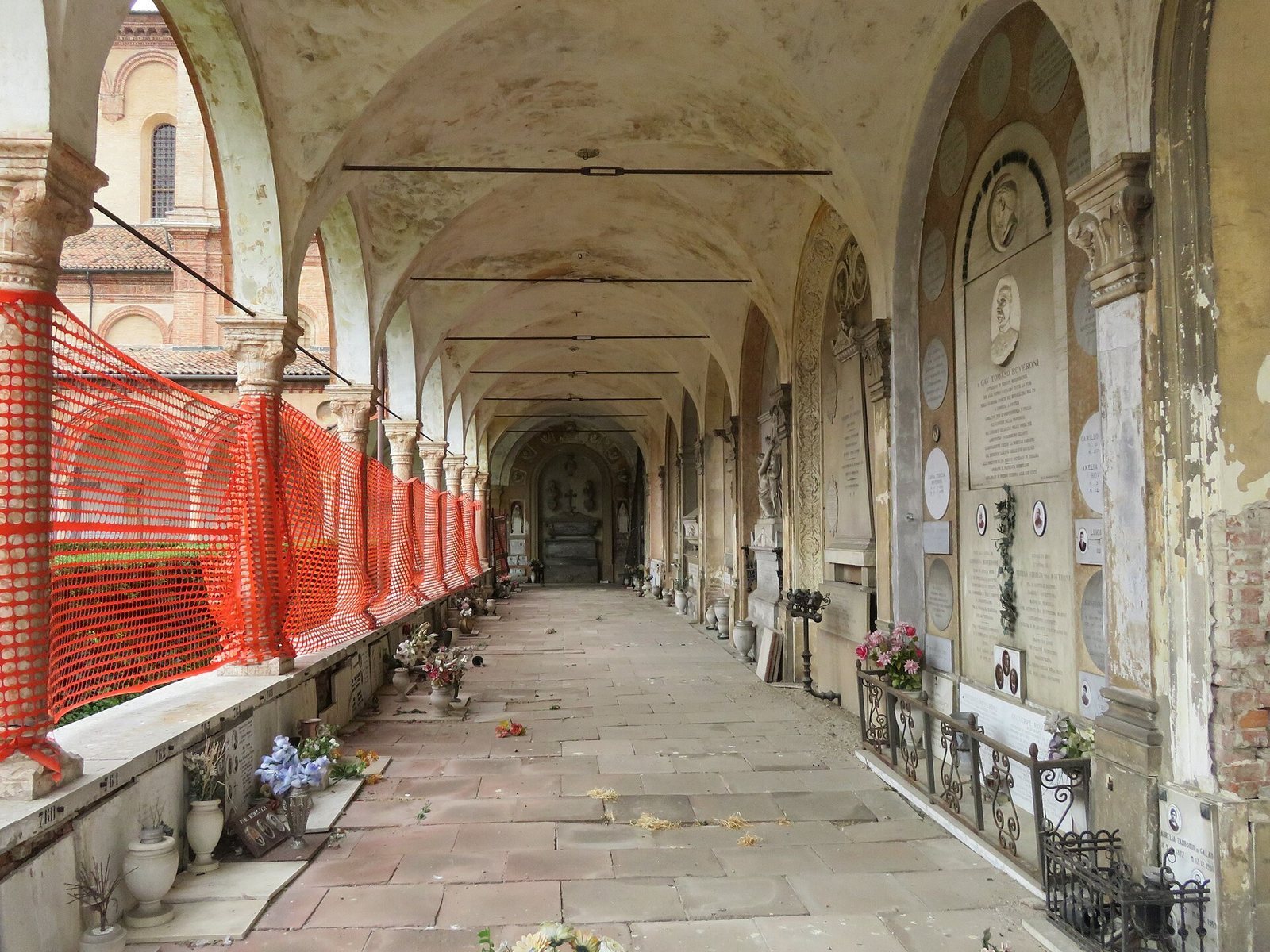
The First Great Cloister, also called the Great Cloister, stands beside the south side of San Cristoforo. Pietrobono Brasavola built it over about ten years, beginning in 1452. Its covered walkways form an open-sided gallery around the courtyard, a design later reused by Canonici when he enlarged the cemetery in the nineteenth century. At the rear center stands Borso d’Este’s funerary monument; its fifteenth-century sarcophagus is now housed in a later memorial hall. Before the Addizione Erculea, a country lane began beside the cloister and ran toward the area of today’s Piazza Ariostea.
Second Great Cloister and memorial spaces
The Second Great Cloister lies north of the church, nearer Ferrara’s walls. It contains the War Dead Memorial Hall and a nearby chapel for those who died for freedom. Alda Costa, a teacher and patriot from Ferrara, was commemorated there when her ashes were transferred to the chapel on 16 November 2006.
Cemetery and funerary art
Graves and family chapels
The cemetery’s former monastic cells became family tomb chapels, and its burial monuments include the graves of figures from Ferrara’s civic and cultural history. Those named include the painter Giovanni Boldini, filmmaker Michelangelo Antonioni, artists Filippo de Pisis and Gaetano Previati, poet Corrado Govoni, and architect Carlo Savonuzzi. The cemetery also holds Borso d’Este’s tomb monument. Giovanni Boldini has both an earlier and a later tomb monument; Carlo Savonuzzi designed the earlier one.
Monuments and sculpture
Funerary works include Antonio Canova’s memorial to Ferrara’s illustrious people and his memorial to art historian Leopoldo Cicognara. Other monuments were made by Pietro Tenerani, Giulio Monteverde, Vincenzo Consani, Cesare Zocchi, Camillo Torreggiani, and Luigi Legnani. The lawn and cemetery also contain works by Pietro Canonica, Lorenzo Bartolini, Leonardo Bistolfi, Arrigo Minerbi, Mario Sarto, Libero Andreotti, and other local and visiting artists. Bistolfi made the angel on the Forti tomb and a bust of Giorgio Baruffaldi.
Recorded artworks and manuscripts
Church paintings and furnishings
An inventory made in 1770 records the monastery’s former artworks and furnishings. It lists Passion paintings by Niccolò Roselli in the chapels and Sebastiano Filippi’s Last Judgment with Sibyls at the altar to the right of the crossing, where the nave and transept meet. Other works included Scarsellino’s painting of Saint Bruno at prayer at Squillace, meeting Roger I of Sicily, and two canvases of Carthusian monks by Carlo Bononi in the main chapel’s arches. The main altar’s tabernacle, which holds the consecrated Eucharist, contained paintings by Agostino Carracci; its canopy carried a canvas by Francesco Ferrari, and its statues included work by Pierro Turchi. Giuseppe Avanzi painted scenes of Saint Bruno and his companions. A Saint Christopher by Filippi stood on the choir partition, and the church also held his Ascension near the presbytery, the area around the main altar.
The inventory also describes works in other parts of the complex, including Carlo Bononi’s Marriage at Cana, painted in 1622 for the refectory, or communal dining hall, and a Madonna and Child with Saint Bruno in the prior’s chapel. It lists works by Jacopo Bambini, Lorenzo Costa, Dosso Dossi, Garofalo, and other painters. Scarsellino’s Birth of the Virgin is now in the Galleria Estense in Modena.
Books and cloister decoration
Around 1455, Borso commissioned an illuminated gradual, a book of Mass chants, and an antiphonary, a collection of chants used in worship, for the monastery. Bartolomeo da Ferrara made the books. Guglielmo Giraldi illuminated works for the community, including miniatures for a four-volume Bible, and contributed extensively to the miniatures in the monastery’s graduals. The 1770 inventory also noted Gabriello Rossi’s painted architectural design and fresco of Saint Bruno with angels on a cloister façade.