Castrum Branodunum: A Roman Fort on the Saxon Shore
Site at a Glance
- Rating
- 2.8
- Popularity
- Low
- Country
- United Kingdom
- Primary era
- Classical
- Eras represented
- Classical
- Civilizations
- Roman
- Site type
- Military
- Remains
- Fort
On this page11 sections
History
Castrum Branodunum is a Roman stone fort east of modern Brancaster in Norfolk, England. Built around AD 230 to guard the approaches to the Wash, it later formed part of the Saxon Shore, Rome’s coastal defence system in Britain, and remained occupied from the third to the fifth century.
The settlement before the stone fort
A civilian settlement, or vicus, had developed beside the site in the second century, before the stone fort was built. Its streets followed a different alignment from the fort, prompting the proposal that an earlier timber-and-earth fort stood here. That predecessor may date to the mid-first-century revolt against Roman rule led by Boudica, queen of the Iceni, a people of eastern Britain.
Garrisons and coastal activity
A stamped roof-tile fragment suggests that the fort’s first garrison included Cohors I Aquitanorum, a Roman military unit recruited in Aquitania. For the late Roman period, the Notitia Dignitatum, an administrative register of offices and military commands, names a Dalmatian cavalry unit, Equites Dalmatarum Branodunensium. It was led by a praepositus, or military commander, under the authority of the comes litoris Saxonici per Britanniam, the commander of the Saxon Shore in Britain.
The nearby harbour may also have served as a base for the Classis Britannica, the Roman fleet operating in Britain. It was probably used chiefly to load and ship amber and other goods, including grain and oysters.
Use after Roman rule
Burials and grave goods point to possible Anglo-Saxon use of the site after the Roman withdrawal from Britain.
Damage and archaeological investigation
The fort’s walls still stood up to about four metres high in the seventeenth century, but stone robbing later removed them. The site was first investigated and partly excavated in 1846. Residential construction in the 1970s covered much of the land west of the fort and almost entirely destroyed the civilian settlement, while the fort itself remained unbuilt over. Further investigation by the archaeological television programme Time Team took place in 2013, followed by geophysical survey in 2018.
Remains
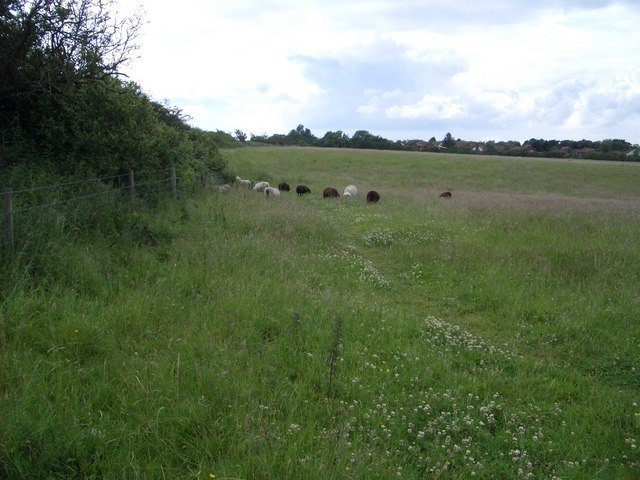
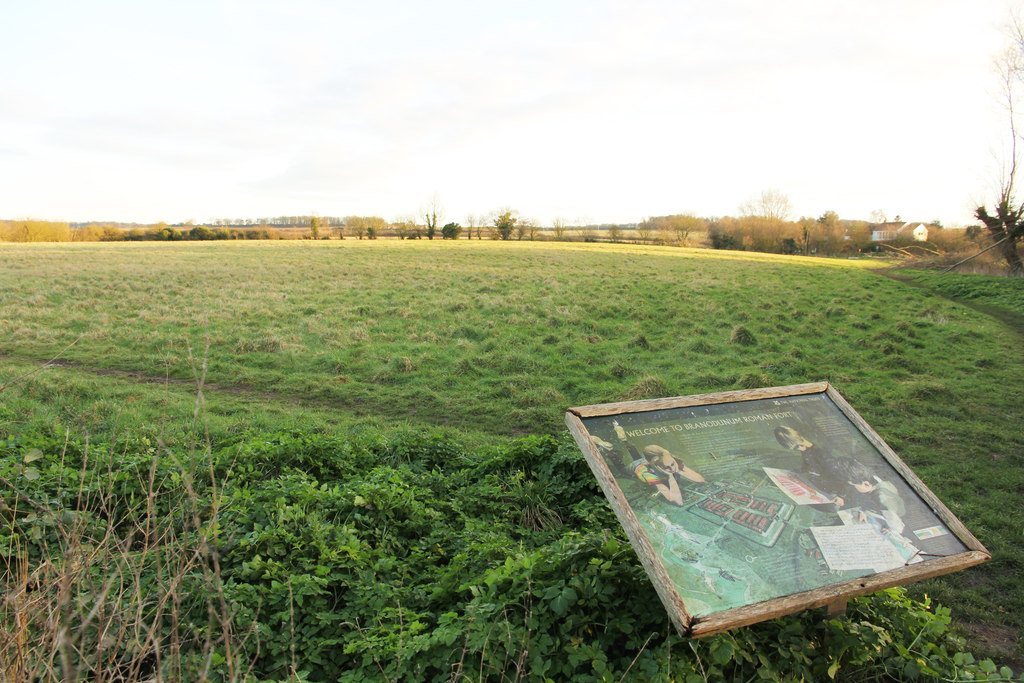
The fort occupied a roughly square area of about 2.56 hectares, with rounded corners. Its stone defences were encircled by a shallow, V-shaped ditch. Today, an eroded raised platform and earthworks form the principal visible traces of the site.
Walls, towers, and gates
The walls were about three metres thick, built from locally sourced sandstone and faced with sandstone on the exterior. An earthen rampart pressed against the inner face, helping support the wall and providing access to the battlements. Turrets stood inside the corners, including a tower against the inside of the northeast corner. Four gates, one on each side, are considered likely; archaeological evidence confirms the east and west entrances. Each had two slightly projecting flanking towers.
Buildings within the fort
The headquarters building, or principia (the fort’s command centre), was identified within the enclosure. Survey and archaeological investigation also established the arrangement of interior features, including barrack rooms and other major buildings.
The settlement outside the fort
The second-century civilian settlement lay beyond the north and east gates. It was among the larger settlements in Iceni territory, and its streets did not follow the fort’s plan. Roads may have connected Branodunum with Holme to the west and Kempstone to the south.
The former harbour
In Roman times, the northern wall stood directly beside the sea, which formed a sheltered natural harbour. The shoreline has since shifted outward and the harbour basin has silted up; the site now lies inland of salt marshes.
Inscribed altar
A Latin inscription on a votive altar, a religious offering, was dedicated to Hercules, a Roman god associated with strength.