Ebernburg Castle: A Medieval Hilltop Fortress in Germany


Site at a Glance
- Rating
- 4.5
- Popularity
- Medium
- Country
- Germany
- Primary era
- Medieval
- External website
- Open
- Eras represented
- Medieval, Early Modern
- Civilizations
- Holy Roman Empire
- Site type
- Military
- Remains
- Castle
On this page9 sections
History
Ebernburg Castle is a large medieval hilltop fortress in present-day Bad Kreuznach, Germany, built in the medieval period and later associated with the Sickingen family and the early Reformation. An earlier castle and settlement may have occupied another location, possibly near the Protestant Old St. John’s Church, a fortified church. The name Ebernburc first appears in 1206, although it is uncertain whether the reference concerned the castle or the settlement.
Medieval origins and the Sickingen family
Count Ruprecht and Count Johann of Sponheim-Kreuznach constructed the castle in 1338. By 1448, the Ebernburg estate had passed to the Sickingen family, first as a pledge and later as a feudal possession. The family held it for about three centuries. In 1482, Schweickhardt von Sickingen and his son Franz expanded the castle and equipped its defenses with several large cannons known as Scharfmetzen. Ebernburg became the family’s ancestral seat and the birthplace of Franz von Sickingen, a knight and military leader associated with the early Reformation.
Ebernburg and the early Reformation
The castle became associated with religious reform through Franz von Sickingen’s protection of reform-minded theologians. Ulrich von Hutten, a German humanist and writer, called Ebernburg the “Hostel of Justice” in a polemical work concerning Exsurge Domine, the papal bull in which Pope Leo X condemned propositions associated with Martin Luther. The epithet referred to Sickingen’s offer of asylum to Luther while he travelled to the Diet of Worms, the imperial assembly held in 1521. Luther declined the offer and later went to the Wartburg under the name Junker Jörg after the Diet declared him an outlaw on 16 May 1521.
Other reformers who faced persecution or lost their positions because of their Lutheran allegiance accepted Sickingen’s invitation to Ebernburg. They included Martin Bucer, Johannes Oecolampadius, Johannes Schwebel, and Caspar Aquila. Oecolampadius stayed at the castle in the summer of 1522 as its chaplain. In June, he began reading the Gospels and Epistles in German rather than Latin during daily Mass while retaining the customary ceremonies. After the Mainz archiepiscopal authorities demanded an explanation, Communion was celebrated at Ebernburg with both bread and wine. This service is described as the first Protestant service at the castle. Oecolampadius left for Basel in November 1522.
Destruction, military occupation, and abandonment
Franz von Sickingen died during the Trier Feud in 1523, an early-sixteenth-century conflict shaped by political and religious tensions during the Reformation era. After his death, Ebernburg was besieged, stormed, and burned. The Sickingen family rebuilt it in 1542 and strengthened its fortifications further.
The castle avoided serious destruction during the Thirty Years’ War. At the beginning of the War of the Palatine Succession, a late-seventeenth-century conflict between France and the empire, French troops occupied Ebernburg. Imperial forces failed to recapture it in 1692, but troops commanded by the Margrave of Baden forced the French garrison to surrender after a short siege on 27 September 1697.
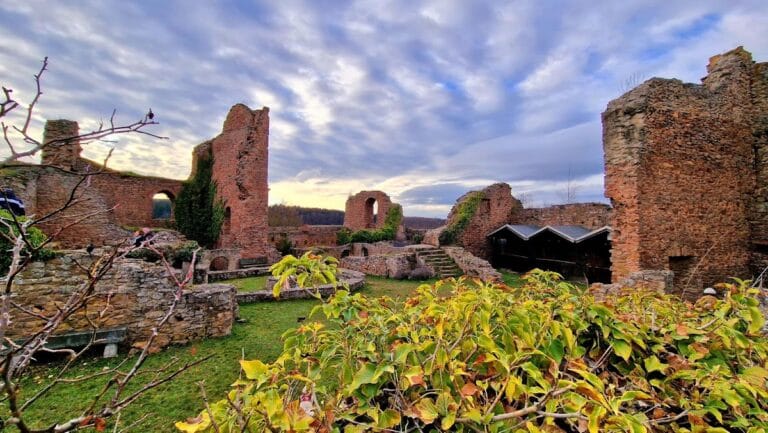
After the war, the castle was abandoned, demolished, and quarried for building material. Local farmers removed stone blocks, beams, and roof tiles for their own buildings, and reused fragments of the castle remain in structures in the surrounding area. The estate returned to the Electorate of the Palatinate, a major territorial principality of the Holy Roman Empire, between 1750 and 1771.
Rebuilding and modern use
In 1838, the ruins passed to Karl Günther, a wealthy landowner and mayor of Feilbingert. He rebuilt the complex in an old-style form, made it his residence, and developed it into a commercial and administrative center containing farm buildings and an inn. From 1849, it also became a destination for excursions. Ferdinand Freiligrath’s 1842 poem Ein Denkmal, with its romanticized image of Ulrich von Hutten, mentioned Ebernburg and helped attract travellers. The castle became a popular destination during the second half of the nineteenth century.
In 1914, the Günther family sold the castle and its contents to the Ebernburg Foundation, which had been established for its commercial management. The foundation leased the property to the Ebernburg Association. The purchase was made possible chiefly by a donation from Theodor Wilhelm Simon, a leather manufacturer and commercial councillor from Kirn. After the Second World War, the castle underwent thorough restoration and partial reconstruction, creating its present form. It now functions as a hotel and restaurant and accommodates seminars, celebrations, and other events.
A popular legend connects the name Ebernburg, interpreted as “boar’s fortress,” with a deception during a siege. When provisions were almost exhausted, the castle lord supposedly had the last surviving boar dragged into the courtyard repeatedly and made to squeal. The besiegers believed that many pigs and ample food remained inside, and withdrew after two weeks.
Remains
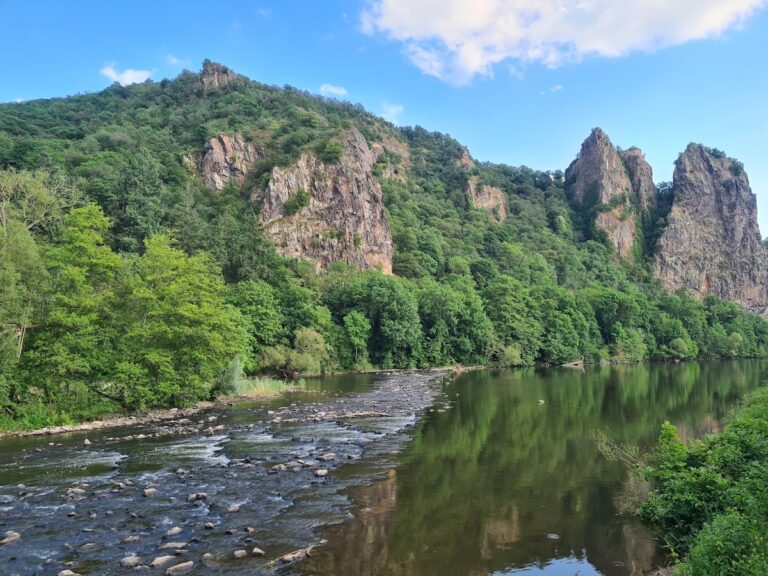
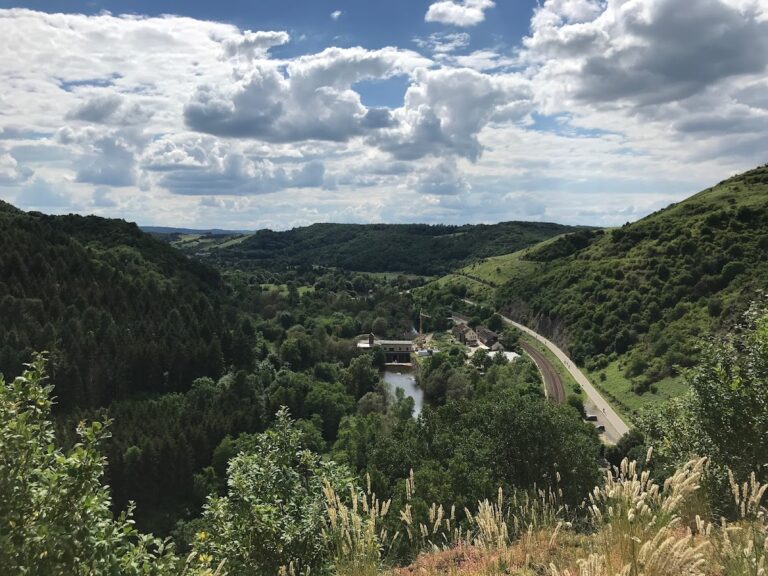
Ebernburg occupies a high rocky base on a mountain spur above the Nahe valley, at about 185 metres above sea level. The elongated hilltop fortress is enclosed by a ring wall. Its position also relates to the area’s long-established trade routes, which passed through the surrounding region from ancient times.
Walls, towers, and entrance
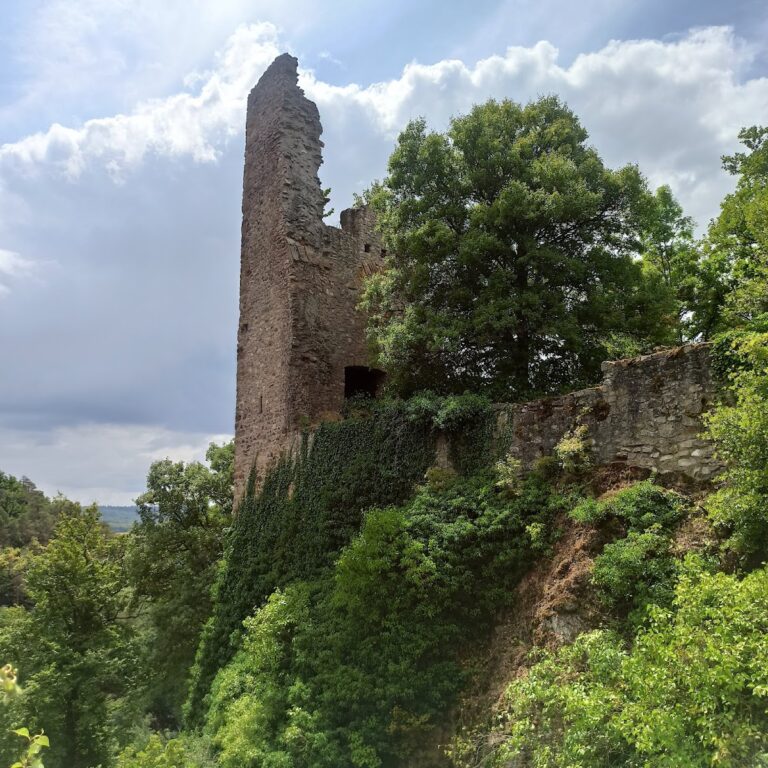
Large bastions, projecting gun platforms, extend beyond the ring wall on the southern and eastern sides. Square towers adjoin the northern wall. The complex has a single entrance on the southwest side, where a drawbridge formerly provided access. Stone and brick are the principal construction materials, while the expanded defenses reflect the artillery improvements introduced in 1482.
Residential buildings and later additions
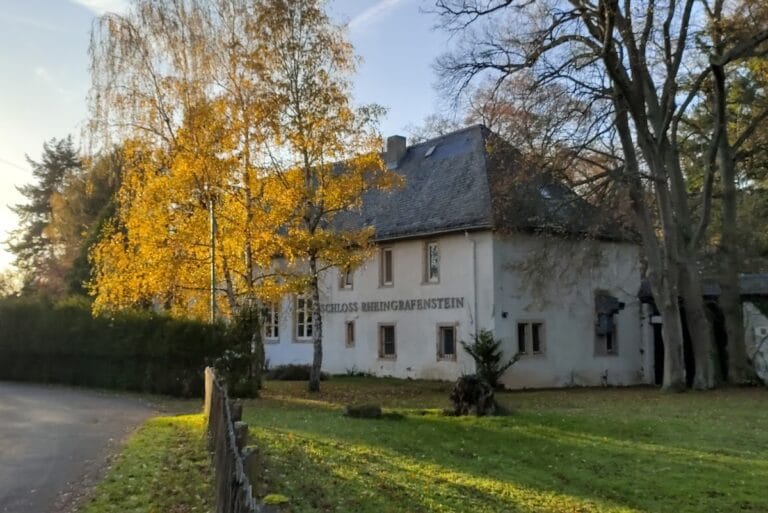
The former residential complex within the fortress was rebuilt and later adapted for hotel use. Its northeastern part contains a restaurant with viewing terraces. These later functions form part of the restored and partly reconstructed appearance produced after the Second World War.
Hutten-Sickingen Monument
Near and below the castle stands the Hutten-Sickingen Monument, a bronze Historicist work erected in 1889. Historicism was a nineteenth-century approach that deliberately drew on earlier historical styles. The monument depicts Ulrich von Hutten and Franz von Sickingen. Karl Cauer of Bad Kreuznach designed it, and his sons Robert and Ludwig executed the sculpture.
Nearby sites