Castle of Trancoso: A Medieval Fortress in Portugal



Site at a Glance
- Rating
- 4.5
- Popularity
- Medium
- Country
- Portugal
- Primary era
- Medieval
- External website
- Open
- Eras represented
- Medieval
- Civilizations
- Kingdom of León, Portuguese
- Site type
- Military
- Remains
- Castle
On this page13 sections
History
The Castle of Trancoso is a medieval fortress in Portugal, in the city of Trancoso. It developed from a defensive tower established during the Christian Reconquest of the Iberian Peninsula, a medieval expansion of Christian-ruled territories over lands held by Muslim rulers, and later acquired Romanesque and Gothic characteristics. Its position on the frontier gave it a military and political role from the tenth century through the medieval wars with Castile.
Early fortification and frontier rule
Tradition places human occupation at the site as far back as prehistory, while some interpretations suggest Roman roots. The first fortification that developed into the castle was established in the early tenth century, when the region was occupied and repopulated under Rodrigo Tedoniz, a nobleman. The tower later passed by inheritance to his daughter, Chamôa Rodrigues, a niece of Mumadona Dias.
The earliest documentary reference to a castle at Trancoso occurs in Chamôa Rodrigues’s testament of 960. In it, she donated Trancoso, together with the castles of Moreira de Rei and Terrenho, to the Monastery of Guimarães. The testament also named the castle of Cótimos. Trancoso and neighboring fortifications then stood within a shifting frontier between Christian and Muslim territories for roughly a century. The lands were incorporated into the territories reconquered by Ferdinand I of León in 1057 or 1058.
The Portuguese frontier in the twelfth century
After the County of Portugal was established, Trancoso and its castle formed part of the dowry of Countess Theresa of León. From the twelfth century onward, the settlement gained strategic importance on the frontier with the Kingdom of León.
In 1140, a Muslim force commanded by Esmar reached Trancoso after capturing Leiria and invading the Beira. The settlement was plundered and the castle besieged, but forces led by Afonso Henriques, the first king of Portugal, repelled the attack at the Battle of Trancoso. The defenses were probably strengthened during this period, as attacks in the region continued until 1155, when Afonso Henriques granted Trancoso a charter.
The castle’s foundation is documented in 1159. A new charter in 1173 transferred Trancoso and its castle to the Order of the Temple, a religious-military order that administered fortified properties during the medieval period. During this Romanesque phase, the original Mozarabic tower, reflecting the traditions of Iberian Christians living under or near Muslim rule, was transformed into a keep and enclosed by a defensive wall.
Royal charters and medieval expansion
Sancho I confirmed Trancoso’s charter in 1207. The town continued to expand, and construction of its larger enclosure wall is attributed to his son and successor, Afonso II. The fortifications thus became part of a broader urban defense system rather than remaining an isolated stronghold.
Trancoso and its castle were drawn into the succession crisis that followed the reign of Sancho II. Political difficulties eventually gave way to the control of Prince Afonso, the regent appointed by Pope Innocent IV and the future King Afonso III. Local tradition relates that in 1248 Fernão Garcia de Sousa challenged Martim Gil de Soverosa, a knight supporting the deposed Sancho II, to single combat, with control of the castle at stake. Sancho II opposed the duel and continued toward exile in Castile, after which the castle came under Afonso III’s authority.
On 24 June 1282, Denis of Portugal married Isabel of Aragon at Trancoso. The castle was later among the fortifications granted to Isabel as part of her dowry. In connection with the Treaty of Alcañices in 1297, Denis expanded the town’s enclosure with several rectangular towers. The same phase brought the monumental El-Rei and Prado gates and reorganized the urban fabric, producing an important example of Gothic urbanism in Portugal.
Wars with Castile and later military use
During the Portuguese crisis of 1383–1385, Castilian troops plundered the outskirts of Trancoso in late spring 1385 while marching toward Viseu. On their return, Gonçalo Vasques Coutinho, the town’s governor, confronted them with forces led by Martim Vasques da Cunha of Linhares Castle and João Fernandes Pacheco of Celorico Castle. The Battle of Trancoso took place at the Chapel of São Marcos in June 1385.
In July of the same year, Castilian troops commanded by King John I of Castile crossed the frontier through Almeida and burned the Chapel of São Marcos in retaliation. King John I of Portugal subsequently strengthened Trancoso’s defenses during the continuing wars with Castile and the invasions of the Beira in 1396 and 1398. Work carried out on the defenses during the fourteenth and fifteenth centuries reflects the regional importance of the fortifications.
The walls and castle again accommodated military forces during the Peninsular War, the conflict in Iberia involving the forces of Napoleon and their opponents, including British troops commanded by General William Carr Beresford in 1809. By the mid-nineteenth century, the ruined Chapel of Santa Bárbara inside the enclosure had been adapted as a gunpowder magazine, although it was never used for that purpose. During the same period, the municipal council authorized the demolition of sections of the town wall so that the stone could be reused in public works, including road paving. Several older gates and their flanking towers were demolished around the transition to the twentieth century.
Protection and reconstruction
The castle and Trancoso’s town walls were designated a National Monument by decree on 8 July 1921. In the 1930s, the Directorate-General for Buildings and National Monuments recreated several destroyed sections, including parts of the walls and battlements. Responsibility for the monument passed from the national government to the Municipality of Trancoso in 2021. The castle remains a principal historic landmark of the city.
Remains
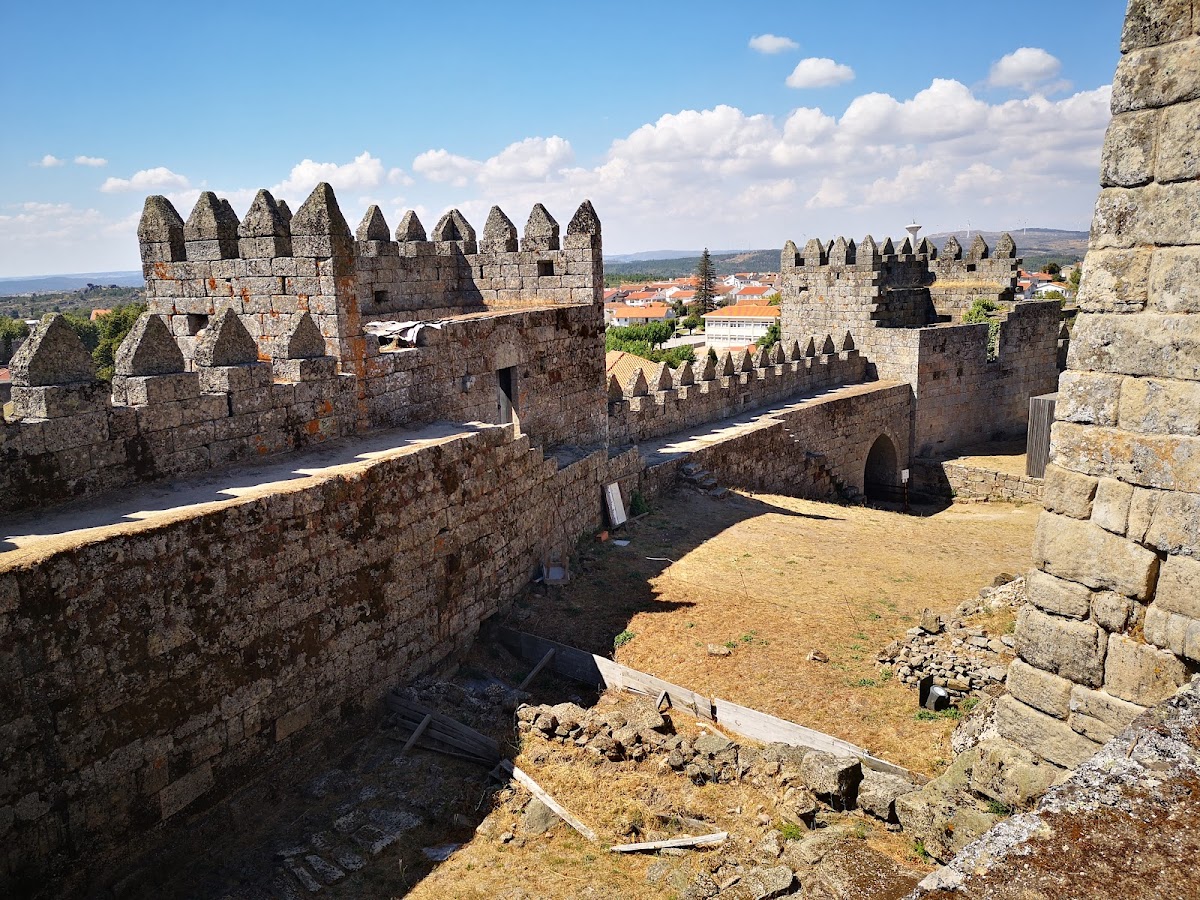
The Castle of Trancoso occupies a plateau in northeastern Beira, near the source of the Távora River, a tributary of the Douro, and near Penedono Castle. It forms the northeastern part of the fortified enclosure of the former medieval town. The complex combines Romanesque and Gothic construction, with defensive walls, square towers, a wall-walk, gates, and a keep arranged around a broad parade ground.
Castle fortifications
Walls and towers
The castle walls are reinforced by five square-plan towers. Their upper edges carry square merlons, the raised sections between openings in a battlement, each with a pyramidal termination. A protected wall-walk runs along the fortifications, providing a passage for defenders. Twentieth-century reconstruction recreated several destroyed stretches of wall and battlements, and the castle is described as being in good condition.
Keep
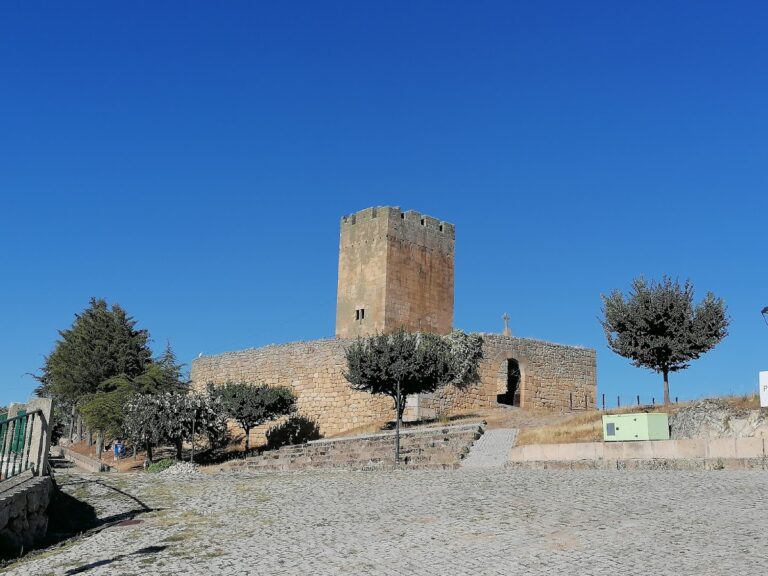
The keep stands on the southern side of the broad parade ground. This principal fortified tower has a square plan and a truncated-pyramidal form. Its doorway has a horseshoe-shaped arch attributed to the pre-Romanesque style. The structure began as the original Mozarabic tower and was transformed into a keep during the Romanesque phase associated with the castle’s medieval development.
Town enclosure and gates
Enclosure and entrances
The original town enclosure extended for approximately one kilometer in circumference and was reinforced by fifteen towers. Four gates, each defended by towers, provided access through the fortifications, while three smaller secondary gates, known as posterns, served as additional openings. The late-thirteenth-century expansion added rectangular towers and included the monumental El-Rei Gate and Prado Gate.
Chapel of Santa Bárbara
The Chapel of Santa Bárbara stood within the enclosure and was in ruins by the mid-nineteenth century. It was then converted into a gunpowder magazine, a building intended for storing explosive military supplies, but it was never used operationally for that function.